
 Nila Kartika Wati
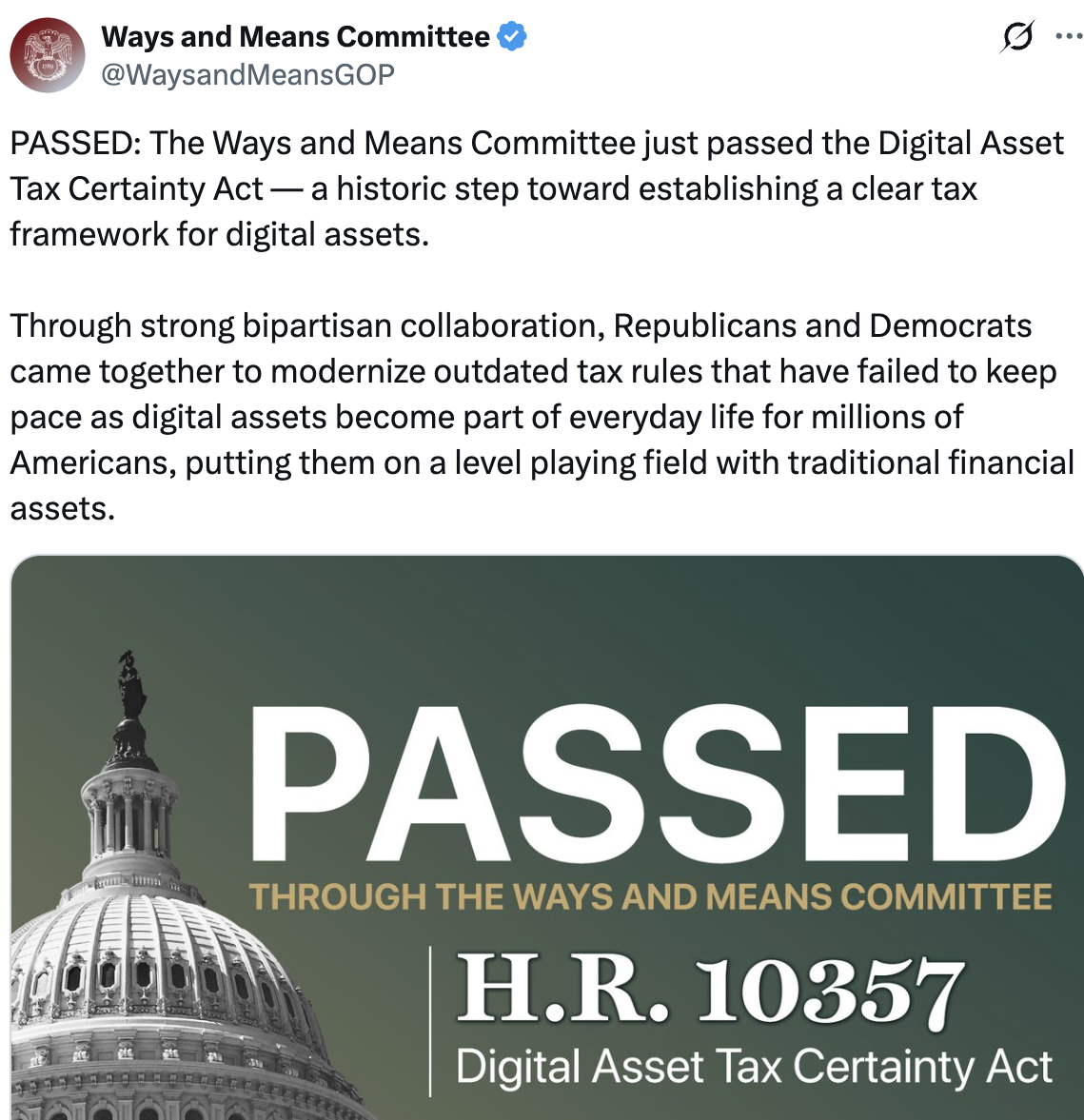
The US House Ways and Means Committee has taken a significant step towards clarifying the federal tax treatment of digital assets, passing the Digital Asset Tax Certainty Act with robust bipartisan support on Wednesday. This move signals a focused effort within Congress to address specific facets of the burgeoning cryptocurrency industry, even as broader legislative attempts at establishing a comprehensive regulatory framework face considerable headwinds in the Senate. The committee’s approval, with a decisive 38-5 vote, sends the bill to the full House of Representatives for further consideration, marking a pivotal moment in the ongoing national debate surrounding digital asset policy.
The Digital Asset Tax Certainty Act is designed to bring much-needed clarity across various crypto-related activities, encompassing stablecoins, mining and staking operations, digital asset lending, and the often-overlooked area of transaction fees. Its provisions aim to provide a more defined tax landscape for participants in the digital economy, an area long plagued by ambiguity under existing tax laws. Among the bill’s key proposals is the establishment of special tax treatment for qualifying dollar-pegged stablecoins, recognizing their unique role as a bridge between traditional fiat currencies and the volatile crypto market. This provision could potentially alleviate the tax burden associated with using stablecoins for everyday transactions, which currently might trigger taxable events depending on minor price fluctuations against the dollar.
Furthermore, the legislation seeks to introduce specific guidelines for certain crypto lending agreements, an increasingly popular financial activity within the decentralized finance (DeFi) ecosystem. Currently, the tax implications of lending and borrowing digital assets remain largely undefined, leading to uncertainty for both individual investors and institutional players. The bill also addresses the complex area of mining and staking income, proposing new rules that could clarify when and how income from these activities is recognized for tax purposes. This is particularly crucial as the Internal Revenue Service (IRS) has previously struggled to issue comprehensive guidance on these innovative methods of earning digital assets, often leading to confusion and potential non-compliance among taxpayers.
A significant practical relief offered by the bill is the creation of a de minimis exemption for certain crypto transaction fees. This provision would allow taxpayers to avoid recognizing minor gains or losses when digital assets are used to pay qualifying network or transaction fees of $10 or less. In a world where blockchain networks often charge small fees for every transaction, this exemption could dramatically reduce the administrative burden on everyday users and businesses, preventing the need to track and report countless micro-taxable events. Without such an exemption, a user paying a $0.50 transaction fee with Bitcoin could technically be required to calculate and report a gain or loss if the value of that Bitcoin had changed since acquisition, a cumbersome process that has been a major pain point for crypto adopters.
Finally, the bill proposes extending wash-sale rules to widely traded digital assets. Wash-sale rules, traditionally applied to stocks and other securities, prevent investors from claiming a tax loss on the sale of an asset if they repurchase a "substantially identical" asset within 30 days before or after the sale. Applying these rules to digital assets aims to prevent investors from artificially generating tax losses through rapid buying and selling, a practice known as "tax-loss harvesting." This extension signals a move towards aligning the tax treatment of digital assets more closely with that of conventional financial instruments, promoting fairness and preventing exploitation of existing loopholes.

The bipartisan nature of the 38-5 vote within the Ways and Means Committee underscores a growing consensus among lawmakers that clearer tax guidance for digital assets is essential, regardless of broader disagreements on market structure or regulatory oversight. This suggests that while comprehensive legislative frameworks might be difficult to achieve, targeted, practical reforms addressing specific pain points like taxation could find easier pathways through Congress.
The CLARITY Act’s Setback: A Broader Regulatory Impasse
The positive movement on the tax front in the House stands in stark contrast to a significant setback experienced in the Senate just a day prior. On Tuesday, the Senate failed to advance the CLARITY Act, a far more ambitious piece of legislation that aimed to establish a comprehensive federal regulatory framework for digital assets. This bill sought to delineate the respective roles of the Securities and Exchange Commission (SEC) and the Commodity Futures Trading Commission (CFTC), resolving a long-standing jurisdictional dispute that has created immense uncertainty for the crypto industry.
The cloture motion for the CLARITY Act, which would have allowed the bill to proceed to debate on the Senate floor, failed in a narrow 49-50 vote, falling short of the 60 votes required. This outcome represents a substantial blow to efforts aimed at providing holistic regulatory guidance for the digital asset market, an industry estimated to be worth over $2 trillion globally and attracting millions of American investors. The failure to advance such a broad market structure bill means that the US will likely continue to grapple with a fragmented regulatory landscape, relying on existing statutes and agency interpretations rather than a unified legislative approach.
Senator Cynthia Lummis (R-WY), a leading voice for digital asset regulation and a co-sponsor of the CLARITY Act, expressed deep disappointment following the vote. Lummis, who chairs the Senate Banking Subcommittee on Digital Assets, publicly blamed Democrats for the bill’s failure. In a post on X (formerly Twitter), she stated, "For over a year, they presented demands and the second we met them, they made new demands and moved the goal posts." She further alleged that Democrats had voted against proposed consumer protections and restrictions on politicians’ personal crypto investments, implying political maneuvering rather than substantive disagreement as the cause of the bill’s demise.
The political dynamics surrounding the CLARITY Act highlight the deep ideological and practical divisions within Congress regarding digital assets. While proponents argue that a clear framework is vital for innovation, investor protection, and preventing illicit finance, critics often raise concerns about market volatility, consumer risks, environmental impact (particularly proof-of-work mining), and the potential for crypto to be used in money laundering or sanctions evasion. The "moving the goalposts" accusation suggests that even when compromises were attempted, fundamental disagreements or strategic resistance prevented a consensus from forming.
Regulatory Agencies Signal Continued Action
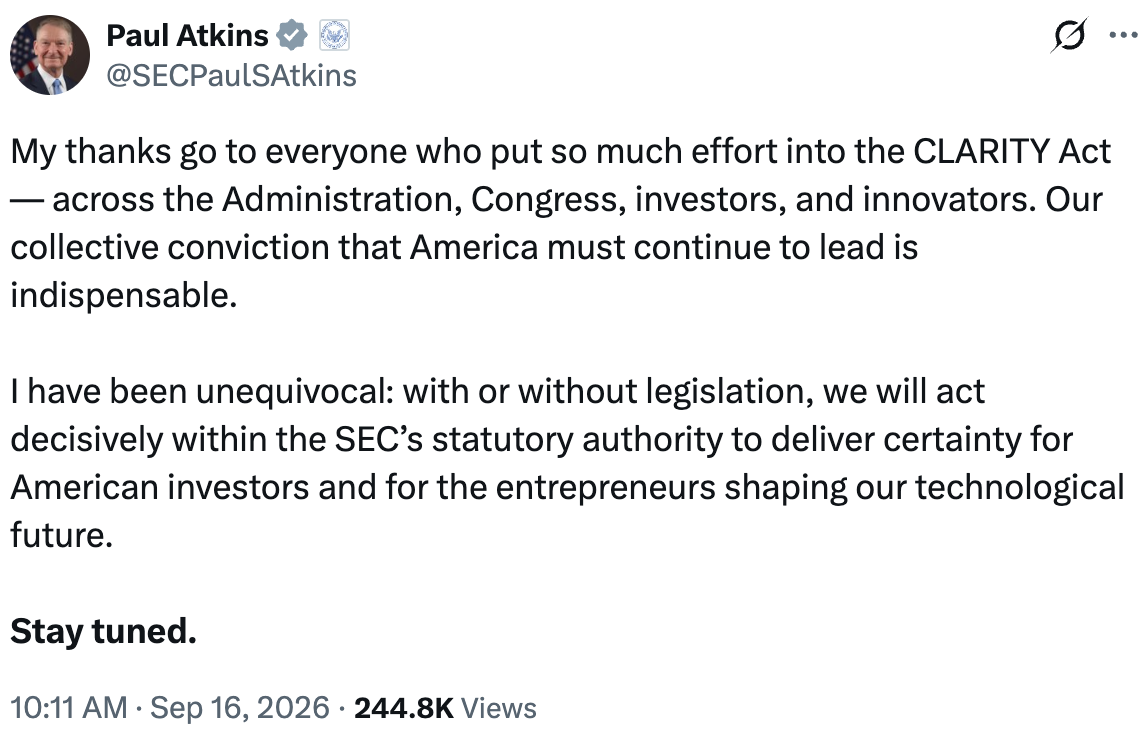
In the wake of the Senate’s legislative impasse, top financial regulators swiftly signaled their intent to continue asserting authority over the digital asset space, emphasizing that the absence of new legislation would not deter their efforts. SEC Chair Paul Atkins, in a post on X, reiterated the agency’s commitment to delivering certainty for investors and entrepreneurs. "With or without legislation, we will act decisively within the SEC’s statutory authority to deliver certainty for American investors and for the entrepreneurs shaping our technological future," Atkins stated, adding a concise "Stay tuned."
Atkins’s statement underscores the SEC’s long-standing position that many digital assets fall under its purview as securities, a stance that has led to numerous enforcement actions against crypto companies. The SEC’s approach, often described as "regulation by enforcement," relies heavily on applying existing securities laws, such as the Howey Test, to digital assets. This strategy has been a source of significant tension with the crypto industry, which frequently calls for clearer rules specifically tailored to the unique characteristics of blockchain technology. The SEC’s continued assertiveness, in the absence of a legislative mandate like the CLARITY Act, suggests that this enforcement-first approach will persist, potentially leading to more legal battles and a continued climate of regulatory uncertainty for many crypto projects.
Echoing Atkins’s sentiment, CFTC Chair Michael Selig also affirmed his agency’s resolve to move forward using its existing statutory authority. "The CFTC is locked in and ready to ship its rules for the new frontier of finance," Selig posted on X, emphasizing that Americans "deserve regulatory clarity, legal certainty, and consumer protections in crypto asset markets." The CFTC primarily regulates commodities and derivatives, and it has increasingly sought to assert jurisdiction over certain digital assets, particularly those it deems commodities like Bitcoin and Ethereum. Selig’s proactive stance indicates that the CFTC will continue to develop and implement rules within its existing mandate, further contributing to the patchwork of federal regulations governing the crypto sector.
The pronouncements from both the SEC and CFTC chairmen highlight a critical consequence of legislative inaction: the regulatory landscape for digital assets will likely continue to be shaped by agency interpretations, enforcement actions, and potentially conflicting guidance. While agencies possess significant power under existing laws, this approach often lacks the comprehensive scope, democratic legitimacy, and predictability that a well-crafted legislative framework could provide.
Broader Implications for the Digital Asset Ecosystem
The divergent outcomes in the House and Senate this week paint a complex picture for the future of digital asset regulation in the United States. On one hand, the bipartisan passage of the Digital Asset Tax Certainty Act by the Ways and Means Committee offers a glimmer of hope for targeted, practical reforms that address specific pain points for the industry and taxpayers. If this bill were to become law, it would undoubtedly provide a significant measure of relief and clarity for millions of crypto users and businesses grappling with opaque tax obligations. The de minimis exemption for transaction fees alone could save countless hours of accounting and reduce the barrier to entry for casual users of blockchain technology. The clarification around stablecoins and lending could foster greater adoption and integration of these financial instruments into the broader economy.
However, the failure of the CLARITY Act in the Senate casts a long shadow over the prospect of a unified and comprehensive regulatory framework. This legislative roadblock means that the fundamental questions of jurisdiction between the SEC and CFTC, the classification of various digital assets, and the overall market structure will remain largely unresolved by Congress for the foreseeable future. This continued ambiguity poses several challenges:
- Regulatory Fragmentation: The reliance on individual agencies to interpret and enforce existing laws will likely lead to a fragmented regulatory environment. Different agencies may issue conflicting guidance or pursue enforcement actions based on varying interpretations, creating a labyrinthine compliance landscape for businesses operating across multiple facets of the digital asset industry.
- Innovation and Competitiveness: Without a clear regulatory roadmap, US-based crypto companies may face higher compliance costs and greater legal risks compared to those in jurisdictions with established frameworks, such as the European Union’s Markets in Crypto-Assets (MiCA) regulation. This could potentially stifle innovation in the US and encourage companies to relocate to more crypto-friendly environments.
- Investor Protection: While agencies like the SEC and CFTC are committed to investor protection, a lack of comprehensive legislation can leave gaps or create inconsistencies in safeguards. A unified framework could provide clearer rules for disclosures, market manipulation prevention, and consumer recourse that might be more difficult to achieve through piecemeal agency actions.
- Market Uncertainty: The digital asset market thrives on predictability. The absence of a clear legislative framework contributes to ongoing market uncertainty, which can deter institutional investment and hinder the mainstream adoption of cryptocurrencies. This uncertainty can also exacerbate volatility as market participants react to every new agency guidance or enforcement action.
The immediate path forward for the Digital Asset Tax Certainty Act involves a vote in the full House of Representatives. Should it pass there, its journey to becoming law would then depend on its reception in the Senate, where it would need to garner sufficient support to overcome potential filibusters and political hurdles. Given the bipartisan nature of its committee passage, it may have a better chance than broader regulatory bills, as tax clarity is often viewed as less contentious than overarching market structure.
However, the larger narrative remains one of legislative gridlock on comprehensive crypto regulation. The US, despite being a hub for technological innovation, continues to lag behind some other major economies in establishing a dedicated and cohesive legal framework for digital assets. The recent events underscore the deep political divisions and the intricate challenges inherent in legislating for a rapidly evolving technological frontier. As regulatory agencies continue to assert their authority, the industry will undoubtedly continue to push for legislative clarity, hoping that future congressional sessions might yield a more unified approach to governing the digital economy. The dual outcomes this week signify that while incremental progress on specific issues like taxation is possible, the grand vision of a clear, comprehensive regulatory regime for digital assets in the US remains an elusive goal.









