
 James Watt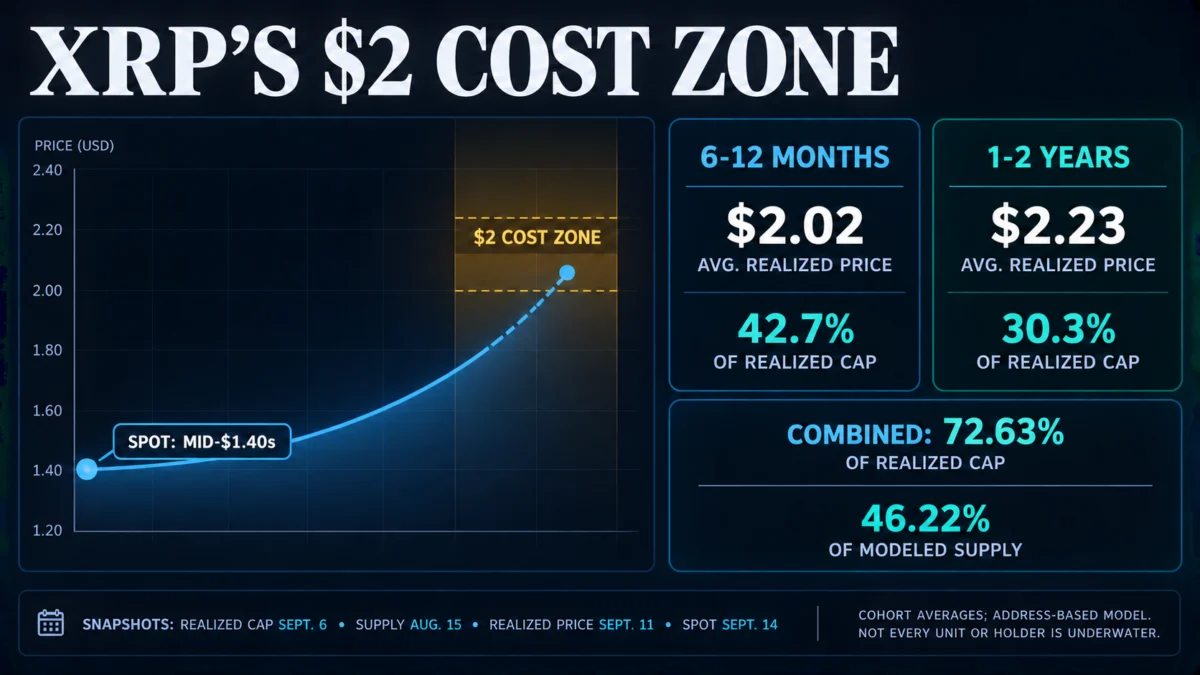
The digital asset market is currently witnessing a significant concentration of capital within the XRP ecosystem, as on-chain metrics reveal that nearly three-quarters of the token’s realized capitalization is held by investors who entered the market at significantly higher price points. According to recent data snapshots from Glassnode, approximately 75% of XRP’s realized capitalization is now concentrated in coins that last moved between six months and two years ago. With average realized prices for these specific cohorts starting above the $2.00 mark, a substantial portion of the network’s value remains "underwater" while XRP continues to trade in the mid-$1.40 range. This discrepancy between current market value and the historical cost basis of the largest holder groups sets the stage for a potential volatility event as the price approaches the $2.00 psychological and technical threshold.
The Architecture of XRP’s Realized Capitalization
To understand the current state of the XRP market, it is essential to distinguish between market capitalization and realized capitalization. While market capitalization values every unit of a cryptocurrency at its current trading price, realized capitalization offers a more granular view by valuing each unit at the price it was last moved on-chain. This metric effectively maps the "embedded cost basis" of the network, identifying the price levels at which the majority of current holders acquired their positions or moved their assets.
Data from a Sept. 6 realized-cap snapshot provided by Glassnode highlights a massive concentration of value in two specific age bands. The "six-to-12-month" cohort accounts for over $39.2 billion in realized value, while the "one-to-two-year" cohort represents approximately $27.5 billion. Combined, these two groups represent 72.6% of the network’s total realized capitalization. This suggests that the vast majority of the capital currently "locked" in the XRP ledger was deployed during periods when the asset was trading significantly higher than its current valuation.
A secondary data set from Aug. 15, focusing on supply-by-age, further reinforces this trend. Approximately 31.36 billion XRP, or 46.22% of the modeled supply, falls within these same two timeframes. These cohorts are primarily composed of addresses that could represent a diverse array of market participants, including retail individuals, institutional custodians, and centralized exchanges. While a transfer of coins does not always equate to a purchase—as internal exchange migrations or custody changes can also reset the "last moved" timestamp—the sheer volume of capital concentrated in these bands indicates a formidable zone of overhead resistance.
The $2.00 Breakeven Zone and Its Market Implications
The most critical finding from the Sept. 11 realized-price data is the specific cost basis for these dominant cohorts. Glassnode estimates the average acquisition cost for the six-to-12-month cohort at $2.02, while the one-to-two-year cohort sits at an even higher average of $2.23. With XRP trading near $1.45, these holders are currently facing modeled losses of approximately 28% to 35%.
In contrast, newer market participants appear to be in a much healthier position. The data places the average cost basis for the three-to-six-month cohort near $1.40, the one-to-three-month cohort at $1.14, and the most recent one-week-to-one-month buyers at $1.28. Because these newer cohorts are already at or near profitability, they are less likely to create immediate "panic" selling pressure. However, the true test for the market will occur if and when XRP rallies toward the $2.00 level.
As the price approaches $2.00, the massive stock of historical capital represented by the older cohorts will enter a "breakeven zone." Historically, such zones act as significant areas of supply, as investors who have been held in a losing position for months or years often choose to exit their positions once they are no longer at a loss. The market’s ability to absorb this potential selling pressure will determine whether XRP can sustain a breakout or if it will be forced back into a lower trading range.
Analyzing Exchange Dynamics: The Binance Rotation
While long-term holders remain largely dormant, short-term activity on centralized exchanges has surged. On Sept. 11, CryptoQuant contributor CryptoOnchain reported a massive spike in gross flows on Binance, the world’s largest cryptocurrency exchange by volume. The data showed that Binance received 91.23 million XRP while simultaneously sending out 113.91 million XRP. Both of these figures represent six-month highs for the platform.
Despite the intensity of these movements, the net impact on Binance’s reserves remained relatively flat. The exchange’s seven-day average XRP reserve stood at 2.63 billion, a marginal increase of 0.43% from the previous week and just 0.18% below its quarterly baseline. Similarly, derivatives open interest saw a modest uptick of 0.23% week-over-week, reaching $476.7 million.

The simultaneous surge in both inflows and outflows, coupled with stable reserves, suggests what analysts call "gross rotation" rather than a directional sell-off or a massive accumulation phase. Such movements are often attributed to internal wallet restructuring by the exchange or rebalancing by large-scale market makers. However, without a firm directional signal from exchange flows, the market remains in a state of equilibrium, waiting for an external catalyst to break the current trend.
Legislative Catalysts: The Digital Asset Market Clarity Act
The external catalyst that many market participants are watching is currently unfolding in the United States Senate. On Tuesday, Sept. 15, the Senate is scheduled to take a procedural vote on H.R. 3633, known as the Digital Asset Market Clarity Act (CLARITY Act). According to the official Senate schedule, a cloture motion concerning the bill is set to "ripen" at 2:15 p.m. ET.
The cloture vote is a critical procedural step. Under the Senate’s ordinary rules, it requires a three-fifths majority—typically 60 votes in a full 100-member Senate—to end debate and move toward a final vote on the legislation. The CLARITY Act aims to provide a definitive regulatory framework for digital assets, distinguishing between securities and commodities and establishing clear guidelines for intermediaries and trading platforms.
The bill has undergone significant revisions to garner bipartisan support. Republican sponsors have indicated that the final draft incorporates 126 substantive changes requested by Democratic lawmakers. Senator Cynthia Lummis, a prominent advocate for digital asset legislation, noted in a Sept. 10 release that the updated text includes over 114 specific provisions aimed at addressing concerns regarding consumer protection and market integrity.
For the XRP market, the progress of the CLARITY Act is of particular importance. While a March 2026 SEC securities-law interpretation—supported by CFTC guidance—already categorized XRP as a "digital commodity," the interpretation did not establish a comprehensive statutory framework. The passage of the CLARITY Act would codify these classifications into law, potentially removing the lingering "regulatory cloud" that has affected XRP’s institutional adoption in the United States.
Broader Market Impact and Future Outlook
The convergence of on-chain cost basis data and legislative developments creates a complex outlook for XRP. If the Senate vote shows strong bipartisan momentum for the CLARITY Act, it could serve as the fundamental driver needed to push XRP toward the $2.00 resistance zone.
Market analysts will be looking for three key signals to confirm the strength of any upcoming rally:
- Activation of Dormant Coins: If the six-month-to-two-year cohorts begin to move their coins as the price approaches $2.00, it will indicate whether these holders are "exiting at breakeven" or if they are holding out for higher valuations.
- Net Exchange Inflows/Outflows: A decisive shift in Binance reserves—specifically a sustained decrease in reserves—would suggest that investors are moving XRP into private custody for long-term holding, reducing available sell-side liquidity.
- Open Interest Expansion: An increase in derivatives open interest alongside a rising spot price would signal that new speculative capital is entering the market, providing the momentum necessary to overcome the $2.00 cost-basis wall.
However, if the legislative process stalls or if the cloture motion fails to reach the 60-vote threshold, the market may remain stuck in its current consolidation phase. In such a scenario, the high gross flows seen on exchanges like Binance would likely continue to reflect internal rotation rather than a meaningful change in market structure.
Ultimately, XRP sits at a crossroads. It is currently positioned beneath a concentrated zone of historical cost basis, with nearly half of its supply waiting to return to profitability. While newer buyers are currently in the green, the true health of the XRP ecosystem will be tested by its ability to navigate the $2.00 threshold and the evolving regulatory landscape in Washington D.C. The coming days will reveal whether the massive stock of historical capital remains dormant or if the shrinking of modeled losses will trigger a new era of market activity.









