
 admin
admin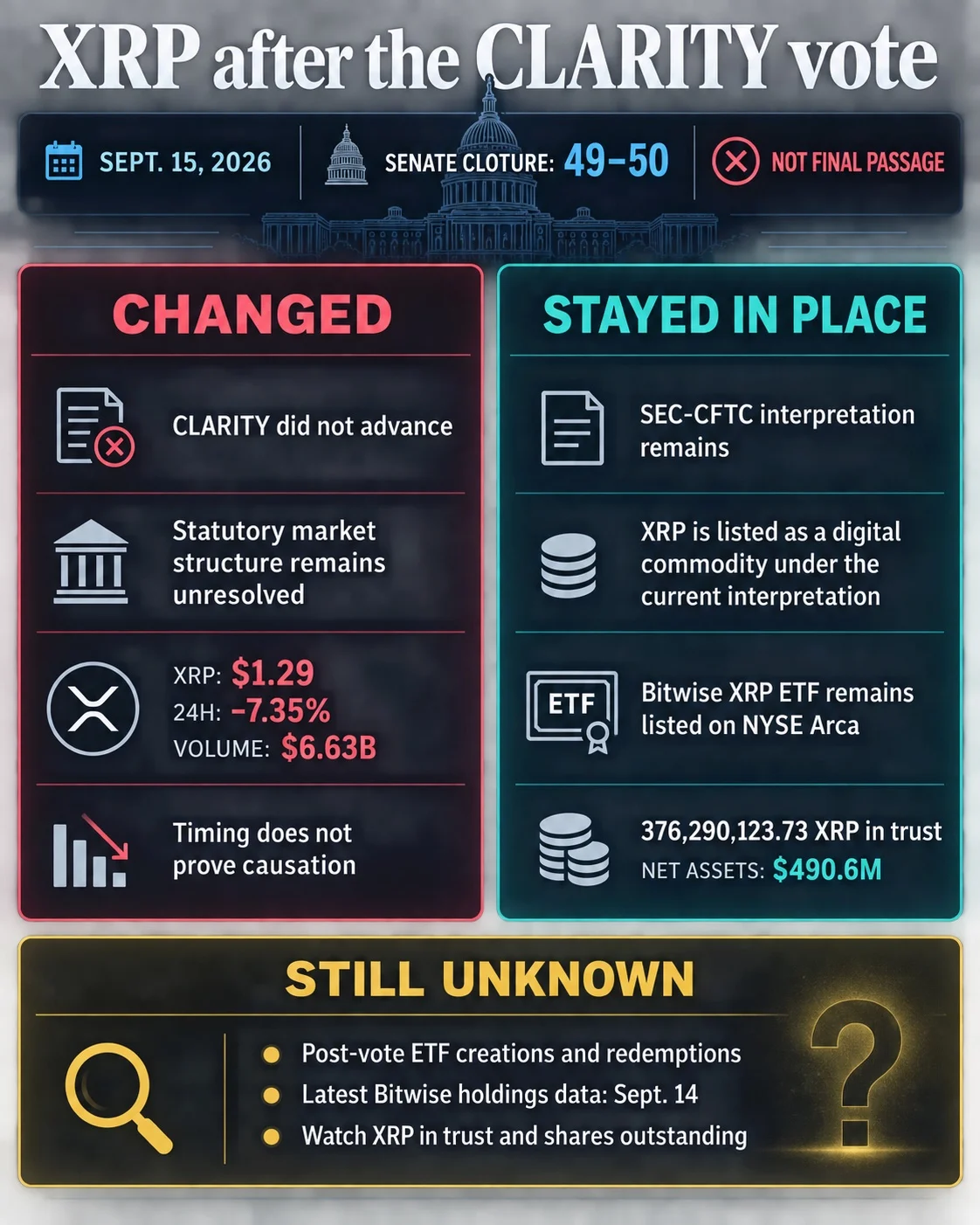
The price of XRP experienced a significant downturn, dropping by over 8% following the U.S. Senate’s decisive rejection of a pivotal cryptocurrency bill. Despite the legislative setback, the existing regulatory classification of XRP within the United States remains unchanged, a point emphasized by Ripple executives. Data from CryptoSlate indicated that XRP touched a low of $1.27 before partially recovering to approximately $1.29 at the time of reporting. This decline extended a downward trend that began around $1.42 on September 14, occurring amidst a broader market slump affecting major cryptocurrencies and a wave of leveraged long liquidations across the digital asset space.
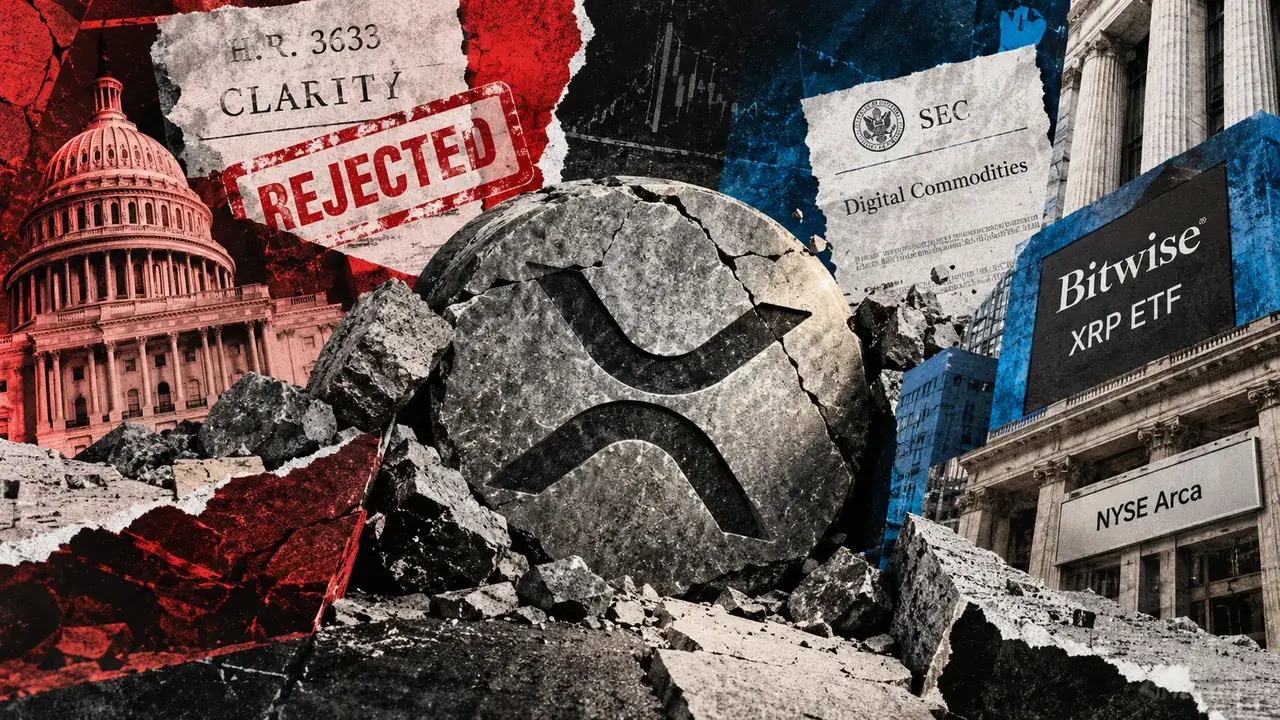
The market reaction was directly linked to the U.S. lawmakers’ failure to advance the Digital Asset Market Clarity Act (H.R. 3633). A procedural vote to proceed to the bill, which aimed to establish a federal market-structure framework for digital assets, was defeated by a narrow margin of 49-50. This outcome denied one of the cryptocurrency industry’s most significant legislative priorities the opportunity to be debated on the Senate floor, effectively closing a near-term avenue for codifying clear regulatory guidelines at the federal level.
Ripple’s Chief Executive Officer, Brad Garlinghouse, expressed his disappointment, stating that the result "stings." However, he was quick to assert that this legislative defeat would not derail the company’s commercial trajectory. Garlinghouse pointed to sustained demand from both traditional finance and the digital asset sectors as evidence that the failed vote would not impede Ripple’s momentum, its global presence, or its established customer base.
Ripple’s Regulatory Standing: A Tale of Two Arenas
While legislative progress has stalled, Ripple’s confidence in its U.S. operational future is partly anchored in regulatory clarity it secured earlier in the year. Ripple’s Chief Legal Officer, Stuart Alderoty, argued that this existing regulatory ground remains firm, even in the wake of the Senate’s vote. Alderoty referenced interpretative guidance issued in March by the Securities and Exchange Commission (SEC) and the Commodity Futures Trading Commission (CFTC), asserting that XRP continues to stand on "settled ground."
The March guidance from the SEC offered an interpretation of how federal securities laws apply to various categories of crypto assets. Concurrently, the CFTC indicated its intention to administer the Commodity Exchange Act in alignment with this framework. Crucially, XRP was identified among 18 assets that, based on their characteristics, terms, and functions at the time of the interpretation, were considered digital commodities. This classification, established prior to the Senate vote on the Clarity Act, provided a degree of regulatory certainty that had been conspicuously absent for Ripple during its protracted legal dispute with the SEC.
This sustained classification as a digital commodity, as defined by the March guidance, grants Ripple a distinct advantage. Many other participants in the broader digital asset industry continue to operate without a comprehensive, statutory market structure in place. This situation highlights the nuanced and often fragmented nature of crypto regulation in the United States, where agency interpretations and judicial decisions can hold significant sway in the absence of legislative action.
The Limits of Agency Guidance and the Path Forward
However, the regulatory protection afforded by agency interpretations is inherently less durable than codified legislation. The March guidance is an interpretation of existing statutes, leaving room for the SEC to refine or alter its approach over time. Furthermore, it preserves the transaction-specific analysis under the Howey test. This means that even if a digital asset is classified as a commodity, its offering or sale could still be subject to securities laws if it is part of an investment contract. This distinction underscores the ongoing complexity and potential for future regulatory shifts.
The current environment places greater emphasis on the actions of regulatory bodies. With Congress seemingly gridlocked on comprehensive digital asset legislation, Ripple anticipates that key figures such as SEC Chairman Paul Atkins and CFTC Chairman Mike Selig will play an increasingly prominent role in shaping crypto rules. Ripple has indicated its commitment to continued engagement with both agencies as this regulatory development process unfolds.
The company also expressed its expectation that XRP’s digital commodity treatment will endure through future rulemaking processes. While agencies can clarify the application of existing statutes to activities like trading and custody, a more definitive division of authority between the SEC and CFTC would necessitate further congressional intervention. This leaves the industry reliant on a combination of judicial outcomes, agency interpretations, and the potential for future regulatory pronouncements, all while lawmakers deliberate on how to address the persistent legislative vacuum.
Market Reaction and Institutional Interest: A Contradictory Landscape
The immediate market reaction to the Senate’s rejection of the Clarity Act was a sharp sell-off in XRP. This price depreciation mirrored broader market weakness, with Bitcoin and other major cryptocurrencies also experiencing declines. The volatility was further exacerbated by a significant volume of leveraged long liquidations, a common occurrence during periods of market uncertainty and price drops.
Despite the token’s price slump and the legislative setback, institutional interest in XRP-linked financial products appears to remain substantial. Through September 14, U.S. spot XRP Exchange-Traded Funds (ETFs) had accumulated approximately $1.71 billion in cumulative net inflows, with net assets under management reaching roughly $1.58 billion. This performance places XRP-linked ETFs in a strong position within the U.S. market, trailing only Bitcoin and Ether among major single-asset spot crypto ETF categories. It also positions XRP ahead of Solana, which had recorded approximately $1.37 billion in cumulative inflows during the same period.
This sustained institutional demand presents a somewhat contradictory picture. While the legislative environment remains uncertain, the financial markets are demonstrating continued appetite for XRP-based investment vehicles. The key question moving forward is whether this demand will persist in the wake of the Senate’s vote and, critically, whether the relevant financial agencies can translate their March interpretation into a more robust and enduring regulatory framework.
Chronology of Events and Broader Implications
The events leading to XRP’s price drop and the broader market sentiment can be traced through a series of key developments:
- March [Year]: The SEC and CFTC issue interpretative guidance on federal securities laws as they apply to crypto assets. XRP is identified as a digital commodity under this guidance. This provides a crucial, albeit temporary, layer of regulatory clarity for Ripple and XRP.
- [Date of Bill Introduction]: The Digital Asset Market Clarity Act (H.R. 3633) is introduced, representing a significant effort by lawmakers to establish a comprehensive federal framework for digital asset markets. This bill garners substantial attention and support from parts of the crypto industry.
- [Date of Senate Vote]: The U.S. Senate votes on a motion to proceed to H.R. 3633. The motion fails by a vote of 49-50, effectively blocking the bill from further debate and consideration in the Senate.
- September 14 [Year]: Data shows cumulative net inflows into U.S. spot XRP ETFs reaching $1.71 billion, highlighting ongoing institutional investment.
- September [Day after Senate Vote]: XRP’s price falls by over 8%, reaching a low of $1.27, as the market reacts to the Senate’s rejection of the Clarity Act. Broader cryptocurrency markets also experience declines.
The implications of this legislative failure are multifaceted. For Ripple, it means continued reliance on agency interpretations and a potentially longer road to definitive regulatory clarity in the U.S. The company, however, appears resolute in its strategy, emphasizing its global expansion and its ongoing engagement with regulators.
For the broader digital asset industry, the Senate’s decision underscores the challenges of achieving comprehensive legislative reform in the United States. The reliance on agency guidance, while providing some immediate relief, creates an environment of potential uncertainty. The absence of a clear, federal market-structure framework could continue to stifle innovation, deter institutional investment in certain areas, and create an uneven playing field compared to jurisdictions with more developed regulatory regimes.
The path forward for the U.S. crypto market appears to be a continuation of a multi-pronged approach: navigating agency rulemakings, anticipating potential court decisions that could set precedents, and the ongoing, albeit challenging, effort to build consensus for future legislative proposals. The performance of XRP and other digital assets will likely remain sensitive to these regulatory developments, alongside broader macroeconomic factors and technological advancements within the industry. The immediate future will hinge on the ability of regulatory bodies to provide durable clarity and the capacity of lawmakers to find common ground on a path forward for digital asset regulation.








