
 Nila Kartika Wati
The global cryptocurrency ecosystem is grappling with a significant escalation in state-sponsored cyber warfare, marked by a staggering 420% surge in on-chain malware this year, primarily driven by North Korean and Iranian state-linked hacking groups. This alarming trend underscores a broader narrative unfolding across Asia, where nations are simultaneously confronting sophisticated digital threats, refining regulatory frameworks, fostering innovation in blockchain technology, and adapting to dynamic market conditions. From Hong Kong’s strategic maneuvers to become a leading Web3 hub and India’s pioneering tokenized bond pilot, to Vietnam’s burgeoning digital asset oversight and Singapore’s advanced financial integration, the continent presents a diverse and evolving landscape for digital assets, punctuated by both progress and persistent challenges.
Escalating Threat: State-Sponsored On-Chain Malware and Illicit Finance
A recent report by Chainalysis has cast a stark light on the escalating threat of state-sponsored cyberattacks, revealing a 420% increase in on-chain malware this year. The prominent blockchain analytics firm attributes the majority of this surge to hackers linked with North Korea and Iran, highlighting a critical shift in how malicious actors leverage public blockchains for their illicit operations. These state-linked groups are now responsible for approximately two-thirds of new activity involving the storage of malware instructions or infrastructure information directly on public blockchains.
The strategic use of public blockchains by these actors significantly enhances the durability and resilience of their malware campaigns. Unlike traditional methods where malicious domains, servers, or code repositories can be identified and subsequently shut down, information stored on immutable public ledgers remains persistently accessible. This inherent characteristic of blockchain technology, originally designed for transparency and censorship resistance, is being cunningly exploited to ensure that malware instructions can endure even after other components of a cyberattack are neutralized. Chainalysis specifically identified UNC5342, a North Korea-linked group, as responsible for previously unattributed activity across various prominent blockchains, including Tron, Aptos, and BNB Smart Chain. This is not an entirely new tactic for North Korean operatives; in 2025, hackers from the Democratic People’s Republic of Korea (DPRK) famously utilized a similar technique known as EtherHiding, embedding crypto-stealing code within smart contracts to evade detection and maintain operational longevity.
The motivations behind North Korea’s aggressive cyber activities are deeply rooted in its geopolitical isolation and the urgent need to circumvent stringent international sanctions. Cyberattacks, particularly those targeting cryptocurrency exchanges and decentralized finance (DeFi) protocols, have become a primary means for Pyongyang to generate illicit revenue. This stolen capital is then funneled directly into its illicit weapons programs, including the development of nuclear warheads and ballistic missiles. The notorious Lazarus Group, a collective of North Korean state-sponsored hackers, has been implicated in numerous high-profile crypto heists over the years, collectively siphoning billions of dollars in digital assets. According to various United Nations reports, these funds are critical for sustaining the regime and advancing its military capabilities, making cryptocurrency theft a national security priority for the DPRK, with estimates suggesting that cybercrime has funded a significant portion of its WMD programs.

Adding another layer to North Korea’s sophisticated infiltration strategies, recent reports indicate that the DPRK is now employing remote workers from third countries, such as Iran and Lebanon, to bypass conventional security measures. These foreign talents are used to successfully navigate job interviews for positions within US companies, often in the IT or tech sectors, after which North Korean operatives take over the roles. This elaborate scheme allows Pyongyang to infiltrate critical US infrastructure and companies, not only to steal funds for its weapons programs but potentially to acquire sensitive technologies and intelligence. The reliance on foreign intermediaries complicates attribution and enhances the stealth capabilities of these state-sponsored cyber operations, posing a significant challenge for global cybersecurity defense and international law enforcement agencies. This tactic highlights a growing trend of nation-states leveraging a globalized workforce to facilitate their clandestine operations, blurring the lines of digital espionage and financial crime.
Asia’s Diverse Regulatory and Market Evolution
Amidst the backdrop of escalating cyber threats, various Asian nations are actively shaping their approaches to digital assets, reflecting a complex interplay of innovation, regulation, and market adaptation.
Hong Kong: Seizing a Strategic Window Amidst US Regulatory Stumbles
Hong Kong is demonstrating a proactive stance in positioning itself as a leading global Web3 hub, particularly in light of recent legislative setbacks in the United States. Following the failure of the CLARITY Act vote in the US Congress, which aimed to provide a comprehensive regulatory framework for cryptocurrencies, industry insiders are urging Hong Kong policymakers to seize this "critical strategic window." Allen Ding, director of Bitfire Research, emphasized this opportunity, suggesting that the delay in US crypto legislation gives Hong Kong an advantage in attracting talent, capital, and innovative projects. Shawn Yan, founder of Cregis Technology, echoed this sentiment, advocating for the city to prioritize "building infrastructure that can operate across regulatory boundaries, rather than waiting for any single jurisdiction to define the market for everyone." This strategy aligns with Hong Kong’s broader ambition to become a competitive and innovation-friendly environment for digital assets, complementing its status as a traditional financial powerhouse and seeking to differentiate itself from other financial centers with more conservative crypto policies.
In corporate developments, Metaplanet, a firm making strides in the Bitcoin adoption space, recently moved to significantly reduce its Series 10 stock pool. This decision came after a public controversy surrounding an initial plan to allocate as much as 20% of its fully diluted shares to executives. The company has now slashed the number of potential shares underlying the rights from 319.464 million to 188.19 million and reset the conversion ratio to its pre-September 2025 international share offering level. This adjustment effectively extinguishes over $220 million in warrant value and, notably, increases the company’s Bitcoin per fully diluted share by approximately 8.8%. This move appears to be a direct response to investor feedback and reflects a commitment to stronger corporate governance and shareholder value in the evolving crypto market, signaling a willingness to adapt to market expectations and maintain investor confidence.
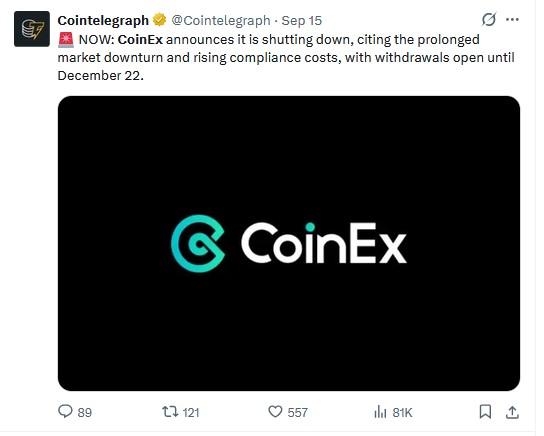
However, the market’s volatility and increasing regulatory pressures continue to impact even established players. CoinEx, a Hong Kong-founded exchange that had operated for nine years, announced its decision to cease operations. Citing falling trading volumes and liquidity during the prolonged bear market, coupled with rising regulatory and compliance costs, the exchange determined that continuing business was no longer viable. Withdrawals for users remain open until December 22, underscoring the ongoing challenges faced by smaller and mid-sized exchanges in an increasingly competitive and scrutinized global landscape. The closure of CoinEx highlights the consolidation trend in the crypto exchange market, where only the most robust and compliant platforms are likely to thrive amidst tighter regulations and sustained market downturns.

India: Balancing Innovation with Stringent Oversight
India is pursuing a dual strategy in the digital asset space, simultaneously exploring the potential of blockchain technology for financial innovation while intensifying efforts to combat economic crime involving cryptocurrencies. The Securities and Exchange Board of India (SEBI) and the Reserve Bank of India (RBI) have successfully launched a pioneering tokenized corporate bond pilot. Dubbed Demat 2.0, this new market infrastructure saw three companies issue a combined 10.25 billion rupees (approximately $107 million) through tokenized bonds. The system allows corporate bonds to be issued and held as digital tokens on a distributed ledger maintained by the country’s statutory depositories. Critically, Demat 2.0 is integrated with the RBI’s wholesale central bank digital currency (CBDC) through its Unified Market Interface, signaling a sophisticated approach to leveraging blockchain for traditional finance within a controlled environment. This pilot represents a significant step towards modernizing India’s financial markets, enhancing settlement efficiency, and exploring the efficiencies offered by tokenization for capital markets.
Concurrently, India’s regulatory and enforcement bodies are strengthening their grip on the cryptocurrency sector. The Parliamentary Standing Committee on Finance has concluded its year-long hearings on cryptocurrency policy, with the government expected to respond next week before the committee prepares its final report. This extensive review indicates a concerted effort to formulate a comprehensive and long-term regulatory framework for digital assets in the country, potentially moving beyond previous discussions of an outright ban towards a regulated ecosystem. Complementing this legislative push, India’s Enforcement Directorate (ED) is significantly beefing up its capabilities to track and investigate economic crimes involving cryptocurrencies. The ED aims to finalize investigations within an ambitious 18-month timeframe, reflecting a heightened focus on combating illicit financial activities, including money laundering, terror financing, and fraud, often facilitated by digital assets. This dual approach highlights India’s cautious but progressive engagement with the crypto world, seeking to harness its benefits while mitigating inherent risks and ensuring financial integrity.
Southeast Asia: Diverse Approaches to Digital Asset Integration
Southeast Asian nations are also charting their distinct courses in the digital asset domain, showcasing a spectrum of regulatory philosophies and market developments.
Vietnam is emerging as a notable player, attracting international attention and developing robust domestic oversight. Bitcoin Suisse, a prominent Swiss crypto trading and custody provider, has announced plans to relocate up to half of its Swiss jobs abroad, with a significant portion destined for a new center in Vietnam. This move underscores Vietnam’s growing appeal as a hub for back-office and administrative roles in the crypto sector, leveraging its skilled workforce and competitive operating costs. Parallel to this, Vietnamese regulators are actively building a comprehensive supervisory mechanism for crypto asset service providers and investor transactions. This initiative draws heavily upon recommendations from the Financial Action Task Force (FATF), signaling a commitment to aligning with international anti-money laundering (AML) and counter-terrorist financing (CTF) standards. Further cementing its position, Binance, the world’s largest cryptocurrency exchange, has signed an agreement to help develop the Vietnam International Finance Center in Ho Chi Minh City, indicating a strategic partnership aimed at fostering digital finance infrastructure and promoting responsible blockchain innovation within the country.
Singapore, long recognized as a leading global financial hub, continues to solidify its position in the crypto space with progressive regulatory moves. The Singapore Exchange (SGX) has achieved a significant milestone by becoming the first major Asian traditional finance (TradFi) exchange to receive approval from the US Commodities Futures Trading Commission (CFTC). This authorization allows SGX to offer Bitcoin and Ethereum perpetual futures to US institutions, effectively bridging the gap between conventional finance and the digital asset market and enhancing institutional access to crypto derivatives. Furthermore, Singapore’s High Court has provided crucial guidance for valuing crypto assets in legal claims. A recent decision established a precedent that departs from the usual breach-date damage assessment principles, emphasizing that "the court is unlikely to allow claimants to delay mitigation for years and then seek damages at a higher present-day market price." This clarification offers greater legal certainty for investors and businesses operating with digital assets, reinforcing Singapore’s robust legal framework. However, the region is not immune to illicit activities; six Malaysian men were recently sentenced in Singapore to hefty penalties, including up to 12 years and 11 months in jail plus 24 strokes of the cane, for a 2024 armed robbery involving crypto, cash, and luxury items, highlighting the persistent real-world risks associated with digital asset wealth and the need for stringent security measures.
Thailand is taking a more cautious approach to stablecoins, with the Securities and Exchange Commission (SEC) proposing new regulations that would impose a daily transfer cap of 5 million baht (approximately $151,000). This proposed limit reflects a regulatory desire to manage potential risks associated with stablecoin flows, particularly concerning financial stability, consumer protection, and illicit finance, without stifling innovation entirely. The move indicates a measured approach to integrating stablecoins into the broader financial system.
Finally, Malaysia is being recognized as one of the more crypto-friendly Islamic nations, according to Fitch Ratings. The local Securities Commission has notably declared several major cryptocurrencies, including Bitcoin, Ethereum, Ripple (XRP), and Stellar (XLM), as sharia-compliant. This official recognition provides a significant boost for crypto adoption within the Muslim-majority nation, aligning digital asset investments with Islamic finance principles and potentially unlocking new market segments for ethical and faith-based investing.
South Korea: Strict Enforcement and Consumer Protection
In contrast to some of its more liberal neighbors, South Korea maintains a stringent regulatory environment for cryptocurrencies, particularly concerning activities perceived as gambling. Authorities in South Korea have referred users of Polymarket, a decentralized prediction market, to prosecutors. The rationale behind this action is that Polymarket transactions constitute illegal gambling under South Korea’s Criminal Act, as users stake assets on outcomes that cannot be predicted with certainty. This firm stance underscores South Korea’s commitment to consumer protection and its strict interpretation of gambling laws, which significantly impacts the types of decentralized applications and services that can operate within its jurisdiction. The prosecution of users involved in such activities sends a clear message about the boundaries of permissible crypto-related operations in the country, reflecting a cautious approach to new financial instruments that could be perceived as speculative or high-risk.
Conclusion: A Dynamic and Fragmented Global Digital Frontier
The confluence of these events paints a picture of a global digital asset frontier that is both dynamic and fragmented. The persistent and evolving threat of state-sponsored cyberattacks, particularly from actors like North Korea and Iran, necessitates enhanced international cooperation, robust cybersecurity measures, and advanced forensic capabilities to safeguard the integrity of the financial system. The sophisticated methods employed, such as leveraging public blockchains for malware persistence and using foreign talent for infiltration, pose significant challenges to traditional security paradigms.
Simultaneously, Asian nations are forging distinct paths in integrating blockchain technology and cryptocurrencies into their economies. From Hong Kong’s aggressive pursuit of Web3 leadership and India’s strategic adoption of tokenized assets, to Vietnam’s emerging regulatory framework and Singapore’s institutional embrace, the region is a crucible of innovation and regulatory experimentation. The contrasting approaches, from Malaysia’s sharia-compliant crypto framework to South Korea’s strict gambling prohibitions and Thailand’s stablecoin caps, underscore the diverse cultural, economic, and legal considerations at play. As the digital asset landscape continues to mature, the delicate balance between fostering innovation, ensuring financial stability, protecting consumers, and countering illicit activities will remain a critical challenge for policymakers worldwide. The next phase of cryptocurrency evolution will undoubtedly be shaped by how effectively these complex challenges are addressed across this crucial and influential continent.









