
 Layla Zulfa
A landmark research initiative involving experts from ETH Zurich, the AI safety organization MATS, and researchers from the AI firm Anthropic has unveiled a significant shift in the landscape of digital privacy, demonstrating that Large Language Models (LLMs) can now identify pseudonymous internet users with alarming accuracy. The study, which has recently resurfaced across major social media platforms such as X and Reddit, suggests that the "practical obscurity" once afforded by anonymous accounts is effectively reaching its end. By leveraging the advanced reasoning and synthesis capabilities of models like GPT-4, Claude, and Gemini, researchers have successfully developed a methodology that unmasks real-world identities using nothing more than publicly available, unstructured text.
The research arrives at a time of heightened sensitivity regarding digital footprints and personal security. Unlike traditional cyberattacks that rely on software vulnerabilities, data breaches, or unauthorized access to private servers, this form of deanonymization is purely "passive." It utilizes the same capabilities that make AI chatbots useful for everyday tasks—summarization, web searching, and logical deduction—to connect disparate pieces of information scattered across years of internet history. The findings indicate that a user’s unique "digital fingerprint" is composed of mundane details: linguistic quirks, geographic references, professional jargon, and even mentions of personal hobbies or pets.
A Four-Stage Framework for Deanonymization
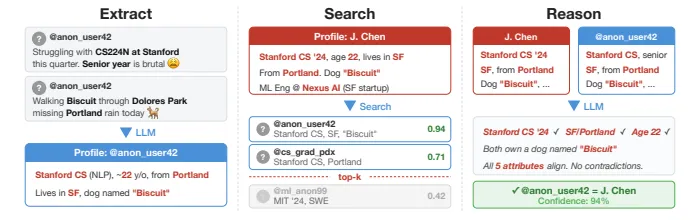
The researchers, including Nicholas Carlini of Anthropic, structured their deanonymization pipeline into a logical four-step process: Extract, Search, Reason, and Calibrate. This systematic approach allows the AI to function as a highly efficient, automated private investigator, operating at a fraction of the cost and time required for human-led surveillance.
The first stage, Extract, involves feeding the AI a collection of posts from a pseudonymous account. The model is tasked with creating a comprehensive profile of the individual based on subtle clues. This includes identifying geographic markers (such as references to local weather or transit), professional backgrounds (based on industry-specific terminology), and idiosyncratic habits (such as the use of British versus American spelling).
The second stage, Search, transforms the extracted profile into a mathematical "embedding." An embedding is a high-dimensional vector representation of data that allows a computer to find similar profiles within a massive database nearly instantaneously. By comparing the pseudonymous profile against thousands of potential real-world candidates—often pulled from platforms like LinkedIn or professional directories—the AI can narrow the field to a manageable list of suspects.

The third stage, Reason, is where the power of modern LLMs is most evident. A more sophisticated model analyzes the top candidates and performs a deep-dive comparison. It cross-references the details found in the anonymous posts with the public biographies of the candidates. For instance, if an anonymous user mentioned a specific dog breed and a move from Chicago to Berlin in 2021, and a LinkedIn candidate’s profile reflects a similar move and a photo of that same dog breed on another public platform, the AI reasons that a match is highly probable.
The final stage, Calibrate, serves as a quality control mechanism. The AI is programmed to rate its own confidence in the match. By assigning a probability score to its findings, the system can filter out "hallucinations" or low-confidence guesses, ensuring that the final output is statistically significant. This step is crucial for preventing the system from producing false positives, which would otherwise undermine its utility for large-scale surveillance.
Empirical Evidence: Hacker News and Scientific Transcripts
To validate their methodology, the research team conducted several controlled experiments. In one notable test, the researchers targeted users of Hacker News, a popular forum for technology and startup discussions where many users operate under pseudonyms. The team identified 338 users who had, at some point in their history, linked their LinkedIn profiles in their bio or posts. After stripping all direct identifiers from their post histories, the researchers tasked the AI with identifying the users using only web searches.
The results were stark: the AI correctly identified 226 of the 338 users, a success rate of 67%. Furthermore, the system demonstrated high precision; in the cases where the AI felt confident enough to make a guess, it was correct approximately 90% of the time. This suggests that the AI is not merely guessing but is effectively "connecting the dots" between fragmented pieces of public information.
In a separate study, the team analyzed transcripts from research interviews conducted by Anthropic with 125 scientists. Even in this professional and highly specific context, where participants were discussing their work in general terms, the AI was able to correctly identify nine individuals solely based on how they described their niche areas of expertise and career trajectories. This highlights the vulnerability of professionals who may believe their identity is protected by the technical nature of their discussions.
The Economic Democratization of Cyber-Surveillance
One of the most significant findings of the ETH Zurich and Anthropic study is the cost-effectiveness of this technology. According to the research paper, the total cost of running a single deanonymization search ranges from $1 to $4 in AI API subscription fees. Historically, unmasking an anonymous individual required either a state-level intelligence operation or the hiring of a private investigator, costing thousands of dollars and dozens of man-hours.

The transition from expensive, human-led investigation to automated, low-cost AI analysis represents a "democratization" of doxxing. The researchers argue that because this capability is built into the core functionality of LLMs—which are designed to be excellent at pattern recognition and information retrieval—there is no simple way to disable the "deanonymization feature" without crippling the model’s overall utility. This creates a paradox for AI developers who must balance the helpfulness of their models against the potential for privacy-eroding misuse.
Historical Precedents and the Evolution of Privacy Risks
The concept of deanonymization is not new to the digital age. In 2008, researchers successfully unmasked users in a "sanitized" movie-rating dataset released by Netflix. By cross-referencing anonymous Netflix ratings with public reviews on the Internet Movie Database (IMDb), they were able to identify individuals and their potentially sensitive viewing habits.
However, the current shift toward AI-driven deanonymization represents a fundamental evolution of this threat. While the 2008 Netflix study relied on structured data (numerical ratings and dates), modern AI can navigate unstructured data—the messy, conversational text that makes up the vast majority of social media. AI can interpret jokes, sarcasm, and offhand mentions, turning "useless" noise into actionable intelligence.
The timeline of privacy erosion has accelerated significantly in the mid-2020s. In 2025, a massive data breach at Coinbase led to a wave of targeted doxxing and physical security threats against cryptocurrency holders. These incidents demonstrated that once a digital identity is linked to a physical address, the consequences can move from the digital realm to the real world in hours. The ETH Zurich study suggests that in 2026 and beyond, a data breach may not even be necessary; the AI can simply "read" its way to your front door.
Broader Impact and Implications for Free Speech
The implications of this research extend far beyond the technical community. For activists operating in authoritarian regimes, whistleblowers, or members of marginalized communities who rely on pseudonymity for safety, the ability of AI to unmask their identities poses an existential threat. If an anonymous post can be traced back to an employer or a government agency for the price of a cup of coffee, the "chilling effect" on free speech could be profound.
The study also touches on the concept of "stylometry"—the study of linguistic style. Each person has a unique way of writing, including sentence structure, vocabulary preferences, and punctuation habits. LLMs are particularly adept at identifying these patterns. Even if a user never mentions their location or job, their "literary fingerprint" may be enough to link them across multiple platforms, eventually leading to a real-world identification.
Official Responses and Strategic Mitigation
The research team at ETH Zurich and MATS followed strict ethical protocols, undergoing a review board assessment before publishing their findings. In an effort to prevent immediate harm, they did not release the specific tools, prompts, or the names of the individuals they successfully deanonymized. Instead, the paper serves as a formal warning to the tech industry and policy-makers.
Anthropic, whose researcher co-authored the paper, has previously acknowledged the dual-use nature of its Claude model. Earlier in 2026, the company disclosed that state-backed hackers had attempted to use Claude to orchestrate cyberespionage campaigns. This latest research reinforces the necessity for robust guardrails, though the authors admit that blocking these specific "reasoning" attacks is difficult because each individual step in the process appears harmless.
For the average internet user, the researchers suggest that the primary defense is a change in digital habits. The "fix" for AI deanonymization is not a single software patch but a rigorous approach to personal information hygiene. This includes:
- Reducing the volume of specific, identifying details shared across any single pseudonym.
- Avoiding the reuse of unique phrases or anecdotes across different platforms.
- Utilizing privacy-centric AI tools that are designed not to retain or train on user data.
- Recognizing that "anonymity" is now a spectrum rather than a binary state.
As AI models continue to grow in capability, the traditional models of online privacy—which rely on the assumption that it is too difficult to find a needle in a digital haystack—are becoming obsolete. The haystack is no longer a barrier; to an AI, it is simply a searchable database. The ETH Zurich study stands as a definitive marker of this transition, signaling a future where privacy must be actively engineered rather than passively assumed.









