
 Lina Irawan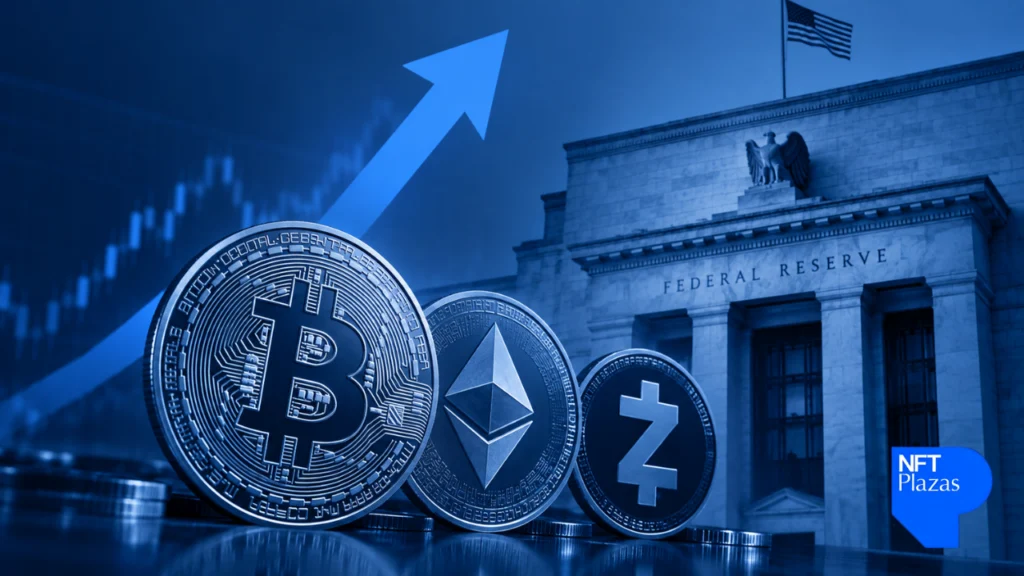
Bitcoin and major cryptocurrencies experienced a notable upward trend following the Federal Reserve’s announcement of its first interest-rate hike since 2023. Rather than reacting negatively to the quarter-point increase, traders demonstrated a clear focus on the central bank’s forward guidance regarding its future monetary policy trajectory. This shift in market sentiment saw speculative appetite return across the digital asset landscape, with Zcash emerging as a leading gainer in the burgeoning rally.
On Thursday, Bitcoin’s price trajectory saw it climb back above the significant $76,000 mark. This recovery followed an initial dip immediately after the Federal Reserve’s decision was officially disseminated. By midday, Bitcoin (BTC) had reached a trading price of $76,621, reflecting a gain of 0.88% over the preceding 24-hour period. Ether, the second-largest cryptocurrency by market capitalization, also demonstrated positive momentum, appreciating by 1.1% to trade at $2,444. Solana, another prominent digital asset, recorded a more substantial gain of 2%, reaching $100.57.
The broader cryptocurrency market, as a collective entity, also rebounded, surpassing the $2.7 trillion threshold. This recovery occurred after the total market capitalization had dipped below this crucial level in the hours preceding the Federal Open Market Committee (FOMC) meeting. The resilience shown by digital assets in the face of tightening monetary policy signals a complex interplay between traditional financial indicators and the evolving dynamics of the cryptocurrency ecosystem.
The FOMC’s decision to raise the federal funds target range by 25 basis points, bringing it to 3.75%-4%, marked a significant development in the Fed’s monetary tightening strategy. This move, the first of its kind since 2023, was closely watched by global financial markets. Despite the shift towards a more restrictive monetary stance, a broad rally was observed across risk assets, with cryptocurrencies participating actively in this trend. This suggests that market participants had largely anticipated and priced in the rate hike, rendering its immediate impact less disruptive than might have been expected.
Markets Had Already Priced In the Hike
The Federal Reserve’s decision to implement a 25-basis-point interest rate increase came as little surprise to seasoned investors and market observers. In the days and weeks leading up to the FOMC meeting, financial markets had assigned a high probability to such a move. This consensus allowed traders ample opportunity to strategically position their portfolios and to hedge against potential downside risks. Consequently, the announcement itself had a muted impact, as the market had already incorporated this information into asset valuations.
The cryptocurrency market, in particular, had already weathered significant selling pressure in anticipation of the Fed’s actions. Data indicated that the total market capitalization of cryptocurrencies had fallen from approximately $2.73 trillion on September 3rd to $2.53 trillion just before the Fed’s decision. Bitcoin also experienced a dip, trading around $75,350 shortly before the announcement, before beginning its recovery above the $76,000 level. This pattern of pre-emptive selling followed by a post-announcement recovery is a common market phenomenon when an event is widely anticipated.
The observed market reaction strongly suggests that the quantum of the rate hike itself was less critical than the Federal Reserve’s forward-looking guidance. Investors and analysts meticulously parsed the Fed’s statements and projections for clues about the future path of interest rates and the duration of the tightening cycle. The committee’s median projection indicated a policy rate of 4.1% at the end of both 2026 and 2027. This forecast implies one additional 25-basis-point increase from the current range. Notably, the number of policymakers expecting another hike before the end of 2026 increased significantly to 16 out of 18, a marked rise from the nine who held this view in June.
Fed Chair Jerome Powell, in his post-meeting remarks, reiterated concerns about inflation, stating that it remained "too high for too long." This commentary underscored that persistent inflationary pressures continue to be a primary concern for policymakers. However, the projections did not signal an imminent or prolonged period of aggressive tightening. This nuanced outlook provided a degree of reassurance to investors, who were sensitive to the potential for an extended period of restrictive monetary policy that could stifle economic growth and dampen risk appetite.

The positive sentiment extended beyond the cryptocurrency markets, influencing a wider range of risk assets. Nasdaq 100 futures saw a gain of 1.04%, while S&P 500 futures rose by 0.81%. Gold, traditionally considered a safe-haven asset, also advanced by 1.02%. Conversely, the U.S. Dollar Index experienced a slight slip of 0.17%. This broad-based rally indicated that cryptocurrencies were participating in a general rebound of risk assets rather than acting as a primary driver of the market’s upward momentum.
Zcash Leads the Crypto Rally with Strong Momentum
Within the cryptocurrency space, the most pronounced gains were observed at the more speculative end of the market. Data compiled by CoinDesk revealed that 94 out of its top 100 largest cryptocurrencies were trading higher over a 24-hour period. The smaller-cap CoinDesk 80 index posted an impressive advance of 4.7%, significantly outperforming the 1.2% gain seen in the Bitcoin-heavy CoinDesk 5 index. This performance differential suggests a broader appetite for riskier altcoins among investors.
Zcash (ZEC) emerged as a standout performer in this speculative surge. Over the past seven days, ZEC experienced a remarkable price jump of over 20%, briefly trading above $1,350 and nearing a record high close to $1,400. The privacy-focused cryptocurrency has demonstrated exceptional year-to-date performance, gaining approximately 160%, a figure that substantially outperforms Bitcoin’s returns during the same period.
This significant rally in Zcash’s price has been underpinned by a series of specific developments within its ecosystem. A recent governance vote saw an overwhelming majority of participants back a proposal to reduce block times from 75 seconds to 25 seconds, while crucially maintaining the network’s Bitcoin-style halving schedule. This decision, supported by nearly 2.4 million ZEC in participation, with an astonishing 99.9% voting in favor of faster block confirmation times, is expected to enhance network efficiency and transaction throughput.
Furthermore, Zcash Labs announced an $80,000 agreement with Ledger, a prominent hardware wallet manufacturer. This collaboration is aimed at facilitating the integration of Zcash’s new Ironwood shielded pool with Ledger devices, thereby enhancing the security and accessibility of private transactions for Ledger users.
The token also received a notable endorsement from Matt Huang, co-founder of Paradigm, a leading cryptocurrency investment firm. Huang disclosed that Paradigm holds ZEC, describing it as a "private complement to Bitcoin." Such high-profile backing from influential figures within the crypto investment community often serves to boost investor confidence and attract further capital. As a result of these developments and renewed investor interest, Zcash’s market capitalization has surged to approximately $23 billion, positioning it firmly among the largest cryptocurrencies by market value.
The robust performance of Zcash has also widened the gap between it and its rival privacy coin, Monero (XMR). Over the same 24-hour period, XMR experienced a slight decline of about 1%, trading around $494, while ZEC continued its upward trajectory.
Other altcoins also joined the broader market recovery. NEAR Protocol saw an approximate 16% increase in its value, Venice Token gained 14%, and Pump.fun’s PUMP token advanced by nearly 8%. The overall sentiment in the altcoin market was further reflected in CoinMarketCap’s Altcoin Season indicator, which rose to 39 out of 100. While this represents an increase from around 32 earlier in the week, the reading remains below levels typically associated with a widespread altcoin rally, suggesting that further momentum may be needed to confirm a full-blown altcoin season.
Derivatives Show Rising Risk Appetite Amidst Market Uncertainty
The derivatives market provided further evidence of a resurgence in risk appetite within the cryptocurrency ecosystem. Aggregate crypto futures open interest climbed to $64.4 billion, an increase from $59.7 billion recorded on Monday. Concurrently, 24-hour futures trading volume reached an impressive $112.6 billion, indicating heightened trading activity and speculative engagement.

Bitcoin’s open interest in futures contracts saw a rise of 1.41%, reaching $26.6 billion, while Ether’s open interest increased by 1.39% to $16.7 billion. The simultaneous rise in open interest alongside higher prices is a significant indicator. It suggests that traders are actively initiating new long positions rather than simply closing out existing bearish bets. This active addition of leveraged positions points to a growing conviction among traders that prices are likely to continue their upward trend.
Coinalyze’s aggregate long/short ratio stood at 1.13, marking its eighth consecutive day above 1. This sustained ratio above parity, following a period of roughly three weeks below this level, indicates a prevailing bullish sentiment among leveraged traders.
Zcash, in particular, has witnessed an exceptionally sharp increase in leverage. ZEC’s open interest surged by an impressive 37.84% to $2.2 billion over a 24-hour period. Despite this significant increase in open interest and rising prices, its funding rate remained negative at -0.0253%. A negative funding rate in futures markets signifies that short-position holders are paying a premium to long-position holders. This situation, occurring even as ZEC reached new highs, points to sustained pressure on traders who are betting against the rally, suggesting a potential for further upward price momentum as shorts are squeezed.
Bitcoin ETF Outflows Remain a Concern for Sustained Recovery
Despite the positive signals from the derivatives market and the broader cryptocurrency rally, the recovery has not yet been unequivocally confirmed by spot Bitcoin fund flows. U.S. spot Bitcoin Exchange-Traded Funds (ETFs) recorded approximately $296 million in net outflows on Wednesday, following $450 million in withdrawals the previous day. Over the past seven sessions, since September 8th, total outflows from these ETFs have exceeded $1 billion, leading to a reduction in total net assets under management to around $95.2 billion.
The price of Bitcoin also remains 6.9% below its recent monthly high of $82,284, which was achieved on September 4th. This divergence between the optimism seen in derivatives markets and the ongoing capital outflows from spot Bitcoin ETFs presents a mixed picture. While futures traders are demonstrably increasing their exposure and showing a willingness to take on more risk, investors in spot ETFs appear to be exercising caution, withdrawing capital from the market.
This divergence creates an important dynamic for the ongoing market recovery. The increasing leverage in derivatives suggests a speculative appetite for further price appreciation, but the sustained demand from spot investors, particularly institutional investors represented by ETFs, is yet to fully materialize. This could indicate that while traders are anticipating short-term gains, broader, more sustained institutional buying that underpins long-term price appreciation is still pending.
The Next Test for Crypto: Sustained Demand and Policy Clarity
The Federal Reserve’s first rate hike since 2023 has, thus far, failed to trigger the kind of broad risk-off reaction that tightening monetary policy can sometimes produce. However, policymakers’ persistent concerns about inflation and the majority expectation of at least one more rate increase before the end of the year remain significant factors. For the cryptocurrency market, the crucial question moving forward is whether the current rebound can evolve into sustained buying pressure or if it will remain a short-term reaction to an event that was largely anticipated and priced in.
Several key indicators will shape the trajectory of the cryptocurrency market in the coming weeks and months. Bitcoin needs to reclaim its recent highs to signal a genuine upward trend. The persistent outflows from Bitcoin ETFs represent a notable headwind, potentially limiting the influx of institutional capital. Furthermore, the building leverage across derivatives markets, while currently fueling a rally, could also amplify any future downturn if market sentiment shifts.
Conversely, the remarkable strength exhibited by Zcash and other speculative altcoins indicates a growing willingness among traders to embrace risk. This increased speculative appetite, if sustained, could provide further impetus for a broader market recovery. For now, the cryptocurrency market has demonstrated resilience by absorbing the Fed’s initial rate increase and moving higher. The ultimate success of this recovery, however, will hinge on the emergence of robust spot demand, the availability of liquidity within the ecosystem, and the Federal Reserve’s future policy decisions, which will undoubtedly continue to be a primary driver of global financial market sentiment.









