
 James Watt
The global financial landscape is currently witnessing a rare and significant divergence as Bitcoin maintains its valuation near the $84,000 threshold despite a historic selloff in the United States bond market that has propelled Treasury yields to levels not seen in decades. This decoupling comes at a time when the benchmark 10-year Treasury yield recently climbed to 5.22%, marking its highest point since 2007, while the 30-year yield touched a 22-year peak of 5.5185% before stabilizing slightly. In traditional financial models, such a surge in "risk-free" returns typically exerts downward pressure on non-yielding assets like cryptocurrencies and gold, yet the digital asset market has displayed a notable degree of stoicism in the face of these tightening financial conditions.
The current bond rout is not merely a short-term fluctuation but part of a broader structural shift in the fixed-income market. As borrowing costs rise throughout the financial system, the "hurdle rate" for risk assets increases significantly. When investors can secure a guaranteed 5% return from the US government, the incentive to hold volatile assets like Bitcoin theoretically diminishes. However, the crypto market’s ability to absorb this latest leg of the bond rout suggests a shifting investor thesis or a high level of conviction among current holders. After retreating from a weekly high near $87,000, Bitcoin has remained largely range-bound between $83,000 and $85,000, refusing to capitulate to the gravitational pull of rising interest rates.
The Magnitude of the Treasury Selloff
To understand the pressure facing Bitcoin, one must examine the unprecedented nature of the current movement in US government debt. The 10-year Treasury yield is currently on a trajectory for its seventh consecutive monthly increase. According to data from Jefferies, such a streak would tie the longest period of sustained yield growth since 1970. This persistent upward pressure reflects a fundamental repricing of the "higher for longer" interest rate environment.
The strain on the bond market was further evidenced by recent Treasury auctions, which have shown signs of waning demand. James Lavish, co-managing partner of the Bitcoin Opportunity Fund, highlighted a recent $44 billion sale of seven-year notes that cleared at a yield of 5.085%. This represents a massive jump from the 4.512% recorded in August and stands as the highest auction yield for this maturity since April 1993. The auction "tailed" the prevailing market yield by 0.7 basis points, a technical indicator that demand was lower than expected, forcing the government to offer higher yields to attract buyers. Furthermore, the bid-to-cover ratio—a measure of demand—slipped from 2.50 to 2.42, signaling that the traditional appetite for US debt is being tested by the sheer volume of supply and the shifting economic outlook.
Mohamed El-Erian, chief economic adviser at Allianz, noted that this selloff is the culmination of several forces that have been building for some time. These include heavy government and corporate borrowing requirements, surprisingly resilient domestic economic activity, and a reduced capacity or willingness among traditional foreign and domestic buyers to absorb more Treasury duration. El-Erian suggests that many investors remain psychologically "anchored" to the abnormally low-interest-rate environment that followed the 2008 financial crisis, leaving them ill-prepared for a structural return to 5% or higher borrowing costs.

Economic Resilience and the Inflation Challenge
The upward trajectory of yields is being fueled by a series of robust economic data points that complicate the Federal Reserve’s path toward potential easing. Although the Fed recently adjusted its target range, subsequent data suggests the economy is running hotter than many anticipated. S&P Global’s preliminary September composite purchasing managers’ index (PMI) surged to 58.4 from 56.0, marking its strongest reading since mid-2021.
Within this data, several concerning trends for inflation-watchers emerged: companies are increasing payrolls at the fastest pace in over four years, and input costs are climbing toward four-year highs. These metrics reinforce the narrative that inflation may remain "sticky," preventing the Fed from lowering rates as quickly as the market had hoped earlier this year. For Bitcoin, this creates a dual-edged sword. While persistent inflation can sometimes bolster the "inflation hedge" narrative for digital assets, the resulting high interest rates create a massive opportunity cost for holding an asset that pays no dividends or coupons.
Analyzing the Opportunity Cost and Investment Asymmetry
The shift to a 5% yield environment fundamentally changes the calculus for institutional portfolio managers. Jurrien Timmer, director of global macro at Fidelity Investments, has pointed out the growing asymmetry in the bond market. At a 5% yield for the 10-year Treasury, investors are provided with a substantial "cushion" against further price declines. Timmer’s calculations suggest that if yields were to decline by 100 basis points, the total return on the bond would be approximately 11.9%. Conversely, if yields were to rise further to 6%, the resulting loss would be limited to roughly 1.9%.
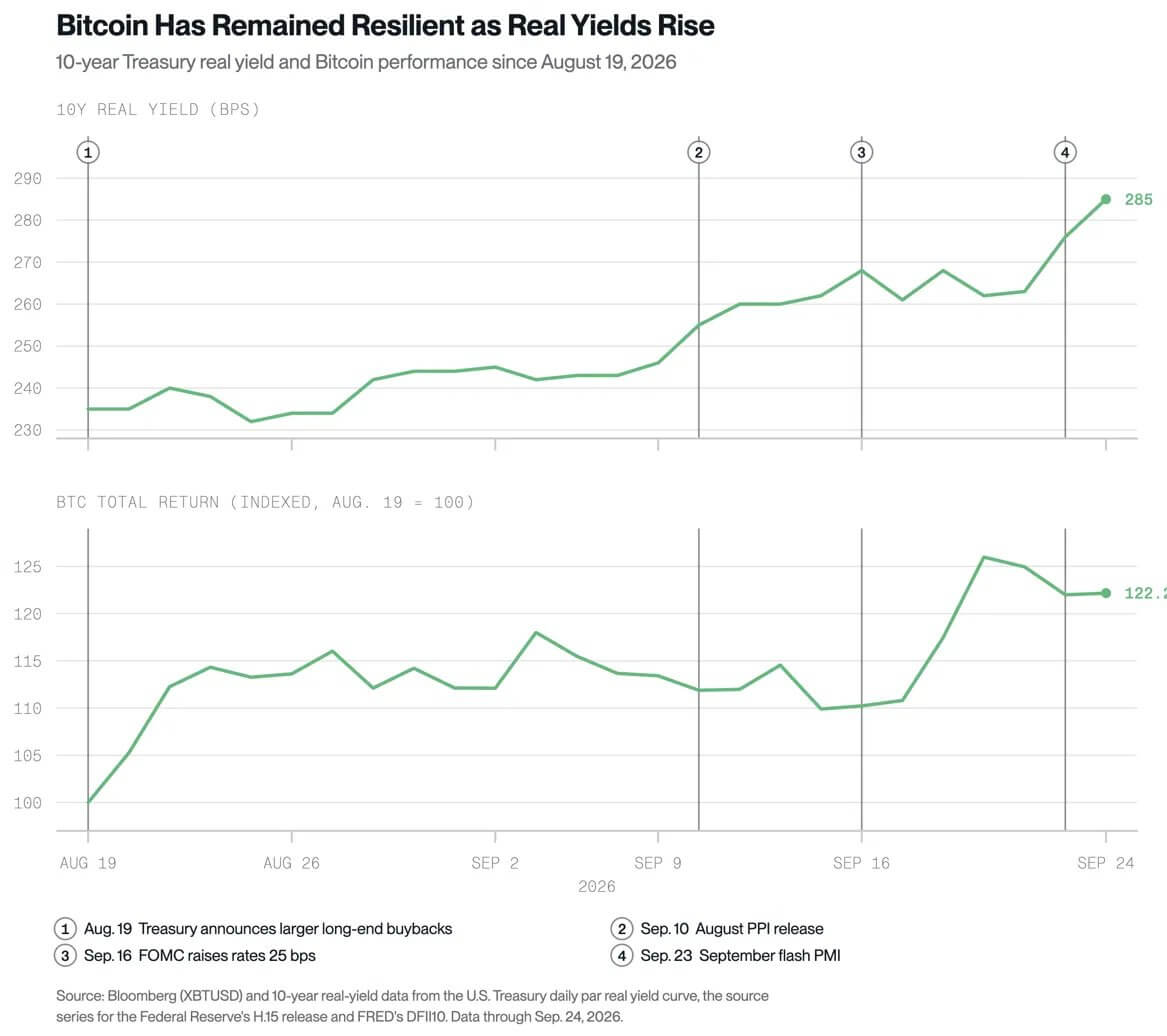
This favorable risk-reward profile for bonds makes them a formidable competitor for capital that might otherwise flow into the crypto space. Despite this, Timmer observes that Bitcoin remains a leading asset in his multi-asset framework, outperforming long-duration bonds which have struggled significantly during this tightening cycle. The fact that Bitcoin has gained roughly 22% since mid-August—a period during which the 10-year real yield climbed 50 basis points—defies traditional correlations. Real yields (nominal yields minus inflation) are often considered the "kryptonite" of the crypto market, yet Bitcoin has managed to hold the majority of its gains even as real yields rose steadily.
Internal Market Mechanics: Deleveraging Without a Crash
One of the most encouraging signs for Bitcoin advocates is how the market has handled the recent macro shock internally. Rather than a price collapse, the adjustment has manifested as a significant reduction in leverage within the derivatives market. Data from CryptoQuant indicates that combined Bitcoin open interest across major exchanges—including Binance, Gate.io, HTX, and Bybit—fell from $12 billion on September 22 to approximately $10.3 billion by September 25.
This $1.7 billion contraction represents a 14.3% reduction in leveraged exposure. Remarkably, during this same period, the spot price of Bitcoin only declined by about 2.3%, moving from $86,000 to $84,000. This disparity suggests that the market is "flushing out" speculative leverage without triggering the kind of cascading liquidations that have historically led to 10% or 20% flash crashes.
The reduction in open interest was broad-based, with Gate.io and Binance seeing declines of $710 million and $680 million, respectively. While it is difficult to determine whether these were long or short positions being closed, the scale of the deleveraging relative to the price stability suggests a transfer of coins from speculative hands to more "patient" capital. However, risks remain. CoinGlass’s 24-hour liquidation heatmap reveals significant clusters of liquidity between $85,300 and $85,700 on the upside, and a larger "liquidity pocket" near $80,000 on the downside. A breach of these levels could still trigger volatility if the Treasury market continues its volatile path.
The Road Ahead: Key Macro Catalysts
The resilience of Bitcoin is currently being tested in a "live" environment. BlockScholes has noted that the surge in long-term Treasury yields has not yet produced a corresponding expansion in crypto volatility. Bitcoin’s 30-day implied volatility remains near the lower end of its recent range, suggesting that crypto traders are not yet panicking about the bond market selloff.
However, the upcoming weeks contain several high-stakes data releases that could break this stalemate. The market is closely watching the Federal Reserve’s preferred inflation metric, the Personal Consumption Expenditures (PCE) price index, scheduled for release on September 30. This will be followed by the September employment report on October 2. If these reports show continued economic strength or accelerating inflation, it could provide bond bears with the ammunition needed to push the 10-year yield above 5.2% or the 30-year yield beyond 5.52%.
The critical question for the final quarter of the year is whether Bitcoin can continue to decouple from the traditional "risk-off" response to rising yields. If yields begin to stabilize or fall, the pressure on Bitcoin would likely ease, potentially allowing it to resume its upward trajectory after having successfully weathered a double-digit contraction in leverage. Conversely, a sustained move toward 6% Treasury yields would subject Bitcoin’s current resilience to its most rigorous macro test since its inception. For now, the "digital gold" narrative appears to be providing a floor for the asset, even as the "risk-free" alternative becomes more attractive than it has been in a generation.









