
 James Watt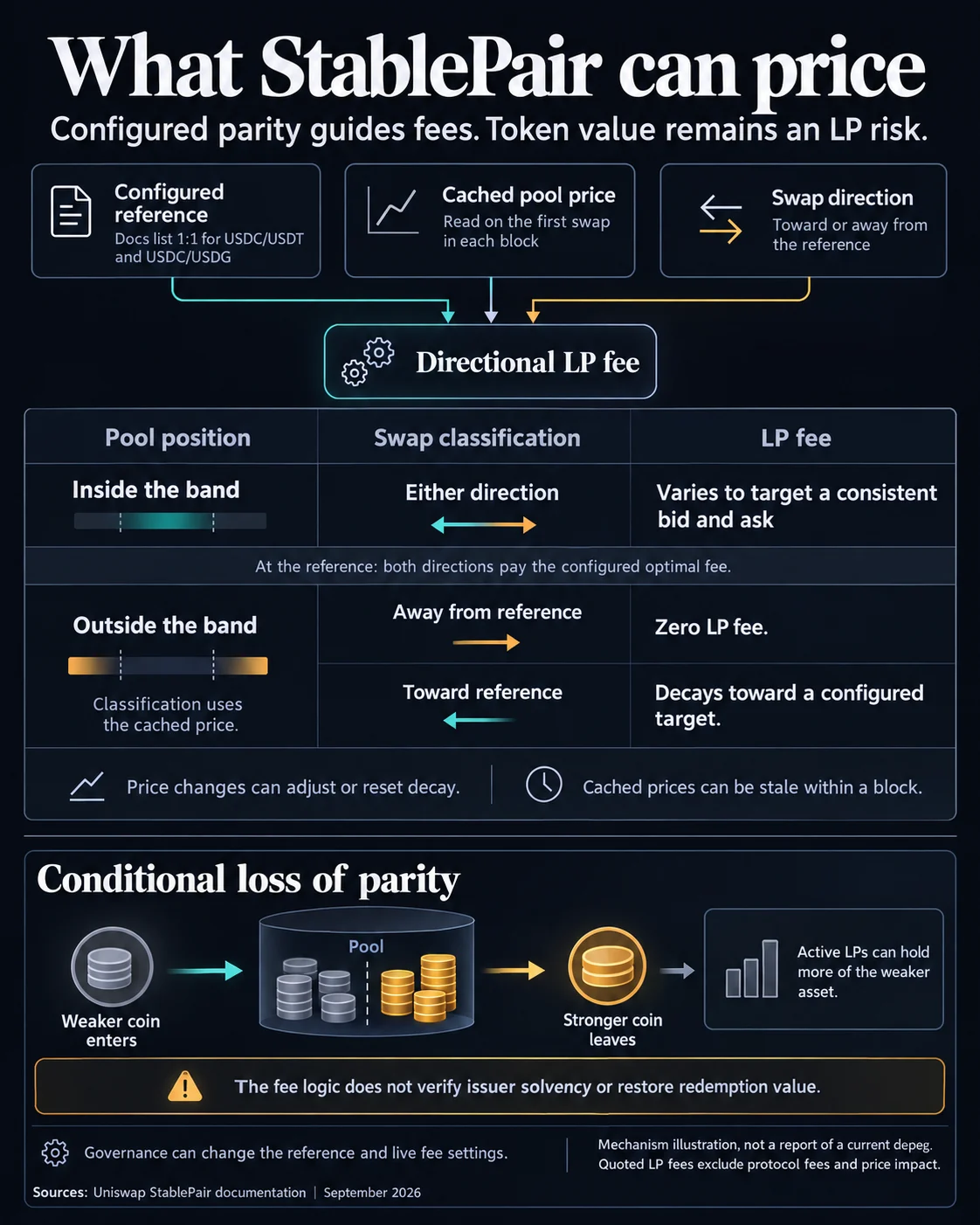
The decentralised finance ecosystem is witnessing a significant shift in how liquidity is managed and rewarded with the introduction of Uniswap v4’s "hooks" architecture. Among the most anticipated of these technical implementations is the StablePair fee hook, a specialized smart contract designed to alter the fundamental behavior of stablecoin liquidity pools. By dynamically adjusting fee structures based on a pre-configured reference rate, the StablePair hook aims to internalize the value traditionally captured by arbitrageurs, redirecting those profits back to the liquidity providers who facilitate the market. However, as the protocol moves toward this more active management style, it introduces a new set of economic considerations regarding inventory risk and the reliance on static internal benchmarks.
The Evolution of Uniswap and the Advent of v4 Hooks
Uniswap v4 represents a departure from the "one-size-fits-all" approach of its predecessors. While v2 introduced the constant product formula and v3 brought concentrated liquidity, v4 introduces "hooks"—externally deployed contracts that execute custom logic at specific points in a pool’s lifecycle. This allows developers to create highly specialized pools without rewriting the core protocol. The StablePair hook is one of the first major implementations of this technology, specifically targeting the low-volatility, high-volume environment of stablecoin pairs.
The primary objective of the StablePair hook is to solve a persistent issue in decentralized exchanges (DEXs): Loss-Versus-Rebalancing (LVR). In traditional automated market makers (AMMs), liquidity providers (LPs) often lose money to "toxic flow." This occurs when the external market price of an asset moves, but the AMM price lags behind. Arbitrageurs then step in to trade against the pool at a stale price, essentially extracting value from the LPs. For stablecoin pools, where the price is expected to remain at parity (e.g., 1.000), these inefficiencies are particularly pronounced.
Mechanism Design: How the StablePair Hook Functions
The StablePair hook operates by comparing the current pool price with a "reference rate" stored within the hook’s configuration. Unlike traditional oracles that pull real-time data from external exchanges, the current iteration of StablePair relies on a governance-configured benchmark. For major pairs like USDC/USDT, this reference is typically set at a strict one-for-one (1:1) ratio.
The fee logic is bifurcated based on whether the pool price is within a "narrow band" around this reference or outside of it. Inside the band, the hook targets a consistent bid-ask spread. When the pool is perfectly balanced at the reference rate, both buying and selling incur the "optimal fee" (for example, 0.01% or one basis point). As the pool price drifts slightly, the fees adjust dynamically: the fee for a trade that moves the price back toward the reference decreases, while the fee for a trade pushing it further away increases.
Outside of this narrow band, the rules become more aggressive. Swaps that are classified as moving the pool further from the reference rate pay zero fees to the liquidity providers. Conversely, "corrective" swaps—those that pull the pool price back toward the benchmark—face a decaying fee structure. This decay is designed to offer increasingly attractive terms to traders as time passes, incentivizing rebalancing trades that restore the pool’s target price.
Chronology of Development and Deployment
The rollout of the StablePair hook followed a structured timeline of technical disclosures and security audits. On September 10, 2026, Uniswap Labs officially announced the deployment of two primary Ethereum-based pools utilizing the technology: USDC/USDT and USDC/USDG. This announcement marked a significant milestone for the v4 ecosystem, showcasing the practical utility of hooks in a production environment.
Following the announcement, on September 16, Uniswap Labs released a detailed technical explanation of the mechanism. This document clarified that LPs participating in these pools were not just providing capital, but were actively opting into a specific fee-capture strategy. The explanation emphasized that the design was intended to capture the "vast majority" of rebalancing profits by making it more expensive for arbitrageurs to extract value during periods of price drift.
Security remained a central focus during the development phase. Between February 9 and February 13, 2026, the security firm OpenZeppelin conducted a comprehensive review of a non-upgradeable predecessor of the core fee mechanism. A key finding during this audit was the potential for "trade splitting" attacks, where a trader could bypass fees by breaking a single large swap into multiple smaller ones within the same block. To mitigate this, Uniswap implemented "block-price caching," where the first swap in a block sets a cached price that governs all subsequent trades in that same block.
Analyzing the Economic Implications for Liquidity Providers
While the StablePair hook is engineered to maximize fee income, it alters the risk profile for LPs in ways that differ from standard v3 pools. The most significant concern is "inventory risk." Because the hook relies on an internal reference rate rather than an external market feed, it cannot autonomously detect when a stablecoin has lost its fundamental value or "depegged."
If one stablecoin in a pair undergoes a legitimate economic shock—such as an issuer insolvency or a loss of redemption confidence—the market price on external venues like Binance or Coinbase will drop. However, the StablePair hook may still be configured with a 1:1 reference. In this scenario, traders will sell the weakening asset into the Uniswap pool to acquire the stronger asset. The fee logic will classify these trades as "moving away from the reference" and charge zero fees.
Consequently, LPs may find themselves holding an increasing amount of the devaluing asset without receiving any fee compensation to offset the loss in portfolio value. For instance, if an LP holds 10,000 units of a coin that drops from $1.00 to $0.90, their inventory value falls to $9,000. Under the StablePair model, if the trades that caused this shift were classified as "away-from-reference," the LP would have earned zero fees during the entire price discovery process.
Comparative Performance and Market Data
Early data from the StablePair pools provides a snapshot of their market adoption relative to established v3 counterparts. As of late September 2026, the USDC/USDT StablePair pool on Ethereum recorded a total value locked (TVL) of approximately $6.1 million, with a 24-hour trading volume of $117.9 million. This high volume-to-TVL ratio suggests that the hook is successfully attracting significant trading activity, likely due to the competitive pricing offered by the dynamic fee structure.
In contrast, the USDC/USDG StablePair pool showed more modest figures, with a TVL of $2.6 million and a 24-hour volume of $8.7 million. For a broader perspective, the standard Uniswap v3 USDC/USDT pool, which charges a static 0.01% fee, maintained a much higher TVL of $34.2 million but a lower 24-hour volume of $15 million.
These figures highlight a critical trade-off: while the StablePair pools are highly efficient at processing volume, they require LPs to be more cognizant of the specific fee rules. The v3 pool, despite its lower volume-to-TVL ratio, generated approximately $1,100 in fees in a 24-hour period. Because the StablePair interface does not yet provide a standardized "realized return" metric that accounts for inventory valuation and dynamic fees, LPs must perform their own calculations to determine if the increased volume offsets the potential for zero-fee trades.
Governance and Protocol Security
The administration of the StablePair hook is governed by a specific role model that grants Uniswap governance control over key parameters. This includes the ability to change the reference rate, upgrade the implementation, and manage administrative roles. Such flexibility is necessary to ensure the hook can adapt to changing market conditions—for example, if a stablecoin permanently moves away from a 1:1 peg, governance would need to update the reference rate to prevent LPs from being drained.
However, the protocol includes "immutable guardrails" to protect users. The hook’s permanent address permissions are restricted; it cannot use "remove-liquidity" callbacks or custom accounting deltas. This means that even if the hook’s logic is upgraded, it cannot be used to block LPs from withdrawing their funds or to "skim" additional fees by altering swap amounts beyond what is documented.
Despite these protections, the "security of value" remains outside the protocol’s control. The ability to withdraw one’s tokens is guaranteed by the smart contract, but the market value of those tokens is determined by the broader economy. As Uniswap Labs has noted, the economic decision for LPs remains whether the underlying assets justify the reference rate and whether the fee income compensates for the inventory risk.
Broader Impact on the DeFi Landscape
The introduction of StablePair is likely the first of many specialized hooks that will define the Uniswap v4 era. By moving away from passive liquidity provision toward a model that incorporates "market awareness" (even if through a configured benchmark), Uniswap is positioning itself to compete more directly with sophisticated market makers and specialized stablecoin protocols like Curve Finance.
The success of StablePair will likely depend on the accuracy of its reference rates and the speed with which governance can respond to market shocks. If the hook proves effective at keeping rebalancing profits in the hands of LPs without exposing them to excessive toxic flow during depegs, it could become the standard for all low-volatility trading pairs in DeFi.
For the broader market, this signals a shift toward "active" liquidity management where the protocol itself takes on roles previously reserved for professional arbitrageurs. As DeFi continues to mature, the distinction between a "passive" LP and an "active" market participant is becoming increasingly blurred, requiring a higher degree of technical and economic literacy from those providing capital to the decentralized financial system.









