James Watt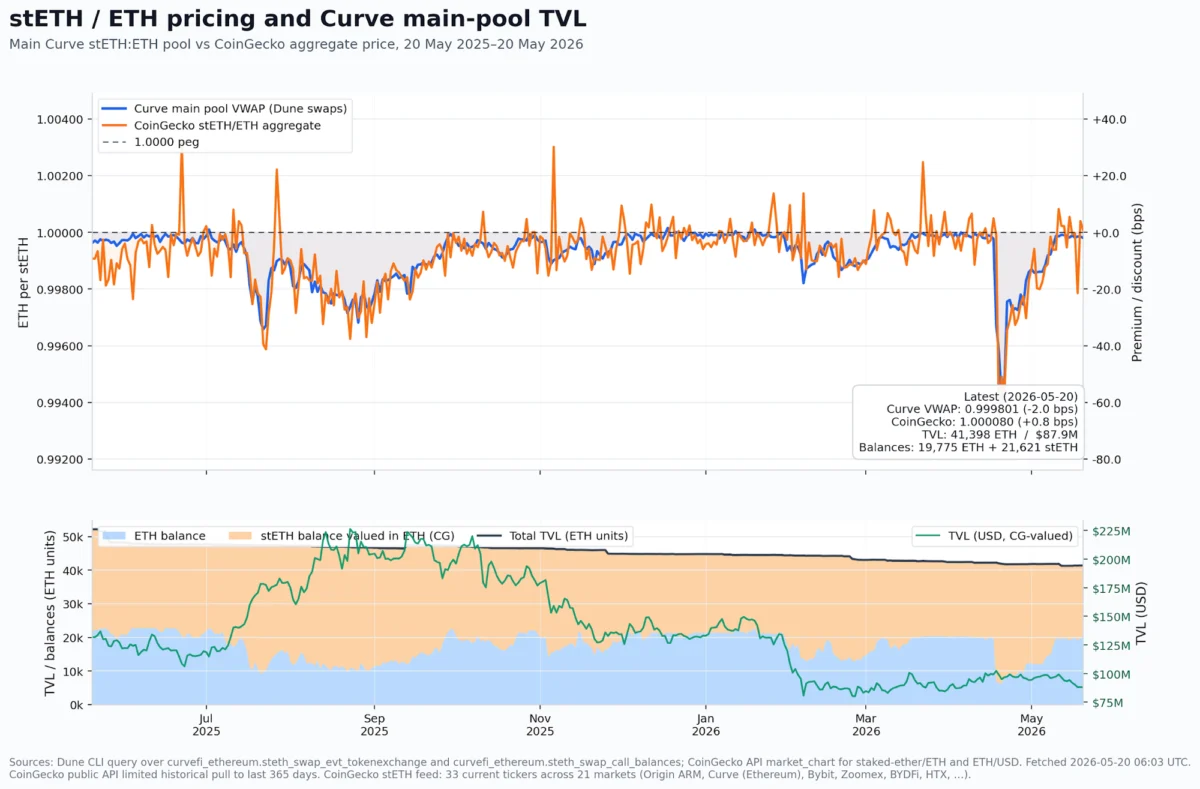
The decentralized finance (DeFi) ecosystem faced a significant stress test in April 2026 when a major external shock, the KelpDAO rsETH exploit, reverberated through restaking and ETH-denominated lending markets. While the incident posed substantial challenges for the affected protocol and its users, a detailed analysis of secondary-market stETH and wstETH pricing and liquidity reveals a remarkable display of resilience, underscoring the foundational strength of Ethereum’s largest liquid staking token. This examination focuses squarely on the market’s response to the crisis, demonstrating that despite the widespread disruption, stETH and its wrapped counterpart, wstETH, were not the compromised asset path, with market data affirming their robust functionality and stability under duress.
Understanding the Core of the Incident: The KelpDAO rsETH Exploit
On April 18, 2026, the DeFi world was alerted to a critical vulnerability that led to a substantial exploit targeting KelpDAO’s rsETH bridge path, which leveraged LayerZero technology. Public post-incident analyses quickly pinpointed the root cause: a cross-chain verification failure. This architectural flaw allowed approximately 116,500 rsETH, valued at roughly $292 million at the time, to be erroneously minted on the Ethereum mainnet without the corresponding burning of assets on the source chain. The immediate and most profound stress channels were therefore concentrated within restaking collateral and the associated lending-market exposures, rather than directly impacting Lido’s core staking infrastructure.
This distinction is not merely semantic; it is crucial for comprehending the subsequent market dynamics. stETH and wstETH, as direct representations of staked ETH managed by the Lido protocol, remained fundamentally unaffected by the KelpDAO incident. Lido’s internal protocol mechanics, designed for the secure operation and issuance of liquid staking tokens, functioned precisely as intended throughout the crisis. These core mechanics bore no responsibility for the market volatility that unfolded. In fact, during this period of heightened uncertainty, the Lido protocol successfully processed one of the largest net outflow events in its operational history, a testament to its underlying robustness and capacity to handle significant withdrawal requests without internal friction. While markets naturally repriced risk across the board, participants demonstrated a clear ability to differentiate between a failure stemming from a specific cross-chain restaking asset path and the intrinsic liquidity profile of stETH as a primary liquid staking token. Consequently, stETH pricing experienced a temporary dip, but swiftly recovered towards its normal parity levels with ETH, indicating a measured and rational market response rather than a widespread panic.
The Landscape of Liquid Staking and Restaking: A Brief Overview
To fully appreciate the implications of the KelpDAO incident, it is essential to understand the intricate landscape of liquid staking tokens (LSTs) and the burgeoning restaking ecosystem. Liquid staking protocols like Lido enable users to stake their Ethereum (ETH) and receive an equivalent LST, such as stETH. This token represents their staked ETH plus accumulated staking rewards, while simultaneously offering liquidity, allowing users to deploy their staked capital across various DeFi applications without forfeiting staking yield. stETH, by virtue of its widespread adoption and deep liquidity, has become a cornerstone asset within the Ethereum DeFi ecosystem, serving as a critical building block for numerous decentralized applications.
Restaking, a more recent innovation, builds upon the LST paradigm. Protocols like KelpDAO allow users to "restake" their LSTs (or even native ETH) to secure additional decentralized networks and protocols, known as Actively Validated Services (AVSs), in exchange for additional yield. rsETH, KelpDAO’s liquid restaking token, aimed to provide liquidity to restaked assets, much like stETH does for staked ETH. This layered approach, while offering enhanced capital efficiency and yield opportunities, inherently introduces new vectors of risk. Cross-chain bridges, facilitating the secure movement of assets between different blockchain environments, are particularly critical components in this architecture, as demonstrated by the KelpDAO exploit. The incident underscored the inherent complexities and potential vulnerabilities that arise from the interaction of multiple protocols, especially when cross-chain functionality is involved. The integrity of these bridges is paramount, as their failure can cascade through interconnected DeFi applications.
A Detailed Chronology of the Exploit and Market Response
The KelpDAO rsETH exploit unfolded rapidly, triggering a chain of events that tested the resilience of interconnected DeFi markets:
- April 18, 2026 (Early Hours): The exploit is initiated. Attackers leverage a critical vulnerability within KelpDAO’s LayerZero-based rsETH bridge, leading to the unauthorized minting of a significant amount of rsETH on Ethereum without a corresponding burn on the source chain. Initial alerts and anomaly detection systems begin to flag unusual activity across various monitoring dashboards.
- April 18, 2026 (Mid-day): Public confirmation of the exploit emerges. Security firms and whitehat hackers begin to analyze the attack vector. The scale of the exploit, involving approximately $292 million worth of rsETH, quickly becomes apparent, sending ripples of concern through the DeFi community. Social media channels and news outlets rapidly disseminate information, leading to heightened market anxiety.
- April 18-20, 2026 (Immediate Aftermath): Market participants react swiftly. The primary impact is felt across restaking collateral and lending markets heavily exposed to rsETH. Liquidations are triggered in some overleveraged positions, and overall market sentiment sours, leading to a flight to perceived safety. Although stETH was not directly compromised, its close association with the broader ETH-denominated DeFi ecosystem meant it experienced secondary market pressure as investors de-risked their positions.
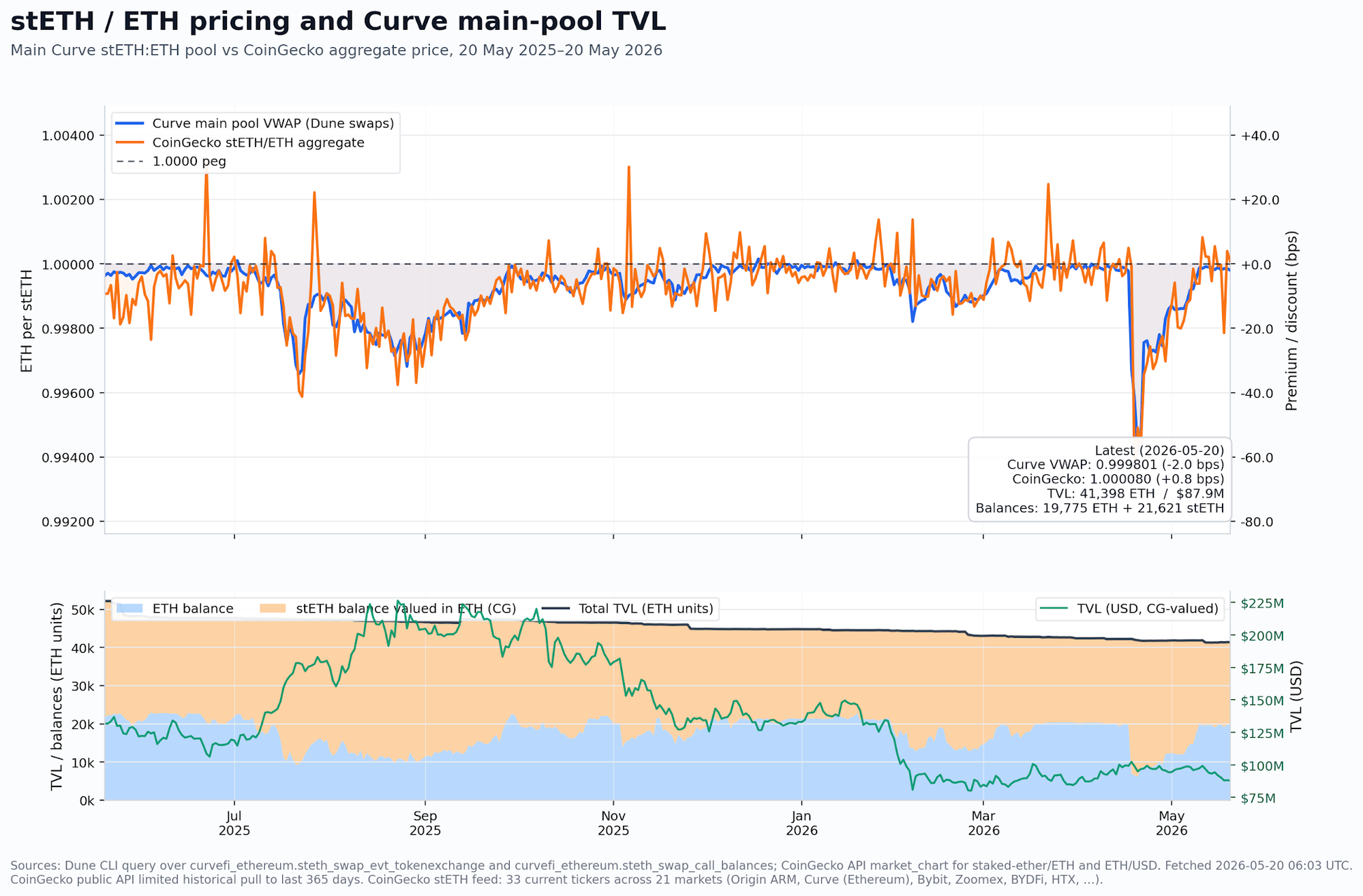
- April 18-28, 2026 (The Stress Window): This ten-day period marked the peak of market uncertainty and repricing for stETH. During this critical interval, the daily Volume Weighted Average Price (VWAP) for stETH in the Curve main-pool, a key liquidity venue, reached a low of approximately 0.9941 ETH per stETH. This represented a discount of about -59 basis points (bps) versus parity. Concurrently, CoinGecko’s aggregate stETH/ETH pricing, which synthesizes data from various exchanges, recorded a comparable low of approximately 0.9934 ETH, or a -66 bps discount. These figures illustrate a tangible, albeit contained, dip in stETH’s peg to ETH, reflecting market participants’ initial scramble to assess risk and adjust their exposure.
- Late April – Early May 2026 (Stabilization and Recovery): As the nature of the exploit became clearer – specifically, that it did not compromise Lido’s core protocol or stETH directly – market confidence began to rebound. Participants demonstrated an increasingly sophisticated understanding, distinguishing between the specific vulnerability of a restaking derivative and the underlying strength of the liquid staking token itself. Buying pressure gradually returned, pushing prices back towards stability.
- May 20, 2026 (Post-Stress Recovery): By this date, a significant recovery was evident. The Curve main-pool VWAP for stETH had largely returned to parity, registering approximately 0.99980 ETH. CoinGecko’s aggregate pricing further confirmed this recovery, moving to 1.00008 ETH, slightly above parity, indicating renewed market trust and robust demand. This swift rebound underscored the market’s capacity for self-correction and its underlying confidence in stETH.
Liquidity Depth: The True Measure of Resilience Under Stress
While headline prices offer a convenient snapshot of market sentiment, they can sometimes mask underlying execution quality. For sophisticated traders, institutional participants, and protocols executing large rebalancing operations, liquidity depth – the ability to execute substantial trades without incurring significant price impact – serves as a more accurate and crucial metric for assessing market health, particularly during times of stress. The KelpDAO incident provided an invaluable opportunity to evaluate stETH and wstETH liquidity depth under adverse conditions.
For a fixed-sell quote of $1 million in wstETH on the Ethereum mainnet, the market data offers compelling insights into how execution quality changed. In the 30 days preceding the exploit, the median daily quote impact – the percentage loss incurred when executing such a trade due to slippage – was a remarkably low -0.1 basis points. This indicates an extremely efficient market where large trades could be executed with minimal friction. During the ten-day stress window following the exploit, this median impact predictably increased to -5.0 basis points. Furthermore, the 7-day moving average of this quote impact reached a trough of -15.9 basis points.
This observed increase in execution cost, from near negligible to a more noticeable fraction of a percent, was indeed a real consequence of heightened market uncertainty and reduced liquidity provision. It reflects the temporary widening of bid-ask spreads and reduced depth at specific price points as market makers pulled back or adjusted their strategies. However, it is critical to emphasize what this data did not show: a complete disappearance of liquidity. For a major external exploit impacting a significant segment of restaking collateral and the broader lending market, the ability to execute a $1 million wstETH/ETH trade remained measurable, routable, and interpretable. This signifies that even under severe pressure, the market for stETH and wstETH remained functional and orderly, capable of absorbing substantial sell pressure without collapsing into illiquidity. This capacity is a direct reflection of the years of concentrated effort in building deep secondary markets, fostering transparent on-chain pricing mechanisms, and achieving wide ecosystem integration for stETH.
The Pillars of stETH’s Comparative Resilience
Several interconnected factors contributed significantly to stETH’s ability to weather the storm with comparative resilience:
- Protocol Immutability and Security: Lido’s core protocol, which underpins the issuance and management of stETH, was not directly compromised. Its smart contracts and operational mechanics continued to function as designed, processing staking rewards and facilitating withdrawals without interruption. This fundamental security assurance, proven through years of operation and numerous audits, was key to maintaining user trust.
- Clear Asset Distinction: The market demonstrated a sophisticated understanding, quickly distinguishing between the integrity of stETH as a direct representation of staked ETH and the specific risks associated with a derivative built on top of it (rsETH) through a cross-chain bridge. This ability to isolate and compartmentalize risk was crucial in preventing a broader contagion event.
- Deep and Diversified Liquidity: The vast network of decentralized exchanges, lending protocols, and other DeFi applications that integrate stETH provides unparalleled liquidity. This diversification across multiple venues ensures that no single point of failure or concentrated selling pressure can entirely cripple market access. The Curve main-pool, a primary liquidity hub for stETH/ETH, maintained substantial Total Value Locked (TVL) throughout the crisis, acting as a critical buffer for large trades.
- Transparent On-Chain Data: The transparent and immutable nature of blockchain transactions allowed market participants to quickly assess the situation, verify the scope of the exploit, and monitor liquidity levels in real-time. This immediate access to verifiable data facilitated informed decision-making and helped to prevent speculative panics based on incomplete or misleading information.
- Community and Developer Response: The rapid and coordinated response from security researchers, protocol developers, and the broader community in analyzing the exploit and communicating its specific impact helped to contain misinformation and guide rational market behavior. Clear and consistent communication from Lido also played a vital role in reassuring its user base.
Statements and Reactions from Key Stakeholders
In the wake of the KelpDAO incident, various entities issued statements or demonstrated actions reflecting the gravity of the situation and the efforts to manage its fallout:
- KelpDAO: Following the exploit, KelpDAO promptly initiated a thorough post-mortem analysis, acknowledging the cross-chain verification failure as the root cause. Their official communications focused on understanding the vulnerability, outlining remediation steps, and working towards mitigating losses for affected users. While the immediate focus was on containment and recovery, the incident underscored the imperative for enhanced security audits and more robust bridge designs within the restaking ecosystem, committing to a detailed plan for preventing future occurrences.
- Lido Finance: Lido’s official channels quickly moved to reassure its community and the broader market that the stETH protocol remained secure and operational. Statements emphasized that stETH itself was not compromised, and Lido’s internal mechanisms functioned flawlessly, even accommodating significant net outflows during the stress period. This proactive and transparent communication was vital in reinforcing trust in stETH’s fundamental stability and distinguishing it from the exploited derivative, effectively curbing unwarranted panic.
- LayerZero Labs: As the underlying cross-chain messaging protocol implicated in the bridge failure, LayerZero likely engaged in its own internal investigations and collaborated closely with KelpDAO to understand the specifics of the exploit. While direct public statements from LayerZero specifically about the KelpDAO incident might not be widely disseminated, such events typically prompt a rigorous review of bridge implementations and the issuance of updated security guidelines and best practices to prevent similar vulnerabilities in the future. The incident serves as a stark reminder for all bridge providers about the critical need for absolute security and auditable code.
- DeFi Analysts and Researchers: The incident became an immediate case study for DeFi security and