Nila Kartika Wati
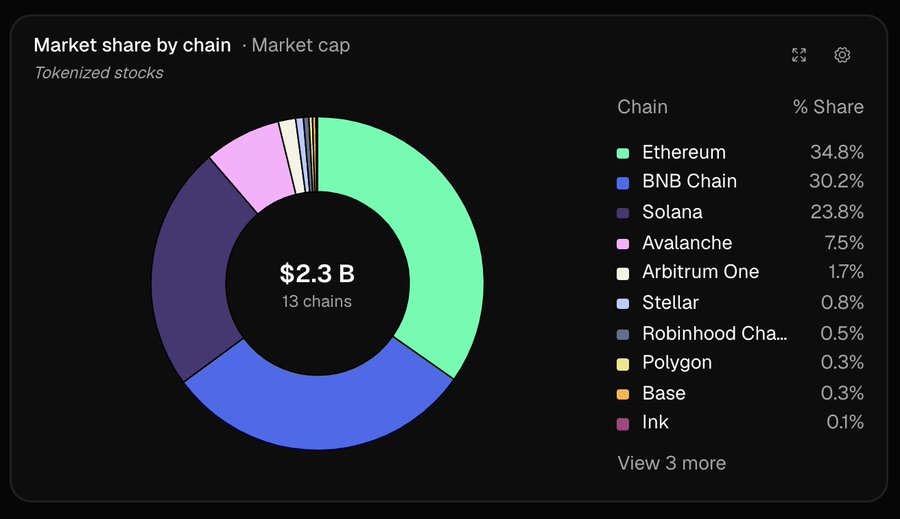
The global market capitalization of tokenized stocks reached an unprecedented $2.3 billion on Wednesday, marking a significant milestone as a growing number of investors seek exposure to equity products facilitated by blockchain technology. This surge underscores a deepening convergence between traditional financial instruments and the burgeoning decentralized finance (DeFi) ecosystem, offering novel avenues for investment and market participation. The record valuation, meticulously tracked by data aggregator Token Terminal, highlights a robust and accelerating trend within the digital asset space.
The burgeoning market for tokenized equities is predominantly distributed across several leading blockchain networks, reflecting the diverse technological infrastructure underpinning this innovation. The Ethereum network continues to command the largest market share, accounting for 34% of the total tokenized stock capitalization. Its established ecosystem, robust security, and extensive developer community make it a favored platform for issuing and trading these digital assets. Following closely, the BNB Chain secures a substantial 30% market share, benefiting from its lower transaction fees and faster processing speeds, which appeal to a broad user base. The Solana network, known for its high throughput and scalability, rounds out the top three with 23% of the market share, demonstrating its growing prominence in the tokenized asset landscape. These figures, disseminated by Token Terminal via a Wednesday X post, paint a clear picture of the competitive yet collaborative environment driving the expansion of on-chain equities.
A closer examination of the recent growth reveals significant contributions from key players within the cryptocurrency exchange and decentralized finance sectors. Kraken exchange’s xStocks emerged as a leading catalyst for this market expansion, contributing an impressive $507 million worth of tokenized stocks to the overall capitalization. This rapid uptake underscores Kraken’s successful strategy in integrating traditional financial products into its crypto-native platform. Similarly, Binance’s bStocks played a pivotal role, adding $334 million to the market. Binance, the world’s largest crypto exchange by trading volume, has aggressively pursued a multi-asset platform strategy, making traditional equities accessible to its vast global user base. Despite the emergence of these new powerhouses, Ondo Finance remains the largest tokenized stock issuer, holding a dominant position with $955 million in on-chain equities. Ondo Finance has strategically focused on providing institutional-grade tokenized products, particularly those backed by real-world assets, cementing its leadership in this specialized segment.
Understanding Tokenized Stocks: Bridging Traditional and Digital Finance
Tokenized stocks are digital representations of traditional shares issued on a blockchain. Each token typically represents a fractional share of a real-world equity, granting holders ownership rights or economic exposure to the underlying asset. This innovation fundamentally transforms how traditional investment products are accessed and traded, leveraging the inherent advantages of blockchain technology.
One of the primary appeals of tokenized stocks lies in their ability to offer fractional ownership. This means investors can purchase a portion of a high-priced stock, such as those of major tech companies, for a much smaller capital outlay than required for a full share. This significantly lowers the barrier to entry for retail investors globally, democratizing access to assets previously exclusive to wealthier individuals or institutional investors.

Furthermore, tokenized stocks enable around-the-clock trading. Unlike traditional stock markets, which operate within fixed hours and are closed on weekends and holidays, blockchain networks facilitate continuous trading. This 24/7 availability provides greater flexibility for investors across different time zones and allows for quicker reactions to market events, enhancing liquidity and efficiency. The immutable and transparent nature of blockchain records also offers a higher degree of auditability and reduces the potential for manipulation, fostering trust in the digital asset class. Moreover, by leveraging blockchain rails, these products can often bypass traditional intermediaries, potentially leading to lower transaction costs and faster settlement times, although regulatory frameworks are still evolving to fully realize these benefits.
Key Industry Players and Their Strategic Initiatives
The rapid expansion of the tokenized stock market is a testament to the strategic foresight and aggressive implementation by major crypto platforms aiming to bridge the gap between traditional finance and the blockchain ecosystem. Their initiatives are not merely about offering new products but about redefining accessibility and operational efficiency in global capital markets.
Binance, the world’s largest crypto exchange, has been a significant driver of this trend. As part of its ambitious strategy to evolve into a comprehensive multi-asset platform, Binance launched zero-commission trading for over 7,000 US tokenized stocks for eligible users. This move, which began on June 1st of a recent year (likely 2024, adjusting for original article’s future-dated typos), significantly broadened access to a vast array of traditional equities, making them available to a global audience that might otherwise face geographical or financial barriers. Binance’s approach emphasizes user-friendliness and cost-effectiveness, aligning with its goal of mainstream adoption for digital financial products.
Coinbase, another industry giant, has also made substantial inroads into the tokenized equities space. In December 2023 (adjusting for original article’s future-dated typos), Coinbase rolled out commission-free US stock and ETF trading with 24/5 availability. This initiative was presented as a core component of its vision for "the future of finance," signaling a commitment to integrating traditional investment vehicles within its secure and compliant digital asset ecosystem. Coinbase’s focus on a robust, regulated platform aims to attract a broader demographic of investors, including those new to crypto but familiar with traditional stock trading.
Kraken, a prominent crypto-native platform, has likewise positioned itself as a leader in this domain. In April 2024 (adjusting for original article’s future-dated typos), Kraken launched access to 11,000 US-listed stocks and ETFs through its xStocks offering. This made Kraken one of the first major crypto exchanges to provide such extensive access to tokenized equities. The market’s response was overwhelmingly positive, with the cumulative trading volume of xStocks exceeding $25 billion within approximately eight months of its launch. This remarkable volume underscores the substantial demand for tokenized traditional assets and validates Kraken’s pioneering strategy.
Beyond these major exchanges, other platforms are also innovating in the tokenized stock sector. In April 2024 (adjusting for original article’s future-dated typos), crypto exchange Bitget launched a unique proxy offering tied to the pre-initial public offering (IPO) phase of Elon Musk’s aerospace manufacturing and space transportation company, SpaceX. This initiative exemplifies the creative ways tokenization can unlock access to less liquid or exclusive investment opportunities, allowing a broader investor base to gain exposure to high-growth private companies.
Similarly, in January 2024 (adjusting for original article’s future-dated typos), Vienna-based crypto exchange Bitpanda shared ambitious plans to significantly expand its offering to include approximately 10,000 stocks and exchange-traded funds (ETFs). Bitpanda’s move signifies a broader European trend towards integrating tokenized securities, catering to a diverse investor base seeking diversified portfolios through digital platforms. These concerted efforts from various industry players are collectively driving the momentum and mainstream acceptance of tokenized stocks.
The Broader Landscape: Tokenized Real-World Assets (RWAs)
While tokenized stocks are experiencing rapid growth, they exist within the larger and equally dynamic market of tokenized Real-World Assets (RWAs). RWAs encompass a wide array of tangible and intangible assets that exist outside the blockchain but are represented on-chain by digital tokens. This category includes everything from real estate and commodities to government bonds and intellectual property.
The market for tokenized RWAs has witnessed an explosive surge, increasing by a staggering 589% from early 2023 to June 2024 (adjusting for original article’s future-dated typos), according to a comprehensive report from Binance Research. This exponential growth highlights a fundamental shift in how value is perceived and managed, as blockchain technology increasingly serves as a robust infrastructure for representing and transferring ownership of diverse assets. The report indicated that this surge was primarily led by tokenized government bonds and money market funds, which offer a blend of stability, yield, and institutional appeal within the volatile crypto landscape. These assets provide crypto investors with opportunities for diversification and a hedge against market fluctuations, drawing significant capital into the RWA sector.
Beyond traditional financial instruments, tokenized precious metals have also attracted considerable investor interest. During the same period, tokenized precious metals accumulated approximately $1.5 billion in value, marking a substantial 39% increase. Gold and silver, long considered safe-haven assets, gain enhanced liquidity and accessibility through tokenization, appealing to investors seeking a digital store of value that mirrors physical holdings.
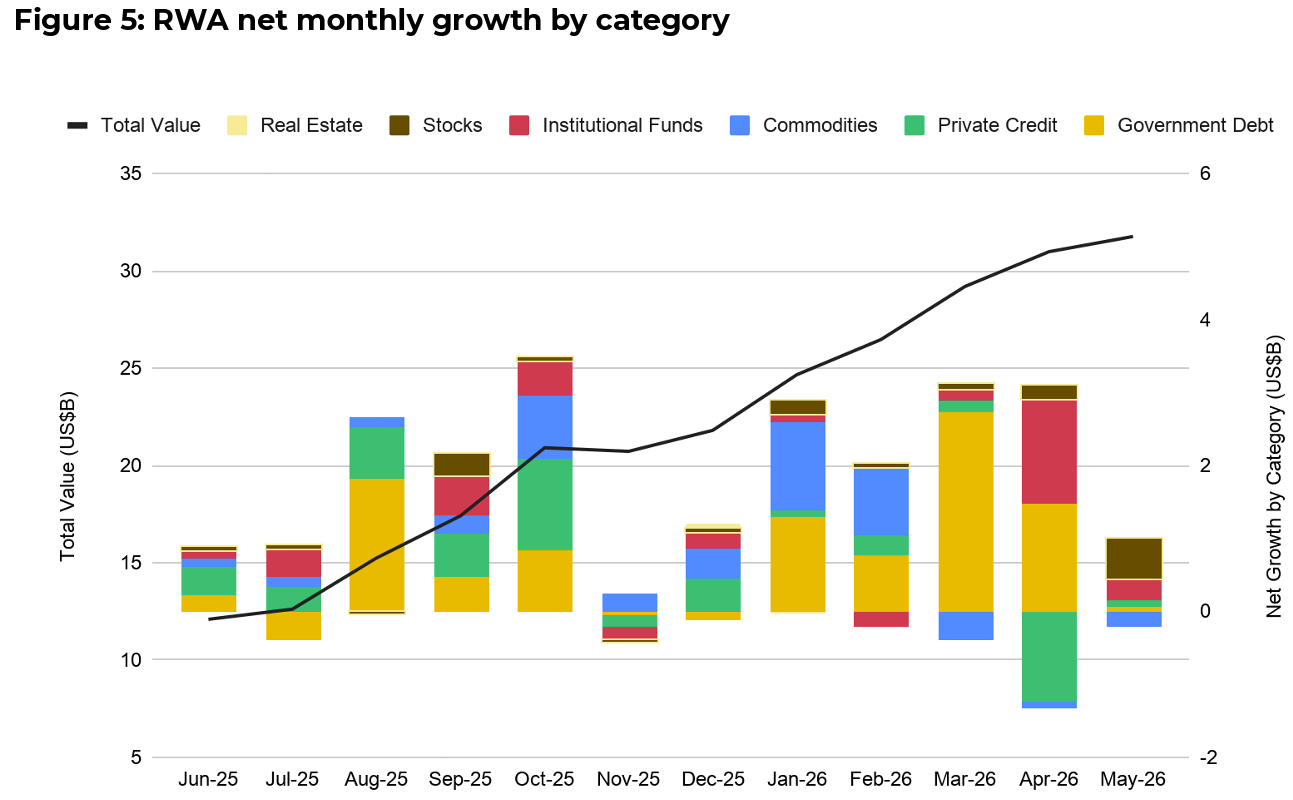
Despite the impressive growth of tokenized stocks, they currently represent a relatively small fraction of the broader tokenized RWA market. Accounting for only about 5.5% of the total $34 billion RWA market capitalization, stocks indicate significant room for further expansion and diversification within the sector. The market’s current composition is heavily skewed towards more stable, yield-bearing assets, particularly government-backed securities.
According to data provider RWA.xyz, about $15 billion in tokenized US Treasury debt constitutes the largest segment of the RWA market, representing a commanding 44% share. This dominance underscores the institutional appetite for low-risk, interest-bearing assets within the digital realm, providing a crucial bridge for traditional finance to engage with blockchain technology. Following this, tokenized commodities account for $4.5 billion, making up 13% of the market. This diversification showcases the versatility of tokenization, allowing for a wide range of asset classes to benefit from the efficiencies and accessibility of blockchain technology. The increasing variety of assets being tokenized points towards a maturing ecosystem where traditional and digital finance are increasingly intertwined.
Implications, Challenges, and the Future Outlook
The record-breaking growth in tokenized stocks and the broader RWA market carries profound implications for the future of global finance. This trend is not merely a niche development within the crypto space; it represents a fundamental shift towards a more interconnected, efficient, and accessible financial system.
Transformative Potential: The tokenization of traditional assets promises to democratize finance on an unprecedented scale. By lowering investment thresholds through fractional ownership and enabling 24/7 global trading, it opens up markets to a wider demographic of investors, particularly in regions with limited access to traditional financial markets. This could lead to increased liquidity for previously illiquid assets, more efficient price discovery, and potentially lower operational costs through the elimination of numerous intermediaries. For corporations, tokenization could offer novel ways to raise capital, bypassing complex and costly traditional fundraising processes.
Regulatory Landscape: A critical factor influencing the long-term success and widespread adoption of tokenized stocks and RWAs is the evolving regulatory environment. Regulators globally are grappling with how to classify, oversee, and protect investors in this new asset class. The current lack of a unified global regulatory framework presents challenges, including legal uncertainties, compliance complexities, and potential jurisdictional arbitrage. However, increased regulatory clarity, coupled with robust consumer protection measures, will be essential for attracting institutional capital and fostering mainstream confidence. Initiatives like the NYSE parent ICE pushing for a "level playing field" for 24/7 on-chain perpetuals indicate a growing recognition from traditional finance giants about the need to adapt to these new realities.
Technological Advancements and Security: While blockchain offers inherent security advantages, the large-scale tokenization of high-value assets necessitates continuous advancements in blockchain infrastructure, interoperability standards, and cybersecurity protocols. Ensuring the integrity of smart contracts, protecting against hacks, and maintaining the stability of the underlying networks are paramount. The development of robust decentralized identity solutions and compliant on-chain KYC/AML processes will also be crucial for institutional adoption.
Convergence of TradFi and DeFi: The surge in tokenized RWAs signifies a powerful convergence of Traditional Finance (TradFi) and Decentralized Finance (DeFi). This integration is driving innovation in both sectors, with TradFi leveraging blockchain for efficiency and DeFi gaining legitimacy and access to stable, yield-generating assets. This synergy is likely to lead to hybrid financial models that combine the best aspects of both worlds – the regulatory oversight and stability of traditional finance with the transparency, efficiency, and accessibility of blockchain.
Looking ahead, the trajectory for tokenized stocks and RWAs appears to be one of sustained growth. As blockchain technology matures, regulatory frameworks become clearer, and institutional comfort levels increase, the market is poised for further expansion and diversification. The potential to unlock trillions of dollars in value from illiquid assets, create more inclusive financial systems, and foster unprecedented levels of transparency and efficiency positions tokenization as a transformative force in the global economy. The current record for tokenized stocks is not just a numerical achievement; it is a strong indicator of an ongoing paradigm shift, pointing towards a future where virtually any asset can be digitally represented, traded, and managed on a blockchain.