Nila Kartika Wati
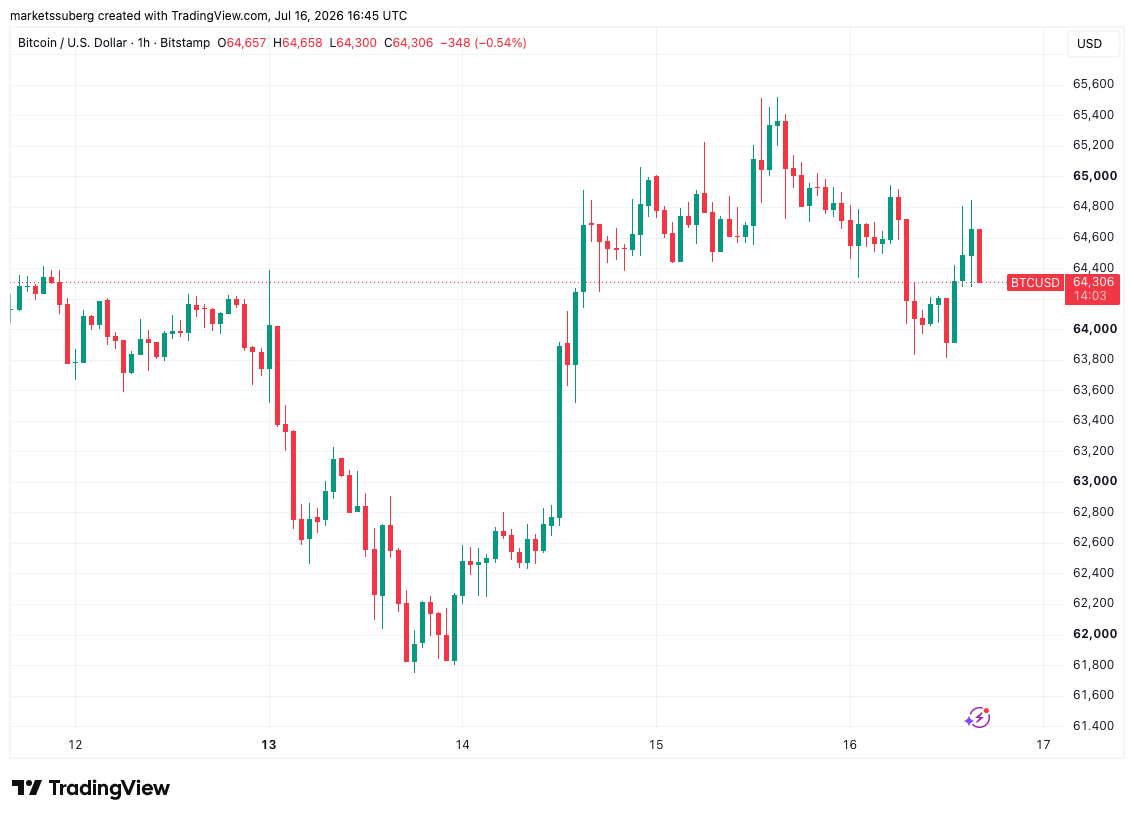
Bitcoin (BTC) experienced a notable cooling trend on Thursday, mirroring a broader sell-off in US technology stocks, even as recent data pointed to moderating inflation. This market correction put the brakes on a nascent rally, with profit-taking in the tech sector appearing to temper any sustained gains that might have otherwise materialized from positive economic indicators. The world’s largest cryptocurrency, BTC/USD, was observed circling the $64,500 mark, registering a 1.5% decline from its three-week highs achieved just the day prior. This downturn underscores the complex interplay of macroeconomic factors, investor sentiment, and sector-specific dynamics currently influencing both digital and traditional asset classes.
The Unraveling: Market Reaction to Inflation Data
The immediate backdrop to Thursday’s market movements was a series of encouraging inflation reports from the United States. For two consecutive days leading up to the market downturn, both the Consumer Price Index (CPI) and the Producer Price Index (PPI) for June came in lower than market expectations. The CPI, a crucial gauge of consumer inflation, demonstrated a significant deceleration, easing concerns that persistent price pressures might compel the Federal Reserve to maintain its restrictive monetary policy for an extended period. Similarly, the PPI, which measures wholesale inflation, also showed a decline, suggesting that cost pressures on businesses were alleviating, potentially leading to further moderation in consumer prices down the line.
Historically, lower-than-expected inflation data often acts as a catalyst for risk assets, including cryptocurrencies and equities. The rationale is straightforward: reduced inflation increases the likelihood of central banks adopting a more dovish stance, potentially leading to interest rate cuts or at least a halt in rate hikes. Lower interest rates generally decrease the cost of borrowing for companies, stimulate economic growth, and make higher-yielding assets, such as stocks and cryptocurrencies, more attractive compared to fixed-income investments. Indeed, following these positive inflation reports, both the crypto market and broader equity indices initially experienced gains, with Bitcoin briefly touching three-week highs, indicating an initial optimistic response from investors. This initial surge reflected market participants pricing in a potentially more accommodating monetary environment, a sentiment that briefly propelled Bitcoin past key resistance levels.
Tech Sector Turmoil: A Deeper Dive into the Sell-Off

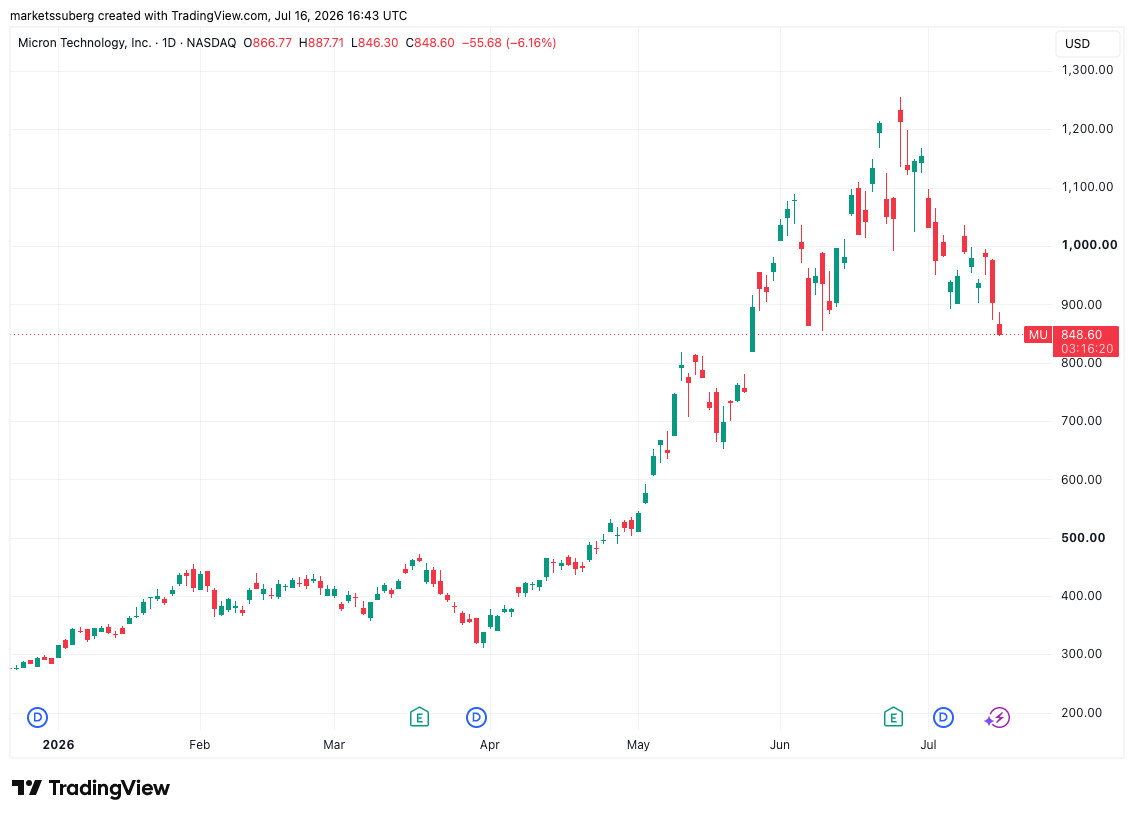
Despite the initial optimism spurred by inflation relief, the momentum quickly reversed, particularly within the technology sector. Thursday saw significant pressure on tech stocks, leading to a ripple effect across the broader market. A prominent example was Micron Technologies, a closely watched semiconductor giant, which saw its stock plummet by a staggering 15% in a single trading session. This sharp decline was particularly noteworthy given that Micron had already fallen over 30% from its record high on June 22nd.
The semiconductor industry is often considered a bellwether for the broader tech sector and, to some extent, the global economy, due to its foundational role in everything from consumer electronics to artificial intelligence. A substantial downturn in a major player like Micron can signal concerns about future demand, supply chain dynamics, or overvaluation within the sector. The trading resource The Kobeissi Letter highlighted this dramatic fall, commenting via X (formerly Twitter): "Micron is now down over -30% since its June 22nd record high." This observation underscored a growing narrative of correction within the tech space.
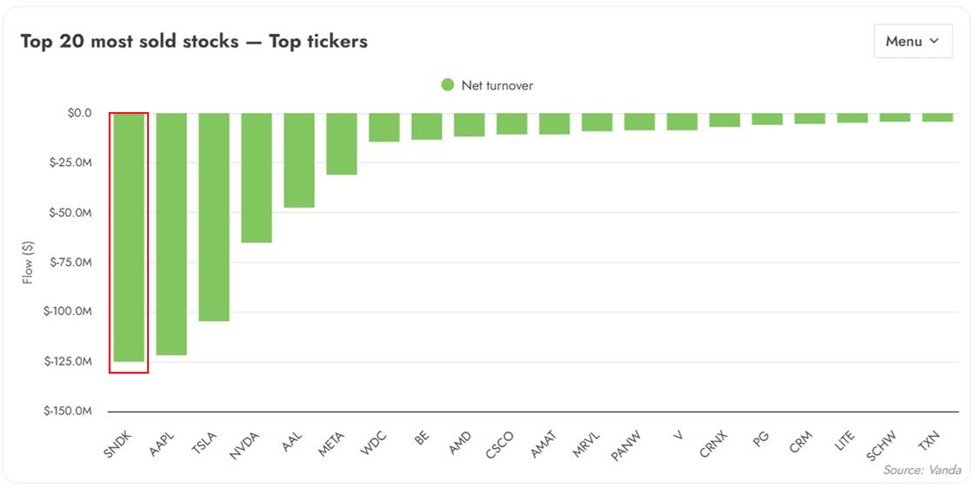
Beyond Micron, The Kobeissi Letter additionally pointed to a broader trend of profit-taking by retail tech-stock investors. Data revealed significant sales activity, with retail investors offloading approximately $200 million worth of shares in tech behemoths Tesla and Apple over the preceding two weeks. This surge in selling was part of a larger pattern, as the total retail turnover in single stocks climbed to an unprecedented $370 billion, a substantial increase from $220 billion at the beginning of 2026. "Retail investors are locking in gains following a historic tech rally," The Kobeissi Letter concluded, suggesting that after an extended period of robust growth in tech valuations, individual investors were opting to realize their profits, contributing to the downward pressure. This phenomenon is typical after prolonged bull runs, where investors, particularly those with shorter-term horizons, capitalize on elevated prices. The tech rally had indeed been historic, fueled by innovation, strong earnings, and a low-interest-rate environment that had made growth stocks particularly appealing. However, as inflation fears recede and the prospect of a plateau in interest rates becomes clearer, some investors may view current valuations as stretched, prompting a re-evaluation and subsequent selling.
Bitcoin’s Symbiotic Relationship with Risk Assets
The simultaneous decline of Bitcoin and tech stocks on Thursday is a stark reminder of the cryptocurrency’s increasingly intertwined relationship with traditional financial markets, particularly high-growth, risk-on assets. For many years, Bitcoin was often touted as "digital gold," a safe-haven asset uncorrelated with conventional markets. However, especially since the institutionalization of crypto and the influx of mainstream investment, its price movements have frequently mirrored those of tech-heavy indices like the Nasdaq Composite.
This correlation stems from several factors. Both tech stocks and cryptocurrencies are often considered growth assets, highly sensitive to changes in macroeconomic conditions such as interest rates, inflation expectations, and overall investor appetite for risk. When interest rates are low and liquidity is abundant, investors are more willing to allocate capital to speculative or high-growth ventures. Conversely, in an environment of rising rates or economic uncertainty, there’s a tendency for investors to rotate out of riskier assets into more conservative ones, leading to simultaneous sell-offs. The profit-taking observed in tech stocks on Thursday, therefore, directly impacted Bitcoin. As retail and institutional investors trimmed their exposure to tech, a portion of that capital may have also been pulled from cryptocurrencies, or the negative sentiment simply spilled over due to perceived similarities in risk profiles. This demonstrates that while Bitcoin possesses unique characteristics, its market behavior is, for now, heavily influenced by broader macro narratives and the ebb and flow of capital in the global financial system.
Technical Analysis: Decoding Bitcoin’s Price Action
Beyond the macroeconomic forces, market commentators delved into the technical aspects of Bitcoin’s price action, with a conservative mood prevailing among participants. The term "rejection" became a key word in the analysis, suggesting that Bitcoin’s recent upward movement was encountering significant resistance.
Prominent commentator Exitpump highlighted the importance of the anchored volume-weighted average price (AVWAP) measured from Bitcoin’s previous peak of $82,000 in early May. According to Exitpump, this AVWAP level served as a critical resistance point, signaling the potential end of the current rebound. "Price is finally going to retest the AVWAP from 82K top that lead to strong local downtrend. To me such retest should cap the upside and give stronger rejection," Exitpump informed X followers, suggesting that any attempt to push above this level would likely be met with strong selling pressure, leading to a downturn. This analytical approach, which ties price action to significant historical trading volumes, often provides insights into areas where large amounts of capital have changed hands, creating natural support or resistance.
Further reinforcing the "rejection" narrative, trader and analyst Rekt Capital observed that BTC/USD was "showing initial signs of rejection" from its 50-month exponential moving average (EMA) at approximately $65,900. The 50-month EMA is a long-term moving average often used by analysts to identify major trends and potential turning points. A rejection from such a significant long-term average indicates that the broader market trend might still be bearish or consolidating, despite shorter-term rallies. Rekt Capital has consistently drawn parallels between current price behavior and the 2022 bear market, having previously warned that the next macro bottom for Bitcoin would not materialize until later in the year. This comparison implies a longer, more drawn-out period of consolidation or further downside before a sustained bullish trend can emerge, reinforcing the cautious sentiment. The failure to decisively break above key resistance levels like the 50-month EMA or the AVWAP from a significant high suggests that the underlying buying pressure might not be strong enough to sustain a prolonged rally, indicating that sellers are still in control at these higher price points.
The Macroeconomic Backdrop: Inflation, Fed Policy, and Investor Sentiment
The recent cooling of US inflation, as evidenced by the lower-than-expected CPI and PPI figures for June, plays a pivotal role in shaping investor sentiment and market dynamics. The CPI measures the average change over time in the prices paid by urban consumers for a market basket of consumer goods and services, while the PPI measures the average change over time in the selling prices received by domestic producers for their output. Both are critical inputs for the Federal Reserve in determining monetary policy.
The Federal Reserve has been on a campaign of aggressive interest rate hikes to combat persistent inflation. Lower inflation data, therefore, typically raises expectations for a pivot in Fed policy, potentially leading to a pause in rate hikes or even future rate cuts. Such a shift makes borrowing cheaper, stimulates economic activity, and generally favors risk assets. However, the market’s reaction on Thursday suggests that while inflation relief is welcome, it’s not a sole determinant of market direction. Other factors, such as corporate earnings, sector-specific vulnerabilities, and investor positioning (like the aforementioned profit-taking), can override the immediate positive implications of macro data. The challenge for investors lies in deciphering whether the inflation slowdown is sufficient to warrant a significant dovish shift from the Fed, or if the central bank will maintain a cautious stance, potentially keeping rates higher for longer to ensure inflation is truly under control. This uncertainty creates volatility and contributes to a "wait-and-see" approach, especially from institutional capital.
Retail Investor Dynamics: Cashing In on Gains
The data presented by The Kobeissi Letter regarding retail investor activity offers a crucial insight into the current market psychology. The substantial increase in total retail turnover in single stocks, rising from $220 billion at the start of 2026 to a record $370 billion, coupled with significant sales in high-profile tech stocks like Tesla and Apple, paints a clear picture: retail investors are actively de-risking after a period of considerable gains.
This behavior is a classic example of profit-taking, a strategy where investors sell assets after a significant price appreciation to lock in their returns. Following what was described as a "historic tech rally," many individual investors who had ridden the wave of growth stocks, particularly during the earlier phases of the bull market, are now choosing to exit positions. This could be driven by a combination of factors: concerns about potential market corrections, a desire to diversify portfolios, or simply reaching personal profit targets. The sheer volume of this retail selling, especially in key tech names, indicates that it’s not an isolated incident but a broad-based trend. The impact of such coordinated (even if unintentional) retail action can be substantial, especially in sectors where these investors constitute a significant portion of the trading volume. It adds downward pressure to prices and can contribute to market volatility, even in the face of otherwise positive macroeconomic news. For Bitcoin, which also attracts a significant retail investor base, similar dynamics of profit-taking after local highs, as reported by Cointelegraph, further underscore the prevailing cautious sentiment among individual investors.
Implications for the Cryptocurrency Market
The events of Thursday highlight several critical implications for the cryptocurrency market. Firstly, Bitcoin’s continued correlation with traditional risk assets, particularly tech stocks, remains a dominant theme. While some hope for Bitcoin to eventually decouple and act as an independent store of value, its current behavior suggests it is still largely influenced by the broader macro-economic environment and the ebb and flow of capital in risk-on assets. This means that future movements in the tech sector, interest rate expectations, and overall economic sentiment will likely continue to dictate Bitcoin’s short-to-medium-term trajectory.
Secondly, the "rejection" narrative from key technical levels suggests that the path of least resistance for Bitcoin might still be downwards or sideways in the near term. The failure to sustain gains above critical resistance points, coupled with expert warnings about a potential prolonged bear market similar to 2022, implies that investors should prepare for continued volatility and potentially further price discovery to the downside. The optimism generated by recent spot Bitcoin ETF approvals and institutional adoption is significant for the long-term, but it doesn’t insulate the asset from short-term macro headwinds or profit-taking cycles. Altcoins, which typically exhibit higher beta (greater volatility) relative to Bitcoin, are likely to feel the magnified effects of any significant downturn in BTC, potentially leading to more pronounced corrections across the broader crypto market.
Looking Ahead: Navigating Market Uncertainty
As markets move past Thursday’s correction, investors will be keenly observing several key factors to gauge future direction. The primary focus will remain on upcoming economic data, particularly further inflation reports, employment figures, and retail sales data, all of which will inform the Federal Reserve’s monetary policy decisions. Any hawkish surprises from the Fed, such as a stronger-than-expected commitment to higher rates for longer, could trigger renewed selling pressure across risk assets. Conversely, continued evidence of disinflation and a dovish shift from the Fed could rekindle investor appetite for growth and speculative assets.
Corporate earnings reports, especially from the tech sector, will also be crucial. Strong earnings could help stabilize stock prices and restore investor confidence, potentially benefiting correlated assets like Bitcoin. However, any signs of weakness could exacerbate the current sell-off. For the cryptocurrency market specifically, monitoring on-chain metrics, institutional flows into spot ETFs, and significant technical levels will be paramount. The debate about Bitcoin’s long-term trajectory – whether it will fully mature into a less volatile, uncorrelated asset or continue its dance with tech stocks – will persist, shaping investment strategies. Risk management, including diversification and cautious position sizing, will be critical for investors navigating this period of heightened uncertainty and complex inter-market dynamics.
In conclusion, Thursday’s market action served as a potent reminder that even positive economic news can be overshadowed by other market forces, such as profit-taking and technical resistance. The cooling of Bitcoin alongside a significant tech stock sell-off, despite lower-than-expected inflation, underscores the intricate web of factors influencing modern financial markets. Investors are advised to remain vigilant, balancing macroeconomic analysis with technical indicators and understanding the nuanced behavior of both retail and institutional participants. The path forward for Bitcoin and the broader market will likely be characterized by continued scrutiny of inflation, Federal Reserve policy, and the ongoing re-evaluation of valuations in a post-rally environment.