James Watt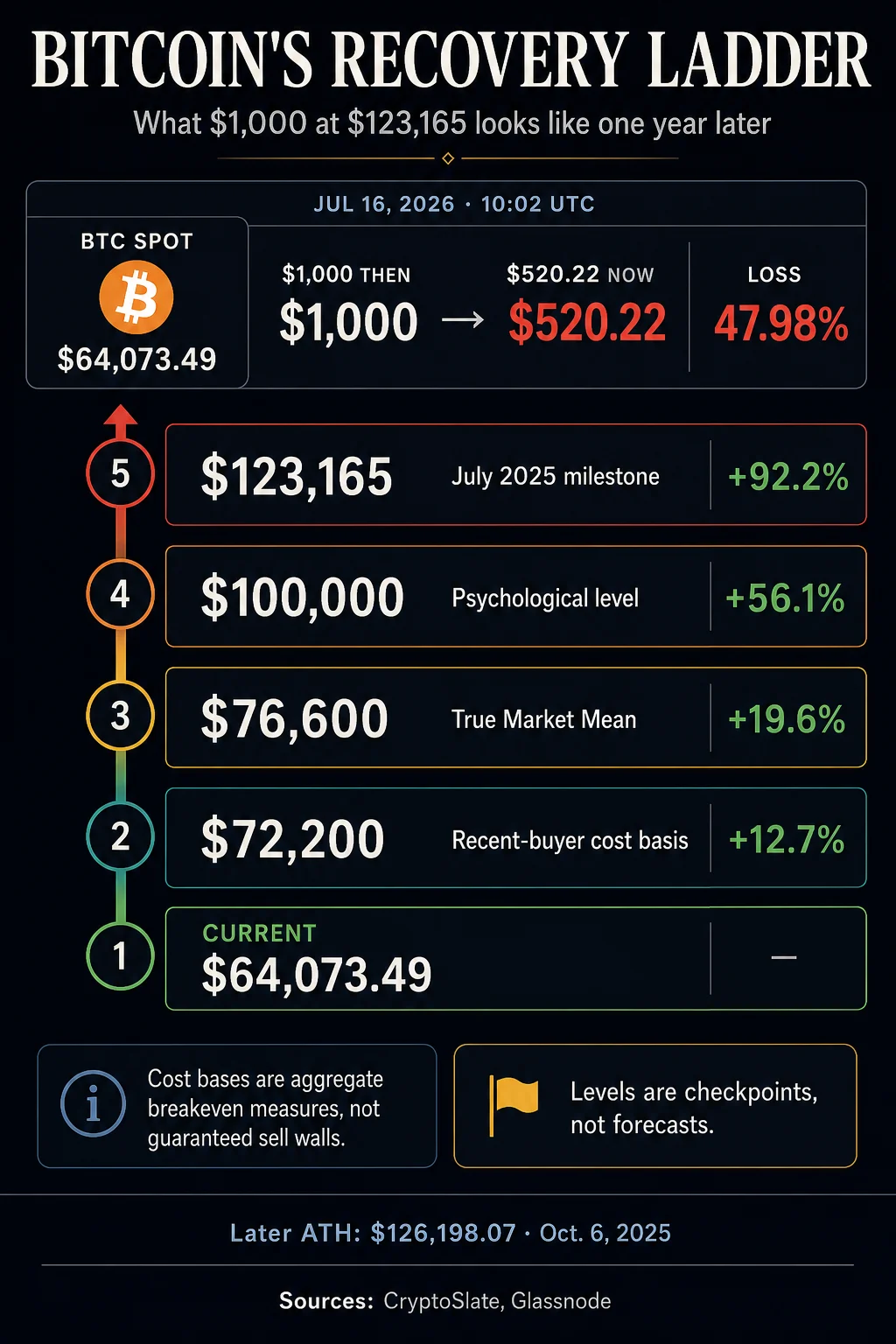
The current state of the Bitcoin market as of mid-July 2026 presents a stark contrast to the euphoric heights witnessed exactly one year ago. For investors who entered the market during the historic surge of July 2025, the anniversary of Bitcoin’s first move above the $120,000 threshold serves as a sobering reminder of market volatility. At the current trading price of approximately $64,073, an initial investment of $1,000 made at the $120,000 milestone has depreciated to a value of just $520. This represents a realized loss of 47.98%, necessitating a massive 92.2% price appreciation simply to return these investors to a break-even point before accounting for exchange fees and inflation.
As the digital asset struggles to regain its footing, market analysts are closely monitoring several on-chain "cost bases"—price levels where specific cohorts of investors purchased their holdings. These levels often act as significant psychological and technical hurdles, as investors who have been "underwater" for months may seek to liquidate their positions the moment they return to profitability. Before Bitcoin can even contemplate a return to its all-time high of $126,198, achieved in October 2025, it must first navigate a series of intermediate resistance zones that begin just above the $72,000 mark.
A Retrospective on the 2025 Bull Cycle and Subsequent Correction
To understand the current predicament of the "anniversary buyer," one must look at the trajectory of the market over the preceding 24 months. The bull run of 2025 was fueled by a confluence of factors, including the delayed impact of the 2024 halving event, the massive success of spot Bitcoin Exchange-Traded Funds (ETFs) in the United States, and a broader shift in global monetary policy toward easing.
In July 2025, Bitcoin broke through the $100,000 psychological barrier for the first time, quickly accelerating to a then-record $123,165. The momentum continued through the third quarter, culminating in a definitive all-time high of $126,198 on October 6, 2025. During this period, retail participation reached levels not seen since the 2021 cycle, with a significant amount of capital entering the market at prices exceeding $110,000.
However, the late-2025 peak was followed by a protracted cooling period. Institutional profit-taking, combined with shifting macroeconomic indicators and a tightening of regulatory scrutiny in several key jurisdictions, led to a gradual but persistent decline. By the first quarter of 2026, Bitcoin had retreated below $90,000, and by the second quarter, it had settled into the $60,000 to $70,000 range where it currently resides. This nine-month downturn has left a substantial portion of the circulating supply held at a loss, creating a "heavy" market characterized by overhead supply.

The Recovery Ladder: Key Technical and On-Chain Milestones
For Bitcoin to initiate a sustainable recovery, it must clear a "ladder" of technical benchmarks. According to recent research from Glassnode, the path to $120,000 is obstructed by several aggregate cost bases that represent the average entry price for different investor groups.
The Short-Term Holder Cost Basis ($72,200)
The first major hurdle is the Short-Term Holder Cost Basis (STH-CB), currently situated near $72,200. This metric tracks the average purchase price of coins that have moved on-chain within the last 155 days. Historically, the STH-CB acts as a "line in the sand" for market sentiment. When the price is below this level, recent buyers are in a state of unrealized loss, often leading to cautious behavior or panic selling. Reclaiming $72,200 would require a 12.7% gain from current levels and would signal that recent demand is beginning to absorb the selling pressure from distressed holders.
The True Market Mean ($76,600)
Slightly higher, at $76,600, lies the True Market Mean. This is a more comprehensive measure of the cost basis for active investors across the market. Bitcoin has traded below this level for approximately five months, indicating a prolonged period of bearish dominance. Reaching this level would represent a 19.6% increase and would be a significant indicator that the broader active market is returning to a state of equilibrium.
The $100,000 Psychological Threshold
Beyond the technical cost bases lies the $100,000 mark. While not tied to a specific on-chain cost basis, $100,000 serves as a primary psychological barrier for both retail and institutional participants. A move to this level would require a 56.1% gain. Analysts suggest that while crossing $100,000 would significantly improve market sentiment, it would still leave the July 2025 buyers deep in the red.
Analysis of Current Market Sentiment and Demand
Despite the potential for recovery, current data suggests that the market lacks the "conviction" necessary for a rapid breakout. Glassnode’s mid-July updates indicate that while the most intense phase of long-term holder capitulation may be cooling, on-chain activity remains subdued. Spot market participation—the actual buying and selling of Bitcoin rather than derivative speculation—is currently at a multi-month low.
Market observers note that the "bottom" of the current cycle is still a work in progress. In June 2026, Bitcoin tested local lows, which were absorbed by buyers, but the lack of follow-through momentum suggests a period of consolidation may be required before the $72,200 level can be challenged. The primary concern for analysts is the "disposition effect," a behavioral finance theory where investors tend to sell assets that have increased in value back to their entry point to "get out even," while holding onto losing assets for too long. This suggests that as Bitcoin approaches $72,000 and $76,000, a wave of sell orders from investors looking to exit their positions could create a ceiling of resistance.

Risk Assessment: The $53,000 Realized Price Floor
While the focus remains on the upward climb, the downside risk cannot be ignored. Glassnode’s July 8 report highlighted a "lower bear-market band" near the $53,000 Realized Price. The Realized Price is the average price at which all Bitcoins in circulation were last moved on-chain. In previous cycles, this level has served as a ultimate floor during bear markets.
If Bitcoin fails to generate sufficient demand to clear the $72,200 STH-CB, a retest of the $53,000 level remains a statistical possibility. This "residual risk" is what keeps many institutional investors on the sidelines. The current market environment is described as a "tug-of-war" between long-term believers who are accumulating at $60,000 and the "anniversary buyers" who represent potential future selling pressure.
Broader Implications for the Crypto Ecosystem
The struggle for Bitcoin to reclaim its 2025 highs has broader implications for the entire digital asset ecosystem. Bitcoin dominance currently sits at 58.44%, meaning its price action dictates the health of the broader market. A stagnant Bitcoin price often leads to a "bleed" in altcoins, as liquidity dries up and investors move toward the perceived safety of the market leader or stablecoins.
Furthermore, the 48% loss faced by those who bought at $120,000 has impacted the narrative of Bitcoin as a "stable" institutional asset. While long-term holders (those holding for 1-3 years) remain largely in profit, the cohort of investors who entered during the 2025 peak represents a significant demographic of "disillusioned" capital. The speed and conviction with which Bitcoin approaches the $72,200 and $76,600 levels will be a litmus test for whether the market can attract new capital or if it will remain trapped in a cycle of "exit liquidity" events.
Conclusion: The Path Forward
The "anniversary buyer" of July 2025 remains far from whole. The recovery of a 92.2% loss is a monumental task that requires more than just technical rebounds; it requires a fundamental shift in market participation and macroeconomic tailwinds.
The immediate future of Bitcoin depends on its ability to recapture the two lower cost bases—$72,200 and $76,600—through broader participation. Until these checkpoints are reclaimed and held, the market remains in a state of tentative recovery. The coming months will determine whether the "bottom" established in June will hold or if the market must test the $53,000 realized price before a true bull cycle can resume. For now, the $120,000 buyers are left waiting, watching as the market attempts to navigate the first "escape routes" of a long climb back to the top.