
 admin
admin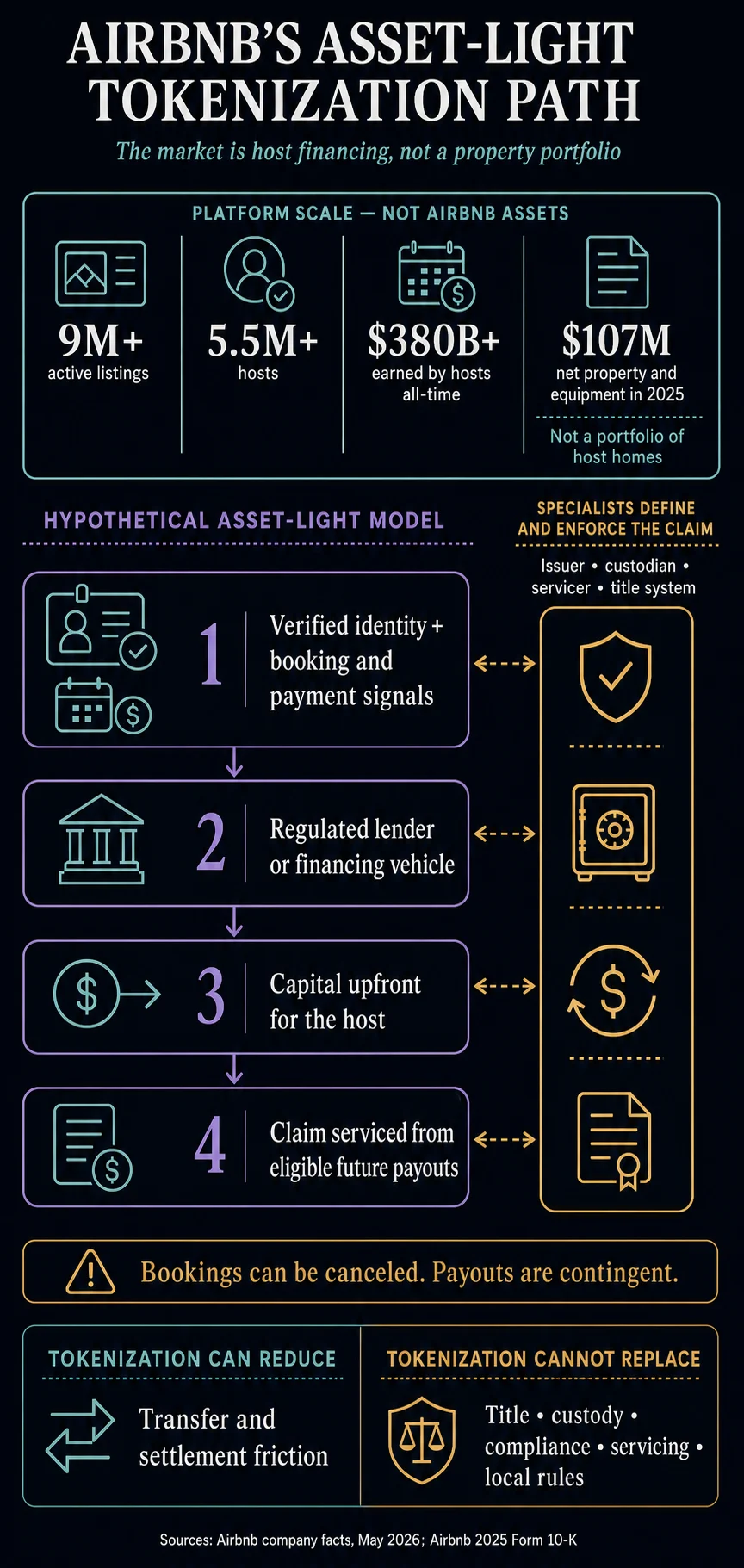
San Francisco, CA – July 17, 2026 – A series of enigmatic posts on X, formerly Twitter, attributed to Airbnb CEO Brian Chesky earlier this week, which explored the potential of real-world asset tokenization, have since been disavowed by the company’s chief executive. Chesky clarified on his X account that his account had been compromised during the incident, humorously noting that the unauthorized foray into cryptocurrency had inadvertently attracted new followers whom he anticipated would be disappointed. The original thread, which has since been deleted, presented a broad argument for tokenization without referencing any specific token, wallet, or sale, leaving the motive behind the apparent hack and the exact nature of the attacker’s intent unclear.
This incident, while perplexing, has prompted a deeper examination of how a company of Airbnb’s scale and market influence might strategically integrate tokenization to augment its existing business model. The analysis presented here delves into the hypothetical applications and implications of such a strategy, irrespective of the compromised nature of the initial communication.
Chesky’s Tokenization Thesis and Airbnb’s Market Position
Prior to the revelation of the hack, Airbnb’s co-founder and CEO Brian Chesky had articulated a compelling vision for real-world asset tokenization via a now-deleted thread on X. His central thesis posited that the true value of tokenization lies in its capacity to dismantle ownership friction and foster trust in the custodianship of underlying assets. This perspective, when applied to Airbnb’s unique marketplace, reveals a counterintuitive yet potentially lucrative avenue for business development.
Chesky’s theoretical framework suggests that Airbnb could leverage its extensive marketplace reach, established brand identity, and robust data on booking and payment patterns to facilitate regulated financing solutions for its hosts. Crucially, this approach would ensure that such financing remains "asset-light" for Airbnb, with separate entities – including lenders, issuers, special-purpose vehicles (SPVs), custodians, and title administrators – defining the legal claims and maintaining ownership of the properties, thus keeping them off Airbnb’s balance sheet.
During the thread, Chesky highlighted potential benefits such as fractional access to assets, accelerated settlement times, and continuous market operation. He further drew parallels between the challenge of tokenization and Airbnb’s core competency: building trust between strangers sharing private homes. This emphasis on trust, underscored by his later statement, "Trust is everything," resonated with the platform’s foundational principles.
These pronouncements followed Chesky’s sharing of a video featuring Robinhood CEO Vlad Tenev. Tenev’s arguments centered on the transformative potential of tokenized productive assets, including stocks, futures, and private company stakes, in driving the growth of the cryptocurrency sector as financial markets increasingly migrate on-chain.
The sheer scale of Airbnb’s operations underscores the potential impact of any such tokenization initiative. As of May 2026, the company reported a staggering network of over 9 million active listings, supported by more than 5.5 million hosts. Since its inception, hosts on the platform have collectively earned over $380 billion, painting a picture of a global economic ecosystem deeply intertwined with Airbnb’s infrastructure.
Airbnb’s 2025 annual filing further clarifies its operational model. The company acts as an agent in recording rental revenue, a designation that signifies its lack of control over host properties, its non-fulfillment of hosts’ rental promises, its absence of inventory risk, and its inability to set host pricing. Consequently, Airbnb’s revenue primarily derives from service fees charged for facilitating these transactions.
As of December 31, 2025, Airbnb reported $107 million in net property and equipment on its balance sheet. However, this figure does not represent the vacation homes listed on its platform. Instead, the company’s gross property and equipment are predominantly comprised of software and leasehold improvements. A remaining $49 million category encompasses a diverse mix of assets, including buildings and land, computer equipment, construction in progress, and office furniture, further illustrating its asset-light operational stance. The platform’s terms of service explicitly state that Airbnb and its affiliates do not own, control, offer, or manage the listings available on its platform, reinforcing its role as an intermediary.
Host Payout Financing: The Clearest Asset-Light Path
The most apparent and strategically aligned avenue for Airbnb to explore tokenization, while preserving its asset-light model, lies in host payout financing. The company has already demonstrated its capacity to facilitate financial solutions for hosts without assuming the role of a lender or property owner. In 2018, Airbnb enabled participating hosts to present Airbnb-generated proof of income to specialized mortgage lenders, thereby streamlining access to capital.
A future tokenization strategy could build upon this established precedent. Hypothetically, a host could receive immediate capital in exchange for tokenized claims on their anticipated future Airbnb payouts. These tokens would precisely define payment rights and distribution terms, creating a transparent and verifiable financial instrument.
Alternatively, a dedicated financing vehicle could raise capital from investors and subsequently disburse funds to hosts. This vehicle would then issue tokens representing investors’ claims against the vehicle itself, rather than directly against Airbnb or the underlying properties. In such a scenario, Airbnb might, with appropriate agreements and host consent, provide verification signals for host activity, assist in product distribution, or route eligible payments. The lender or investor would hold legally enforceable rights granted by on-chain financing contracts against the host or the financing vehicle, not an automatic claim on Airbnb or the physical property.

However, the complexities of the short-term rental market introduce significant variables. A booking might be canceled or modified before a stay becomes eligible for payout, leading to a reduction or complete loss of expected revenue. Consequently, any financing contract would need to incorporate robust provisions addressing eligibility criteria, refund policies, chargeback procedures, occupancy fluctuations, payment control mechanisms, servicing protocols, data privacy, loss allocation frameworks, and mechanisms for addressing shortfalls.
The legal classification of such financing structures would vary significantly depending on their design. The Consumer Financial Protection Bureau (CFPB), for instance, categorizes certain sales-based financing tied to anticipated revenue as business credit. Other structures, depending on their specific terms and conditions, could trigger securities regulations or other applicable laws. It is important to note that a blockchain record alone does not definitively resolve these legal classifications.
Airbnb’s strategic options diverge significantly once the nature of legal claims and balance-sheet exposure are clearly delineated:
| Structure | Investor or Lender Claim | Possible Airbnb Role | Fit with Current Model | Main Friction |
|---|---|---|---|---|
| Contingent Host-Payout Financing | A contractual claim against a host or financing vehicle, potentially serviced from payouts. | Hypothetical data, verification, distribution, or payment-routing support. | Strongest Analytical Fit | Cancellations, eligibility, privacy, servicing, and loss allocation. |
| SPV-Based Property Equity | An interest in a vehicle that owns or evidences the property interest. | Host data and distribution support. | Moderate | Title, liens, custody, securities compliance, governance, maintenance, vacancy. |
| Platform Fee or Minority Participation | Rights defined by the issuer or property vehicle, not by Airbnb’s listing network. | Airbnb could earn a fee or separately hold a minority stake. | Fee-only is lighter. | Valuation, conflicts, capital exposure, and governance. |
| Airbnb Buys Homes and Sells Interests | The security or SPV interest granted by documents tied to company-controlled property. | Owner, operator, and issuer or sponsor. | Least Consistent | Capital, vacancy, maintenance, governance, and housing-policy risk. |
| Reservation, Membership, or Loyalty Token | Only the access or benefits defined by its operative terms. | Product and distribution platform. | Potentially Compatible | The label alone determines neither ownership, yield, nor legal status. |
It is crucial to reiterate that none of these structures represent an officially announced product by Airbnb. The first structure, contingent host-payout financing, offers the most robust alignment with Airbnb’s current role as a marketplace facilitator. While SPV-based property equity could remain asset-light for Airbnb if a separate entity held title, it would necessitate considerably more off-chain operational involvement. A loyalty product, on the other hand, could prove beneficial without necessarily creating an investable claim.
The Limitations of Tokenization: Legal Rights Prevail
The existing landscape of tokenized stocks provides a salient example of how the legal framework surrounding an asset, rather than the token itself, dictates the holder’s rights. Robinhood’s Chain, designed for tokenized real-world assets, facilitates the trading of its new Stock Tokens. However, these tokens are structured as debt securities issued by Robinhood Assets in Jersey. Consequently, holders possess contractual rights derived from this debt instrument but lack any direct legal or beneficial ownership or shareholder rights in the underlying companies.
A statement issued by the SEC staff in January 2026 regarding tokenized securities elaborated on issuer-sponsored and third-party models, including custodial and synthetic structures. This non-binding statement specifically applies to instruments classified as securities, emphasizing that digitizing a security on-chain does not exempt it from federal securities law requirements. The fundamental structure of the instrument remains the determining factor of what a holder legally owns or is owed.
In the context of property equity, a token, by itself, cannot establish clean title, discharge a lien, or define investor governance. The off-chain entity responsible for holding or evidencing the property interest would still be required to manage crucial aspects such as maintenance, vacancy, and adherence to local regulations.
These responsibilities highlight why Airbnb purchasing properties and subsequently selling interests represents the most significant departure from its established agent model. Such a strategy would introduce inventory, capital, and operational risks that Airbnb currently largely delegates to its hosts, alongside potential conflicts of interest between investors and the supply side of its marketplace.
With contingent payout financing, the primary challenge resides in the contractual agreements. Airbnb could maintain its position outside the direct ownership chain by ensuring clear eligibility rules, obtaining necessary consent, implementing robust payment controls, and establishing enforceable claims that align the interests of hosts, investors, and service providers. Its established trust mechanisms and operational data could serve as a foundation for such a structure, with specialized firms managing and enforcing the claims.
Crypto exchanges are increasingly evolving into distribution channels for traditional asset exposure. Airbnb’s potential competitive advantage, however, would lie in its verified history of host activity and its direct payment relationship with individuals seeking capital.
The most concrete indicator of a developing tokenization strategy within Airbnb would be the formation of a regulated partnership that utilizes verified booking history to finance contingent host payouts, with specialized entities assuming the responsibilities of ownership, servicing, and claim enforcement.
An "Airbnb coin" or the tokenization of individual listings would represent a far more radical departure for the company. Conversely, a financing partnership offers a more pragmatic approach to testing the viability of Chesky’s ownership concept without fundamentally disrupting Airbnb’s core marketplace model. The incident, though initially misleading, has inadvertently illuminated potential pathways for innovation within the decentralized finance and accommodation sectors.








