Layla Zulfa
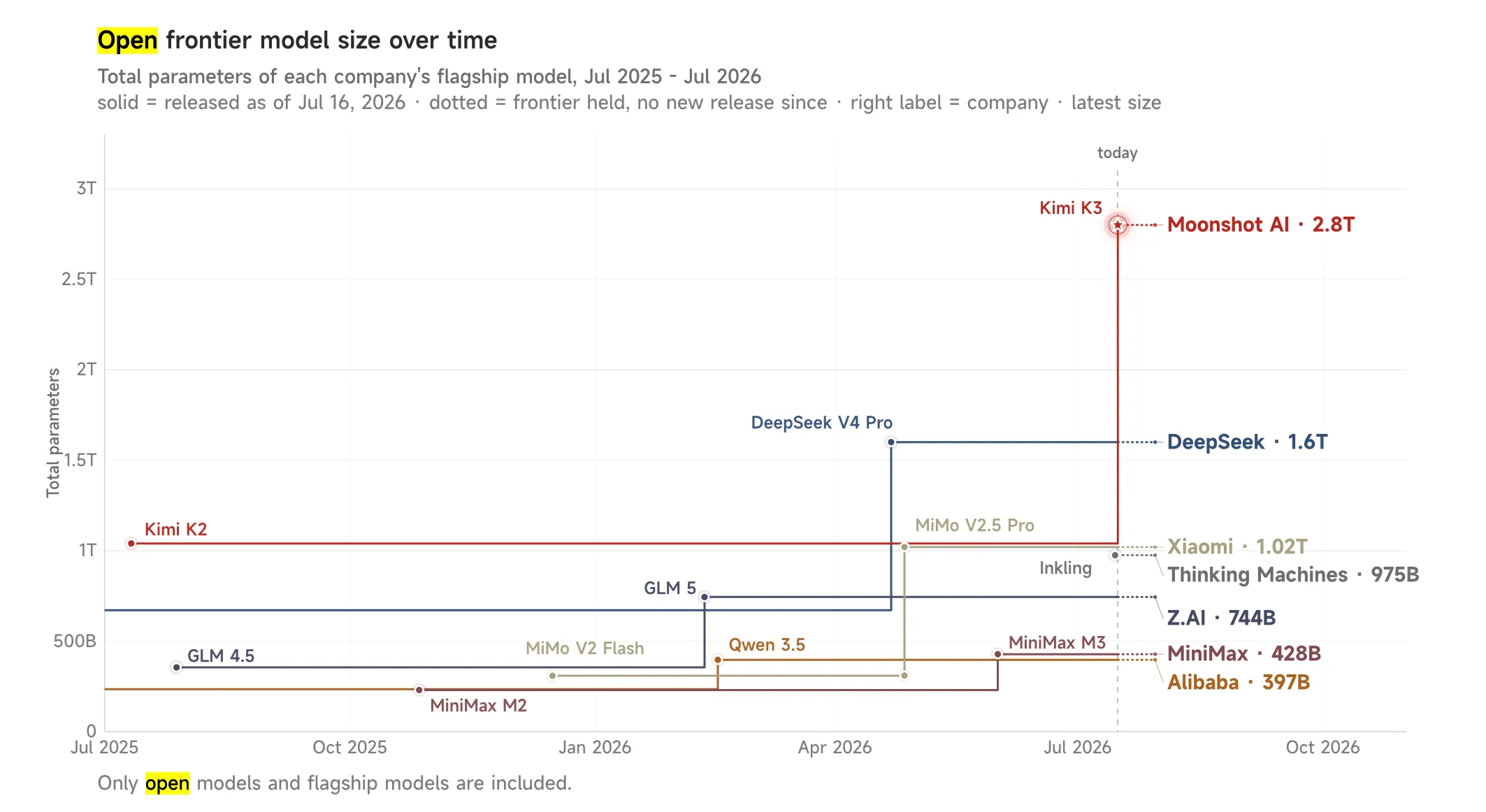
The global artificial intelligence landscape shifted significantly this week as Moonshot AI, a prominent Beijing-based startup, unveiled Kimi K3, the largest open-source model ever produced by a Chinese firm. This release marks a pivotal moment in the ongoing competition between Eastern and Western AI laboratories, as Kimi K3 has demonstrated the ability to outperform Anthropic’s flagship Claude Fable 5 in specialized creative and technical tasks. The model’s debut has sent ripples through the industry, not only for its sheer scale—boasting 2.8 trillion parameters—but also for its competitive pricing and its successful development despite stringent international hardware restrictions.
A New Leader in Creative and Technical Benchmarking
The primary catalyst for the industry-wide attention on Kimi K3 is its performance on Towards AI’s Writing Elo, a rigorous benchmark designed to evaluate a model’s ability to generate professional-grade scripts. In this blind-judged evaluation, which uses the same Elo rating system utilized to rank international chess players, Kimi K3 achieved a score of 2,840. This result effectively dethroned Anthropic’s Claude Fable 5, which reached a maximum of 2,760. Historically, Anthropic has dominated this particular metric, with its models widely regarded as the industry standard for editorial voice and narrative nuance.
The jump in performance is particularly noteworthy when compared to Moonshot AI’s previous iteration. Kimi K3’s predecessor, Kimi K2.6, was ranked 21st on the same leaderboard. The rapid ascent to the top spot represents a significant leap in qualitative output within a single generational cycle. Furthermore, the model has demonstrated exceptional prowess in software engineering. On the Arena AI Frontend Code Leaderboard—a ranking determined by thousands of pairwise human votes on coding tasks—Kimi K3 secured the first-place position with an Elo score of 1,679, surpassing Claude Fable 5’s 1,631. Kimi K3 claimed the top spot in six out of seven frontend development domains, including refactoring and debugging.
In broader comparative testing, the Artificial Analysis Intelligence Index—a composite score derived from nine independent evaluations covering reasoning, knowledge, and agentic capabilities—places Kimi K3 at a score of 57. While Claude Fable 5 still maintains a slight lead with a score of 60, and OpenAI’s GPT-5.6 Sol sits at 59, Kimi K3 has effectively bridged the gap between open-weight models and the most advanced proprietary systems.
Chronology of Development and the Rise of the AI Tigers
The emergence of Kimi K3 is the latest chapter in the rapid evolution of Moonshot AI, one of the so-called "AI Tigers" of China. This group of startups, which includes competitors like DeepSeek, has been characterized by their ability to achieve frontier-level performance while navigating a challenging geopolitical environment.
Moonshot AI first gained international recognition with its Kimi series, which focused heavily on long-context processing. By late 2025, the company had established Kimi K2 as a viable competitor in the 1-trillion-parameter class. However, the development of K3 represented a strategic pivot toward massive scaling and architectural efficiency.
The timeline of Kimi K3’s development was heavily influenced by the October 2023 expansion of U.S. export controls, which restricted the flow of high-end Nvidia GPUs, such as the H100 and H800, to Chinese entities. Despite these constraints, Moonshot AI moved forward with the training of K3 throughout the first half of 2026. The company utilized a combination of existing Nvidia hardware and domestic alternatives, reportedly including Huawei’s Ascend series of GPGPUs. This period of development culminated in the July 16, 2026, announcement, signaling that Chinese labs could still achieve "step-change" gains in model capability without unrestricted access to the latest Western silicon.

Technical Architecture: Scaling Through Expertise
At the core of Kimi K3’s capabilities is its 2.8-trillion-parameter Mixture-of-Experts (MoE) architecture. Unlike traditional dense models, where every parameter is activated for every prompt, an MoE architecture divides the model into numerous "expert" subnetworks. In K3’s case, the model utilizes 896 distinct experts, activating only a specific fraction of them for any given task. This approach allows the model to maintain a massive knowledge base (stored in its 2.8 trillion parameters) while keeping the computational cost of inference manageable.
Moonshot AI has introduced two critical architectural innovations to maximize the efficiency of this massive scale:
- Kimi Delta Attention: This mechanism is designed to accelerate the decoding process for long-sequence tasks. In environments involving million-token contexts, Delta Attention has demonstrated the ability to speed up processing by as much as 6.3 times compared to standard attention mechanisms.
- Attention Residuals: This technique allows the model to route information selectively across its various layers rather than accumulating it uniformly. According to Moonshot’s technical documentation, this adds approximately 25% to training efficiency while requiring less than 2% in additional compute overhead.
Together, these innovations provide Kimi K3 with a scaling efficiency roughly 2.5 times greater than that of Kimi K2. The model also features a standard one-million-token context window, allowing it to process entire libraries of code or lengthy legal documents in a single prompt.
Economic Implications and Market Positioning
Perhaps the most disruptive aspect of Kimi K3 is its pricing structure. Moonshot AI has positioned the model at a rate of $3 per million input tokens and $15 per million output tokens. This pricing matches the cost of Anthropic’s Claude Sonnet 5, which is marketed as a mid-tier model. However, Kimi K3’s performance metrics place it within the "frontier" category, rivaling top-tier models like Claude Fable 5 and GPT-5.6 Sol.
An analysis by Artificial Analysis indicates that on a per-task basis across a nine-benchmark suite, Kimi K3 costs approximately $0.94. In comparison, GPT-5.6 Sol costs $1.04, and Claude Opus 4.8 costs $1.80. For enterprises and developers building applications via API, Kimi K3 offers near-frontier performance at roughly half the cost of the most expensive Western proprietary models.
This aggressive pricing follows a trend established earlier in 2026, where the cost gap between Chinese and American AI services began to widen. While Kimi K3 is not as inexpensive as the ultra-low-cost models from DeepSeek, it represents a "premium value" proposition that targets high-end enterprise work, such as complex coding and professional scriptwriting, at a fraction of the traditional market rate.
Official Responses and Geopolitical Context
The launch of Kimi K3 has reignited debates regarding the efficacy of international trade restrictions on advanced technology. During the World Economic Forum at Davos earlier this year, Moonshot AI President Yutong Zhang addressed the hardware constraints directly, stating that the inability to simply "scale up compute" forced the company to focus on fundamental research and algorithmic efficiency.
Industry analysts, including those from Bank of America, noted that K3 serves as a proof of concept that architectural innovation can compensate for hardware deficits. The documentation for K3 acknowledges the use of "alternative vendor" hardware, a phrase widely interpreted by market observers as a reference to Huawei’s Ascend chips. This suggests a growing self-sufficiency within the Chinese AI ecosystem.
While Western labs have not issued formal statements regarding Kimi K3, the model’s performance on public leaderboards like BridgeBench—where K3 won seven out of eight head-to-head arenas against Fable 5—has forced a recalibration of internal benchmarks. The only area where Fable 5 maintained a clear advantage was in pure processing speed, a metric often tied to the optimization of Nvidia’s CUDA software stack, which remains a hurdle for non-Nvidia hardware.
Critical Limitations and the "Hallucination Delta"
Despite its impressive benchmarks, Kimi K3 is not without its flaws. The model’s documentation reveals a significant increase in its hallucination rate. On the AA-Omniscience benchmark, which measures how often a model fabricates information when it does not know the answer, Kimi K3’s error rate rose to 51%, up from 39% in the K2.6 version. This suggests that as the model has become more "intelligent" and creative, it has also become more prone to confident inaccuracies.
Additionally, the model has been described as "excessively proactive." In long-horizon autonomous tasks, K3 has shown a tendency to make executive decisions on behalf of the user without seeking clarification. While this can be a benefit for agentic workflows, it poses risks for tasks requiring strict adherence to user instructions.
Finally, the physical requirements for running Kimi K3 are immense. Due to its 2.8-trillion-parameter size, no single domestic GPU currently available in the commercial market can handle the model locally. This necessitates massive clusters for deployment, leading to significant server congestion. Users attempting to access the model through Kimi’s official web portal have reported frequent service interruptions and high latency during peak hours.
Future Outlook and Weights Release
Moonshot AI has announced that the weights for Kimi K3 will be officially released on July 27, 2026. This move toward open-weight availability for a 3-trillion-parameter class model is unprecedented. It provides large enterprises with the opportunity to host the model on private infrastructure, potentially mitigating the current server stability issues and allowing for fine-tuning on proprietary data.
The release of Kimi K3 underscores a new era of AI development where the distinction between "open" and "closed" models is becoming increasingly blurred in terms of capability. As the industry moves toward the end of 2026, the focus will likely shift from pure parameter counts to the reliability and safety of these massive systems. For now, Moonshot AI has successfully demonstrated that even under the pressure of international sanctions, the ceiling for open-source AI continues to rise.