James Watt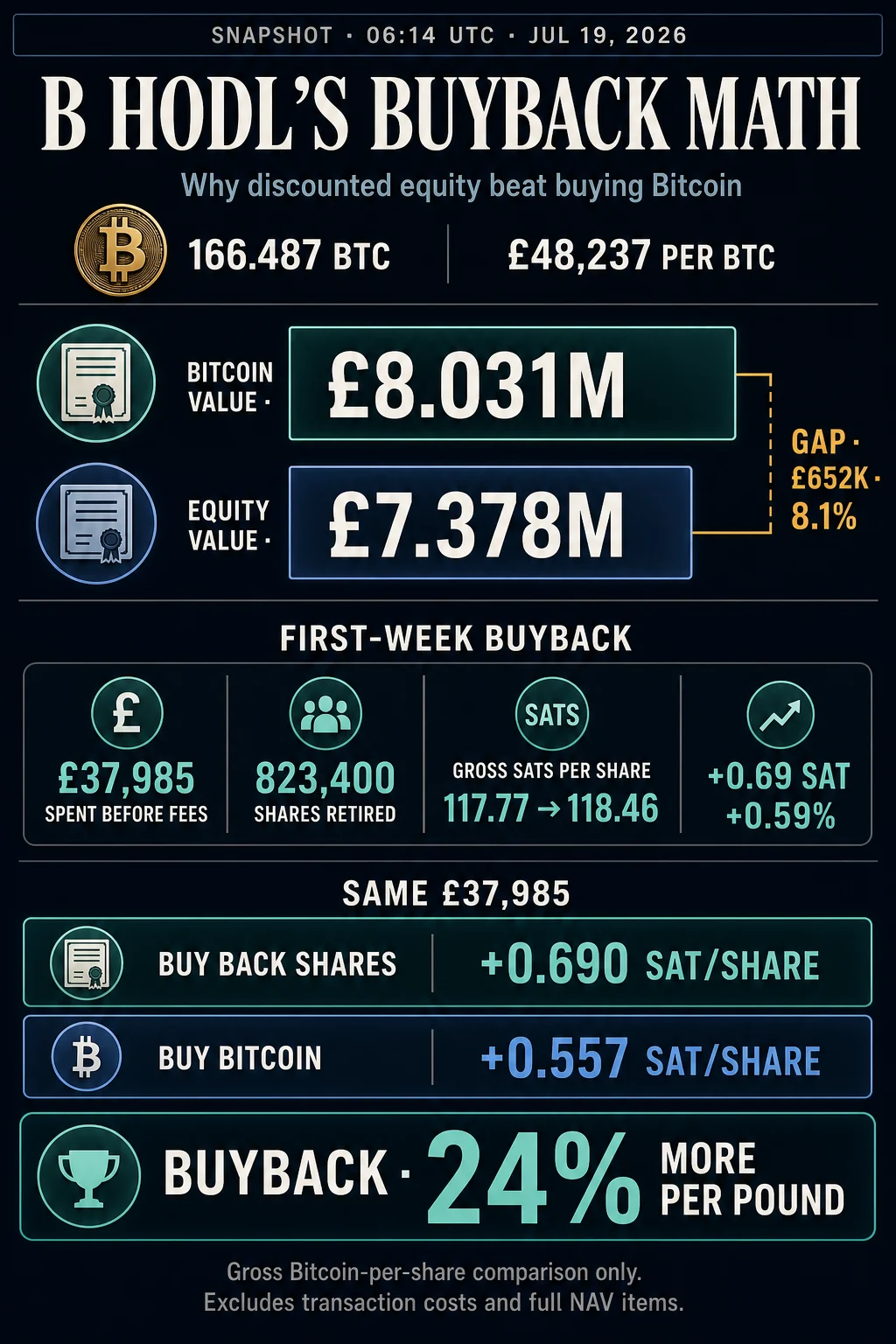
The London-listed Bitcoin treasury firm B HODL Plc has reported a significant tactical success in its capital allocation strategy, revealing that repurchasing its own undervalued shares proved substantially more efficient than purchasing Bitcoin directly. During its initial week of stock repurchases in July 2026, the company successfully increased its gross Bitcoin exposure per share by 24% more than it would have achieved by spending the same capital on the open Bitcoin market. This phenomenon occurs when a company’s market capitalization trades at a discount to the value of the Bitcoin held in its treasury, creating a unique arbitrage opportunity for the firm to benefit its remaining shareholders.
By retiring 823,400 of its own shares for a total outlay of approximately £37,985 (excluding fees), B HODL Plc demonstrated a "sats-per-share" accretion that outperformed direct asset acquisition. While the 24% edge represents a gross gain before accounting for transaction fees or the company’s broader net asset value (NAV), it highlights a critical shift in how digital asset treasury companies manage their balance sheets in volatile equity markets.
The Mechanics of the Strategic Buyback
The efficiency of B HODL’s buyback is rooted in the mathematical relationship between its share price and its underlying assets. On July 19, 2026, the company’s official dashboard indicated holdings of 166.487 BTC. At the prevailing Bitcoin price of £48,237, these holdings were valued at approximately £8.031 million. However, the company’s stock was trading at 5.25 pence per share, resulting in a total market capitalization of only £7.385 million.
This discrepancy created a valuation gap of approximately £646,000, or roughly 8.1% below the spot value of the Bitcoin held. In such a scenario, every pound spent by the company to buy back and cancel its own shares effectively "claims" more Bitcoin for the remaining shares than if that same pound were used to buy Bitcoin at the market rate.
Following the cancellation of the repurchased shares, B HODL’s total share count was reduced from 141,366,091 to 140,542,691. With the total Bitcoin treasury remaining constant at 166.487 BTC, the gross Bitcoin per share rose from 117.77 satoshis to 118.46 satoshis—an increase of 0.69 satoshis per share. Had the company spent the same £37,985 to buy 0.787 BTC at the market price and distributed that exposure across the original share count, the increase would have been only 0.557 satoshis per share. Consequently, the decision to retire equity was 24% more accretive per pound than a direct purchase.
Chronology of the Repurchase Program
The strategic shift toward buybacks began in early July 2026, following a formal authorization of a £100,000 buyback program. This program was designed to provide the company with a mechanism to support shareholder value during periods when the equity market failed to reflect the full value of the company’s digital asset holdings.
The timeline of the first week of operations was as follows:
- July 9, 2026: The buyback authorization officially took effect. The company made its first market intervention to capitalize on the widening discount to NAV.
- July 10, 2026: Continued repurchases as the share price remained stagnant despite a stable Bitcoin price.
- July 13–16, 2026: A series of planned purchases were executed and subsequently disclosed through official regulatory channels (RNS).
- July 19, 2026: B HODL updated its investor analytics dashboard, confirming the retirement of 823,400 shares at a weighted average price of 4.613 pence per share.
By the end of this period, the company had utilized approximately 38% of its initial £100,000 authorization. The speed and efficiency of the execution suggested a disciplined approach to capital management, prioritizing the highest return on "Bitcoin-per-share" for the company’s long-term holders.
The "Capital-Allocation Switch" Strategy
B HODL’s approach represents a sophisticated evolution of the "Bitcoin Standard" for corporate treasuries. Unlike companies that only buy Bitcoin, B HODL operates a dual-track system involving an At-The-Market (ATM) issuance program alongside its buyback authorization.
This creates what management refers to as a "capital-allocation switch." When B HODL shares trade at a premium to their Bitcoin-backed value, the company can utilize its ATM program to issue new shares and use the proceeds to buy more Bitcoin. This process is accretive because the new shares are sold for more than the Bitcoin they represent, increasing the total Bitcoin-per-share for all holders.
Conversely, when the shares trade at a discount—as they did during the second week of July 2026—the switch flips. The company stops issuing shares and instead uses its cash reserves to buy back and cancel stock. This ensures that the company is always taking the most efficient path to increasing its core metric: the amount of Bitcoin represented by a single share of stock.
Distinguishing Gross BTC from Net Asset Value (NAV)
While the 24% accretion in gross Bitcoin-per-share is a compelling metric, financial analysts note that it does not tell the entire story of the company’s valuation. A market capitalization trading below the value of the gross Bitcoin holdings is common in the sector, but it does not always indicate an irrational market discount.
The full Net Asset Value (NAV) of B HODL Plc is influenced by several factors beyond its Bitcoin treasury:
- Cash Reserves: The liquidity required to fund operations and the buyback program itself.
- Liabilities: Any outstanding debt or contractual obligations that must be settled.
- Operating Assets: B HODL is not merely a holding company; it operates a Lightning Network business intended to generate yield and utility from its Bitcoin holdings.
- Operational Costs: The "burn rate" associated with being a publicly listed company, including legal, regulatory, and administrative expenses.
The company’s most recent interim balance sheet serves as a historical reference, but it does not reflect the real-time fluctuations of the Bitcoin market. Therefore, while the buyback is demonstrably accretive in terms of "sats-per-share," investors must still weigh this against the company’s ability to manage its Lightning Network operations and maintain sufficient cash runway.
Broader Impact on the Bitcoin Treasury Sector
The results of B HODL’s buyback program are being closely watched by the broader digital asset treasury sector, which includes major players like MicroStrategy, Metaplanet, and Semler Scientific. For years, the primary focus of these companies has been the aggressive acquisition of Bitcoin through debt issuance or equity dilution. However, as the market matures, investors are becoming increasingly sensitive to dilution.

In recent months, there has been a growing trend of "Bitcoin treasury investors turning on companies" that dilute shareholders to buy Bitcoin at any cost, especially when those companies are trading at a discount. B HODL’s data provides a roadmap for how these companies can pivot. If a company’s stock is the "cheapest" way to acquire Bitcoin, failing to buy back shares can be seen as a failure of fiduciary duty.
Market analysts suggest that B HODL’s success could lead to a "buyback era" for Bitcoin-heavy firms. If the market continues to apply a "conglomerate discount" to companies holding Bitcoin, those firms may increasingly opt to shrink their share counts rather than grow their total Bitcoin piles. This shift emphasizes quality of exposure (Bitcoin per share) over the quantity of exposure (total Bitcoin held).
Industry Reactions and Market Outlook
While B HODL has not issued an official statement beyond its regulatory filings and dashboard updates, the reaction from the investment community has been one of cautious optimism. Proponents of the Bitcoin-as-a-treasury-reserve model argue that B HODL is demonstrating a "common sense" approach to finance that has been missing from the hyper-growth phase of the crypto industry.
"The math is undeniable," noted one digital asset analyst. "If you can buy Bitcoin for 92 cents on the dollar by buying your own stock, you do it. It’s the most basic form of arbitrage, and it rewards the loyal shareholders who didn’t sell during the dip. It turns the market’s irrationality into a permanent gain for the company’s capital structure."
However, critics warn that this strategy requires a delicate balance. A company that spends too much of its cash on buybacks may find itself "Bitcoin-rich but cash-poor," potentially forcing it to sell its Bitcoin at a disadvantageous time to cover operating costs or debt obligations. For B HODL, the key to long-term success will be the performance of its Lightning Network business, which is intended to provide the organic cash flow necessary to sustain these capital management activities without depleting the treasury.
Conclusion: A New Standard for Treasury Management
B HODL Plc’s discovery that buying its own stock adds 24% more BTC per share than direct purchases marks a significant milestone in the maturation of Bitcoin-centric corporate finance. By treating its own equity as a vehicle for Bitcoin exposure, the company has shown that it can navigate market inefficiencies to the benefit of its shareholders.
As the company continues its £100,000 buyback program, the industry will be watching to see if the valuation gap closes. If the market recognizes the accretive nature of these buybacks, the share price may rise to meet the NAV, eventually flipping the "capital-allocation switch" back to equity issuance. Regardless of the short-term market movement, B HODL has established a precedent for disciplined, data-driven treasury management in the digital age, proving that sometimes the best way to "HODL" Bitcoin is to buy back the company itself.