James Watt
The digital asset market is witnessing a significant structural shift in the supply and demand dynamics of XRP, as the token attempts to solidify its recovery above the $1.16 threshold. This price movement, characterized by a period of stabilization following weeks of volatility, is being driven by two primary catalysts: a pronounced accumulation phase by large-scale investors, commonly referred to as "whales," and a consistent four-month streak of inflows into United States-listed spot XRP exchange-traded funds (ETFs). While the token recently faced a minor retracement to the $1.14 level, the underlying on-chain data suggests a growing conviction among institutional and high-net-worth holders, which may provide the necessary foundation for a more sustained breakout in the coming months.
Whale Accumulation and the Exodus from Centralized Exchanges
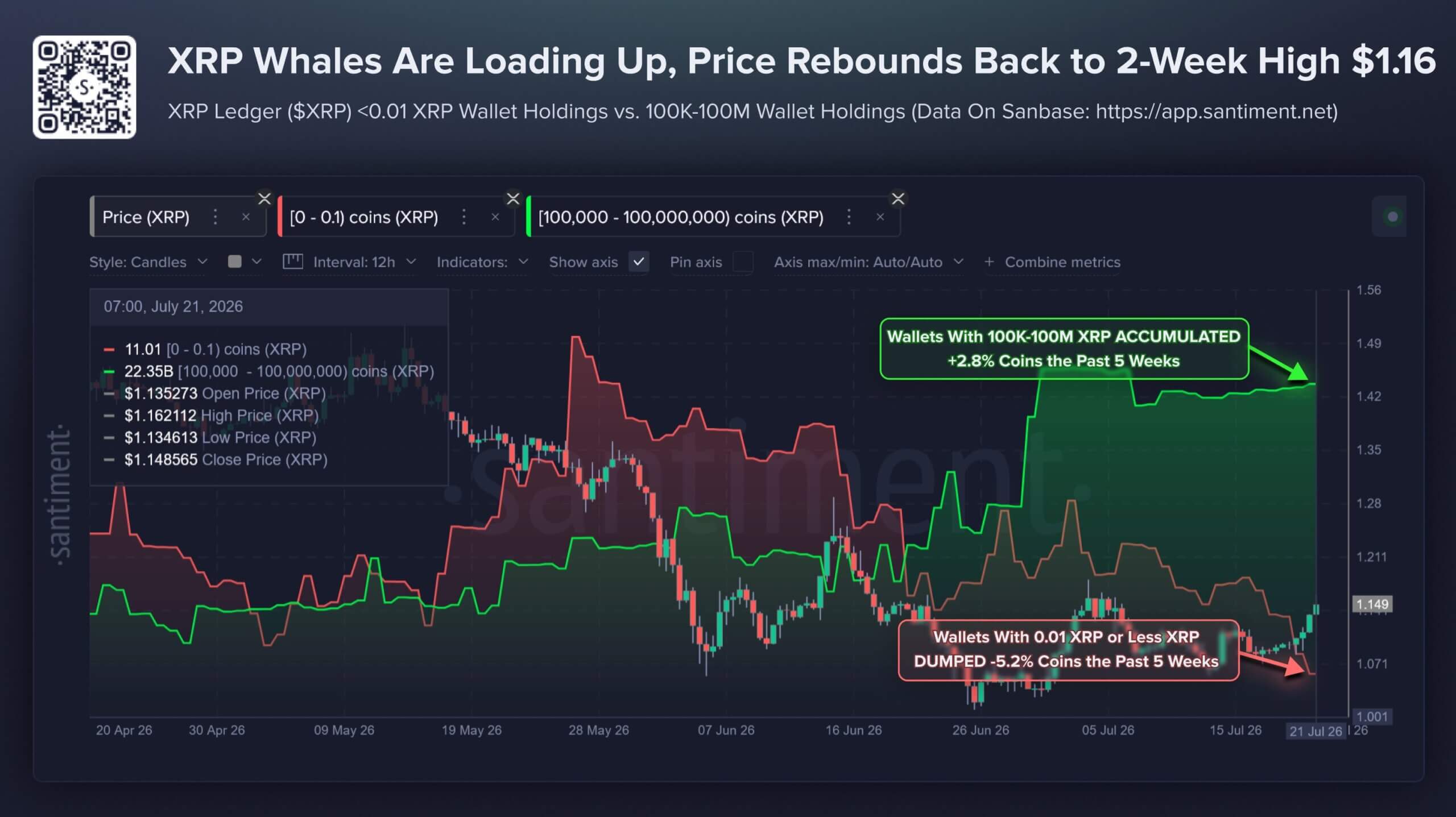
A granular analysis of blockchain data reveals a stark divergence between the behavior of institutional-grade investors and retail participants. Over the past five weeks, wallets categorized as "whales"—those holding between 100,000 and 100 million XRP—have aggressively expanded their positions. According to data provided by Santiment, these entities increased their collective holdings by 2.8% during this period. This accumulation occurred even as XRP struggled to maintain momentum above the psychological $1.00 level, suggesting that large holders viewed the consolidation phase as a strategic entry point rather than a signal of further decline.
In contrast, retail activity has shown signs of exhaustion or capitulation. Small-scale wallets containing less than 0.01 XRP saw their holdings decrease by 5.2% over the same five-week window. This "shakeout" of smaller participants often precedes a shift in market structure, as supply migrates from speculative, short-term hands into the portfolios of long-term conviction holders.

Perhaps the most telling metric of this shift is the record-breaking share of exchange withdrawals attributed to whales. On July 22, 2026, large-scale holders accounted for 77.8% of all XRP outflows from centralized exchanges. This represents a significant escalation from May 6, when the whale share of outflows stood at 63%. As whales move their assets into private custody or cold storage, the "liquid supply" available for immediate sale on exchanges diminishes. Concurrently, the retail share of withdrawals has plummeted from 36% to 22%, widening the gap between institutional and retail movement to a staggering 56%.
The Collapse of Exchange Deposits and the Binance Case Study
The reduction in exchange-side liquidity is further evidenced by a dramatic collapse in whale deposits to major trading platforms. Binance, the world’s largest cryptocurrency exchange by volume, has seen a near-total evaporation of XRP inflows from its largest clients. At its previous peak, whales were depositing as much as 583 million XRP onto the platform, a figure valued at approximately $1.36 billion at the time. Recent data shows that these deposits have plummeted by 96%, falling to a mere 25.3 million XRP, worth roughly $23 million.
This trend is not a localized anomaly but part of a broader, long-term decline in exchange-bound supply. The 90-day moving average of whale inflows to Binance has retreated from $460 million in January 2025 to approximately $69 million in July 2026. This sustained reduction in deposits indicates that large holders are no longer positioning their assets for near-term liquidation. Instead, the move toward self-custody suggests a "buy and hold" strategy, effectively creating a supply-side constraint that could amplify price gains if demand continues to rise.
Institutional Demand: The $285 Million ETF Inflow Streak
While whales are restricting the supply of XRP, US-listed spot XRP ETFs are providing a consistent and growing source of demand. These financial products have become a critical bridge for institutional capital, allowing traditional investors to gain exposure to XRP without the complexities of direct digital asset management.

The month of July has seen approximately $12 million in fresh capital enter these funds, marking the fourth consecutive month of net positive inflows. This streak began in earnest in April 2026, which saw $81.59 million in inflows, followed by a record $131.94 million in May and a solid $59.46 million in June. In total, the four-month streak has brought $285 million into the XRP ecosystem. Since their inception, cumulative net inflows into the four primary XRP funds have reached $1.49 billion, with total assets under management (AUM) hovering around $1.06 billion.
While these figures are modest when compared to the multi-billion-dollar flows seen in Bitcoin-based ETFs, the persistence of the demand is noteworthy. ETF providers must often source physical XRP from the spot market or through specialized counterparties to back the creation of new fund shares. This recurring buy pressure acts as a counterbalance to any remaining market volatility, slowly absorbing the supply that whales have moved off-exchange.
Chronology of the Recovery: From $1.00 to the $1.18 Resistance
The current market environment is the culmination of several months of range-bound trading and technical testing.
- The Consolidation Phase (May – June 2026): XRP spent much of the late spring oscillating around the $1.00 mark. Despite several attempts by bulls to push the price higher, limited spot demand and a lack of clear catalysts kept the token tethered to this baseline.
- The Liquidity Shift (Early July 2026): On-chain data began to signal a change as whale outflows from exchanges started to outpace inflows. This period coincided with the midpoint of the ETF inflow streak, providing the first signs of a supply-demand imbalance.
- The $1.16 Breakout Attempt (July 21, 2026): XRP successfully surged past $1.16, driven by a $300 million spike in leveraged bets and increased spot buying. However, the token met heavy resistance at the $1.18 line, a level that has historically served as a significant hurdle for the asset.
- Current Market Position (July 23, 2026): As of the latest reporting, XRP has retraced to approximately $1.14, representing a 2.79% decline over a 24-hour period. Despite this minor setback, the token remains up 1.03% on a seven-day basis, maintaining its position as the sixth-largest cryptocurrency by market capitalization ($69.27 billion).
Analysis of Broader Implications and Market Outlook
The convergence of whale accumulation and institutional ETF demand suggests that XRP is entering a "mature" phase of its market cycle. The reduction in whale deposits to Binance is particularly significant, as it suggests that the large-scale "dumping" that often plagues high-cap altcoins is becoming less likely. When a significant portion of the circulating supply is locked in cold storage or held within regulated ETF structures, the asset becomes more sensitive to positive news or shifts in the broader macroeconomic environment.
Furthermore, XRP’s performance must be viewed in the context of the wider digital asset landscape. Recent reports indicate that XRP has outperformed major competitors like Ethereum and Solana in terms of 90-day flows related to Real World Asset (RWA) tokenization. The Ripple ecosystem’s focus on cross-border payments and institutional liquidity pools appears to be resonating with investors who are looking for utility-driven assets rather than purely speculative tokens.
However, the path to a full recovery is not without obstacles. The $1.18 resistance level remains a formidable barrier. For XRP to achieve a decisive breakout and target the $1.30-$1.50 range, it will require a further increase in spot trading volume. While the ETF inflows are steady, they are currently insufficient to trigger a parabolic move on their own. The market is effectively waiting for a "catalyst event"—potentially related to further regulatory clarity or a major partnership announcement—that could ignite broader retail interest to complement the institutional foundation currently being built.
Conclusion: A Market in Transition
The data from July 2026 paints a picture of a market in transition. On one side, the "smart money" is quietly absorbing supply and moving it into long-term storage, effectively betting on the future value of the XRP Ledger. On the other side, the traditional financial sector is establishing a permanent foothold through ETF products, providing a consistent, albeit slow-moving, stream of liquidity.
The collapse of whale deposits to exchanges is perhaps the most bullish signal for long-term holders, as it indicates a shift in sentiment from "trading" to "investing." While the short-term price action remains tied to the $1.14-$1.16 range, the underlying metrics suggest that the "path of least resistance" may eventually lead upward, provided the current trend of institutional absorption continues. As the market digests the recent gains and tests support levels, the focus remains on whether the combined force of whale conviction and ETF demand can finally push XRP beyond its long-standing price constraints.