admin
admin
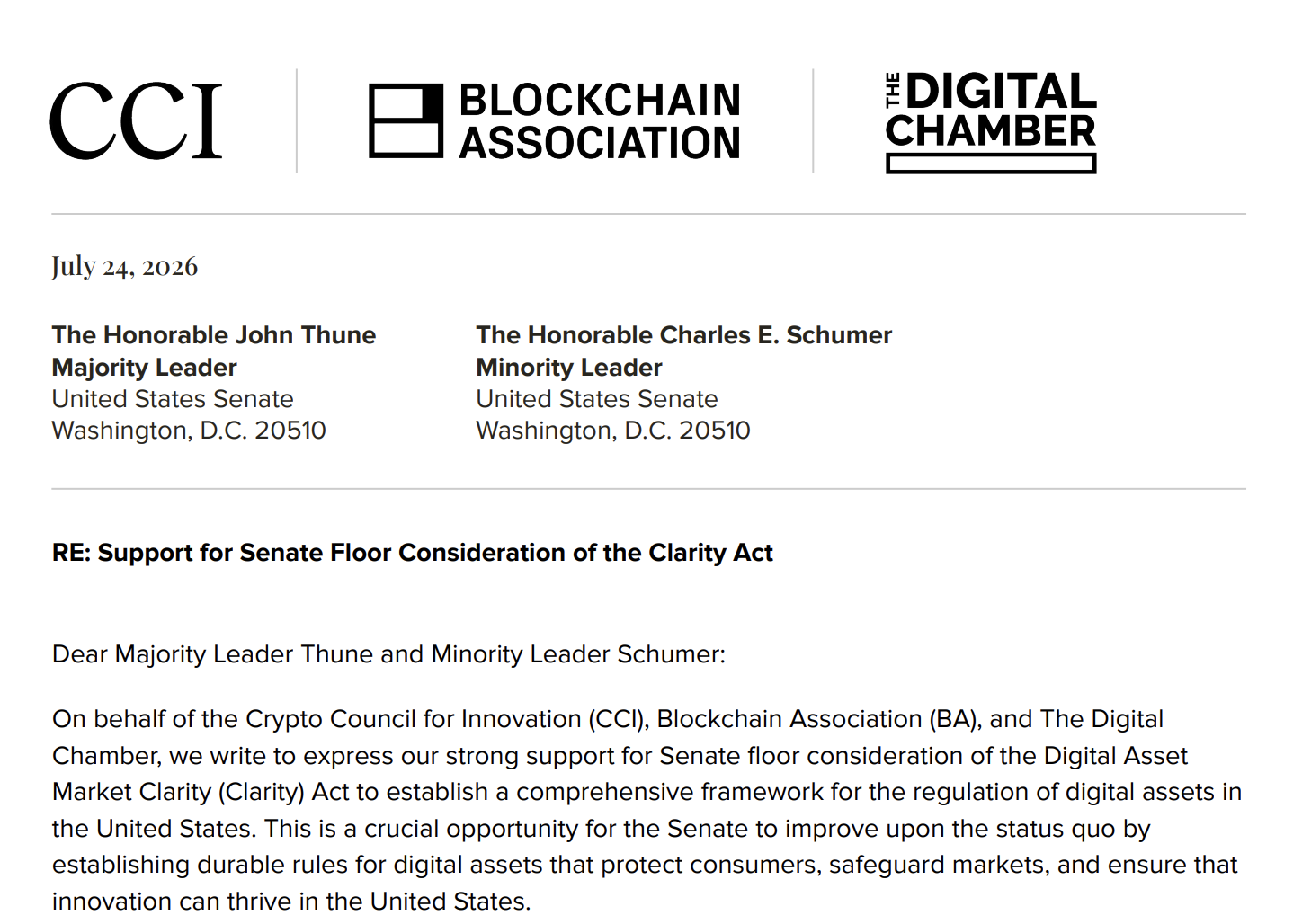
In a coordinated effort to secure a definitive federal framework for the digital asset industry, three of the most prominent cryptocurrency advocacy organizations in the United States—the Crypto Council for Innovation, the Digital Chamber, and the Blockchain Association—formally petitioned Senate leadership on Friday. The joint letter, addressed to Senate Majority Leader John Thune and Minority Leader Chuck Schumer, calls for the immediate prioritization of "floor consideration" for the Digital Asset Market Clarity (CLARITY) Act. This legislative push comes as Republican lawmakers accelerate their efforts to bring the bill to a vote before the upper chamber adjourns for its scheduled state work periods in August. While the bill represents a significant milestone in the quest for regulatory certainty, it faces a complex path forward characterized by intense bipartisan negotiations and sharp disagreements over ethics provisions.
The CLARITY Act is widely regarded as one of the most consequential pieces of legislation for the American crypto industry to date. It seeks to establish a comprehensive market structure that differentiates between digital commodities and securities, providing much-needed jurisdictional boundaries for the Securities and Exchange Commission (SEC) and the Commodity Futures Trading Commission (CFTC). Despite advancing through the Senate Banking and Agriculture committees, the bill remains in a state of legislative limbo as several key lawmakers have signaled their intention to withhold support until specific points of contention are resolved.
The Legislative Context and the Push for Floor Consideration
The advocacy groups’ letter emphasizes the urgency of the current moment, noting that the "status quo" of regulation by enforcement is no longer sustainable for the domestic industry. By requesting a floor vote, the Crypto Council for Innovation, the Digital Chamber, and the Blockchain Association are attempting to force a resolution on a bill that has been the subject of months of deliberation. The groups acknowledged that while the bill is not yet in its final form, the ongoing "constructive bipartisan negotiations" are a sign of progress that should be codified through a formal Senate vote.
The timing of this request is strategic. With the August recess approaching, the legislative calendar is tightening. If the CLARITY Act is not addressed before the break, its consideration could be pushed into the late summer or early autumn, placing it dangerously close to the 2026 US midterm elections. Historically, major policy overhauls become increasingly difficult to pass as the election cycle nears its peak, as political posturing often takes precedence over substantive policy debate.
A Chronology of the CLARITY Act’s Development
The journey of the CLARITY Act has been marked by both rapid progress in committees and significant friction in the public square. Earlier this week, Republican lawmakers released the full text of the market structure bill, which included a new suite of ethics provisions. These provisions were designed to address concerns regarding corruption and conflicts of interest, specifically barring public officials from issuing or sponsoring cryptocurrencies.
However, the introduction of these ethics rules, rather than smoothing the path to a vote, ignited a firestorm of criticism from Democratic colleagues. Senator Ruben Gallego, a vocal critic of the current proposal, expressed deep frustration with the Republican counterproposal. According to reports from Politico, Gallego dismissed the ethics provisions as a "not a serious effort," suggesting that the months of bipartisan work had been undermined by a proposal that failed to meet the standards required to prevent corruption.

This divide highlights the primary hurdle facing the bill: the 60-vote threshold. In a Senate where Republicans hold a narrow 52-47 majority, the bill cannot pass on a purely partisan basis. At least eight Democratic votes are required to overcome a potential filibuster, making bipartisan consensus not just a goal, but a mathematical necessity.
Industry Leaders Rally Behind Regulatory Reform
The call for the CLARITY Act’s passage has been echoed by major figures in the private sector. Brian Armstrong, CEO of Coinbase, the largest cryptocurrency exchange in the United States, took to social media to voice his support for the legislation. Armstrong argued that the lack of a federal framework has historically benefited bad actors and pushed legitimate innovation outside of US borders.
"The status quo in the US isn’t working," Armstrong stated. "There’s no federal framework, so bad actors like FTX can harm US customers and much of the industry has gone offshore totally outside US purview. This bill fixes that with strong consumer protections, real tools for law enforcement, and a path for America to lead in this industry."
Armstrong’s comments reflect a broader sentiment within the industry that the current "regulation by enforcement" model—led primarily by the SEC—is detrimental to long-term growth. Industry proponents argue that clear rules of the road would allow companies to innovate within the US, rather than seeking more favorable regulatory environments in jurisdictions like the European Union, which has already implemented its Markets in Crypto-Assets (MiCA) regulation.
Technical Implications for Non-Custodial Protocols
Beyond the high-level political debate, the CLARITY Act carries significant technical implications for decentralized finance (DeFi). Orest Gavryliak, Chief Legal Officer of the DeFi platform 1inch, highlighted the importance of the bill in recognizing the unique nature of non-custodial protocols. Speaking on Cointelegraph’s Chain Reaction podcast, Gavryliak noted that current regulatory attempts often try to force decentralized technologies into legacy "custodial" frameworks that are ill-suited for the technology.
"Some regulators, they try to be friendly to non-custodial protocols or projects, they still try to fit us in into the custodial frameworks and make us use custodial solutions to solve problems that they used to in this legacy custodial or traditional finance," Gavryliak explained. He argued that the CLARITY Act is essential because it provides a legal basis for protocols that do not hold user funds, ensuring they are not unfairly penalized by rules meant for centralized banks or exchanges.
The Ethics Standoff and Political Math
The core of the current stalemate revolves around the definition of "public official" and the scope of the ban on cryptocurrency involvement. While Republicans believe their proposal provides a sufficient barrier against corruption, Democrats like Senator Gallego argue that the language is too narrow and leaves significant loopholes for influence peddling.
The White House has also weighed in, with crypto advisers suggesting that the Democratic opposition to the current ethics rules is rooted in a desire for more stringent oversight. The friction between the two parties suggests that while there is a shared understanding that a market structure bill is needed, the details of its implementation remain a significant wedge issue.
The political math of the Senate adds another layer of complexity. With a 52-47 split, the Republican leadership must negotiate with moderate Democrats who are under pressure from both the pro-crypto wing of their party and the more skeptical progressive wing. The "constructive bipartisan negotiations" mentioned in the advocacy groups’ letter are likely focused on these few swing votes that will ultimately decide the fate of the CLARITY Act.
Market Sentiment and the Path Forward
The uncertainty surrounding the bill is reflected in the prediction markets. As of Friday, Kalshi, a regulated prediction market platform, offered event contracts showing a 40.3% chance that the Senate would successfully vote on the CLARITY Act before the August recess. This figure suggests that while the market is hopeful, there is a healthy degree of skepticism regarding the Senate’s ability to move quickly on such a complex piece of legislation.
If the bill fails to reach the floor before the August break, the implications could be twofold. First, it would likely result in a continued period of regulatory uncertainty, potentially leading to further enforcement actions by the SEC. Second, it could shift the crypto regulatory debate into the 2026 election cycle, where it may become a "litmus test" issue for candidates in key states with high crypto ownership.
Broader Implications for the US Economy
The passage of the CLARITY Act is not just a matter of concern for crypto enthusiasts; it has broader implications for the US economy and its standing in the global financial system. Proponents of the bill argue that by providing a clear path for digital asset companies, the US can retain its position as a global hub for financial technology. Conversely, failure to act could accelerate the "brain drain" of developers and capital to more welcoming jurisdictions.
Furthermore, the bill’s focus on consumer protections and law enforcement tools is designed to prevent a repeat of the 2022 market collapses. By mandating transparency and establishing clear standards for asset custody, the CLARITY Act aims to build a more resilient market that can withstand volatility without systemic failure.
As the Senate enters its final weeks of session before the summer recess, the pressure from the Crypto Council for Innovation, the Digital Chamber, and the Blockchain Association serves as a reminder that the industry is no longer a niche interest. It is a significant economic force demanding a seat at the table and a clear set of rules to follow. Whether the Senate leadership can bridge the partisan divide and bring the CLARITY Act to a vote remains the defining question for the American digital asset landscape in 2026.