Nila Kartika Wati
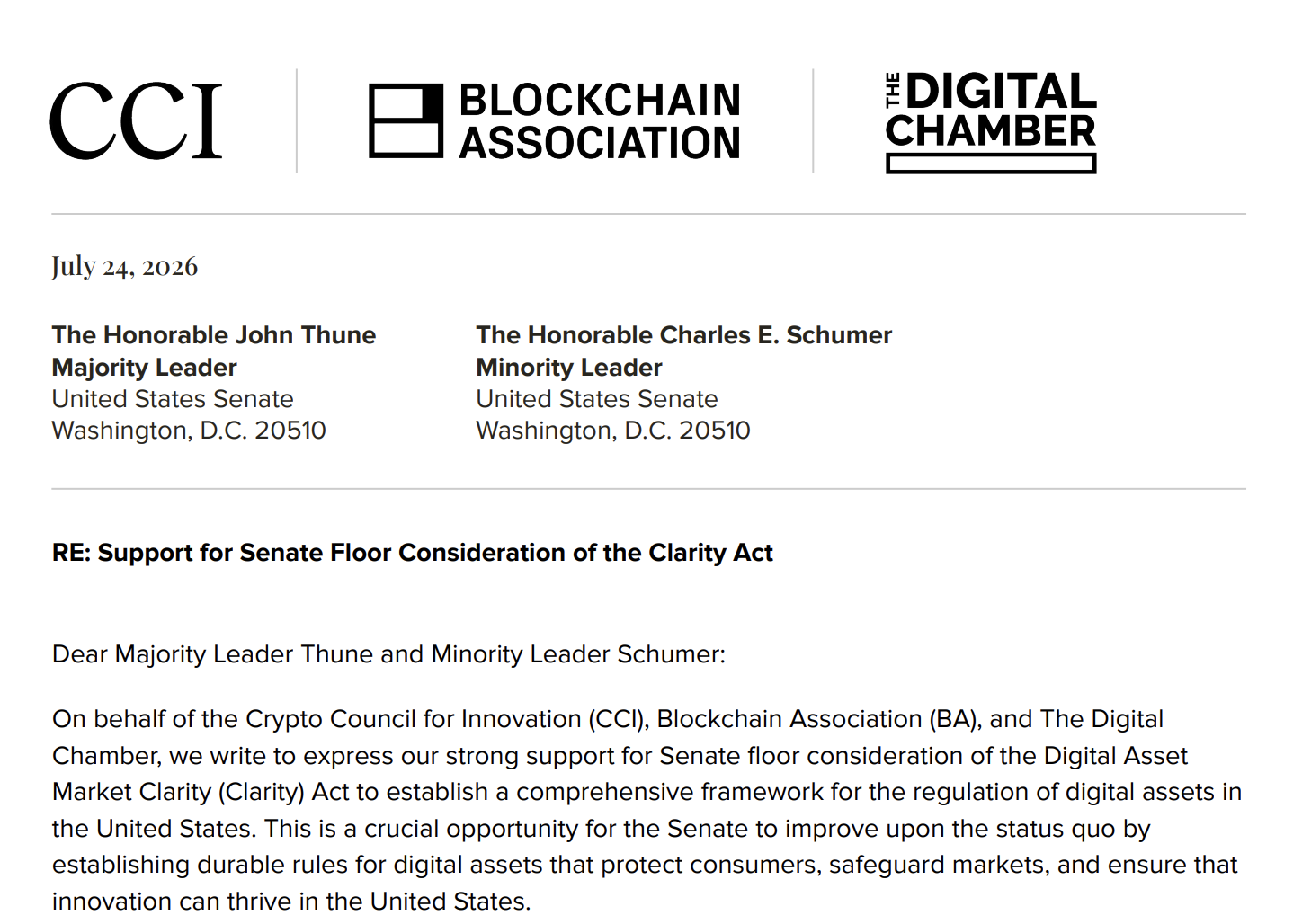
Three prominent cryptocurrency advocacy organizations — the Crypto Council for Innovation (CCI), the Digital Chamber, and the Blockchain Association — delivered a joint letter to US Senate leaders on Friday, emphatically calling for the chamber to prioritize "floor consideration" of the Digital Asset Market Clarity (CLARITY) Act. This urgent appeal arrives as the Senate approaches its critical August state work period recess, with time rapidly dwindling for a vote on what is widely considered a landmark piece of legislation for the burgeoning digital asset sector. The push underscores the industry’s growing impatience with the current regulatory vacuum in the United States and its fervent desire for a comprehensive, federal framework.
The letter, addressed to Senate Majority Leader John Thune and Minority Leader Chuck Schumer, highlighted the necessity of providing clear rules of the road for digital assets, an objective that has largely eluded American lawmakers for years. The CLARITY Act, a bipartisan initiative despite its current political quagmire, seeks to establish a much-needed market structure for cryptocurrencies, delineating jurisdictional boundaries between regulatory bodies like the Securities and Exchange Commission (SEC) and the Commodity Futures Trading Commission (CFTC), and instituting robust consumer protection measures. Its proponents argue that such clarity is not merely beneficial but essential for fostering innovation, retaining talent, and safeguarding consumers within the United States, preventing the migration of legitimate businesses offshore.
A Legislative Journey Marked by Obstacles
The journey of the CLARITY Act through Congress has been a testament to the complex and often contentious nature of cryptocurrency regulation. Introduced earlier this year, the bill quickly gained traction within the industry and among a segment of lawmakers who recognize the strategic importance of establishing a competitive regulatory environment for digital assets. It successfully navigated initial hurdles, securing passage through key Senate committees, including the Banking, Housing, and Urban Affairs Committee and the Agriculture Committee. This bipartisan committee approval was seen as a significant step forward, signaling a potential path for comprehensive crypto legislation.
However, the momentum has been significantly hampered by persistent disagreements over specific provisions, particularly those related to ethics. Republican lawmakers, who hold a narrow 52-47 majority in the Senate (with one independent often caucusing with Democrats), have been vocal in their desire to bring the bill to a floor vote before the August recess. They view the CLARITY Act as a crucial step towards cementing America’s leadership in the global digital economy. The recently released text of the market structure bill included ethics provisions designed to prevent conflicts of interest, specifically barring public officials from issuing or sponsoring cryptocurrencies. While a step, this measure has failed to satisfy a critical mass of Democratic lawmakers.
The Ethics Quagmire: A Sticking Point for Bipartisanship
The debate over ethics provisions has emerged as the primary stumbling block, threatening to derail the entire legislative effort. While Republicans contend their proposed ethics framework provides adequate safeguards, many Democrats argue these measures do not go far enough to curb potential corruption or undue influence within the digital asset space. Senator Ruben Gallego, a prominent voice among the dissenting Democrats, expressed profound frustration with the Republican counterproposal, stating emphatically on Thursday, "Whatever piece of s*** they sent back to us, that was not a serious effort." His comments, widely reported by Politico, underscored the deep chasm separating the two parties on this critical issue.

Senator Gallego elaborated on his disappointment, highlighting the extensive, months-long bipartisan negotiations that preceded the current impasse. "After all the work that we’ve done with our Republican colleagues, that they would take the months and months of work and somehow interpret that and turn around and think what they offered was even remotely close," he remarked, indicating a significant breakdown in trust and understanding during the drafting process. This sentiment suggests that Democrats believe the Republican ethics provisions are either insufficient to address the complexities of financial conflicts of interest in the digital asset space or are perceived as a tactical maneuver rather than a genuine attempt at compromise. The White House crypto adviser, as captured in a widely shared image, echoed similar concerns regarding Democratic opposition to the CLARITY Act’s ethics rules, signifying the issue’s prominence within the executive branch’s considerations as well.
The core of the Democratic objection likely stems from concerns about the "revolving door" phenomenon, where former regulators or lawmakers transition into high-paying positions within the industries they once oversaw, potentially leveraging their insider knowledge and connections. They might also advocate for more stringent disclosure requirements for digital asset holdings by public officials, broader restrictions on lobbying activities, or clearer prohibitions against conflicts of interest that extend beyond merely "issuing or sponsoring" cryptocurrencies. The implication is that without robust ethics provisions, the act could inadvertently create loopholes or opportunities for undue influence, undermining public trust in the nascent digital asset market.
Industry Leaders Weigh In: A Cry for Clarity
The urgency of the situation is deeply felt across the cryptocurrency industry, where regulatory uncertainty has been a persistent source of frustration and impediment to growth. Industry leaders are vocal in their support for the CLARITY Act, viewing it as a vital step towards legitimizing the sector and protecting consumers.
Brian Armstrong, CEO of Coinbase, one of the largest cryptocurrency exchanges globally, articulated the industry’s predicament in a Wednesday X post. "The status quo in the US isn’t working," Armstrong stated unequivocally. He pointed to the stark reality of "no federal framework," which has allowed "bad actors like FTX" to harm US customers and driven much of the industry offshore, beyond the purview of American regulators. Armstrong believes the CLARITY Act offers a definitive solution, promising "strong consumer protections, real tools for law enforcement, and a path for America to lead in this industry." His comments reflect a widespread sentiment that the absence of clear rules disproportionately harms legitimate businesses and consumers, while enabling illicit activities to flourish in unregulated spaces.
Orest Gavryliak, Chief Legal Officer of the DeFi platform 1inch, echoed Armstrong’s sentiments during an interview on Cointelegraph’s Chain Reaction podcast on Friday. Gavryliak highlighted a crucial aspect of the CLARITY Act’s potential impact: its ability to recognize and establish a framework for non-custodial protocols. He lamented the current approach where "some regulators… try to fit us in into the custodial frameworks and make us use custodial solutions to solve problems that they used to in this legacy custodial or traditional finance, which is wrong [and] doesn’t apply to us at all." This "regulation by enforcement" approach, where regulators apply outdated frameworks to innovative decentralized technologies, has been a significant point of contention. Gavryliak stressed that CLARITY is "very important" because it would create tailored regulations for non-custodial systems, distinguishing them from traditional financial intermediaries and acknowledging their unique operational characteristics.
The industry’s collective voice emphasizes that regulatory clarity is not merely a convenience but a necessity for its long-term viability and growth within the United States. Without it, the risk of capital flight, brain drain, and a stifled innovation landscape remains high.
The Broader Implications: US Competitiveness and Consumer Protection
The stakes surrounding the CLARITY Act extend far beyond the confines of the cryptocurrency industry. The United States has long grappled with establishing a coherent regulatory stance on digital assets, often lagging behind other major global economies that have moved to create clearer frameworks. This regulatory inertia has raised concerns about America’s competitiveness in the rapidly evolving fintech landscape. Countries and regions like the European Union, the UK, and parts of Asia have made significant strides in developing comprehensive crypto regulations, attracting innovation and investment. Should the US fail to pass meaningful legislation like CLARITY, it risks ceding its leadership position in an industry poised to reshape global finance.
The absence of a clear federal framework also poses significant risks for consumer protection. As Armstrong noted, the lack of defined rules has historically allowed bad actors to operate with relative impunity, leading to high-profile collapses and substantial financial losses for investors. The CLARITY Act aims to rectify this by establishing clear responsibilities for various market participants, mandating disclosures, and empowering regulators with the tools necessary to oversee the digital asset market effectively. This would provide a much-needed layer of security for millions of Americans who participate in the crypto economy.
Furthermore, the ongoing partisan deadlock highlights a broader challenge in American politics: the ability to legislate effectively on complex, emerging technologies. The inability to find common ground on critical issues, even those with broad economic implications, suggests a deeper systemic issue that could hinder the US’s capacity to adapt to technological advancements and maintain its global economic standing.
The Looming Deadline and Political Calculus
The impending August recess adds another layer of urgency and complexity to the CLARITY Act’s fate. If lawmakers are unable to secure the necessary 60 votes for floor consideration and passage before the break, the bill’s prospects become significantly more complicated. Pushing consideration into the weeks leading up to the 2026 US midterm elections would undoubtedly politicize the discussions further. In an election year, legislative priorities often shift, and compromise becomes even harder to achieve as both parties focus on campaigning and shoring up their respective bases. Issues that might otherwise be bipartisan can quickly become fodder for campaign rhetoric, making substantive legislative progress an uphill battle.
The current political landscape, with a closely divided Senate and deep ideological rifts, means that every vote is critical. Republicans require at least eight Democratic senators (assuming all Republicans vote in favor) to reach the 60-vote threshold needed to overcome a potential filibuster and pass the bill. The resistance from key Democrats, particularly on ethics provisions, suggests that securing these votes will be a formidable challenge.
Market observers are keenly aware of the legislative timeline. Kalshi, an event prediction market platform, reflected this uncertainty, offering users event contracts with a 40.3% chance that the CLARITY Act would pass before the Senate’s August recess as of Friday. This relatively low probability underscores the significant hurdles the bill faces, despite widespread industry support. The political calculus dictates that if a deal on ethics cannot be struck quickly, the bill could languish, potentially being shelved until a more opportune political moment arises, or even facing a complete restart in a new legislative session.
In conclusion, the call for immediate Senate action on the CLARITY Act represents a critical juncture for the US digital asset industry. While the need for regulatory clarity is broadly acknowledged, the deeply entrenched partisan divide over ethics provisions poses a substantial threat to its passage. As the clock ticks down towards the August recess, the ability of Senate leaders to bridge this divide will determine not only the future regulatory landscape for cryptocurrencies but also America’s position in the global race for fintech innovation and leadership. The outcome will be closely watched by innovators, investors, and consumers alike, all hoping for a clearer, more secure future for digital assets in the United States.