admin
admin
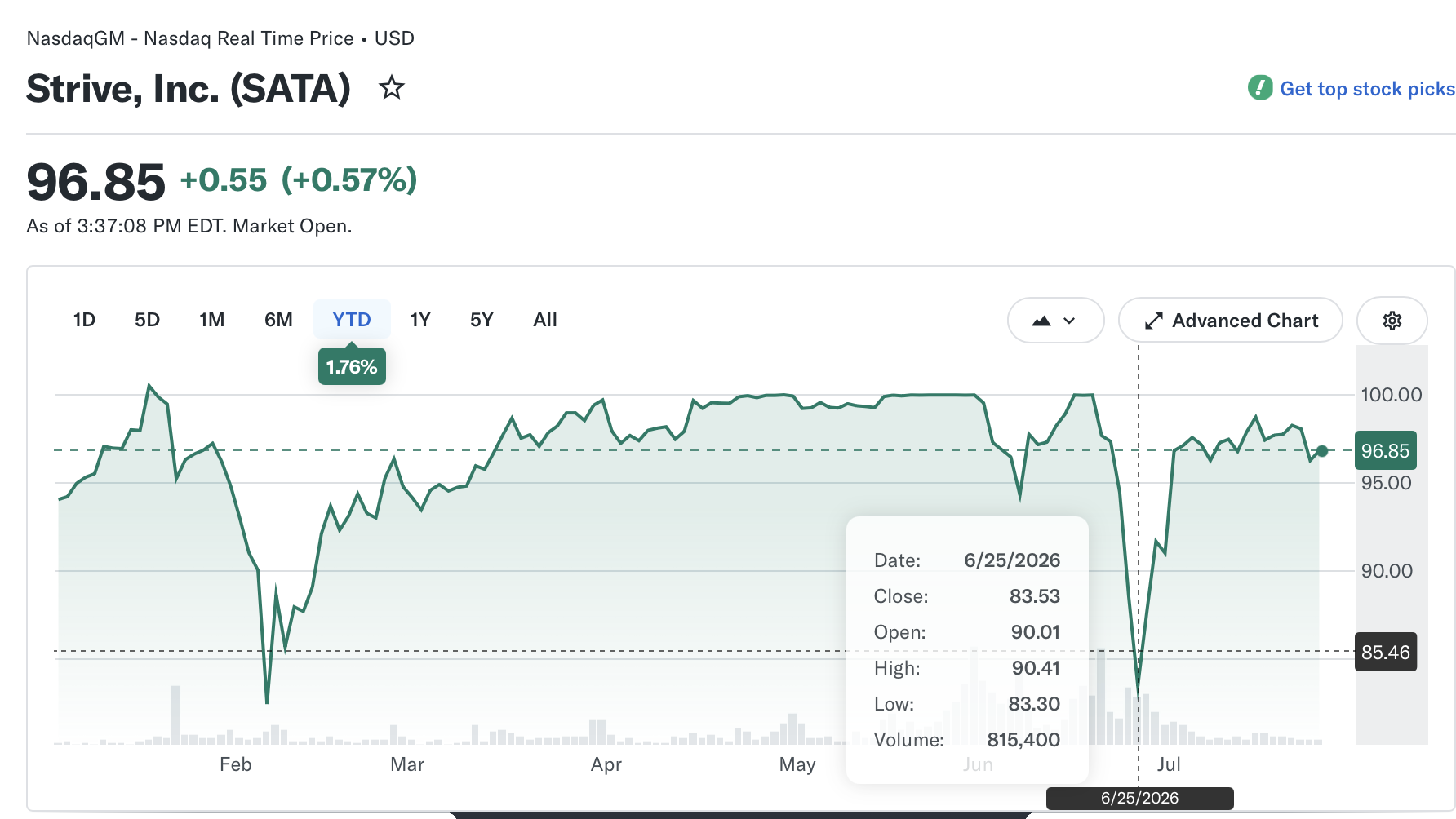
The digital asset landscape has reached a significant milestone in its evolution toward traditional financial integration as Strive’s SATA preferred shares demonstrated a robust recovery, signaling renewed investor confidence in Bitcoin-backed corporate treasury models. According to the latest data from Yahoo Finance, SATA preferred shares have rebounded from a June low of $83.30 to approximately $97, effectively reclaiming the majority of losses sustained during a volatile mid-year selloff. This recovery brings the instrument within roughly 3% of its $100 par value, a critical threshold for the variable-rate perpetual preferred stock model that has become a cornerstone of Strive’s aggressive capital-raising strategy.
The resurgence of SATA is not merely an isolated price movement but serves as a bellwether for the emerging "digital credit" sector. Introduced by Strive in November 2025, SATA was designed as a sophisticated financial vehicle to fund the expansion of the company’s Bitcoin treasury. By utilizing preferred equity rather than common stock, Strive has pioneered a method to accumulate Bitcoin (BTC) without diluting existing common shareholders. The mechanism relies on a variable dividend rate that adjusts to market conditions, theoretically ensuring the shares trade near their $100 par value regardless of broader market fluctuations.
The Evolution of the Bitcoin Treasury Model
The concept of using corporate balance sheets to hold Bitcoin was popularized early in the decade by firms like MicroStrategy—referred to in current market parlance as Strategy. However, the maturation of the market has seen a shift from simple spot accumulation to the creation of complex yield-bearing instruments. Strategy’s STRC, a similar preferred-share product launched in 2025, also faced significant headwinds during the late-June market contraction. While STRC has recovered from its lows, it currently trades at approximately $87, trailing behind the recovery pace of Strive’s SATA.
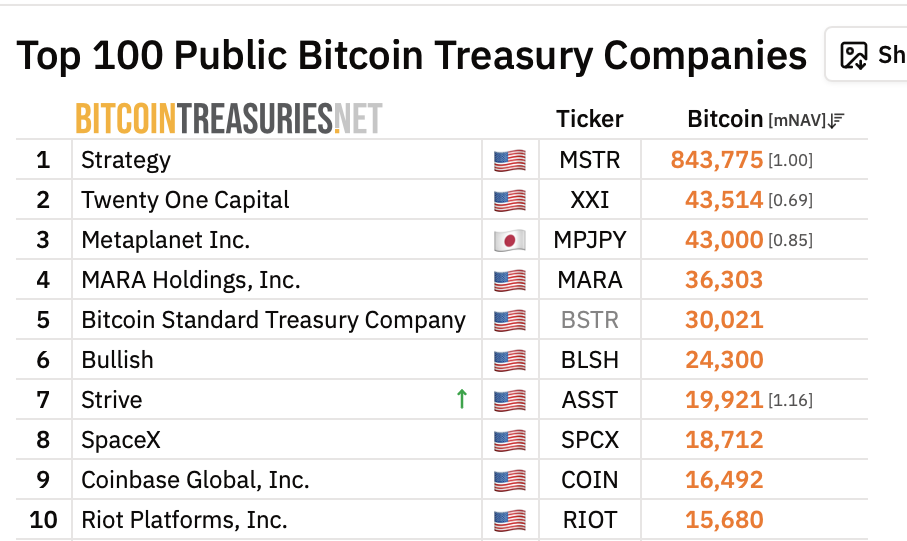
The disparity between the two products highlights the nuances of investor sentiment regarding corporate credit risk and Bitcoin exposure. While Strategy remains the undisputed leader in global corporate Bitcoin holdings, boasting a massive treasury of 843,775 BTC, Strive has rapidly ascended the ranks. Currently occupying the seventh position among public companies, Strive holds 19,921 BTC, according to data from BitcoinTreasuries.NET. The ability of these firms to maintain the par value of their preferred shares is viewed by analysts as a litmus test for the viability of Bitcoin-denominated corporate credit.

Chronology of the 2025-2026 Bitcoin Credit Cycle
To understand the current recovery, it is essential to trace the timeline of the "digital credit" movement:
- November 2025: Strive launches SATA via an oversubscribed and upsized Initial Public Offering (IPO). The Nasdaq listing marks a turning point for preferred equity products tied to digital assets.
- Early 2026: A wave of institutional interest drives several firms to adopt the "Strategy Model," leading to the launch of various digital bonds and preferred share offerings.
- June 2026: A broader market correction in the cryptocurrency sector triggers a liquidity squeeze. SATA drops to its record low of $83.30, and STRC sees a similar sharp decline. Market skeptics question the sustainability of the variable-dividend model.
- July 2026: Leading Bitcoin treasury companies announce balance sheet reinforcements. Strive and Strategy emphasize their multi-year dividend coverage.
- July 15, 2026: Lyn Alden’s Orange Juice treasury company enters the market, signaling that macro-analysts and institutional players still see a "lower cost basis" opportunity despite recent volatility.
- Late July 2026: SATA recovers to $97, leading the sector back toward par value and stabilizing the "digital credit" narrative.
Analytical Perspective: The Mechanics of Variable-Rate Perpetual Equity
The core appeal of SATA and STRC lies in their "perpetual" nature and the "variable-rate" dividend. Unlike traditional bonds that have a maturity date, perpetual preferred shares stay on the balance sheet indefinitely, providing the issuing company with permanent capital. For a Bitcoin-heavy firm, this is an ideal arrangement: they receive cash to buy Bitcoin today, and in exchange, they pay a dividend to shareholders that fluctuates based on the share’s market price relative to par.
If the share price falls below $100, the dividend rate typically increases to attract buyers and push the price back toward par. Conversely, if the price exceeds par, the dividend can be lowered. This self-correcting mechanism is designed to minimize volatility for the investor while providing the issuer with a non-dilutive source of funding. The recent recovery of SATA suggests that the market believes Strive has sufficient cash flow—or Bitcoin-backed collateral—to sustain these dividend payments even during periods of price stagnation.
Industry Reactions and Expert Insights
Samson Mow, the founder and CEO of Jan3 and a prominent figure in the Bitcoin ecosystem, has been a vocal proponent of the treasury model. In a recent interview, Mow suggested that the recovery of SATA is a precursor to a broader stabilization of the Bitcoin credit markets. He argued that the panic witnessed in June was unfounded, as the primary players in the space are well-capitalized.
"I think every action that Strategy has undertaken to strengthen their balance sheet and encourage STRC to go back to par is also working," Mow stated. He emphasized that the sector functions in tandem; as SATA returns to par, it provides a psychological and financial floor for STRC and other similar products. "People say, ‘OK, this model’s not broken.’ Everyone is capitalized for three or more years of dividend payments… there was no reason to panic all along."
Mow’s assessment points to a "maturation phase" where the market is learning to differentiate between the volatility of Bitcoin the asset and the stability of the financial instruments built on top of it. He also highlighted the entry of new players like Lyn Alden’s Orange Juice as a sign of healthy competition and a diversifying market. These new entrants often bring different strategic approaches and lower entry points, which helps build a more resilient ecosystem.
Broader Impact on Corporate Finance and "Digital Credit"
The success of the SATA recovery has implications that extend far beyond the crypto-native community. Traditional corporate finance has long relied on preferred shares for utilities and financial institutions. By successfully porting this model to the Bitcoin sector, companies like Strive and Strategy are creating a new asset class often referred to as "digital credit."
This emerging segment allows institutional investors—such as pension funds and insurance companies that may be restricted from holding spot Bitcoin—to gain exposure to the asset’s growth through a regulated, yield-bearing instrument. If these shares can consistently maintain their par value, they could eventually be used as high-quality collateral in the broader repo markets, further integrating Bitcoin into the plumbing of global finance.
However, risks remain. The "digital credit" model relies heavily on the long-term price appreciation of Bitcoin or the ability of the issuing company to generate enough operational cash flow to cover dividends. Should Bitcoin enter a multi-year bear market, the pressure on these companies to maintain dividend payments without selling their BTC holdings would be immense.
The Path Forward for Bitcoin Treasury Companies
As of late July 2026, the hierarchy of Bitcoin holders remains concentrated at the top, but the "middle class" of corporate holders is expanding. While Strategy’s 843,775 BTC makes it a category of its own, Strive’s 19,921 BTC and the emergence of firms like Metaplanet in Japan and Orange Juice in the U.S. indicate a global trend.
The next six months will be crucial for SATA and STRC. If SATA can maintain its position at or near the $100 par value, it will likely encourage a new wave of IPOs from other firms looking to mirror Strive’s success. Investors will be watching the dividend adjustment cycles closely to see if the "variable-rate" promise holds true under different interest rate environments.
For now, the recovery of SATA from its $83.30 low stands as a testament to the resilience of the Bitcoin treasury strategy. It suggests that the market has moved past the initial shock of the mid-year selloff and is now pricing in a more stable, institutional-grade future for Bitcoin-backed equities. As Mow concluded, the model is not broken; rather, it is being refined in real-time, providing a blueprint for the future of corporate capitalization in a digital-first economy.