James Watt
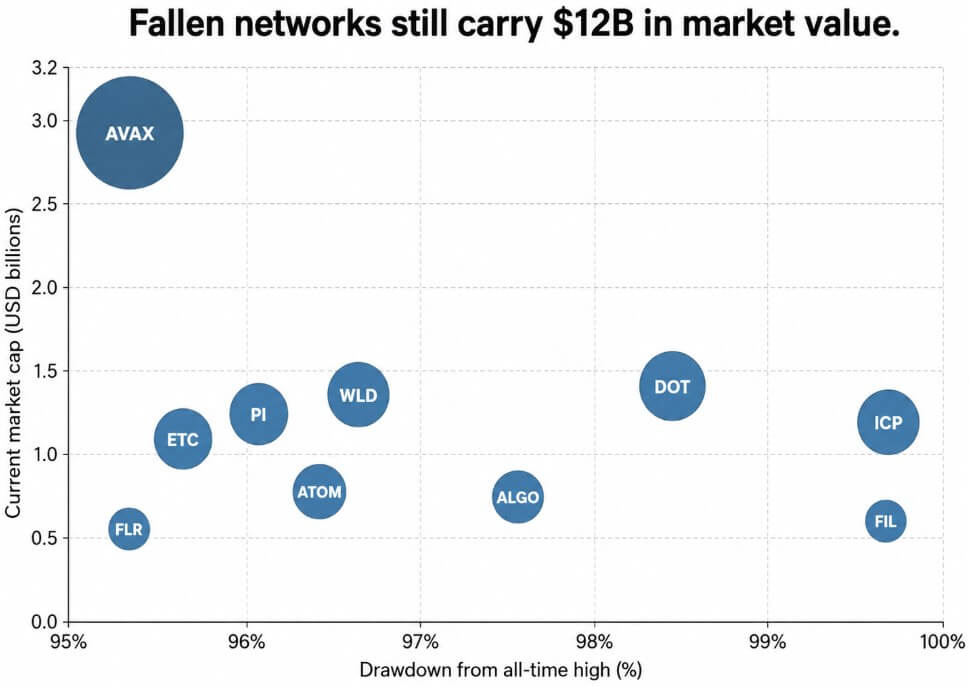
Ten once-prominent cryptocurrency networks currently maintain a combined market capitalization of $12.06 billion, yet they are trading at an average of 97.13% below their historical peaks, raising urgent questions regarding their long-term economic viability. According to a comprehensive analysis by Taurex, the recovery requirements for these assets are staggering; Avalanche, the largest of the group with a market value of $2.91 billion, requires a 21.5x increase to reclaim its all-time high, while the Internet Computer (ICP) remains 99.7% below its peak, necessitating a 323x rally to return to its former valuation. This massive drawdown represents more than just a loss for investors; it signifies a fundamental shift in the ability of these decentralized protocols to fund essential operations, including network security, developer grants, and ecosystem growth.
The traditional blockchain economic model relies heavily on token issuance and treasury spending to incentivize validators and attract talent. This "subsidy-led" growth is highly effective during periods of price appreciation, where newly minted tokens carry significant real-world purchasing power. However, at current levels of devaluation, the same rate of token issuance provides substantially less funding in dollar terms, leading to a precarious cycle of dilution for existing holders and a recurring supply of tokens that enters a market with diminishing demand. The core challenge facing these ten networks—Algorand, Internet Computer, Filecoin, Polkadot, Cosmos Hub, Avalanche, Flare, Ethereum Classic, Worldcoin, and Pi Network—is whether they can achieve self-sustainability through user-generated fees before their treasuries or issuance schedules are exhausted.
The Mechanics of the Subsidy Coverage Ratio
To evaluate the health of these ecosystems, analysts utilize the subsidy coverage ratio, defined as user-paid transaction fees divided by token rewards and incentives. This metric serves as a barometer for a network’s economic independence. A ratio of 1.0 indicates that a network is fully self-sustaining, where user demand covers the costs of securing and maintaining the infrastructure. Currently, most of the networks in this group fall significantly below this threshold, indicating a heavy reliance on subsidies.
A secondary metric, known as the routed security coverage, focuses specifically on the income received by validators and miners. By dividing the fees actually collected by infrastructure operators by the consensus rewards, stakeholders can determine if the people securing the chain are being paid through genuine utility or through inflationary pressure. When token prices collapse by 95% or more, the fiat-denominated costs for validators—such as electricity, hardware, and data center fees—remain fixed, while their revenue in native tokens loses its value, often forcing smaller or less capitalized operators to exit the network.
Case Studies in Economic Strain: Algorand and Internet Computer
The disparity between network incentives and organic revenue is most visible in the recent performance data of Algorand. In May 2026, Algorand validators earned approximately 6.93 million ALGO in staking rewards. During the same period, the network generated only 50,000 ALGO in transaction fees. This implies that for every ALGO distributed as a reward, the network collected only 0.7 cents in fees, excluding additional subsidies from the Algorand Foundation. By June, rewards remained high at 6.57 million ALGO, contributing to a total of 40.15 million ALGO distributed in the first half of the year, a rate of issuance that the current fee structure cannot support without significant token price appreciation.

The Internet Computer (ICP) faces a different but equally complex challenge due to its unique reward structure. Node-provider rewards on the Internet Computer are denominated in XDR (a basket of international currencies) and paid out in ICP based on a 30-day moving average. As the price of ICP weakens, the protocol must issue a larger volume of tokens to cover the same fixed operating costs. While the network utilizes a "burn" mechanism—where users burn ICP to create "cycles" for computational power—the ultimate test for the network is whether the volume of burned cycles and transaction fees can eventually outpace the governance and node-provider rewards that continue to dilute the supply.
Strategic Shifts: Filecoin and Polkadot Governance
In response to these economic pressures, several networks have begun implementing drastic governance changes to pivot away from inflationary models. Filecoin, for instance, has introduced a "Solstice" proposal aimed at reshaping its service economy. The strategy focuses on redirecting rewards toward "useful work" and paid storage usage rather than simple capacity provision. With final vesting periods for early contributors ending later this year, Filecoin is attempting to transition into a model where storage providers are compensated by paying customers, thereby closing the gap between subsidized growth and real-world demand.
Polkadot has also moved toward a more constrained economic architecture. Starting in March 2026, the network began a scheduled step-down in token issuance, a process that will repeat every two years until a hard cap is reached. To manage this transition, Parity’s Dynamic Allocation Pool (DAP) now routes fees, "coretime" sales, and slashes dynamically across the treasury, validators, and reserves. This allows the network to decide in real-time which sectors receive funding as the total pool of new tokens shrinks, effectively forcing the ecosystem to prioritize high-value projects over broad subsidies.
Inflation and Sell-Pressure in the Cosmos Ecosystem
The Cosmos Hub has encountered significant scrutiny regarding its issuance rate. Research from July 2026 revealed that the Hub releases approximately 0.153% of its total supply in claimed rewards every week. This rate is 3.6 times higher than that of Near Protocol and 5.7 times higher than Ethereum’s issuance. Such high levels of inflation create constant sell-pressure, particularly when the market’s ability to absorb new tokens is limited. Recent proposals within the Cosmos community have suggested adjusting future issuance based on observed demand and market liquidity. Furthermore, concerns regarding decentralization have surfaced, with the Hub’s Nakamoto coefficient currently sitting at six, and a single large validator controlling over 17% of the staked supply, complicating the network’s efforts to balance security with economic stability.
The Outliers: Avalanche, Ethereum Classic, and Worldcoin
Avalanche remains the most robust of the "fallen" networks in terms of market valuation, yet its economic model is not without risks. Unlike networks that use fees to pay validators, Avalanche burns all transaction fees. While this creates a deflationary mechanism for the token supply, it means that validators are paid exclusively through the minting of new AVAX from a fixed cap of 720 million tokens. Consequently, the demand signal generated by users (fees) does not directly fund the people securing the chain, making the network’s security dependent on the long-term value of the remaining unminted supply.
Ethereum Classic (ETC) continues to follow its rigid, Bitcoin-like monetary policy. The network reduces block rewards by 20% every 5 million blocks. The upcoming "Era 6" reduction, expected around block 25 million in July 2026, will automatically tighten the economics for miners. In an environment where the ETC price remains stagnant, these scheduled "halvings" put immense pressure on miner profitability, potentially leading to a consolidation of hash power among only the most efficient operators.
Worldcoin and Pi Network present unique cases that deviate from standard validator-subsidy models. Worldcoin’s primary pressure stems from token unlocks rather than staking rewards. In July 2026, the daily community release was slashed by 50%, reducing the unlock rate from 3.2 million WLD to 1.6 million WLD. Despite this 43% reduction in total unlocks, the network still faces the challenge of absorbing a massive circulating supply into a market that has yet to demonstrate a sustained need for the token beyond its initial distribution. Similarly, Pi Network has allocated 65% of its supply to mining rewards but only 5% to liquidity, meaning its survival depends entirely on whether its internal ecosystem of apps and payments can generate enough utility to justify its massive distribution.
Comparative Analysis and Broader Implications
The plight of these ten networks highlights a broader trend in the cryptocurrency industry: the transition from "speculative infrastructure" to "utility-driven economies." During the 2021-2022 market cycle, investors valued networks based on their potential capacity and theoretical throughput. In the 2024-2026 era, valuation is increasingly tied to the Subsidy Coverage Ratio.
The implications of a prolonged failure to close the funding gap are severe. If token prices do not recover, foundations will be forced to make difficult choices:
- Grant Reductions: Cutting funding for third-party developers, which slows ecosystem growth and pushes talent toward newer, better-funded chains (such as Layer 2 solutions or high-velocity Layer 1s like Solana).
- Infrastructure Attrition: As rewards lose value against fiat operating costs, smaller validators exit, leading to increased centralization and potential security vulnerabilities.
- Treasury Depletion: Foundations holding their native tokens as primary reserves see their "runway" evaporate, leading to a loss of strategic influence and the inability to defend the network during crises.
Conversely, the bull case for these networks involves a "convergence" where paid demand meets issuance. If Filecoin successfully captures a portion of the global decentralized storage market, or if Polkadot’s coretime sales generate significant revenue, these networks could reach a point of self-sustainability. Once a network is no longer dependent on continuous token issuance to survive, it can operate effectively even if its token price remains far below its all-time high.
Conclusion: The Two-Year Outlook
The next 24 months will serve as a definitive period for these ten blockchain networks. The evidence suggests that governance bodies are already aware of the impending "subsidy cliff," as seen in the flurry of proposals like Flare’s FIP.16 and the Cosmos Hub’s demand-linked emissions framework. However, governance alone cannot manufacture user demand.
The real test is whether these platforms can transform from $12 billion "legacy assets" into functional utilities. For the holders of these tokens, the focus must shift from waiting for a price recovery to monitoring the growth of user-paid fees. In the mature phase of the crypto economy, the networks that survive will not be those that reached the highest peaks in 2021, but those that managed to balance their books when the hype vanished. The transition from inflationary subsidies to fee-based sustainability is the most difficult hurdle in the lifecycle of a blockchain, and for these ten networks, the clock is ticking.