admin
admin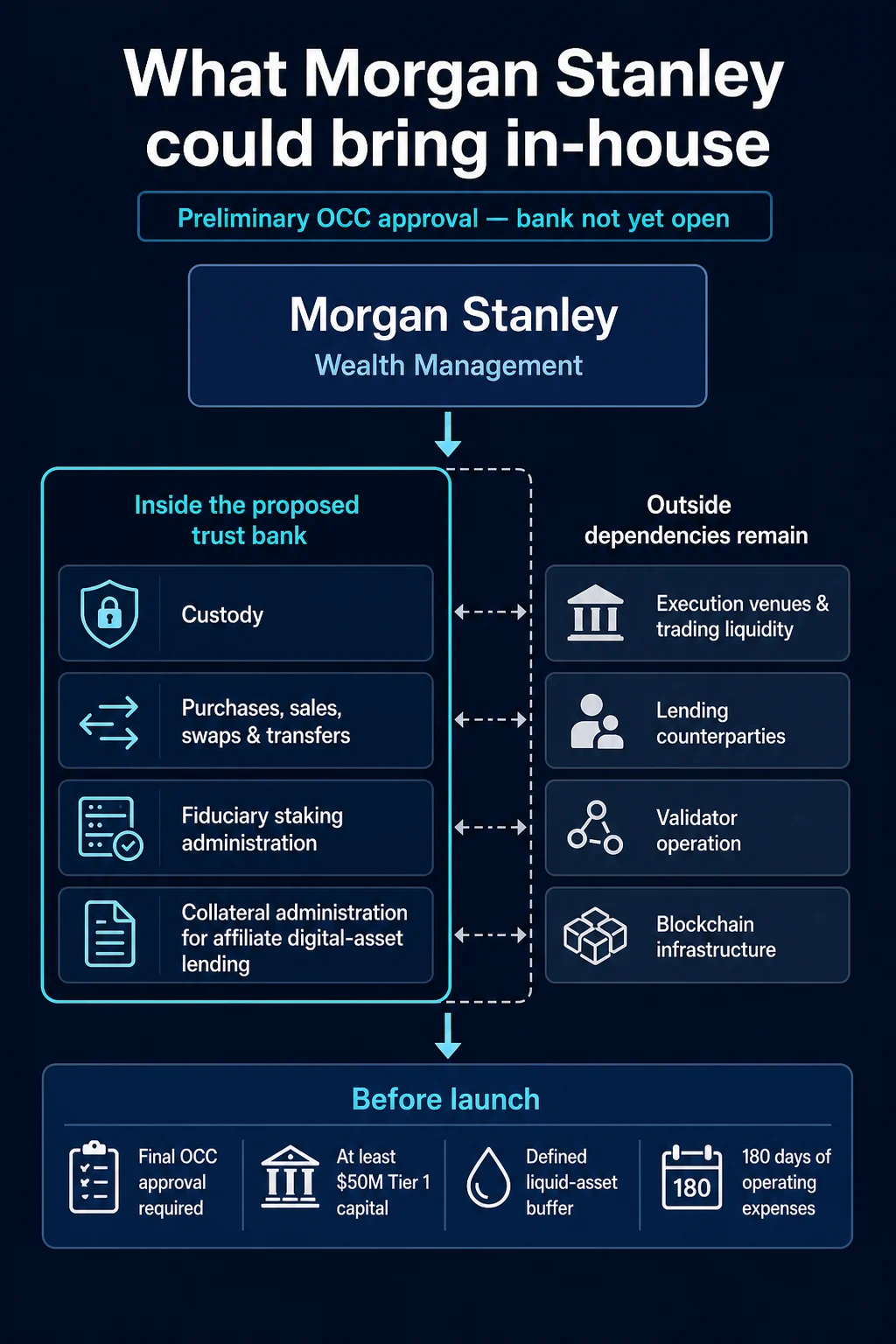
Morgan Stanley, a titan of the financial services industry, has received preliminary conditional approval from the Office of the Comptroller of the Currency (OCC) to establish a national trust bank dedicated to digital assets. This significant development, greenlit in June, paves the way for the banking behemoth to internalize a suite of critical cryptocurrency functions, including custody, transaction administration, fiduciary staking, and collateral support, potentially reshaping the competitive landscape for crypto-native intermediaries.
A Strategic Move Towards Vertical Integration
The OCC’s decision, documented in its Corporate Decision 1378, marks a pivotal moment in traditional finance’s engagement with digital assets. By establishing Morgan Stanley Digital Trust, a wholly owned national trust bank, the firm aims to consolidate services that have historically been outsourced to specialized third-party providers. This move signifies a strategic push towards vertical integration, allowing Morgan Stanley to exert greater control over its digital asset operations and client relationships.
The proposed trust bank would primarily serve Morgan Stanley’s Wealth Management clients, offering a regulated and secure environment for their digital asset activities. The public application for this new charter details a comprehensive range of services, encompassing the safeguarding of assets, management of transactions, and administration of fiduciary staking and collateral for affiliated digital asset lending. This level of in-house control was previously uncommon for traditional financial institutions venturing into the digital asset space.
Chronology of an Evolving Regulatory Landscape
The path to this approval has been unfolding over several years, reflecting a gradual but determined effort by major financial players to navigate the complex regulatory terrain of cryptocurrencies. As early as 2023, reports indicated Morgan Stanley’s growing interest in expanding its digital asset capabilities beyond brokerage and trading. The OCC’s proactive stance on chartering digital asset-focused entities has been instrumental in facilitating such initiatives.
The preliminary approval in June 2026 follows a rigorous application process, during which Morgan Stanley had to demonstrate its financial capacity and operational readiness. According to the OCC’s records, the charter action was officially approved on June 18, 2026. This preliminary green light means that Morgan Stanley must now meet specific capital and liquidity requirements before full operationalization. These requirements include maintaining at least $50 million in Tier 1 capital, a designated pool of liquid assets, and sufficient liquidity to cover 180 days of operating expenses.

Expanding the Scope of In-House Capabilities
The services outlined in Morgan Stanley’s application are extensive and cover a broad spectrum of the digital asset lifecycle. They include:
- Custody: Securely holding and safeguarding client digital assets.
- Transaction Administration: Managing the execution of purchases, sales, swaps, and transfers of digital assets.
- Fiduciary Staking: Administering staking activities on behalf of clients, potentially earning rewards for them through participation in proof-of-stake networks.
- Collateral Administration: Managing digital assets used as collateral for lending activities, particularly those involving affiliated entities.
By bringing these functions in-house, Morgan Stanley aims to streamline operations, enhance security, and potentially reduce costs associated with relying on external service providers. This consolidation could lead to a more cohesive and efficient client experience, as all aspects of digital asset management are handled within a single, trusted entity.
Impact on the Crypto-Native Ecosystem
The implications of Morgan Stanley’s move are significant for the existing crypto-native ecosystem. Third-party custodians, staking administrators, and collateral service providers, whose business models often revolve around offering these specialized services to institutional clients, will face intensified competition. As a major Wall Street firm brings these core functions under its umbrella, the reliance on external intermediaries for these critical services may diminish.
This shift could lead to a reassessment of value propositions by crypto-native firms. They will need to articulate clearly where they continue to offer unique advantages or specialized expertise that Morgan Stanley’s in-house solution may not fully replicate. Areas such as cutting-edge blockchain technology development, specialized DeFi strategies, or bespoke risk management solutions could become key differentiators.
External Dependencies Remain Crucial
Despite the move towards internalization, it is crucial to note that several layers of the digital asset infrastructure will continue to rely on external venues and providers. The OCC filing explicitly delineates what Morgan Stanley intends to keep within its regulated trust bank structure, while acknowledging that other essential components will remain outside.
These external dependencies include:

- Execution Venues: Access to regulated exchanges and trading platforms for the buying and selling of digital assets.
- Trading Liquidity: The availability of sufficient buyers and sellers in the market to facilitate efficient trades.
- Lending Counterparties: The network of institutions and entities willing to engage in digital asset lending and borrowing.
- Validator Operations: For proof-of-stake networks, the operation of validators that secure the network and process transactions.
- Broader Blockchain Infrastructure: The underlying technology, protocols, and network participants that form the foundation of the digital asset ecosystem.
These external relationships and infrastructure choices will continue to necessitate partnerships and integrations with various specialized firms. Morgan Stanley’s trust bank will operate within this broader ecosystem, leveraging external services where necessary while controlling core client-facing functions.
A New Paradigm for Institutional Digital Asset Management
The establishment of Morgan Stanley Digital Trust represents a significant step towards the maturation of institutional digital asset management. It signals a growing confidence in the regulatory frameworks that govern digital assets and a strategic recognition of their potential within diversified investment portfolios.
By internalizing key functions, Morgan Stanley is not only aiming to enhance its service offering but also to set new standards for security, compliance, and operational efficiency in the digital asset space. This move could inspire other traditional financial institutions to follow suit, further accelerating the integration of digital assets into mainstream finance.
The success of Morgan Stanley Digital Trust will hinge on its ability to effectively manage these complex operations, maintain robust security protocols, and adapt to the rapidly evolving digital asset landscape. As the OCC’s preliminary approval transitions to final authorization, the industry will be watching closely to see how this strategic shift by one of Wall Street’s giants reshapes the future of institutional crypto services. The landscape for crypto-native intermediaries is set to become more challenging, demanding greater innovation and specialization to remain competitive against the integrated offerings of established financial powerhouses.