James Watt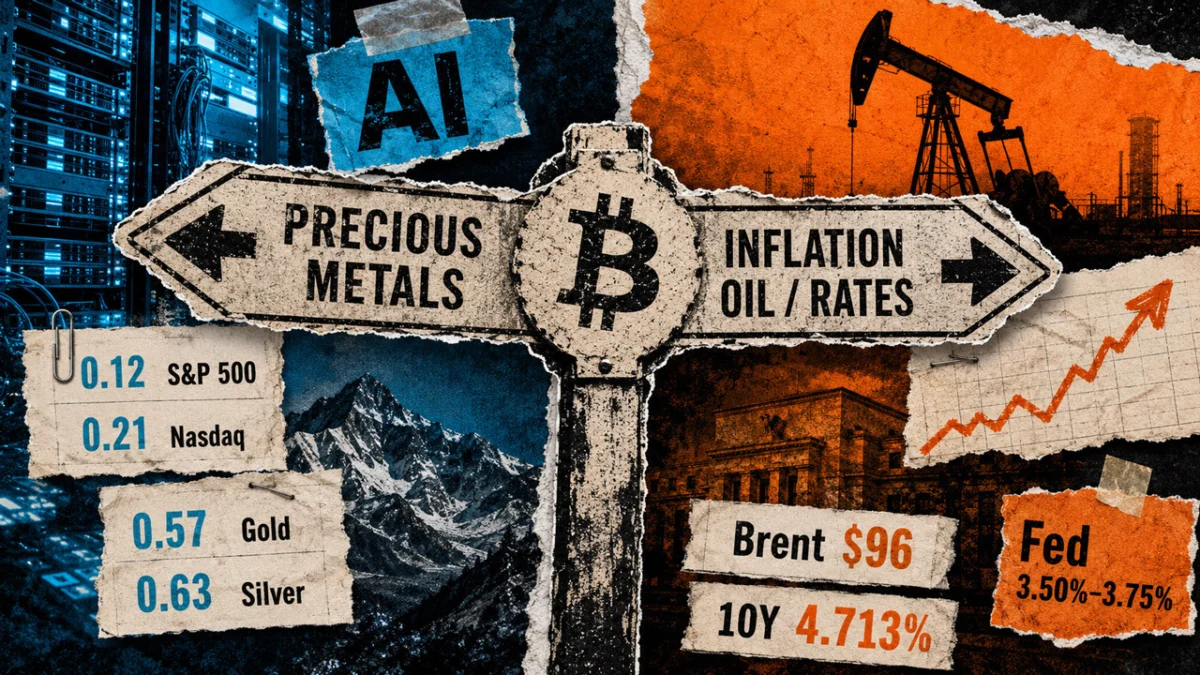
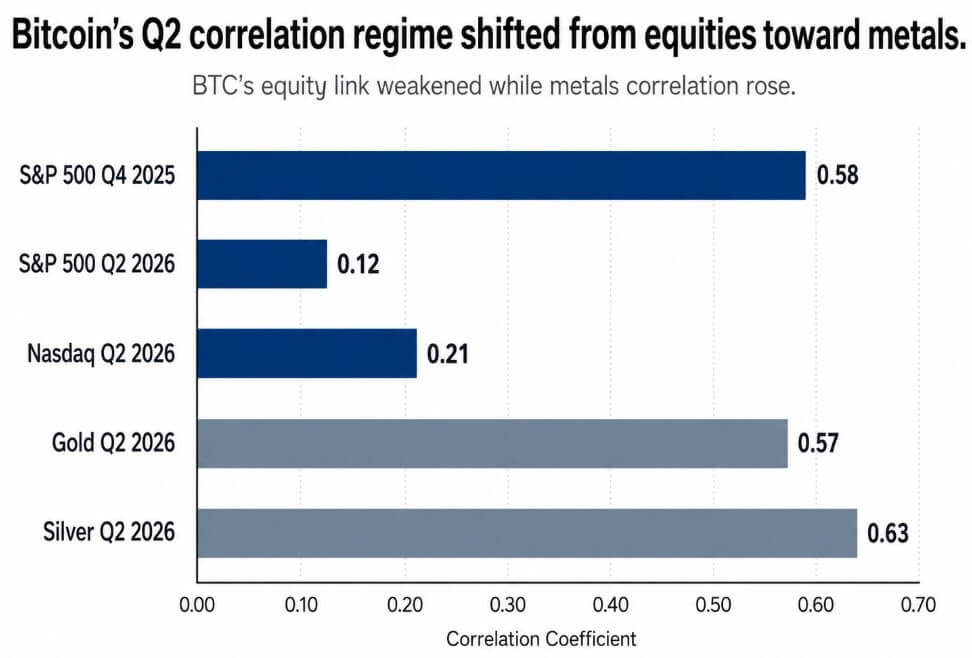
Bitcoin’s historical tendency to trade in lockstep with high-growth technology stocks has reached a significant turning point, as new data reveals a sharp divergence between the world’s largest cryptocurrency and the S&P 500. According to a comprehensive joint report released by Coinbase Institutional and Glassnode, Bitcoin’s daily correlation with the S&P 500 plummeted to 0.12 during the second quarter of 2026, a staggering decline from the 0.58 correlation recorded during the final quarter of 2025. This decoupling marks a fundamental shift in Bitcoin’s market regime, moving it away from the AI-driven equity narrative that has dominated global markets for much of the past two years and realigning it with traditional "hard money" assets like gold and silver.
The data, which covers market activity through June 30, indicates that Bitcoin’s correlation with the tech-heavy Nasdaq sat at a mere 0.21 over the same period. In contrast, the digital asset has moved in closer synchronization with precious metals. Bitcoin’s correlation with gold climbed to 0.57, while its correlation with silver reached 0.63. This transition suggests that investors are increasingly viewing Bitcoin through the lens of a macro hedge or a store of value, rather than a speculative extension of the technology sector.
The Evolution of the Correlation Regime
The shift in Bitcoin’s correlation metrics arrives at a critical juncture for global financial markets. For much of 2024 and 2025, Bitcoin was frequently categorized as a "risk-on" asset, often surging alongside the "Magnificent Seven" and other leaders of the artificial intelligence (AI) revolution. However, as the second quarter of 2026 progressed, this link weakened. The reversal comes as the Federal Reserve prepares for its high-stakes meeting on July 28-29, and as technology titans including Microsoft, Meta, and Amazon prepare to release their quarterly earnings reports.
Analysts from Coinbase Institutional and Glassnode, including Colin Basco, suggest that the current market phase represents a transition from a corrective period toward a period of strategic accumulation. Supporting this view is on-chain data showing that the volume of Bitcoin that last transacted within the past three months has reached multi-year lows. Simultaneously, there has been a notable increase in "dormant supply"—coins held by long-term investors who show no intention of selling despite short-term price fluctuations. Historically, the combination of low short-term transaction volume and rising dormant supply has signaled the late stages of a consolidation phase, often preceding a new upward trend.
A Shared Macro Channel: Real Rates and Liquidity
The strengthening link between Bitcoin and gold is not merely a statistical coincidence; it is rooted in a shared sensitivity to the macroeconomic environment. The Coinbase and Glassnode report frames this second-quarter gold link by pointing to a firmer U.S. dollar and a hawkish Federal Reserve. Both Bitcoin and gold have faced downward pressure from the same "real-rate" and liquidity forces that have dictated price action throughout the year.
When real interest rates (the nominal interest rate minus inflation) rise, the opportunity cost of holding non-yielding assets like Bitcoin and gold increases. Throughout the first half of 2026, the Federal Reserve maintained a restrictive stance to combat stubborn inflation, keeping the federal funds rate between 3.50% and 3.75%. This environment bolstered the U.S. dollar and kept Treasury yields elevated, dragging down both the "digital gold" and its physical counterpart in tandem.
This shared sensitivity changes the outlook for how an AI-driven stock selloff might impact Bitcoin. Previously, a decline in tech shares might have sparked a "risk-off" contagion that hit Bitcoin. Now, the impact depends on the cause of the equity selloff. If money leaves technology shares because of a disinflationary growth slowdown, pushing Treasury yields lower and weakening the dollar, Bitcoin could benefit as a scarce asset. However, if tech shares fall because of rising costs—such as energy, tariffs, or infrastructure spending—the resulting inflationary pressure could keep yields high, hurting Bitcoin and gold simultaneously.

The Burden of AI Infrastructure and Hyperscaler Capex
A significant factor weighing on the broader market is the massive capital expenditure (capex) required to sustain the AI boom. The four largest U.S. "hyperscalers"—Microsoft, Alphabet (Google), Amazon, and Meta—are currently on pace to spend over $700 billion this year on AI infrastructure alone. Morgan Stanley projects this figure could exceed $1 trillion in 2027.
On July 22, Alphabet raised its 2026 capex guidance to a range of $195 billion to $205 billion, up from previous estimates of $180 billion to $190 billion. Perhaps more tellingly, the company reported its first negative free-cash-flow quarter, burning $5.9 billion. This trend has sparked concerns among investors that the massive investments in AI may not yield immediate returns on capital. If current spending trajectories continue, these tech giants could collectively spend more on capex than they generate in free cash flow by 2027.
This "capex crunch" has broader implications for inflation and interest rates. New York Fed President John Williams recently tied elevated inflation to several structural factors, including tariffs, Middle East-driven energy costs, and the surging demand for electricity driven by technology investment. He specifically cited the demand for semiconductors and power transformers as contributors to price stickiness. The Fed’s July Monetary Policy Report listed Personal Consumption Expenditures (PCE) inflation at 4.1% and core PCE at 3.4% for the twelve months through May, figures that remain well above the central bank’s 2% target.
Chronology of Economic Indicators and Market Reactions
The transition in Bitcoin’s market behavior can be traced through a series of key economic data points and central bank projections throughout 2026:
- March 2026: The Fed’s Summary of Economic Projections (SEP) initially estimated a year-end funds-rate median of 3.4%.
- May 2026: PCE inflation data shows persistent core inflation at 3.4%, prompting a more hawkish tone from Fed officials.
- June 2026: The June SEP lifted the 2026 median PCE forecast to 3.6% and the year-end funds-rate median to 3.8%, signaling that rates would stay "higher for longer."
- July 7, 2026: The U.S. Energy Information Administration (EIA) releases a base case putting Brent crude at an average of $74 per barrel for Q3.
- July 22, 2026: Alphabet’s earnings report reveals negative free cash flow, raising questions about AI profitability.
- July 24, 2026: Brent crude surges to $96 per barrel, far exceeding the EIA forecast. On the same day, the 10-year Treasury yield touches 4.713%, and the 30-year yield reaches a 19-year high. Gold trades near $4,073 an ounce, while silver sits near $58.77.
This chronology illustrates a tightening macro environment where inflation risks are being driven by energy and infrastructure costs, creating a challenging backdrop for both equities and alternative stores of value.
Two Versions of the AI Selloff: Bull vs. Bear
As the market enters the third quarter, analysts are weighing two distinct scenarios for how the ongoing volatility in AI shares will affect Bitcoin.
The Bullish Case for Bitcoin:
In this scenario, investors reject the stretched valuations of AI companies or demand more immediate returns on the capital committed to infrastructure. This leads to a rotation out of tech equities. Because this unwind is driven by a reassessment of valuation rather than a spike in inflation, Treasury yields begin to decline and the U.S. dollar softens. Capital rotates toward scarce, liquid assets. Bitcoin, silver, and gold rise in unison, remaining detached from the Nasdaq as investors seek protection from equity market volatility.
The Bearish Case for Bitcoin:
In this scenario, AI shares fall because the costs of the AI revolution—specifically oil, power demand, and specialized hardware—keep inflation stubbornly high. This forces the Federal Reserve to maintain or even increase interest rates, pushing Treasury yields and the dollar higher. In this "tight money" environment, expensive technology stocks, precious metals, and Bitcoin all decline together, as the high cost of money outweighs the "scarcity" appeal of digital and physical commodities.
Oil as the Third-Quarter Macro Switch
The price of energy appears to be the primary variable that will determine which of these scenarios plays out. While the EIA projected Brent crude to average $74 in the third quarter, the live price has remained significantly higher, recently hovering around $96.
Prices above the $90 threshold are viewed as a "caution zone" where energy costs begin to bleed into broader inflation metrics, lifting yields and pressuring Bitcoin. If oil prices return toward the EIA’s $74 target, it would likely provide the disinflationary tailwind needed for the bullish rotation case to manifest. Conversely, sustained prices near $100 could keep the bear case alive by cementing "higher-for-longer" rate expectations.
ETF Flows: A Stabilizing Signal
Amidst the macro volatility, the behavior of institutional investors through U.S. spot Bitcoin ETFs provides a secondary layer of data. After facing net outflows through much of the first half of the year, there are early signs that selling pressure is exhausting.
The funds recorded a notable streak of seven consecutive days of net inflows through July 22, totaling nearly $1 billion. Although this streak ended on July 23 with a $225 million outflow, the brief period of sustained buying suggests that institutional demand is stabilizing. Analysts are closely watching to see if these inflows represent a tactical rotation from AI-heavy portfolios into crypto, though it will take several more weeks of data to confirm a long-term trend.
Analysis: The New Diversification Reality
The decoupling of Bitcoin from the Nasdaq is a development that many crypto advocates have long anticipated, viewing it as a sign of the asset’s maturity. However, the report’s findings offer a nuanced perspective on the benefits of this decoupling.
While Bitcoin’s edge against equities has strengthened, its 0.57 correlation with gold suggests that it may offer limited diversification benefits for portfolios that are already heavily weighted in precious metals. For a modern portfolio manager, Bitcoin is increasingly behaving like a high-velocity version of gold—sensitive to the same macro levers but with higher volatility.
As the third quarter unfolds, the assumption that "bad news for Nvidia is good news for Bitcoin" will be put to the test. Bitcoin has entered a new regime where its path is no longer tied to the success of Silicon Valley’s latest algorithms, but rather to the fundamental cost of money and the price of the energy required to power the global economy. Whether Bitcoin can maintain its status as a "safe haven" will depend on its ability to navigate a macro channel where real rates, not retail hype, are the primary drivers of value.