Layla Zulfa
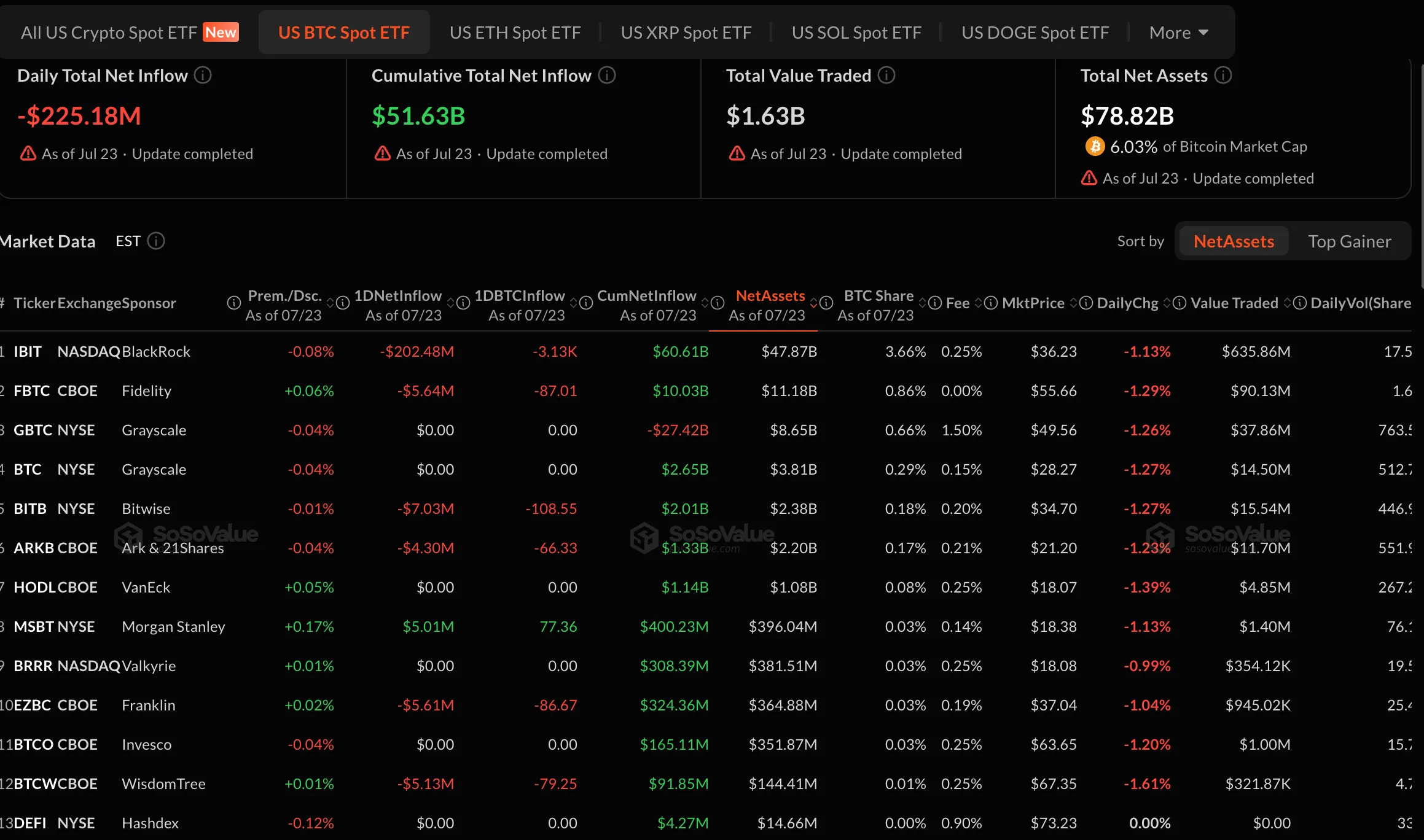
The landscape for United States-listed spot Bitcoin exchange-traded funds (ETFs) underwent a significant shift on Thursday, as a period of sustained bullish momentum came to an abrupt halt. After a seven-session streak that saw nearly $1 billion in fresh capital flow into the sector, the market recorded net outflows totaling $225.2 million. This reversal marks the first negative trading day for the category since July 13, signaling a cautious recalibration among institutional and retail investors alike.
The transition from net inflows to net outflows represents a technical shift in fund mechanics. In the context of spot ETFs, an outflow occurs when the volume of shares being redeemed by investors exceeds the volume of new shares being purchased. To meet these redemption demands and maintain the fund’s peg to the underlying asset, fund managers are required to liquidate a portion of the Bitcoin held in their reserves. Despite the significance of Thursday’s reversal, the broader weekly performance remains in positive territory, with the collective funds maintaining a net gain of approximately $274 million for the five-session period ending Thursday.
Granular Analysis of Fund Performance
The bulk of the day’s selling pressure was concentrated in the market’s largest vehicle, BlackRock’s iShares Bitcoin Trust (IBIT). The fund, which has been a primary driver of institutional adoption since its inception in January, shed $202.5 million. This substantial figure accounted for the vast majority of the day’s total outflows. While BlackRock’s performance was the most pronounced, it was not an isolated incident. Several other major players in the space also reported net losses.
Fidelity’s Wise Origin Bitcoin Fund (FBTC), the Bitwise Bitcoin ETF (BITB), the ARK 21Shares Bitcoin ETF (ARKB), the Franklin Bitcoin ETF (EZBC), and the WisdomTree Bitcoin Fund (BTCW) all posted varying degrees of negative movement. The synchronicity of these outflows across different providers suggests a macro-driven sentiment shift rather than issues specific to any individual fund structure or management team.
In a notable divergence from the general trend, Morgan Stanley’s Bitcoin ETF (MSBT) emerged as the sole institution to record positive movement on Thursday. The fund added $5 million in net inflows, suggesting that certain segments of the institutional market remain committed to accumulating the asset during price dips. This "lone holdout" status highlights the fragmented nature of current market sentiment, where long-term wealth management strategies may occasionally clash with short-term tactical exits.
Geopolitical Instability and the Macroeconomic Backdrop
The timing of the ETF outflows appears closely correlated with broader tremors in the global financial markets. Market analysts have pointed to the escalating military exchanges between the United States and Iran as a primary catalyst for the sudden risk-aversion. Now entering its fifth month, the conflict has exerted consistent upward pressure on global oil prices, fueling concerns regarding persistent inflation and its subsequent impact on central bank policies.

On Thursday, major U.S. stock indices faced downward pressure, with investors rotating out of high-growth and "risk-on" assets. Bitcoin, which has increasingly traded in tandem with technology-heavy indices like the Nasdaq, was not immune to this flight to safety. During the height of the session’s volatility, the digital asset briefly dipped below the psychologically significant $65,000 threshold, reaching a low of $64,600.
This price action triggered technical alarms among market observers. For the second time in recent weeks, Bitcoin’s price chart exhibited signs of a "death cross." This technical indicator occurs when a security’s short-term moving average—typically the 50-day average—crosses below its long-term moving average, usually the 200-day average. In traditional technical analysis, a death cross is often interpreted as a precursor to a sustained bear market or a period of significant consolidation. While crypto markets are notoriously volatile and technical indicators can produce false signals, the appearance of this pattern contributed to the day’s bearish narrative.
Sentiment Metrics and the Fear & Greed Index
The impact of these market movements was clearly reflected in the Crypto Fear & Greed Index. This proprietary metric aggregates data from several sources, including volatility, market momentum, social media sentiment, and dominance trends, to provide a snapshot of investor psychology on a scale of 0 to 100. On Thursday, the index dropped three points to a score of 28.
A score of 28 places the market firmly within the "Fear" zone. Notably, this represents the most panic-driven sentiment recorded in the last thirty days. The rapid descent from "Neutral" or "Greed" levels seen during the previous week’s $1 billion inflow streak underscores the current fragility of market confidence. Investors appear highly sensitive to external shocks, with geopolitical headlines capable of overriding the fundamental narrative of institutional adoption.
Historical Context and the "Two Steps Forward" Cycle
To understand the significance of Thursday’s $225.2 million outflow, it must be viewed within the context of the ETF sector’s performance throughout 2024. The recent seven-day bullish streak was a welcome reprieve for the industry following an exceptionally difficult two-month period. Between May and June, spot Bitcoin ETFs experienced a "record bleed," during which more than $8.2 billion was drained from the funds.
James Butterfill, Head of Research at CoinShares, previously characterized that period as the largest run of outflows the industry had ever witnessed. The recovery that began in early July was seen by many as a "turning of the corner," yet the recent reversal suggests that the path to recovery remains non-linear.
Bloomberg Intelligence analyst Eric Balchunas has frequently compared the trajectory of Bitcoin ETFs to the 22-year track record of gold ETFs. Balchunas posits that the growth of these crypto-linked funds will likely follow a "two steps forward, one step back" pattern. From this perspective, occasional high-volume outflow days are not necessarily indicative of a long-term failure of the asset class, but rather a standard feature of market maturation and price discovery.
The Ethereum Divergence and Market Rotation
Interestingly, while Bitcoin funds struggled, Ethereum-based investment products displayed a different trajectory. U.S.-listed Ethereum ETFs shrugged off the broader market gloom on Thursday, adding $26.3 million in net inflows. This extended Ethereum’s positive streak to five consecutive days.
This divergence suggests a potential "rotation" within the cryptocurrency ecosystem. Rather than a total exit from digital assets, some investors may be shifting capital from Bitcoin into Ethereum, perhaps in anticipation of specific network upgrades or as a diversification play following the recent launch of spot Ethereum ETFs. The ability of Ethereum funds to remain green while Bitcoin saw red indicates that the "crypto market" is no longer a monolithic entity; different assets are beginning to respond to unique fundamental drivers and institutional appetites.
The Federal Reserve and the Near-Term Outlook
As the market processes the recent outflows, attention is shifting toward the Federal Open Market Committee (FOMC) meeting scheduled for July 28-29. The Federal Reserve’s stance on interest rates remains the single most influential factor for risk assets, including Bitcoin.
The current macroeconomic environment is characterized by a delicate balance. While some economic indicators suggest a cooling of the U.S. economy—which would typically prompt the Fed to consider rate cuts—elevated oil prices and geopolitical tensions complicate the inflation outlook. If the Federal Reserve maintains a "hawkish" stance (signaling that rates will remain higher for longer), it could put further pressure on Bitcoin and other non-yielding assets. Conversely, any hint of a "dovish" pivot toward rate cuts in the autumn could provide the necessary catalyst for Bitcoin to reclaim the $70,000 level and reignite ETF inflows.
Implications for Institutional Adoption
The recent volatility serves as a litmus test for the "institutionalization" of Bitcoin. When spot ETFs were approved in January, the prevailing theory was that institutional capital would provide a "sticky" floor for the asset, reducing the extreme volatility associated with retail-driven markets. However, the $202.5 million outflow from BlackRock’s IBIT suggests that institutional investors can be just as reactive to geopolitical events and technical chart patterns as their retail counterparts.
Nevertheless, the entry of major wirehouses like Morgan Stanley into the space provides a counter-narrative. The fact that MSBT recorded inflows during a day of general panic suggests that professional wealth managers are beginning to view Bitcoin through the lens of long-term portfolio allocation rather than short-term speculation. As more financial advisors gain the regulatory clearance to recommend these products to their clients, the underlying liquidity of the spot ETF market is expected to deepen, potentially dampening the impact of future sell-offs.
In conclusion, the $225.2 million outflow on Thursday marks a significant pause in the recent recovery of the Bitcoin ETF market. Driven by a combination of geopolitical fears, technical bearish signals, and a cautious macroeconomic outlook, the event highlights the ongoing challenges of establishing Bitcoin as a stable "digital gold." While the Ethereum market shows signs of independent strength and the broader weekly trend for Bitcoin remains positive, the coming weeks—particularly the Federal Reserve’s upcoming policy announcement—will be critical in determining whether this reversal is a temporary setback or the start of a more prolonged period of capital flight. For now, the market remains in a state of watchful apprehension, navigating the complex intersection of digital innovation and traditional global finance.