Lina Irawan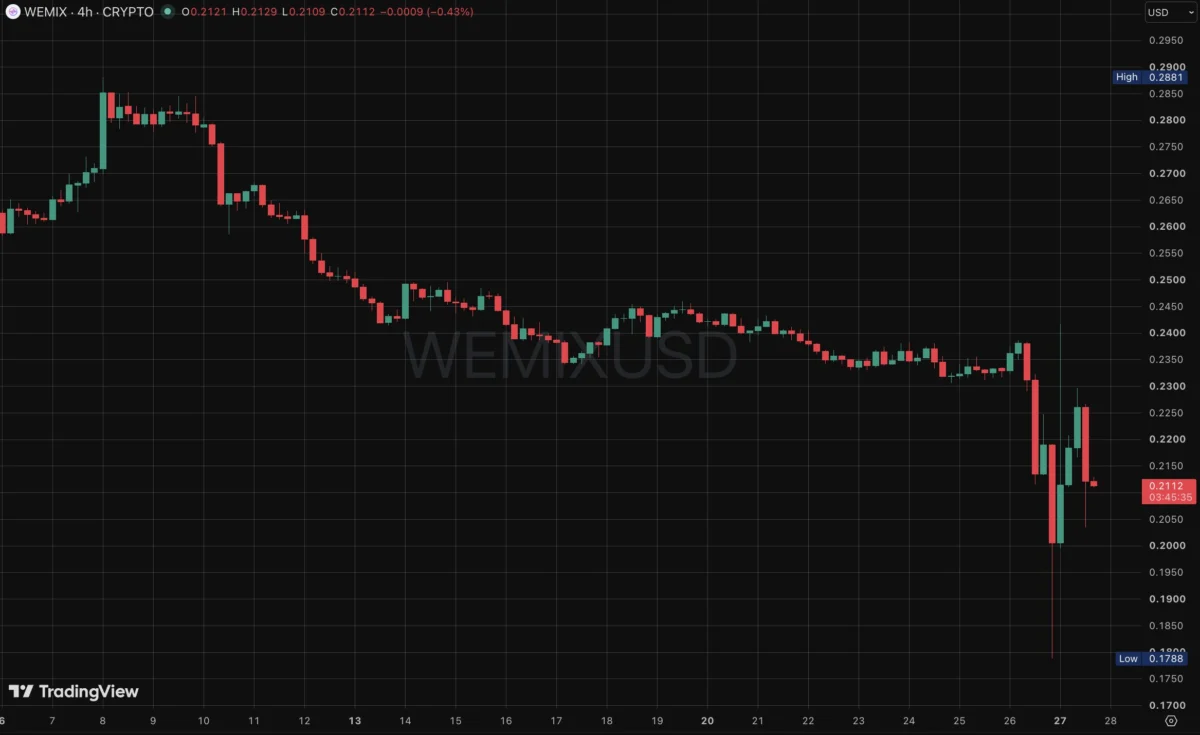
WEMIX has taken the drastic step of suspending all bridges connected to its WEMIX3.0 network following the discovery of a significant security breach. The incident, which unfolded on July 26, 2026, involved the unauthorized minting of approximately 5,225,525 WEMIX$ tokens due to a compromise in a critical contract. This unauthorized issuance led to the conversion of a substantial portion of the minted tokens into other assets, which were subsequently moved out of the WEMIX ecosystem via cross-chain protocols, raising immediate concerns about asset security and the integrity of the network.
The security incident was first detected at 18:17 UTC+9 (Korean Standard Time) on July 26, 2026. Investigations revealed that the ownership rights of a contract intrinsically linked to WEMIX$ had been compromised. This illicit control allowed malicious actors to mint an extraordinary number of WEMIX$ tokens far beyond their intended supply. Preliminary data from WEMIX indicates that the attacker minted approximately 5.23 million WEMIX$. These newly minted tokens were then swiftly converted into 30,736 WEMIX and a significant amount of 724,198.27 USDC.e. The latter, a version of the stablecoin USDC operating on the WEMIX ecosystem, was then exploited further, with the attacker moving these assets out of the WEMIX3.0 network through established cross-chain routes. WEMIX has cautioned that these figures are based on initial findings and may be subject to revision as the comprehensive investigation progresses.
The Genesis of the Breach: Compromised Contract Ownership
The core of the WEMIX security incident lies not in a direct attack on its cross-chain bridges, but in the fundamental compromise of a contract’s administrative privileges. WEMIX officials have clarified that the initial vulnerability stemmed from unauthorized access to the ownership rights of a contract specifically governing WEMIX$. This allowed the perpetrator to act as an administrator, minting tokens at will. The subsequent transfer of assets, including USDC.e, out of the ecosystem was a secondary action enabled by the initial token inflation.
The decision to halt all bridges was therefore a proactive emergency response, not a direct defense against an attack on the bridges themselves. The objective was to immediately stem the outflow of potentially compromised or laundered assets and to prevent further diffusion of liquidity and potential damage across other blockchain networks. This strategic pause aimed to provide the WEMIX security team with the necessary time and space to conduct a thorough investigation, track the movement of funds, and implement remediation measures without the constant threat of assets being moved further afield.
Tracing the Funds: A Complex Cross-Chain Trail
The stolen assets, primarily in the form of USDC.e, did not remain confined within the WEMIX ecosystem. WEMIX’s analysis revealed that the attacker utilized established cross-chain infrastructure, including the Chainlink Cross-Chain Interoperability Protocol (CCIP) and the WEMIX PLAY Bridge, to move the USDC.e to external networks. These networks included Ethereum and the BNB Smart Chain, two of the most prominent blockchain ecosystems.
Once outside the WEMIX3.0 environment, the trail of the illicitly obtained funds became more complex. The attacker reportedly swapped the USDC.e for other cryptocurrencies, specifically ETH and USDT (Tether), further obscuring the origin of the assets. These funds were then dispersed across a multitude of addresses, a common tactic employed to evade detection and asset recovery efforts. WEMIX has acknowledged that a portion of these dispersed assets has been deposited into centralized exchanges (CEXs). This development presents a critical juncture, as freezing these assets now hinges on the effectiveness of collaboration between WEMIX, the implicated exchanges, and the issuers of stablecoins like USDT.
As of the latest updates, WEMIX has stated that it has successfully identified specific wallet addresses associated with the attacker. The project is actively engaged in on-chain tracking to monitor the flow of these funds. However, WEMIX has not yet released a comprehensive list of all compromised wallets, the total value of assets successfully frozen, or the proportion of stolen funds that remain outside their control. This lack of full transparency, while understandable during an active investigation, adds to the uncertainty surrounding the ultimate recovery of the lost value.
WEMIX’s Swift and Decisive Response
Upon detecting the anomalous transactions, WEMIX initiated a series of immediate and decisive countermeasures to safeguard its ecosystem and user assets. The most significant of these was the suspension of all bridges connected to the WEMIX3.0 network. This included critical interoperability solutions like Chainlink CCIP and the PLAY Bridge, effectively creating a temporary barrier to prevent further asset leakage.

Beyond the bridges, WEMIX also moved to neutralize risks within its own ecosystem. Liquidity pools directly associated with WEMIX$ were suspended, bringing trading activities within these pools to a standstill. Furthermore, liquidity provided by the WEMIX Foundation for these pools was withdrawn as a precautionary measure to mitigate the risk of additional losses.
The security review extended to several other services within the WEMIX ecosystem. The WEMIX$ Module and the PNIX Decentralized Exchange (DEX) were temporarily taken offline. Additionally, certain in-game blockchain functionalities, the ability to trade NFTs on the marketplace, and bidding activities were subject to restrictions. These measures, while disruptive to users, were deemed necessary to conduct a thorough security audit and to prevent any further exploitation of vulnerabilities.
On the external front, WEMIX proactively engaged with major cryptocurrency exchanges and stablecoin issuers. The objective was to request the freezing of any identified addresses linked to the attacker. WEMIX has indicated that some exchanges have indeed acted on these requests and implemented freezes, but has not specified the number of exchanges involved or the volume of assets secured through these collaborative efforts.
Broader Implications for the WEMIX Ecosystem and Beyond
The WEMIX network is deeply integrated into the gaming, Non-Fungible Token (NFT), and decentralized finance (DeFi) sectors. This security incident, therefore, carries significant implications for its wider ecosystem and the confidence of its user base. At the time of the incident’s revelation, the WEMIX token was trading in the narrow range of approximately $0.2115-$0.2116 on July 27, 2026. Its market capitalization hovered around $105.4 million, with a fully diluted valuation (FDV) of approximately $118.2 million. The 24-hour trading volume was reported at around $2.55 million. While the token price did not immediately experience a catastrophic collapse, the long-term impact on investor sentiment and network adoption remains a critical concern.
A particularly concerning aspect of this breach is its origin: the compromise of administrative control over a core contract. Unlike typical exploits that might target smart contract logic flaws or economic vulnerabilities, a breach of administrative rights grants attackers a level of power akin to that of the protocol creators. This allows for immediate and unauthorized token issuance, which can then be leveraged against existing liquidity within the ecosystem, potentially magnifying the damage far more rapidly than a standard transactional exploit.
The widespread suspension of services, from cross-chain bridges and liquidity pools to specific marketplace functions, will inevitably impact user experience. Asset withdrawals, token swaps, NFT trading, and engagement with blockchain-integrated gaming elements could be delayed or temporarily unavailable. The resumption of these services is contingent upon the successful completion of security audits and remediation of the compromised contracts and related infrastructure.
Unanswered Questions and the Path Forward
Despite WEMIX’s prompt response and ongoing efforts, several critical questions remain unanswered regarding the full scope and nature of the incident. As of the latest disclosures, WEMIX has not yet provided a detailed technical explanation of the root cause. While it is confirmed that ownership rights of the WEMIX$ contract were compromised, the exact method by which the attacker gained these rights remains undisclosed. This leaves open possibilities ranging from compromised private keys, misconfigurations in contract deployment, or even potential vulnerabilities within internal operational processes.
The potential for full asset recovery is also shrouded in uncertainty. While WEMIX has reported that some exchanges have initiated freezes on related addresses, the precise amount of assets secured, the identities of the collaborating exchanges, and a complete list of affected wallets have not been publicly disclosed. This lack of granular detail makes it difficult to assess the true extent of loss and the likelihood of successful restitution.
Furthermore, a clear timeline for the reopening of suspended services has not been established. The duration of the suspension for bridges, liquidity pools, the PNIX DEX, the WEMIX$ Module, and the NFT marketplace will depend heavily on the progress and outcome of the ongoing security review and remediation efforts. The incident underscores the inherent risks associated with decentralized finance and blockchain interoperability, highlighting the continuous need for robust security protocols and rapid incident response capabilities within the cryptocurrency space. The WEMIX team faces the considerable challenge of not only restoring confidence in its network’s security but also rebuilding trust among its user base and the broader crypto community.