admin
admin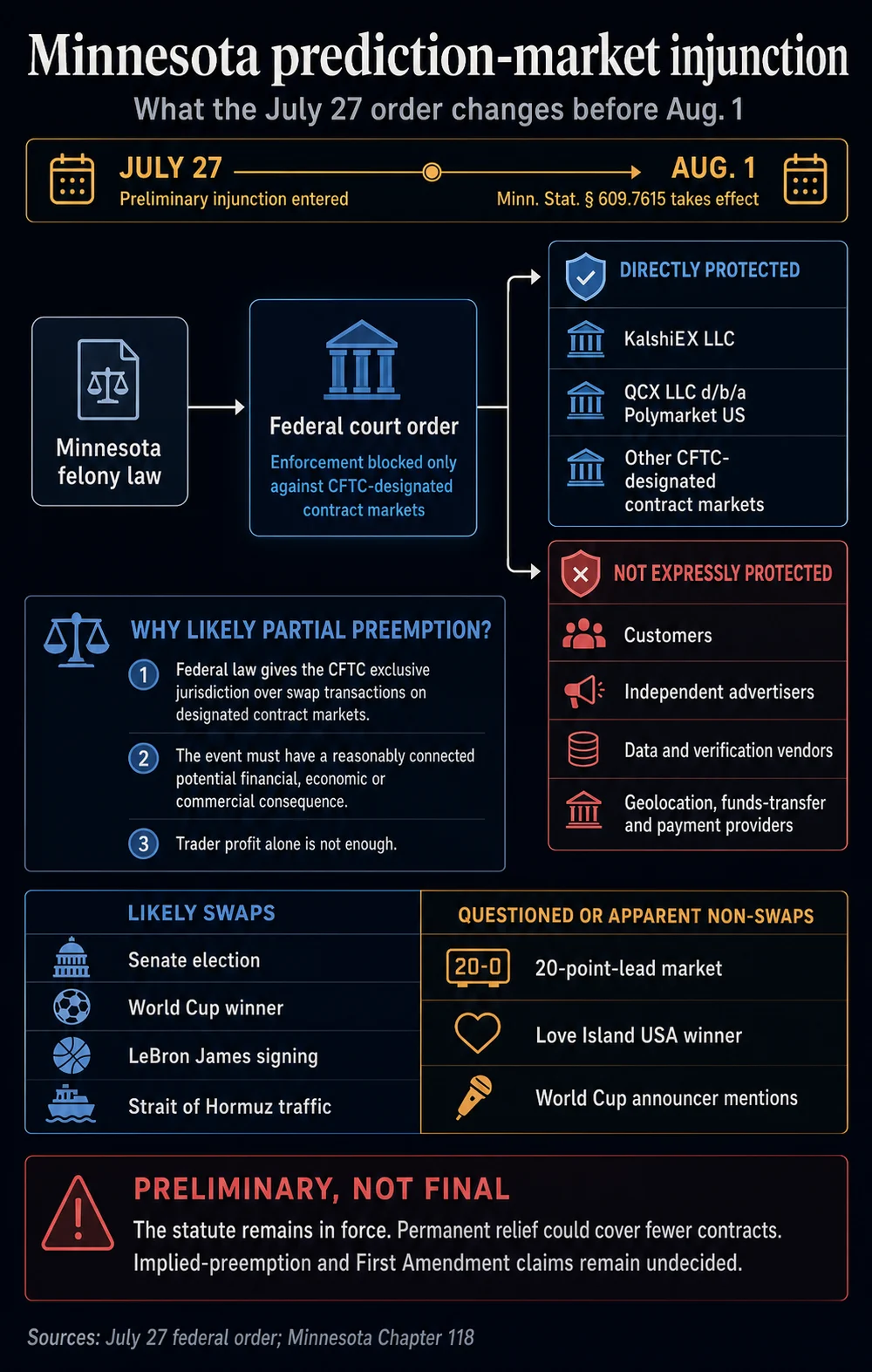
A federal judge has issued a preliminary injunction, temporarily blocking Minnesota from enforcing a new law that would criminalize the operation of prediction markets as felonies. This significant ruling, handed down just days before the law’s August 1 effective date, provides a reprieve for federally regulated exchanges like KalshiEX and Polymarket US, allowing them to continue serving Minnesota users while the legal battles over the merits and contractual boundaries of the state’s legislation unfold.
The injunction, granted by Judge Katherine Menendez on July 27, stems from motions filed by the Commodity Futures Trading Commission (CFTC), KalshiEX, and QCX, the registered entity operating as Polymarket US. The order specifically prohibits named Minnesota officials from enforcing Minn. Stat. § 609.7615 against contract markets designated by the CFTC. This protection will remain in place until a final decision is reached on the substantive claims of the case.
Understanding the Court’s Rationale: Likely Partial Preemption
Judge Menendez’s decision hinges on the plaintiffs’ likelihood of proving that federal law, specifically the Commodity Exchange Act (CEA), expressly preempts certain provisions of Minnesota’s newly enacted statute. The CEA grants the CFTC exclusive jurisdiction over swap transactions conducted on designated contract markets. The definition of a “swap” under federal law can encompass event contracts, provided their outcomes have a reasonably connected potential financial, economic, or commercial consequence. The court clarified that a trader’s potential profit alone is insufficient to categorize an event contract as a swap.
The judge’s order does not universally exempt all event contracts. Instead, she identified specific examples that are likely to fall under the definition of a swap, including markets tied to the outcome of a Senate election, the winner of the World Cup, a LeBron James contract signing, and traffic flow through the Strait of Hormuz. Conversely, she expressed skepticism about markets predicting a 20-point lead in a particular context and deemed contracts related to the winning couple of Love Island USA or specific words uttered by World Cup announcers as unlikely to qualify as swaps. This distinction is crucial, as any permanent injunction, should it be granted, might apply to a narrower subset of contracts than initially envisioned by the state.
Minnesota’s Prediction Market Law: A Deep Dive
Chapter 118 of Minnesota’s statutes, which replaced earlier prediction market provisions enacted under Chapter 97, remains scheduled to take effect on August 1 for crimes committed on or after that date. The core offense criminalizes the creation or operation of a “covered prediction market” as a felony, provided it is conducted for consideration and as part of a business. This also extends to intentionally facilitating such markets through specified activities, including listing, funding, settlement, counterparty management, or pricing.

The law also targets individuals or entities that knowingly supply data directly to a prediction market, or provide geolocation, funds-transfer, or payment services to one, with the intent to enable or settle prohibited wagers. Furthermore, a separate clause criminalizes the advertising or marketing of financial or technological products that promote prohibited transactions.
Scope of the Injunction and Remaining Legal Questions
It is critical to note that the current injunction’s protection is limited. It specifically shields CFTC-designated contract markets, meaning it does not explicitly cover individual customers, independent advertisers, or external service providers who might interact with these platforms. The Minnesota statute itself remains legally in force, and the court has yet to rule on the plaintiffs’ arguments concerning implied preemption or their First Amendment claims. These broader legal questions are central to the ongoing litigation and will shape the future landscape of prediction markets in the state and potentially nationwide.
Timeline of Events and Key Players
The legal challenge leading to this injunction has been swift and complex. Minnesota’s legislative action to criminalize prediction markets was relatively recent, with Chapter 118 of the laws of 2026 significantly altering the regulatory environment. The impending August 1 deadline created a sense of urgency for exchanges operating in the state.
- July 2026: Minnesota lawmakers enact Chapter 118, establishing felony penalties for operating prediction markets.
- Early July 2026: Kalshi seeks and is denied interim protection from existing state gambling enforcement in a New York court.
- Mid-July 2026: The CFTC, KalshiEX, and QCX (Polymarket US) file preliminary injunction motions in federal court in Minnesota.
- July 27, 2026: Judge Katherine Menendez grants the preliminary injunction, temporarily blocking enforcement of the felony law against CFTC-designated contract markets.
- August 1, 2026: The effective date of Minnesota’s new felony law for prediction markets.
The CFTC’s involvement underscores the federal agency’s stance on the regulation of derivatives and event contracts. Their active participation in the lawsuit highlights the potential for federal law to supersede state-level prohibitions on activities that fall within the CFTC’s purview.
Industry Reactions and Broader Implications
Polymarket US publicly welcomed the ruling, expressing confidence in their ability to continue serving Minnesota users. A spokesperson for the platform stated, “We are pleased with the court’s decision to grant a preliminary injunction. This allows us to continue providing our services to Minnesotans while the legal process plays out. We believe that prediction markets, when properly regulated, offer valuable insights and opportunities for users.”
Conversely, Minnesota Attorney General Keith Ellison indicated that the state would continue to defend its law. “We respectfully disagree with the court’s ruling and believe our law is a necessary measure to protect consumers and prevent illegal gambling,” an office spokesperson stated. “We will continue to defend the State of Minnesota’s interests as this case develops.”

The contrasting preliminary outcomes in Minnesota and New York, where Kalshi faced a denial of interim protection, illustrate the fragmented and evolving nature of the legal landscape for prediction markets. These cases are not merely about individual companies but also about the fundamental question of how state gambling laws interact with federal financial regulations, particularly concerning novel forms of digital markets.
The implications of this ruling extend beyond Minnesota. It sets a precedent for how federal oversight of derivatives markets can influence state-level attempts to regulate or prohibit similar activities. If the federal preemption arguments prevail on the merits, it could create a significant barrier for states seeking to ban prediction markets that operate on CFTC-designated exchanges.
The Uncertain Future of Prediction Markets
While the injunction offers a temporary shield, the ultimate fate of Minnesota’s law and its impact on prediction markets remains undecided. The court has yet to address the complex issues of implied preemption, which explores whether federal law implicitly occupies the field to the exclusion of state law, and the First Amendment challenges, which could involve arguments about freedom of speech and expression related to the content of prediction markets.
The data supporting the definition of a “swap” under the CEA will likely be a critical factor in the subsequent stages of litigation. The precise financial, economic, or commercial consequences of a particular event’s outcome will be scrutinized to determine if it aligns with the federal definition. This nuanced interpretation could lead to a scenario where some prediction markets are deemed exempt from state felony laws, while others might still be subject to regulation or prohibition.
The ongoing legal battles involving Kalshi and Polymarket US are being closely watched by the broader cryptocurrency and financial technology sectors. The resolution of these cases could significantly shape the future regulatory framework for prediction markets, influencing innovation, investment, and consumer access to these platforms across the United States. The July 27 injunction is a significant development, but it marks only one chapter in a complex and unfolding legal narrative.