James Watt
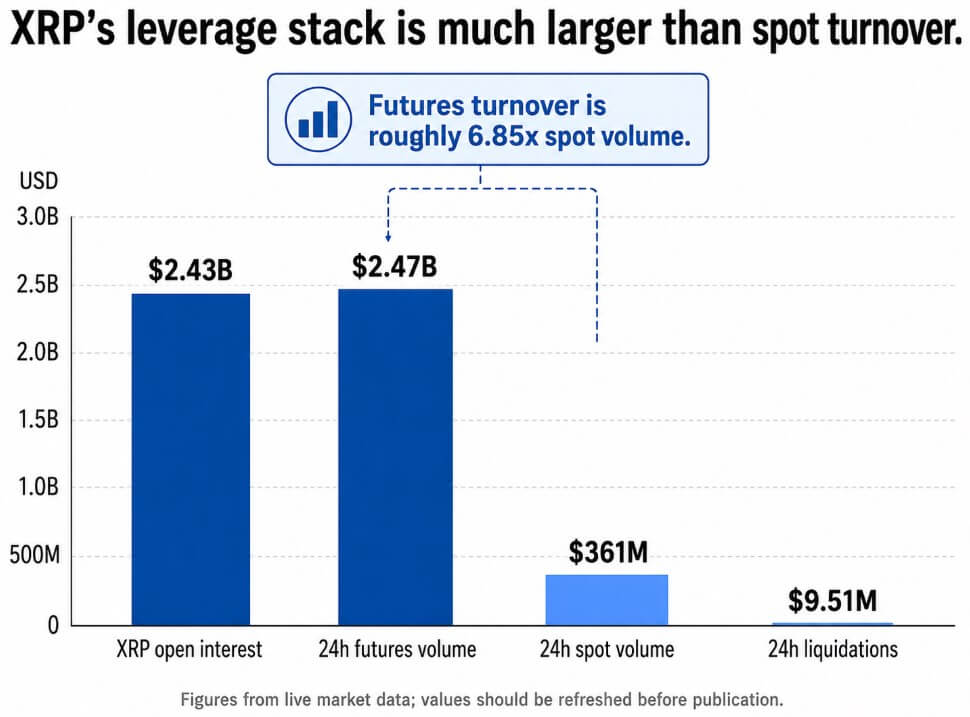
The digital asset XRP is currently navigating a period of heightened volatility and structural fragility, trading near the $1.06 mark as of late July 2026. This price point represents a 2.9% decline over the last 24 hours and a more significant 8.6% retreat over the past week. While price fluctuations are common in the cryptocurrency sector, the underlying market structure for XRP reveals a concerning imbalance between speculative derivatives and organic spot demand. Data from CoinGlass highlights a massive disparity: XRP’s open interest stands at $2.43 billion, with 24-hour futures volume reaching $2.47 billion, while daily spot volume languishes at a mere $361 million.
This statistical mismatch indicates that futures turnover is currently running approximately 6.85 times higher than spot turnover. In such an environment, the "tail wags the dog," meaning that movements in the derivatives market—often driven by high-leverage speculation—exert disproportionate pressure on the actual price of the asset. The consequences of this leverage-heavy setup are already becoming apparent, as forced liquidations have wiped out $9.51 million in XRP positions over the past 24 hours alone.
The Federal Reserve Catalyst and Macroeconomic Uncertainty
The immediate catalyst for the current market anxiety is the Federal Open Market Committee (FOMC) meeting scheduled for July 28 to 29, 2026. The financial world is bracing for the policy statement, expected at 2:00 p.m. Eastern on July 29, followed by a press conference with the Federal Reserve Chair at 2:30 p.m.
According to market pricing data, there is currently a 65% probability that the Federal Reserve will elect to hold interest rates steady. However, the remaining 35% represents a significant margin of uncertainty, with some traders hedging against a surprise rate hike or hawkish rhetoric that could signal prolonged monetary tightening. In the crypto markets, Fed week typically triggers a "risk-off" sentiment where traders reduce exposure to volatile assets. For XRP, which is already grappling with a thin spot market, any hawkish surprise from the Fed could accelerate the current downward trend.
Historically, Federal Reserve announcements serve as a volatility "flush," where overleveraged positions are cleared out in both directions. Given XRP’s current $2.43 billion in open interest, a sudden shift in sentiment following the Fed’s remarks could trigger a cascade of liquidations that the current $361 million spot market may struggle to absorb without significant price slippage.
Analyzing the Liquidity Gap: Why Spot Volume Matters
The fragility of XRP’s current valuation is best understood through the lens of liquidity absorption. When a trader’s leveraged position is liquidated, the exchange must sell the underlying asset on the spot market to cover the loss. If the volume of these forced sales exceeds the available "buy" orders on the spot books, the price drops rapidly, often triggering further liquidations in a "death spiral" or "long squeeze."
Consider the current figures: XRP’s open interest is $2.43 billion. If even 10% of that interest were forced into a flush—amounting to $243 million in notional exposure—it would represent roughly 67% of the total daily spot volume. If the flush reached 15%, the required sell-side liquidity would be approximately $365 million, effectively exceeding the entire reported spot turnover for the day.

While many derivatives trades are settled internally within exchange engines without hitting the public order books, a significant portion of forced position-cutting inevitably spills over. In a market where the derivatives-to-spot ratio is nearly 7-to-1, the lack of a deep spot "cushion" makes the $1.00 psychological floor look increasingly vulnerable.
Bitcoin’s Influence and the Altcoin Beta
As is standard in the digital asset ecosystem, XRP does not trade in a vacuum. Its price trajectory remains heavily tethered to Bitcoin (BTC), which serves as the primary barometer for crypto market health. Recent data from Glassnode’s July 27 Market Pulse suggests that Bitcoin’s own setup is currently fragile. After a brief rally to a local high of $66,700, Bitcoin retreated toward $64,000, eventually settling in a range-bound stretch near $63,700.
The Glassnode report flagged several bearish indicators for the market leader:
- Declining Buy-Side Aggression: There are fewer signs of aggressive dip-buying at current levels.
- ETF Outflows: Institutional demand via spot ETFs has softened, reducing the passive capital inflow that previously supported price floors.
- Stagnant Capital Inflow: New money entering the space has slowed, leaving the market reliant on existing liquidity.
- Muted On-Chain Settlement: Lower network activity suggests a lack of strong conviction among long-term holders.
Research from Bitwise and academic studies conducted in 2026 emphasize the "lagged price transmission" from Bitcoin to altcoins. During periods of market contraction, the "beta"—or sensitivity—of altcoins like XRP to Bitcoin’s movements tends to increase. Bitwise reported that this beta recently climbed to 1.45. This means that if Bitcoin drops by 1%, XRP is statistically likely to drop by 1.45%. With Bitcoin currently trading below the $64,000–$65,100 recovery zone described by analysts, XRP faces significant "beta risk" if the market leader breaks toward the $62,000 level.
Critical Price Levels: The XRP Roadmap
Market participants are currently focused on four distinct price zones for XRP, which will determine the token’s direction through the remainder of the week. These levels are derived from live trading data and represent the boundaries between a routine correction and a structural breakdown.
The Immediate Support: $1.05
XRP is currently hovering just above its 24-hour low of $1.05. This level serves as the frontline for bulls. If this support fails, it signals that the current decline is turning disorderly, likely fueled by the beginning of a derivatives reset.
The Psychological Floor: $1.00
The $1.00 mark is the most significant level on the chart. Beyond its mathematical value, it represents a psychological barrier for retail and institutional investors alike. Falling below $1.00 would likely trigger a "stop-loss" cascade, turning a standard market correction into a visible breakdown of the medium-term uptrend.
The Recovery Threshold: $1.09
To regain a bullish posture, XRP must first reclaim its 24-hour high of $1.09. Successfully holding this level would be the first indication that buyers are stepping in to stabilize the asset after the recent flush.
The Confirmation Zone: $1.11 to $1.15
The range between $1.11 and $1.15 represents the "fair value" area where XRP traded comfortably prior to the latest decline. Reclaiming this zone would suggest that the leverage-driven volatility has been neutralized and that the asset is ready to resume its broader trajectory. Notably, CoinGecko data shows that XRP touched $1.16 as recently as July 26, indicating that the potential for recovery exists if the macro environment stabilizes.
Chronology of Recent Market Events
The current tension is the result of a week-long series of shifts in market sentiment:
- July 24–26: XRP showed strength, benefiting from whale accumulation and a streak of positive sentiment in the broader altcoin complex, pushing the price toward the $1.16 level.
- July 27: Glassnode released its Market Pulse report, highlighting the "softer speculative conviction" in Bitcoin. Bitcoin fell from $66,700, dragging the altcoin market down with it.
- July 28: As the Federal Reserve meeting commenced, XRP traders began de-risking. Spot volume dried up while futures open interest remained high, creating the current "fragile" setup.
- July 29 (Expected): The market awaits the 2:00 p.m. Fed statement. This window is expected to be the peak period for volatility and potential liquidations.
Institutional and Analyst Perspectives
While official statements from Ripple Labs regarding short-term price action are rare, broader institutional sentiment can be inferred from market behavior. The "beta" of 1.45 suggests that institutional "baskets"—which often trade BTC and top altcoins in tandem—are currently the primary drivers of price action.
Analysts from firms like Santiment and CryptoQuant have noted that "social dominance" for XRP has spiked during this dip, often a sign of retail anxiety. However, the lack of aggressive buy-side pressure on the spot side suggests that "smart money" may be waiting for the Fed’s decision before committing new capital. The prevailing view among technical analysts is that the current setup is a "liquidity hunt," where the market moves toward levels of high liquidation (like $1.00) to clear out leverage before a more sustainable move can occur.
Conclusion: The Path Ahead
The outlook for XRP this week is binary and depends heavily on the interplay between the Federal Reserve’s rhetoric and Bitcoin’s stability.
In the Bear Case, Federal Reserve officials adopt a hawkish tone, perhaps suggesting that inflation remains a concern and that rate cuts are further off than anticipated. This would likely cause Bitcoin to slide toward $62,700, breaking its local support. In this scenario, XRP would almost certainly lose the $1.05 support and test the $1.00 floor. Given the high open interest, a break below $1.00 could result in a "flash crash" as derivatives flows overwhelm the thin spot market.
In the Bull Case, the Fed provides a "dovish hold," signaling that the economy is cooling sufficiently to allow for future easing. This would likely spark a "risk-on" rally, propelling Bitcoin back toward $66,700. XRP would follow by reclaiming $1.09 and pushing back into the $1.11–$1.15 confirmation zone. In this version of events, the $2.43 billion derivatives stack would unwind gradually or convert into long positions, supporting a move toward new local highs.
As the July 29 deadline approaches, the structural question remains: can the XRP spot market absorb the weight of its own leverage? The answer will define the token’s performance for the remainder of the summer.