Lina Irawan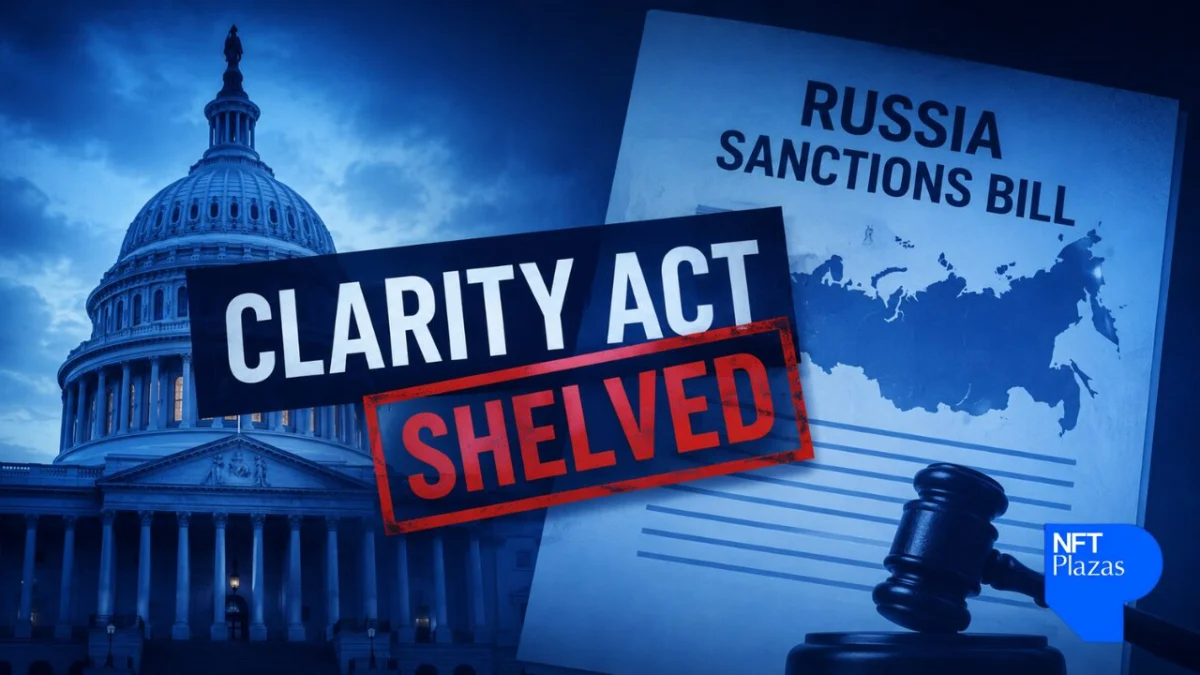
The U.S. Senate has temporarily postponed consideration of the Digital Asset Market Clarity (CLARITY) Act, a pivotal piece of legislation for the cryptocurrency industry, as lawmakers pivot to address urgent foreign policy matters and a significant backlog of federal nominations. This development significantly constricts the remaining legislative window for Congress to enact comprehensive crypto market structure reforms before its scheduled summer recess on August 8th. While Senate leadership has not definitively ruled out bringing the CLARITY Act to the floor before the break, a densely packed legislative agenda and ongoing sensitive negotiations make a timely vote increasingly improbable in the immediate days ahead.
Russia Sanctions Package Takes Precedence on Senate Floor
Senate Majority Leader John Thune commenced the week by prioritizing the advancement of executive and judicial nominations. Subsequently, the Senate’s focus shifted to a bipartisan legislative package designed to bolster sanctions against Russia. This proposed legislation aims to broaden existing sanctions on Russian leadership and introduce tariffs on nations continuing to engage in trade with Moscow. The bill is also being dedicated to the memory of the late Senator Lindsey Graham, whose funeral services this week have further occupied the Senate’s operational schedule, contributing to the already constrained timeline.
Under established Senate procedural rules, the chamber generally dedicates its floor time to one major contested bill at a time. Before the Russia sanctions legislation can proceed, senators must navigate the cloture process, a series of procedural steps that typically spans several days. Consequently, the CLARITY Act is not anticipated to receive floor consideration until the debate surrounding the Russia sanctions concludes, pushing any potential vote into the following week at the earliest. This procedural reality underscores the significant challenges in bringing multiple high-priority bills to a vote within a compressed timeframe.
Diminishing Legislative Window Before August Recess
The postponement of the CLARITY Act leaves lawmakers with a dwindling number of legislative days to debate and vote on critical bills before Congress adjourns for its annual August recess. Senator Thune has repeatedly expressed his desire to bring the CLARITY Act before the Senate prior to the recess. However, he has also candidly acknowledged the necessity for leadership to first ascertain sufficient bipartisan support to advance the legislation. The increasingly scarce floor time in the Senate places considerable pressure on negotiators to resolve the remaining disputes within the CLARITY Act before leadership commits valuable debate time to its consideration. The success of these negotiations is intrinsically linked to the bill’s prospects of moving forward before the recess.
Government Ethics Provisions Remain the Primary Sticking Point
The most significant impediment to the Senate’s approval of the CLARITY Act continues to be the contentious government ethics provisions embedded within the legislation. Negotiators are actively engaged in debates over language that would impose restrictions on senior government officials, including the President, prohibiting them from promoting or financially benefiting from cryptocurrency projects while in office.
Democrats are advocating for more stringent safeguards, emphasizing the need to prevent potential conflicts of interest. Their arguments are often underscored by concerns regarding President Donald Trump’s increasing engagement with digital asset ventures. Conversely, Republicans are seeking language that addresses ethical considerations without enacting restrictions they contend could unfairly target individual officeholders or stifle innovation within the burgeoning digital asset sector.
Reports from the previous week indicated that negotiations had made some headway, with suggestions that President Trump might be amenable to new limitations governing presidential involvement in digital assets. However, Democratic representatives have maintained that the proposed measures still fall short of their requirements, indicating that discussions remain ongoing. Until a consensus is reached between both parties on these critical ethical parameters, it appears unlikely that Senate leadership will schedule a final vote on the CLARITY Act. This deadlock highlights the complex intersection of regulatory policy and political considerations in the digital asset space.

The Significance of the CLARITY Act for the Digital Asset Ecosystem
The CLARITY Act is widely regarded as one of the most consequential legislative efforts concerning digital assets currently before Congress. Its primary objective is to establish a comprehensive and clear regulatory framework for digital assets operating within the United States. A core component of the legislation involves clarifying the jurisdictional boundaries between the U.S. Securities and Exchange Commission (SEC) and the Commodity Futures Trading Commission (CFTC) regarding the oversight of various cryptocurrencies. Furthermore, it aims to provide more transparent and predictable compliance rules for token issuers, digital asset exchanges, and other businesses operating within the digital asset industry.
Proponents of the CLARITY Act argue that its enactment would significantly reduce the pervasive regulatory uncertainty that has long plagued the U.S. crypto industry. This uncertainty has been cited as a contributing factor in driving some innovative firms to seek regulatory clarity and operational bases overseas. The House of Representatives has already passed its own version of the CLARITY Act, making Senate passage the critical hurdle for the legislation to advance further on its path toward becoming law. The differing approaches between the House and Senate versions, however, necessitate reconciliation, adding another layer of complexity to the legislative process.
Potential Ramifications of the Bill’s Delay or Failure
Should the Senate fail to pass the CLARITY Act during the current legislative session, the cryptocurrency industry may be compelled to rely on a patchwork of existing and developing regulatory initiatives while awaiting future congressional attempts at market structure reform. These alternative avenues include the implementation of the GENIUS Act, which seeks to establish a federal framework specifically for payment stablecoins, and the ongoing rulemaking processes undertaken by the SEC and the CFTC.
The Senate has already dedicated months to negotiating the intricacies of the CLARITY Act. Earlier stages of these negotiations were marked by disputes over whether stablecoin issuers should be permitted to offer yield-bearing products that could directly compete with traditional bank deposits. A compromise was eventually reached on this matter, limiting such reward programs. However, negotiations subsequently shifted almost entirely to the complex and politically charged area of government ethics rules, which have proven to be the most intractable obstacle. The prolonged nature of these discussions underscores the deep divisions and competing interests involved in shaping digital asset policy.
The Compounding Pressure of the Political Calendar
Even if the Senate were to successfully approve the CLARITY Act, the bill would still require another vote in the House of Representatives, given that the Senate’s proposed version differs from the legislation previously passed by the House. The existing congressional calendar leaves minimal room for further delays. Following a brief return in September, lawmakers’ attention will increasingly be drawn to the upcoming November elections. This will be followed by the traditional "lame-duck" session, a period in the legislative calendar that can either foster bipartisan compromises on pressing issues or devolve into political gridlock as the next Congress prepares to convene.
If Congress is unable to finalize work on the CLARITY Act before the conclusion of the current legislative session, lawmakers would likely be compelled to reintroduce the legislation in the subsequent Congress. This would necessitate a recommencement of the entire legislative process, potentially delaying the establishment of a clear regulatory framework for digital assets for an even more extended period. The prospect of such a delay adds a significant sense of urgency to the current legislative efforts.
Industry’s Vigilant Waiting Game
Despite the latest setback in the Senate, advocates within the cryptocurrency industry remain cautiously optimistic that momentum can be preserved. Their hope is that the Senate may still initiate procedural steps before lawmakers depart for their recess, which could facilitate a more expeditious progression of the bill upon Congress’s return. For the immediate future, however, the Senate’s agenda continues to be dominated by the Russia sanctions package, the confirmation of federal nominations, and the unresolved ethics negotiations surrounding the CLARITY Act.
With legislative time rapidly diminishing, the coming weeks are poised to be critical in determining the trajectory of the CLARITY Act. The outcome will either see it advance toward becoming the first comprehensive U.S. law governing the structure of the digital asset market, or it will face yet another protracted delay, prolonging the period of regulatory ambiguity for an industry actively seeking clear operational guidelines. The industry’s stakeholders are keenly observing these developments, understanding that the decisions made in the coming days will have far-reaching implications for the future of digital finance in the United States. The interplay of foreign policy imperatives, domestic political considerations, and the complex technicalities of digital asset regulation has created a challenging environment for the passage of this landmark legislation.