James Watt
A Complex GDP Reading Sparks Market Volatility
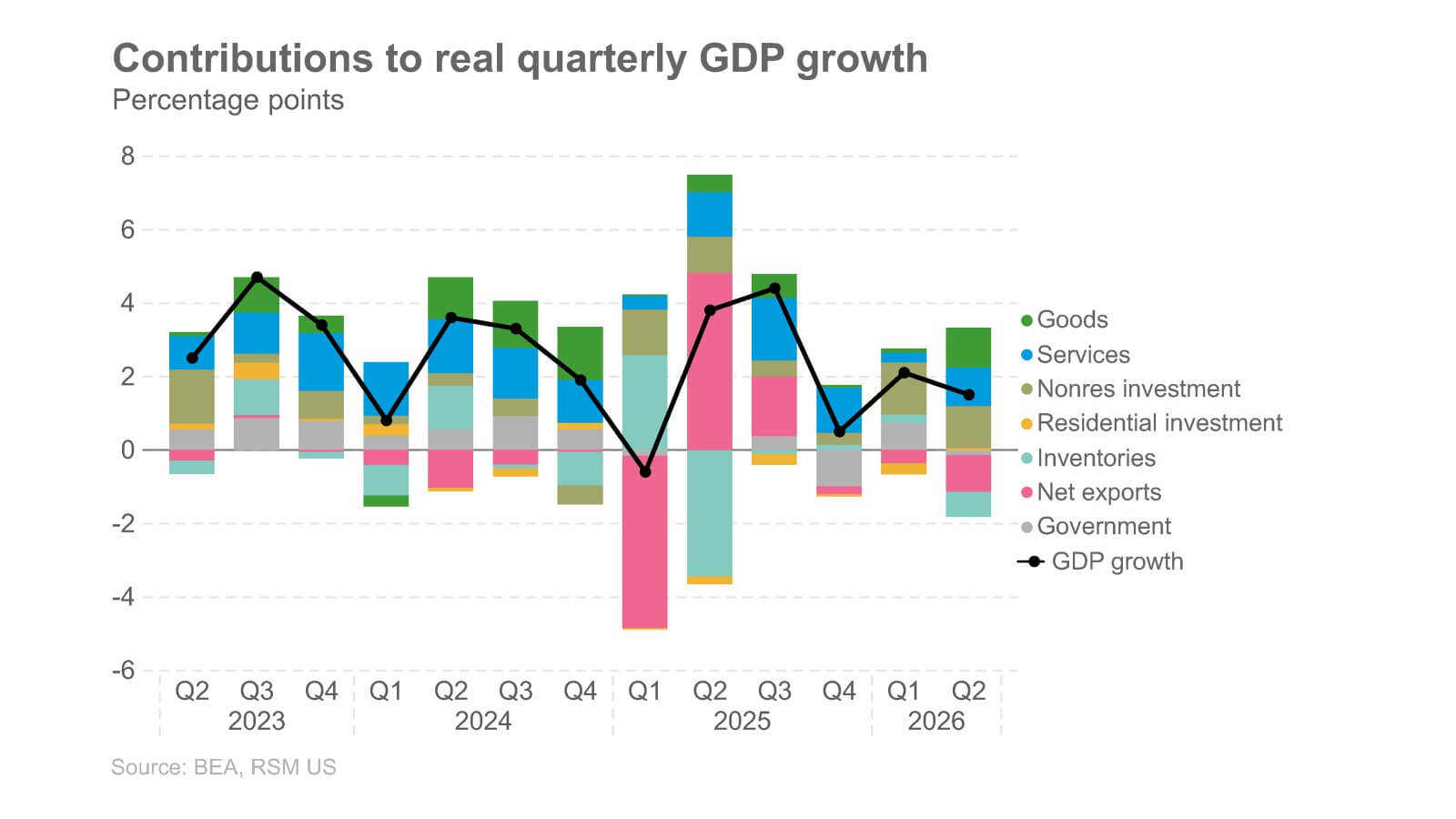
The primary catalyst for Thursday’s price action was the release of the second-quarter GDP figures, which showed the US economy expanding at a 1.5% annualized rate. This figure represented a significant deceleration from the 2.1% growth recorded in the first quarter and fell short of the 2.1% expansion projected by a consensus of Wall Street analysts. In the immediate aftermath of the release, Bitcoin and other risk-sensitive assets saw a spike in demand. The logic behind this "bad news is good news" reaction stems from the belief that weaker economic growth increases the pressure on the Federal Reserve to pivot toward a more dovish monetary policy.
In theory, a slowing economy encourages the central bank to lower interest rates to stimulate activity. Lower rates typically reduce the yield on "safe-haven" assets like US Treasuries and cash, thereby increasing the relative appeal of high-growth or speculative assets like Bitcoin. Furthermore, easier monetary conditions improve global liquidity, which has historically been a strong tailwind for the cryptocurrency market.
However, the initial optimism faded as traders scrutinized the "under the hood" data of the GDP report. While the headline figure missed expectations, the slowdown was largely attributed to a widening trade deficit rather than a collapse in domestic demand.
Resilient Domestic Demand and the Inflation Challenge
A critical takeaway from the second-quarter data was the strength of the American consumer. Household spending accelerated at a robust 3.2% annualized rate during the period, a sharp rebound from the modest 0.5% growth seen in the first three months of the year. Additionally, business investment in equipment remained high, driven largely by the ongoing technological race to build out artificial intelligence (AI) infrastructure.

Joseph Brusuelas, principal and chief economist at RSM US, noted that the headline 1.5% figure was somewhat misleading. He pointed out that the trade deficit subtracted approximately one full percentage point from the headline growth rate. Much of this deficit was fueled by a surge in imports—specifically high-tech equipment and hardware necessary to sustain AI investments. "Once one looks beneath the topline, growth looks much firmer and inflationary," Brusuelas remarked.
This internal strength suggests that the economy is not cooling as rapidly as the headline number implies. For the Federal Reserve, this presents a significant dilemma. The gross domestic purchases price index—a key measure of the prices paid by US consumers and businesses—rose at a 5.7% annualized rate during the quarter. Perhaps more concerning for policymakers was the core Personal Consumption Expenditures (PCE) price index, which excludes volatile food and energy costs. The core PCE increased by 3.4%, remaining stubbornly above the Federal Reserve’s long-term 2% target.
Federal Reserve Internal Divisions and Policy Stagnation
The combination of persistent inflation and resilient consumer demand gives the Federal Open Market Committee (FOMC) little incentive to rush into rate cuts. In fact, the latest policy meeting highlighted growing hawkishness within the central bank. While the Fed ultimately opted to hold its benchmark interest rate steady at a range of 3.50% to 3.75%, the decision was not unanimous. Three officials reportedly voted in favor of an immediate rate hike, citing the need to bring inflation back to target levels more aggressively.
For Bitcoin, this hawkish undercurrent acts as a ceiling. As long as interest rates remain elevated, the "opportunity cost" of holding a non-yielding asset like Bitcoin remains high. Investors are increasingly weighing the volatility of the crypto market against the guaranteed, historically high yields available in the government bond market.
The Institutional Carry Trade: Treasuries vs. Bitcoin
The lack of sustained momentum in Bitcoin’s price is further explained by the behavior of institutional investors. Data from Glassnode indicates that the "basis trade"—a popular strategy where institutions buy spot Bitcoin and sell futures contracts to capture the price difference—is currently less attractive than traditional fixed-income instruments.
The three-month Bitcoin futures basis has remained consistently below the yield of the two-year US Treasury since February. This is only the second time in recorded history that government debt has offered a higher return than the Bitcoin cash-and-carry trade for such a prolonged period. When institutions can earn 4% or 5% on a risk-free Treasury bill, the incentive to deploy capital into the complex and volatile world of crypto derivatives diminishes. This lack of institutional "carry" participation reduces the overall liquidity and market depth, making it difficult for Bitcoin to sustain a breakout above key resistance levels.
Market Participation Hits Multi-Year Lows
The cooling interest from both retail and institutional players is reflected in on-chain and exchange data. Spot trading volumes for Bitcoin have retreated to levels not seen since 2019. Furthermore, the total volume of exchange deposits and withdrawals—a proxy for active market participation—is currently at its lowest point in three years.
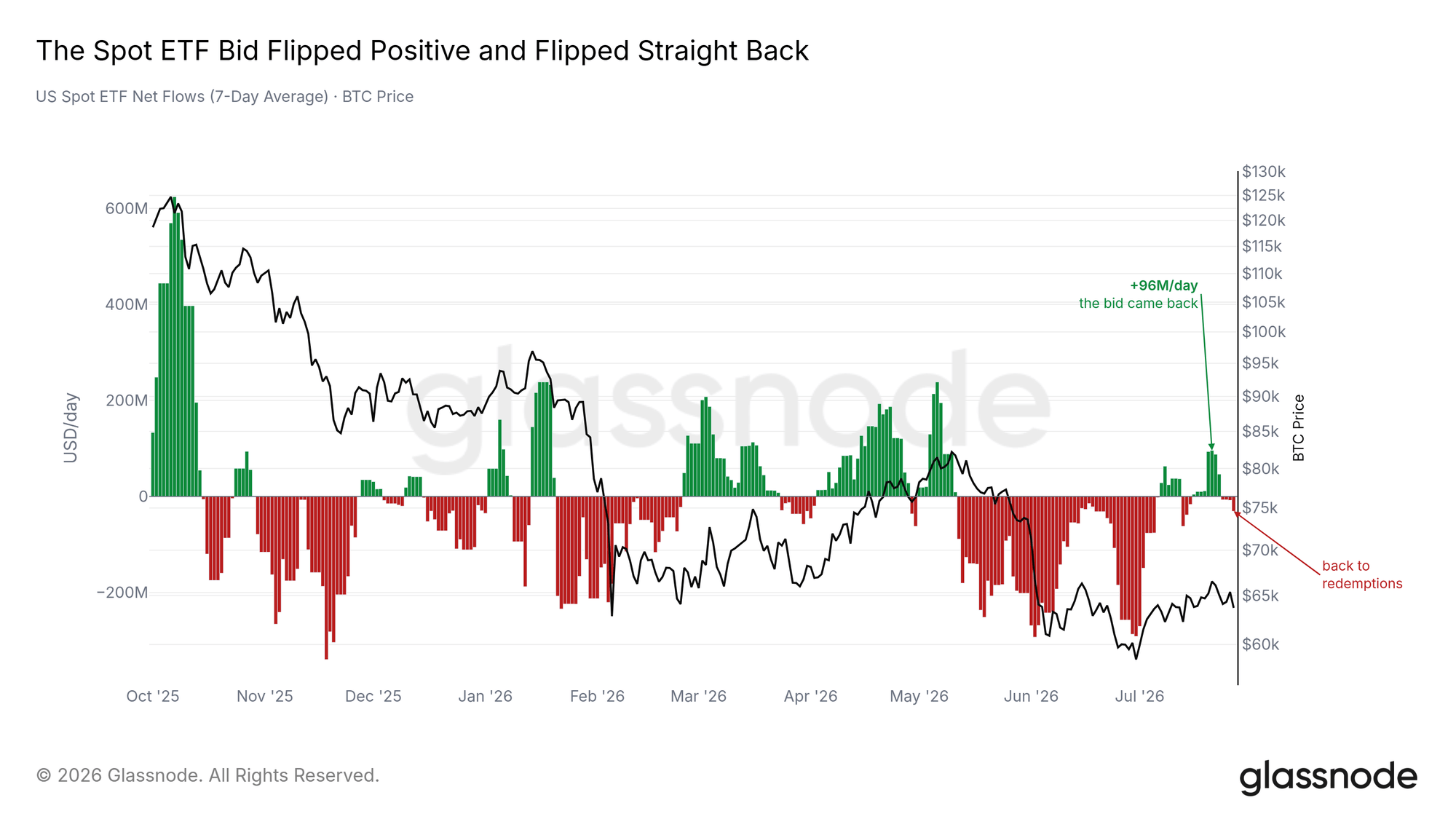
Even the much-celebrated US spot Bitcoin exchange-traded funds (ETFs) have seen a reversal in fortune. After a brief period of renewed inflows in mid-July, these products have returned to a state of modest net outflows. BlackRock’s iBIT, which had previously been a juggernaut of capital absorption, has not been immune to the broader trend of investor caution. Without a steady stream of "new money" flowing through these ETF vehicles, the market lacks the buying pressure required to clear the massive supply of Bitcoin held at higher price points.
The $69,000 Threshold: A Critical Test for Bulls
As Bitcoin navigates the $62,000 to $65,000 range, it is moving through a "thick" zone of investor cost bases. Glassnode data reveals that a significant portion of the total Bitcoin supply last changed hands between $62,000 and $68,000. This range represents a psychological and financial battlefield.
Approximately half of the coins in this range are held by "long-term holders"—investors who have historically shown a high tolerance for volatility. However, the other half is held by "short-term holders" (STHs), who are often more sensitive to price fluctuations. Many of these STHs are currently holding at a slight loss or are just reaching their breakeven point. As Bitcoin approaches the upper end of this range, these investors may be tempted to "exit at par," creating a wall of selling pressure that prevents further gains.
The aggregate cost basis for short-term holders is currently estimated to be near $69,000. Market analysts view this level as the ultimate "line in the sand." A sustained move above $69,000, supported by an uptick in spot trading volume and renewed ETF inflows, would signal that the market has successfully absorbed the overhead supply and that a new bullish phase is beginning. Conversely, a failure to breach this level could result in a period of extended consolidation or a retreat to lower support levels near $60,000.
Outlook: Macro Uncertainty Continues to Govern Crypto
The events of Thursday underscore the degree to which Bitcoin remains tethered to the broader macroeconomic environment. While the cryptocurrency was originally envisioned as an alternative to the traditional financial system, its current role in institutional portfolios is that of a "liquidity barometer."
The path forward for Bitcoin appears inextricably linked to the Federal Reserve’s battle with inflation. If upcoming labor market data or future PCE readings show a more definitive cooling of the economy, the case for a policy pivot will strengthen, potentially providing the fuel for a decisive Bitcoin breakout. However, if consumer spending remains robust and energy costs continue to climb, the Federal Reserve may be forced to maintain its "higher for longer" stance.
In this environment of high interest rates and low volatility, Bitcoin investors find themselves in a waiting game. The brief move above $65,000 served as a reminder of the asset’s sensitivity to macro data, but the quick retracement highlighted the lack of conviction currently permeating the market. For now, the "digital gold" remains confined within a well-defined trading range, awaiting a clearer signal from the halls of the central bank and the wider US economy.