Reza Arap Oktovian
Around the middle of this year, Ethereum, the second-largest blockchain by market capitalization and a critical infrastructure for hundreds of billions of dollars in digital assets, is poised to undergo a monumental transformation. The network will transition from its current Proof-of-Work (PoW) consensus mechanism to a Proof-of-Stake (PoS) model. This monumental undertaking, often likened to "changing the engine of an airplane while flying it," necessitates that Ethereum maintain continuous operation and the production of valid blocks throughout the process. Unlike many other prominent blockchains, such as Bitcoin, Ethereum’s developer community, with strong encouragement from the Ethereum Foundation (EF) and key figures within the ecosystem, has pursued a multi-client strategy for its PoS implementation. This approach, often referred to as Ethereum 2.0, involves the development of several independent client software versions, each built by different teams and often written in distinct programming languages, a strategic decision aimed at bolstering network resilience.
The Genesis of The Merge: A Paradigm Shift in Consensus
The transition, widely known as "The Merge," represents a fundamental architectural shift. It involves the integration of the existing Ethereum network nodes with the "beacon chain," a separate PoS chain that has been operational since December 2020. Post-Merge, the responsibilities of network nodes will be distinctly separated. Currently, nodes are responsible for both executing and validating transactions. In the new architecture, this dual role will be bifurcated.

Post-Merge Node Architecture: Specialization for Enhanced Security
Following The Merge, two primary types of nodes will emerge. The first type will be "execution nodes." These nodes will continue to interface with users and smart contracts via the Ethereum Virtual Machine (EVM), execute transactions, and then forward these transactions to a separate set of nodes for validation. Essentially, execution nodes will perform duties similar to their current roles, but the critical validation process will be delegated to the second type of node.
The second type of node will be "validator nodes." These nodes will be responsible for the consensus-critical task of validating transactions proposed by the execution nodes. They will stake Ether as collateral, incentivizing honest participation and penalizing malicious behavior. This separation of duties is a classic strategy for enhancing robustness and security, creating distinct logical layers within the network’s operational framework. While execution and validator clients will share some code, particularly if developed in the same programming language, the execution clients will require minimal modifications to accommodate The Merge. Core components like the EVM are largely reusable. Eventually, execution clients may shed the code related to Proof-of-Work validation entirely, further streamlining their function.
The Merge, therefore, is not a literal merging of two separate blockchains into one. Instead, at a predetermined block height, the current PoW nodes will cease their validation duties. This critical function will be taken over by the PoS validators, marking a pivotal moment in Ethereum’s history.

The Strategic Imperative of Client Diversity
The decision to develop multiple, independent client software implementations for the Proof-of-Stake protocol is a deliberate safeguard against single points of failure. The core rationale is that a bug, vulnerability, or even a network fault within one client implementation should not cripple the entire Ethereum network, precisely because these clients are developed independently and often in different programming languages. This contrasts with the development model of Bitcoin, where the protocol and its primary implementation are considerably simpler, thus posing a lower inherent risk of widespread vulnerabilities stemming from code divergence. Ethereum’s inherent complexity, an order of magnitude greater than Bitcoin’s, naturally increases the attack surface and the potential for bugs.
The effectiveness of this multi-client strategy hinges on a relatively even distribution of staking power across these different clients. A critical threshold exists: if any single client controls more than one-third (33%) of the network’s staking power, it presents a significant risk. The situation becomes particularly perilous if one client commands more than two-thirds (66%) of the staking power. In such a scenario, the very premise of having diverse code bases becomes undermined, as a bug affecting the dominant client could lead to catastrophic network failure.
The Spectrum of Risk: From Minor Glitches to Catastrophic Failure
The implications of client distribution and potential bugs can be categorized by the percentage of staking power a client commands:
- Below 33%: A serious bug affecting a client with less than one-third of the staking power would likely have minimal impact. The network would continue to operate smoothly, the bug would be addressed, and stability would be restored.
- Between 33% and 50%: A bug in a client within this range would be more serious but would likely be managed by automatic network mechanisms without significant user-facing disruption.
- Above 50%: If a bug impacts a client with over half of the staking power, automatic mechanisms would trigger to rectify the situation, but this would likely involve network complications, disturbances, and user impact.
- Above 66%: This is the most critical scenario, often termed "game over." A client with more than two-thirds of the staking power holds a supermajority, granting it significant control. A bug in such a client could lead to a "buggy chain" finalizing. The only recourse for non-buggy clients would be to either permanently fork the chain, resulting in two distinct Ethereums, or to join the buggy chain and accept the consequences of the bug.
The Prysm Predicament: A Dominant Force Under Scrutiny
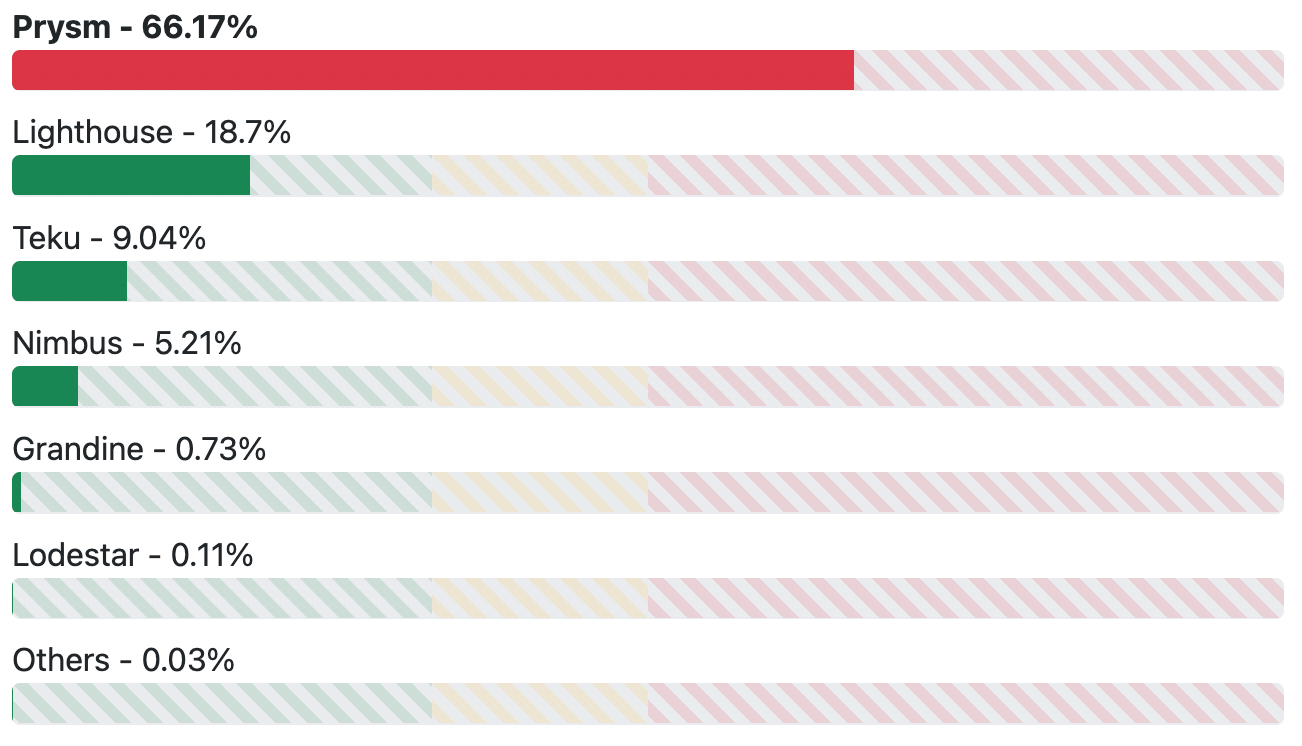
As of early 2022, a significant portion of the network’s staking power, approximately 33%, was concentrated on the Prysm client, developed by Prysmatic Labs. This concentration, while just below the critical 66% threshold, represents a non-ideal situation. Should a critical bug emerge and be exploitable in a way that causes a consensus failure, the network would be at significant risk. While this scenario is considered unlikely, its non-zero probability warrants serious attention.
The Ethereum ecosystem features several other consensus clients, including Lighthouse, Teku, Nimbus, Grandine, and Loadstar. Notably, Grandine and Loadstar have very small market shares, each well below 1%. Grandine is also unique in that it is published under a closed-source license. The illustration below depicts the distribution of consensus clients at the time of reporting, highlighting Prysm’s considerable dominance, though it had not yet crossed the critical two-thirds mark. Resources such as clientdiversity.org provide real-time updates on this crucial metric.
The Roots of Prysm’s Dominance: A First-Mover’s Advantage
The question arises as to why Prysm has achieved such a commanding position. Marius van der Wijden, an Ethereum core developer working on the Geth Proof-of-Work client, offers insights into Prysm’s success. He attributes it to several key factors:
- First-Mover Advantage: Prysm was among the earliest prototype implementations of a beacon chain client. This early start allowed the team to begin optimization efforts sooner and accumulate more experience.
- Tooling and Documentation: The extended development period enabled Prysm to build out additional tooling, such as a Web UI, and develop comprehensive documentation, making it more accessible and user-friendly.
- Golang Programming Language: Prysm is written in Golang, a language known for its performance, ease of reading, and rapid development capabilities. This choice also made it easier for developers familiar with Geth (also written in Golang) to understand and audit Prysm’s codebase.
Execution Layer Diversity: A Less Pressing, but Still Relevant, Concern
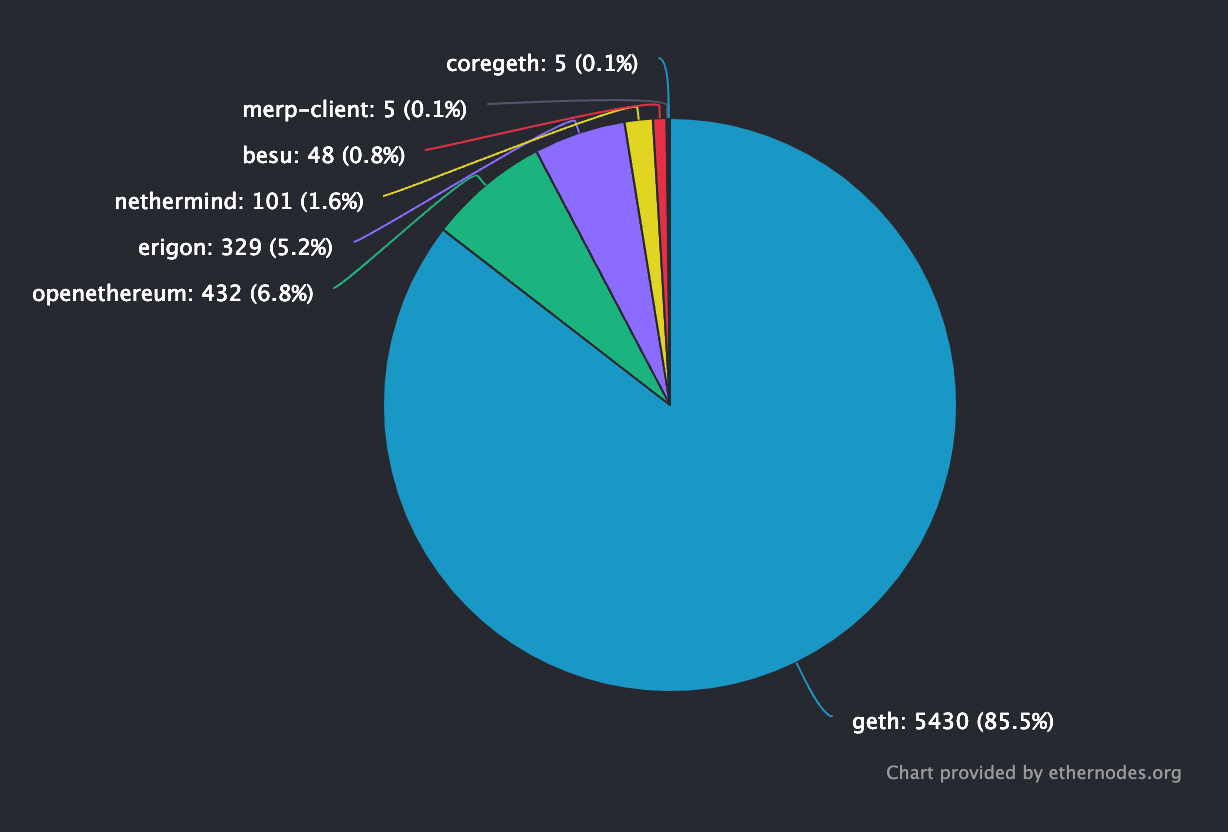
While consensus client diversity is paramount for network security, the distribution of Proof-of-Work execution clients presents a different, though related, concern. At the time of reporting, Geth held a dominant "market share" of over 85% in the execution layer. However, van der Wijden clarifies that this is less critical in a post-Merge world. Execution nodes primarily focus on transaction execution, not on providing the core security of the network, a role that will be primarily handled by the PoS validators. Nonetheless, efforts are underway to improve diversity in this layer as well.
The Influence of Major Exchanges on Client Distribution
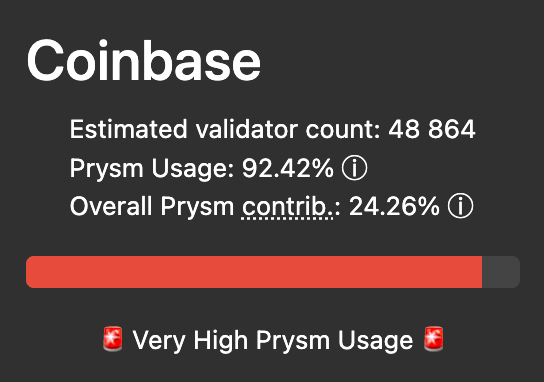
A significant contributor to the concentration of staking power on Prysm is the involvement of major cryptocurrency exchanges that offer staking services. These platforms, including Coinbase, Kraken, and Binance, pool user funds to run validator nodes, allowing individuals to stake Ether without meeting the 32 ETH threshold. The overwhelming adoption of Prysm by these large staking services is a primary driver of its dominance.
Coinbase, with a substantial number of validators, reported that its choice to utilize Prysm was driven by security considerations. Specifically, Prysm was the only viable client at the time that supported remote signers, a crucial feature for generating and storing keys in isolated environments, thereby enhancing the security of their validators. Coinbase Cloud stated they have also begun supporting Lighthouse and working to integrate remote signer support for it, indicating a move towards greater diversity.
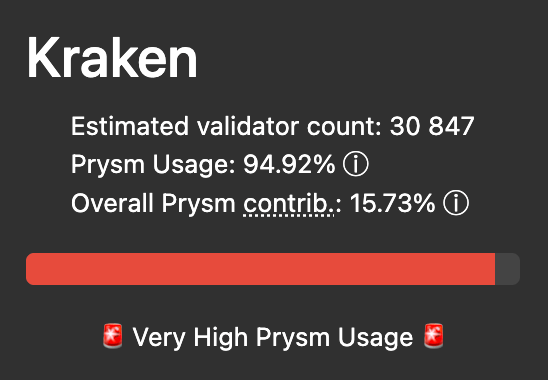
Kraken, another major exchange, also initially opted for Prysm due to its perceived maturity and stability. However, Kraken has announced plans to roll out new validators built on Teku and migrate some existing ones, aiming to improve client diversity and offer a more resilient staking service.
Binance, while a significant staking provider, did not respond to requests for comment regarding their client diversity strategy.
Lido, a prominent decentralized staking pool, while having a substantial number of validators, exhibits a more balanced client distribution compared to the centralized exchanges, contributing less to Prysm’s overall dominance.
Decentralized Alternatives: Rocket Pool’s Contrasting Approach
In contrast to the large centralized staking services, decentralized staking pool Rocket Pool demonstrates a significantly more diverse client distribution. With a much smaller validator count overall, its reliance on Prysm is minimal, contributing a negligible percentage to Prysm’s dominance. This highlights the potential for decentralized protocols to foster greater client diversity.
Addressing the Imbalance: Ongoing Discussions and Future Outlook
The major staking services and pools collectively hold the power to significantly influence client diversity. Fortunately, ongoing discussions are taking place between these entities and the Ethereum Foundation. According to Marius van der Wijden, these discussions are progressing positively, with large staking pools actively working to transition parts of their infrastructure to alternative clients. The process for these larger entities may take longer than for individual validators due to the need to adapt their metrics and monitoring systems to new client APIs.
The Ethereum community appears to be preparing for The Merge with a less-than-ideal client distribution, acknowledging that a substantial reduction in Prysm’s dominance below the 33% threshold is unlikely in the short term. Despite this challenge, the core developers remain committed to proceeding with The Merge. They express confidence in the robustness of the network’s testing and fuzzing infrastructure, which continuously identifies discrepancies between clients. Even in the event of a consensus failure, the team believes they possess the capability to rapidly deploy fixes and resolve forks. Furthermore, a firm consensus exists within the core development community: stakers who opt for a majority client and experience issues due to its misbehavior will not receive bailouts.
The successful execution of The Merge, a complex technological feat of unprecedented scale, will be a testament to the Ethereum community’s collaborative spirit and its commitment to evolving the network into a more sustainable, secure, and scalable platform for the future of decentralized applications and finance. The ongoing focus on client diversity, while a challenge, underscores the community’s dedication to ensuring the long-term health and resilience of the Ethereum blockchain.