James Watt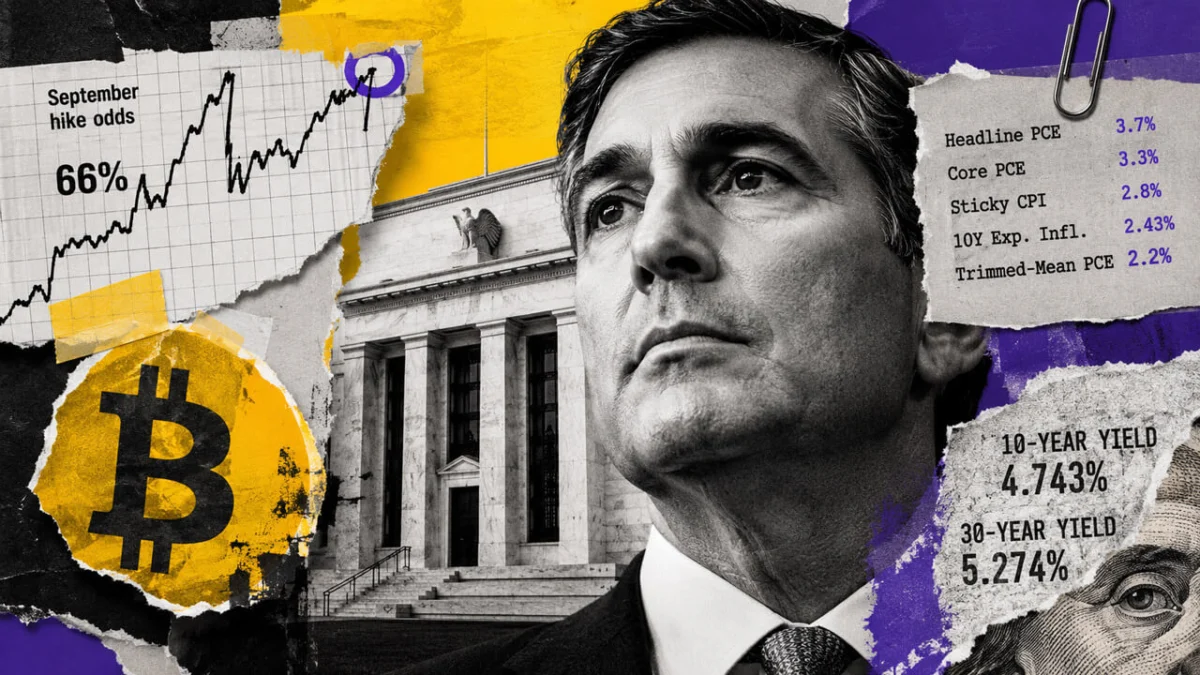
Bitcoin is currently trading near the $63,000 threshold as global financial markets grapple with a complex and somewhat opaque monetary policy environment overseen by Federal Reserve Chair Kevin Warsh. Market participants are currently assigning approximately 66% odds to a potential interest rate hike in September, a sentiment driven by a policy framework that remains partially obscured from public view. While the Federal Reserve has historically leaned on transparency and forward guidance to anchor market expectations, the current leadership has defined its reaction function around the concept of "underlying inflation" without fully disclosing the specific weighting assigned to various economic indicators. This ambiguity has left investors, particularly those in the volatile cryptocurrency sector, attempting to decode a dashboard of inflation metrics that currently spans a wide 1.5 percentage point range.
The divergence in economic data presents a significant challenge for price discovery. Headline Personal Consumption Expenditures (PCE), the Fed’s traditionally preferred metric, is currently running at 3.7%, well above the 2% target. Conversely, the Dallas Fed’s trimmed-mean PCE sits at a much cooler 2.2%. This discrepancy means that a single economy is producing readings that range from nearly double the Fed’s goal to figures that are arguably within striking distance of price stability. For Bitcoin traders, this lack of clarity creates a dual-layer of uncertainty: they must not only anticipate forthcoming inflation data but also guess which specific data points Chair Warsh will prioritize in his decision-making process.
The Fragmented Inflation Dashboard and the Search for Signal
The Federal Reserve’s current analytical framework utilizes a variety of lenses to view the American economy, each offering a different narrative regarding the persistence of price pressures. At the top of the heat map is the Headline PCE at 3.7%, suggesting that inflation remains a significant threat to macroeconomic stability. Core PCE, which strips out volatile food and energy costs, follows closely at 3.3%, indicating that underlying price pressures remain elevated despite previous tightening cycles.
Further down the spectrum, the Atlanta Fed’s sticky-price CPI stands at 2.8%. This metric is often viewed as a more reliable gauge of future inflation trends, as it tracks goods and services whose prices change relatively infrequently. Its current level suggests that while persistent inflation is cooling, it has yet to reach the desired 2% equilibrium. Even more optimistic are the long-term expectations; the Cleveland Fed’s 10-year expected inflation rate is currently 2.43%, suggesting that despite short-term volatility, the public’s long-term outlook remains relatively well-anchored.
The most dovish reading comes from the Dallas Fed’s trimmed-mean PCE at 2.2%. This measure excludes the most extreme price movements in either direction, providing a "smoothed" view of the inflation trend. If Chair Warsh were to favor this metric, the argument for maintaining current rates or even considering future cuts would be significantly bolstered. However, Warsh has invoked Goodhart’s Law—the economic principle that when a measure becomes a target, it ceases to be a good measure—to justify a more holistic and less predictable approach to data interpretation.
Chronology of the New Federal Reserve Policy Lens
The current state of Fed policy is the result of a deliberate restructuring of the central bank’s analytical tools. This process began in earnest on July 9, when the Federal Reserve announced the creation of five specialized monetary-policy task forces. These groups were designed to overhaul how the bank collects data and interprets the drivers of inflation, marking a departure from the 30-year playbook of high-disclosure forward guidance.
On July 29, the Federal Open Market Committee (FOMC) voted 9-3 to maintain the target interest rate range at 3.50% to 3.75%. The three dissenting votes—from Beth Hammack, Neel Kashkari, and Lorie Logan—all favored a 25-basis-point increase. This internal friction served as a catalyst for market volatility, signaling that the prospect of a September hike was very much on the table. Following the vote, the Atlanta Fed tracker briefly placed the probability of a September hike at a staggering 83.05% on July 29, before market sentiment cooled slightly to the current 66% level by July 31.
The timeline for the remainder of the year is punctuated by several key events that will likely dictate Bitcoin’s price trajectory. In late August, the annual Jackson Hole Economic Symposium will serve as the first major opportunity for Chair Warsh to provide clues regarding his weighting system for inflation indicators. This will be followed by the critical FOMC meeting on September 15-16, where new Summary of Economic Projections will be released. Looking further ahead, January 2027 has been identified as the first formal opening for a revised and potentially more transparent strategy statement.
The Real Rate Challenge and Bitcoin’s Opportunity Cost
One of the most significant headwinds for Bitcoin in the current environment is the surge in real interest rates. As of late July, the 10-year Treasury yield ended near 4.743%, while the 30-year yield reached 5.274%, its highest level in nearly two decades. When adjusted for the Cleveland Fed’s 10-year expected inflation of 2.43%, the simple expected real rate sits near 2.31%.
This real return represents a formidable competitor for Bitcoin. Unlike Treasury bonds or dividend-paying stocks, Bitcoin offers zero cash yield. When real rates are high, the opportunity cost of holding a non-yielding asset increases significantly. Furthermore, higher real rates tend to support the strength of the U.S. dollar and reduce the overall balance sheet capacity available for high-risk assets. Bitcoin’s recent move toward $63,000 has occurred within this "tighter liquidity" setting, suggesting that the asset is facing significant structural resistance.
The institutional channel for Bitcoin, primarily through U.S.-traded spot Bitcoin funds, has also shown signs of volatility. On July 30, these funds saw healthy inflows of $233.1 million. However, the very next day, the market recorded $87.9 million in net redemptions. While cumulative net inflows remain robust at approximately $51.56 billion, the inconsistency of daily support suggests that institutional investors are also wary of the Fed’s next move.
Analytical Scenarios: The Bear Case vs. The Bull Case
The future of Bitcoin’s price action appears intrinsically linked to which inflation narrative Chair Warsh adopts. A "bearish" path for the digital asset would materialize if the Fed chooses to treat headline PCE (3.7%) and core PCE (3.3%) as the primary signals of economic health. In this scenario, firm oil prices and continued labor market resilience would likely embolden the hawks within the FOMC. If the market begins to price in a higher probability of a September hike, Treasury yields would remain firm, the dollar would strengthen, and Bitcoin would likely face renewed selling pressure. A failure to hold the $62,000 support level could quickly see the price drop to $60,000, with the late-June lows of $58,000 becoming a distinct possibility.
Conversely, a "bullish" path requires the Federal Reserve to categorize recent spikes in energy and other volatile sectors as "noise" rather than "signal." If Chair Warsh assigns greater weight to the trimmed-mean PCE at 2.2% and the sticky-price inflation at 2.8%, the Fed would have ample room to maintain the status quo in September. Such a pivot would likely cause real yields to ease and the dollar to soften, reopening the liquidity gates for risk assets. In this environment, Bitcoin would first need to reclaim the $64,500 level before attempting a move toward $66,000 or $68,000.
Institutional Responses and Market Implications
The institutional response to this "no-guidance" era has been one of cautious observation. The inclusion of high-profile figures like Raj Chetty, Doug McMillon of Walmart, and Kevin Murphy in the Fed’s Data Sources group suggests a move toward utilizing real-time, private-sector data to supplement traditional government statistics. This could lead to a more reactive and less predictable Federal Reserve, which inherently increases the risk premium for assets like Bitcoin.
Market analysts suggest that the "base case" for the coming weeks is one of continued range-bound trading. As long as the dashboard of inflation indicators remains unresolved and conflicting, Bitcoin is likely to swing between $62,000 and $65,300. The lack of a clear "formula" for policy means that every public comment from a Fed official or every minor data release can trigger outsized moves in both the bond and crypto markets.
Ultimately, Bitcoin is currently trading the "gap" between raw economic data and the Fed’s interpretation of that data. Until the Jackson Hole symposium or the September FOMC meeting provides a clearer roadmap, the digital asset remains vulnerable to sudden shifts in macro sentiment. The transition from a transparent Fed to one that "separates noise from signal" behind closed doors has fundamentally altered the risk landscape, forcing traders to price in the unknown weightings of a hidden policy framework.