Nila Kartika Wati
The burgeoning intersection of artificial intelligence and cybersecurity is creating a profound new chasm within the cryptocurrency industry, where access to the most powerful AI models for defensive purposes is becoming a critical determinant of security posture. While a select group of major players has managed to secure access to these advanced AI capabilities, the vast majority of the crypto ecosystem, including some of its largest exchanges, remains on the outside looking in, grappling with the escalating threat of increasingly sophisticated, AI-assisted attacks. This uneven distribution of cutting-edge defensive tools threatens to create a two-tiered security landscape, potentially leaving billions of dollars in digital assets vulnerable to exploitation.
The Urgent Need for AI in Crypto Security
The cryptocurrency landscape, characterized by its immutable transactions, global reach, and often pseudonymous nature, presents a uniquely challenging environment for security. Exploits, once successful, are frequently irreversible, leading to massive financial losses for individuals and institutions alike. Data from various blockchain analytics firms consistently highlights the staggering sums lost to hacks and scams each year. For instance, reports indicate that billions of dollars have been siphoned from decentralized finance (DeFi) protocols and centralized exchanges (CEXs) over the past few years, with figures often fluctuating but consistently remaining in the multi-billion-dollar range annually. The year 2022 alone saw over $3.8 billion stolen in crypto hacks, according to Chainalysis, a trend that underscores the relentless pressure on security teams.
In this high-stakes environment, artificial intelligence has emerged as a crucial frontier for both offense and defense. Advanced AI models possess an unparalleled ability to sift through vast quantities of code, identify subtle vulnerabilities, predict attack vectors, and even automate response mechanisms with a speed and scale impossible for human analysts alone. For crypto firms, integrating such AI capabilities into their security infrastructure is not merely an enhancement but is rapidly becoming a necessity to safeguard complex smart contracts, secure exchange operations, and protect user funds from evolving threats. The promise of AI lies in its potential to proactively identify flaws before attackers can exploit them, thereby strengthening the foundational integrity of the decentralized economy.
Frontier AI Models: Capabilities and Controlled Access
At the forefront of this technological arms race are models like Anthropic’s restricted Mythos and OpenAI’s GPT-5.5-Cyber. These are not merely general-purpose AI chatbots; they are highly specialized iterations designed with enhanced capabilities for cybersecurity applications, often stripped of the ethical safeguards present in their public counterparts to allow for more aggressive penetration testing and vulnerability analysis.
Anthropic’s Mythos model, for example, is understood to leverage the same powerful underlying architecture as its publicly available Fable model but without the guardrails that typically restrict sensitive cybersecurity-related queries. This allows Mythos to engage in activities like comprehensive code audits and penetration testing that would be limited by safety protocols in a public model. Similarly, OpenAI operates a tiered access system for its advanced GPT-5.5 models, with a "Trusted Access for Cyber" tier available to verified defenders and an even more permissive GPT-5.5-Cyber model reserved for a smaller group conducting authorized penetration testing. These models represent the pinnacle of current AI capabilities for identifying intricate logical flaws, cryptographic weaknesses, and potential backdoors in complex codebases—tasks that are notoriously difficult and time-consuming for human auditors.
The developers of these frontier models have articulated a clear rationale for their restricted rollout: responsible AI deployment. There is a significant concern that unfettered public access to such powerful cyber-capable AI could inadvertently empower malicious actors faster than it empowers defenders. Jimmy Su, Chief Security Officer at Binance, echoed this sentiment, telling Cointelegraph, "If it enhances the attacker much faster than the defender, then it actually is harming the ecosystem." He suggested that a limited testing period could help reduce the potential "blast radius" if the models were prematurely released to the wider public without sufficient understanding of their dual-use implications. This cautious approach aims to prevent a scenario where AI tools become weapons in the wrong hands before the defensive strategies can catch up.

The Emerging AI Access Hierarchy: Who Has It, Who Doesn’t
Despite the clear benefits and the industry’s pressing need, access to these cutting-edge AI security tools remains highly selective, creating a palpable divide within the crypto sector.
The Privileged Few:
Among the handful of entities confirmed to have secured access is Coinbase, a leading U.S. crypto exchange. In June, Coinbase announced its successful acquisition of access to Anthropic’s restricted Mythos model. This move signifies a proactive step by the exchange to leverage advanced AI in fortifying its extensive digital asset infrastructure and user holdings.
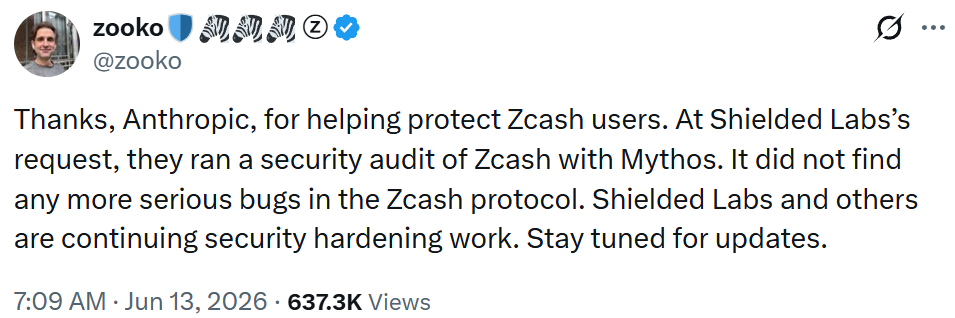
Another notable beneficiary is the privacy-focused cryptocurrency Zcash. Zooko Wilcox, the founder of Zcash, publicly stated that Anthropic utilized the Mythos model to conduct a comprehensive audit of the Zcash protocol. This audit, requested by Shielded Labs, aimed to rigorously test the protocol’s resilience against sophisticated attacks, demonstrating the practical application of Mythos in validating complex blockchain security. The successful audit, which reportedly found no serious bugs, underscores the model’s potential to enhance trust and reliability in critical crypto infrastructure.
Beyond direct crypto entities, some adjacent companies and service providers have also gained entry. FIS, a global leader in financial technology services that partners with Circle for USDC payments, recently joined Anthropic’s Project Glasswing. This initiative is a gated program designed by Anthropic to grant vetted cyber defenders and organizations responsible for critical software infrastructure early access to its restricted Mythos models. Similarly, HackerOne, a prominent bug-bounty and security testing platform that serves many major crypto exchanges, confirmed its participation in Project Glasswing. However, HackerOne’s current testing of Mythos is confined to its internal infrastructure rather than directly applied to its customers’ programs, indicating a cautious, phased integration.
The Waiting Majority:
In stark contrast, many other significant players in the crypto space are still actively seeking or struggling to obtain access to these frontier AI models.
Binance, the world’s largest cryptocurrency exchange by daily trading volume, with a staggering $137.8 billion in assets under management according to DefiLlama, explicitly stated its lack of access. Binance CSO Jimmy Su expressed his company’s efforts: "That’s one advanced frontier model that hasn’t been made available to crypto just yet. We have been trying to make inroads there. We also talked to other crypto exchanges and our own investors to try to make some progress. But we haven’t gotten the most frontier AI model, like Mythos." This highlights the challenge even for industry behemoths to gain entry into this exclusive club.
Fireblocks, a leading crypto custodian responsible for securing trillions in assets annually, also confirmed in April its pursuit of Mythos access. At that time, Fireblocks was reportedly limited to using Anthropic’s publicly available Fable model for penetration testing, which, while capable, lacks the unrestricted cybersecurity-specific functionalities of Mythos.
Uniswap founder Hayden Adams publicly voiced frustration in June over the safeguards embedded in Fable, Anthropic’s publicly available model. These safeguards, designed to prevent misuse, restrict prompts related to sensitive cybersecurity work, effectively limiting the model’s utility for advanced defensive applications for the broader public. This sentiment underscores the dilemma faced by firms without access to the unrestricted versions.
Even the Ethereum Foundation, a cornerstone of the second-largest cryptocurrency ecosystem, announced in July that it has been employing "coordinated AI agents" to identify bugs across its systems. However, the Foundation did not disclose which specific AI models were being utilized, leaving open the question of whether they have secured access to frontier cyber-capable models or are relying on more widely available alternatives. Cointelegraph’s attempts to confirm access from the Ethereum Foundation, Fireblocks, and Uniswap did not yield immediate responses regarding their current status.
Industry Voices: Navigating the Dilemma of Access
The debate over restricted access to these powerful AI models is complex, pitting the imperative of responsible AI development against the urgent need for robust cybersecurity in a high-value industry.
While many crypto security executives acknowledge the initial necessity of restricting access, particularly for newly released, potentially disruptive models, there is a growing consensus that such limitations become harder to justify as publicly available models approach similar capabilities. Binance’s Jimmy Su, despite supporting initial controlled rollouts to mitigate harm, believes that this calculation changes when competing models become more powerful and widely available. "As other more powerful models are being released, the pressure will be on Anthropic to make it more widely available," he stated. He further questioned whether defenders could deploy these frontier models as effectively as attackers once they become broadly accessible.
Michael Coates, the Chief Information Security Officer for the Solana Foundation, who joined in July, voiced strong support for guardrails but emphasized the need for legitimate defenders to have a faster route to these tools. "I fully understand guardrails for advanced models, but we need to streamline the verification programs, the acceptance programs, to give these models to legitimate defenders," Coates urged. His argument is rooted in the belief that "we need to make sure that the best models we can get are in the hands of defenders because attackers will have something capable enough." This highlights a critical imbalance: if attackers can access or develop powerful AI tools, defenders must not be left behind.
Sean Cheetham of Blockchain Capital also supported the eventual opening up of these restrictions. He posited that broader availability could ultimately favor defenders, given that the sheer number of legitimate security researchers and white-hat hackers significantly outweighs the smaller groups conducting sophisticated attacks. "If good people can multiply their defense scale… you’re much better off just opening it up and allowing them to defend themselves," he argued, suggesting that the collective power of a well-equipped defense community could overcome the advantages given to a few attackers.
The Escalating Threat: AI-Assisted Attacks are Here
The theoretical concerns about AI-assisted attacks are rapidly materializing into real-world incidents, underscoring the urgency of the access debate. The increasing sophistication and speed of these exploits highlight the widening gap between the capabilities of attackers and the defensive tools available to many crypto firms.
Just recently, Boltz, a Bitcoin swap service, made the critical decision to halt its non-custodial bridge following a "steady rise in AI-assisted exploits" over the past few months. The service explicitly stated, "The pattern is clear: attackers now iterate faster than a team our size can find and patch." This incident serves as a stark warning that smaller teams, even those committed to security, are struggling to keep pace with the rapid evolution of AI-powered attack methodologies. The ability of AI to quickly identify and test vulnerabilities, refine attack payloads, and adapt to defensive measures significantly compresses the window for defenders to respond.
Another alarming incident involved Coinkite, a Bitcoin hardware wallet company, which reported last week that several of its Coldcard devices were exploited due to a flaw in its wallet seed generation mechanism. The flaw resulted in less randomness than expected, making the seeds potentially guessable. Crucially, Coinkite speculated that the attacker likely used AI to review previous versions of the firmware to uncover and exploit this subtle flaw. This incident is particularly poignant as Coinkite itself had used "one of the best available AI models" to review its code just weeks prior, illustrating the relentless cat-and-mouse game between AI-powered offense and defense. It suggests that even with AI-assisted audits, the possibility of overlooking deep-seated vulnerabilities remains, especially against a determined, AI-equipped adversary.
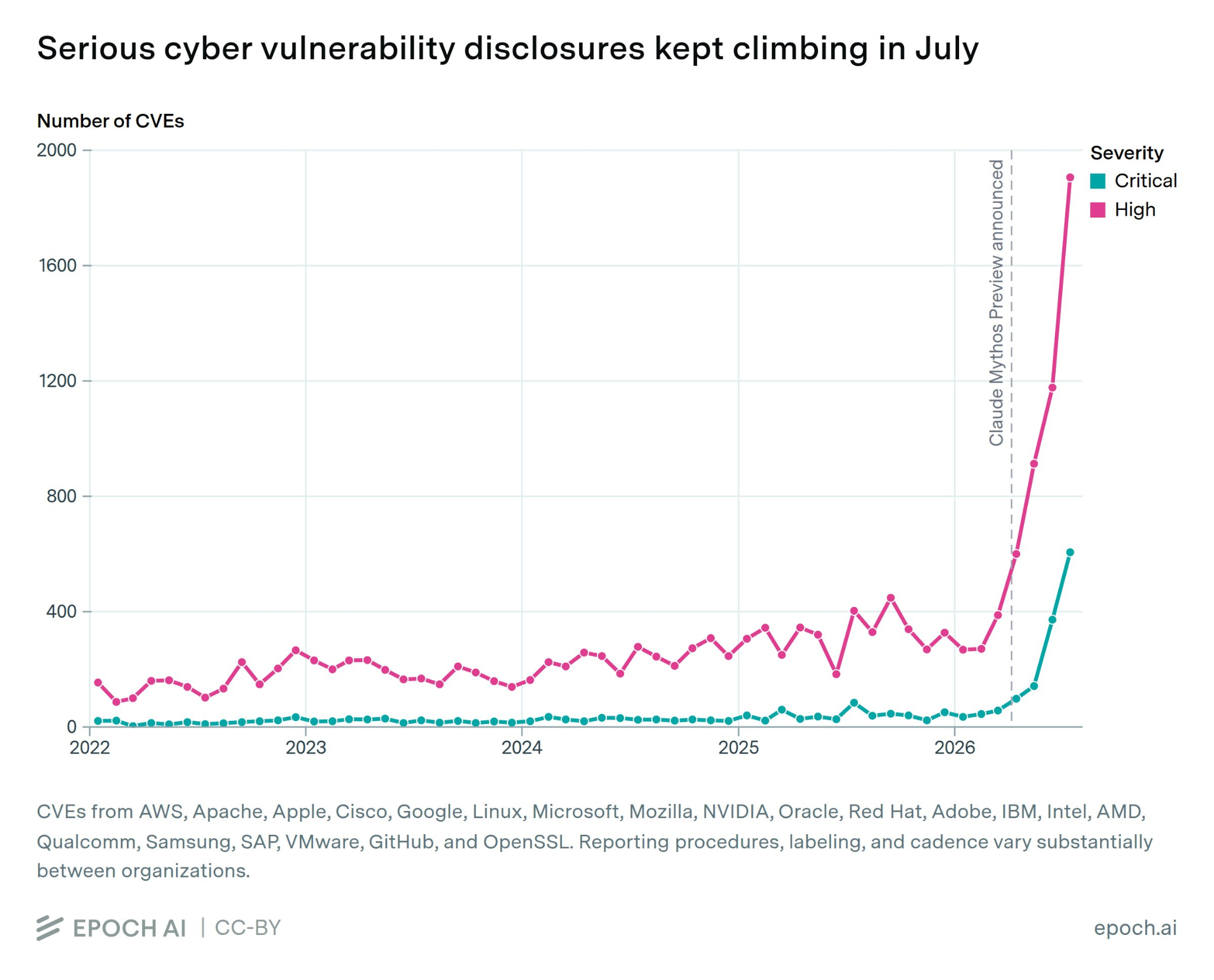
The graphical data from Epoch AI, indicating a climb in critical-severity CVEs (Common Vulnerabilities and Exposures) after the launch of "Claude Mythos Preview," further illustrates the potential for AI to both uncover existing flaws and potentially facilitate new attack vectors. While correlation does not equal causation, the timing suggests a possible link between the increased availability of powerful AI models and the discovery or exploitation of critical vulnerabilities. This underscores the double-edged sword of AI: it can illuminate weaknesses for defenders, but also for attackers.
Implications and The Path Forward
The uneven access to frontier AI models for cybersecurity poses significant implications for the future of the crypto industry.
Security Disparity and Systemic Risk: The most immediate consequence is the creation of a stark security disparity. Firms with access to advanced AI tools will be far better equipped to defend against sophisticated attacks, while those without will face an increasingly asymmetric battle. This disparity could lead to a concentration of wealth and user trust in a few "AI-fortified" entities, potentially marginalizing smaller innovators and increasing systemic risk across the broader crypto ecosystem. A single major exploit on a large, less-protected platform could have ripple effects, eroding public trust and attracting regulatory scrutiny.
The Open-Source Dilemma: The situation also highlights the ongoing tension between powerful, restricted proprietary AI models and increasingly capable open-source alternatives. While proprietary models offer superior performance, the nature of open-source development means that powerful AI tools, even if initially less refined, can quickly evolve and become widely accessible to anyone, including malicious actors. This dynamic pressures AI developers to consider broader access, as limiting their models to a select few might become counterproductive if attackers are already leveraging powerful, unrestricted open-source solutions. The "blast radius" argument for restriction diminishes if similar capabilities are already freely available elsewhere.
Regulatory Scrutiny (Inferred): Given the high financial stakes and the potential for widespread user harm, the emerging AI security divide in crypto could draw the attention of financial regulators worldwide. They may begin to scrutinize how crypto firms are leveraging or failing to leverage advanced security technologies, potentially leading to mandates for robust AI-driven security protocols or requirements for access to verified defensive AI tools. This could further complicate the landscape for firms struggling to gain access.
The Future of Crypto Security: The path forward necessitates a multi-pronged approach. There is an urgent need for greater collaboration between AI developers like Anthropic and OpenAI and the crypto industry to establish clear, transparent, and efficient pathways for legitimate defenders to access these critical tools. Streamlined verification programs, as advocated by Solana Foundation’s Michael Coates, are essential. Furthermore, the industry must invest in developing and sharing best practices for AI integration into security operations, fostering a collective defense against evolving threats. The long-term resilience of the crypto ecosystem will depend on its ability to democratize access to advanced defensive AI, ensuring that all participants, not just a select few, are equipped to combat the sophisticated challenges of the AI age.
In conclusion, the current landscape represents a critical juncture for the cryptocurrency industry. While the initial restrictions on frontier AI models are understandable from a responsible development perspective, the escalating reality of AI-assisted attacks demands a rapid re-evaluation of access policies. Failure to bridge this growing AI security divide risks creating an environment where the most innovative and valuable financial ecosystem remains perpetually vulnerable, undermining its potential and jeopardizing the trust of its global user base.