Lina Irawan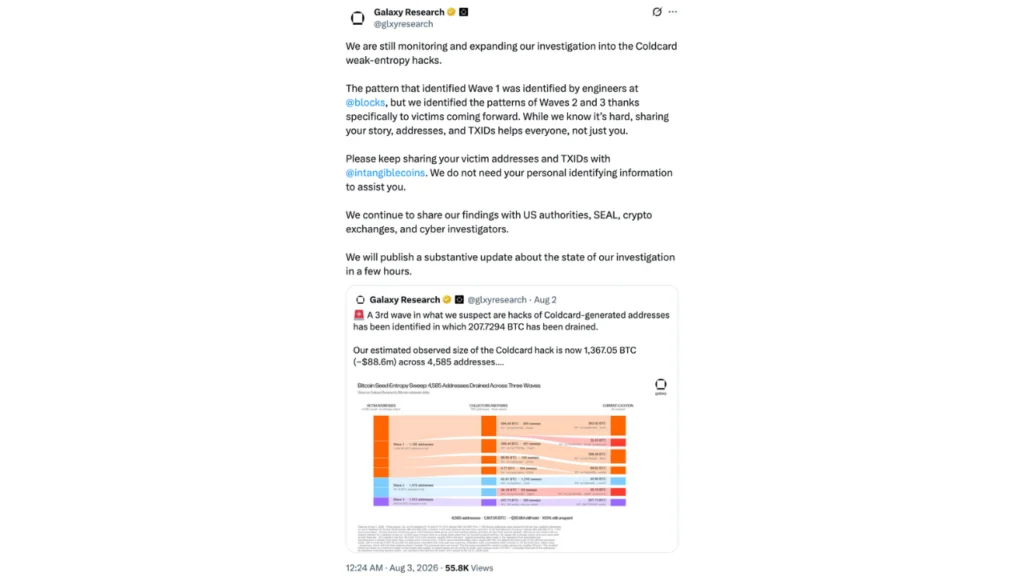
A deeply concerning security breach has seen nearly $89 million worth of Bitcoin siphoned from over 4,500 wallet addresses, stemming from a sophisticated attack campaign that exploits a critical vulnerability present in a specific version of COLDCARD hardware wallet firmware released in March 2021. Blockchain researchers have identified at least three distinct attack waves, with ongoing analysis suggesting a potential fourth may be underway, highlighting the persistent and evolving nature of this threat. The exploit, meticulously detailed by blockchain analytics firms like Onchain Lens and Galaxy Research, does not compromise the hardware wallets directly. Instead, it targets a fundamental weakness in the recovery seed generation process, allowing attackers to reproduce private keys derived from compromised seeds and subsequently drain funds from wallets that have remained offline for years, demonstrating a rare but potent risk to even the most secure cold storage solutions.
The Genesis of the Exploit: A Flaw in Randomness
The root of this extensive theft lies in a firmware bug introduced by COLDCARD in a release from March 2021. This critical flaw caused the wallet’s recovery seed generation process to erroneously utilize a predictable software-based randomizer instead of the device’s inherently more secure hardware random number generator. Bitcoin private keys are intrinsically linked to these recovery seeds, meaning that wallets initialized during this vulnerable period were consequently created with significantly weakened cryptographic entropy. This fundamental weakness effectively made the private keys for these affected wallets susceptible to offline recreation through brute-force computation, rendering the supposed security of air-gapped, offline storage moot. The implication is particularly alarming for long-term Bitcoin holders, as the vulnerability is permanent once a compromised seed is generated, regardless of the physical security measures employed for the hardware wallet.
A Chronology of Attack Waves and Evolving Tactics
The scale and sophistication of the attack became evident on July 30th, when the first wave of illicit activity was detected. Within a mere 41 minutes, approximately 1,083 BTC, valued at roughly $70 million at the time, was stolen from 1,196 distinct wallet addresses. The sheer speed and coordinated nature of these transactions strongly indicated that the attackers had already meticulously mapped a significant portion of the vulnerable private key space and deployed automated scripts to sweep the funds.

This initial wave was swiftly followed by a second, though details on its exact scope remain less publicized. A third wave, observed over the weekend of the initial report, saw a shift in the attackers’ strategy. This phase targeted wallets with smaller balances, suggesting a broader sweep of remaining vulnerable assets. Galaxy Research estimated that approximately 207.7 BTC was drained during this latest confirmed phase, bringing the total observed losses across the first three waves to around 1,367 BTC, a sum translating to nearly $89 million, impacting a total of 4,585 Bitcoin addresses.
Beyond the sheer volume of stolen funds, researchers noted significant tactical evolutions in the attackers’ methods. In the initial wave, stolen funds were consolidated into a small number of collector wallets, making them somewhat easier to track. However, in subsequent waves, the attackers began sending each victim’s Bitcoin to a separate, unique destination address. This decentralized approach significantly complicates blockchain tracing efforts. Furthermore, the attackers switched to utilizing Pay-to-Witness-Script-Hash (P2WSH) outputs. This transaction type, integral to the SegWit upgrade of the Bitcoin protocol, supports more advanced spending conditions, such as multisignature requirements or timelock scripts, potentially adding another layer of complexity for investigators.
Another notable shift in operational efficiency was observed. While the first wave involved emptying individual addresses one by one, later waves saw transactions sweeping funds from multiple victims simultaneously. This could indicate either the same attacker adapting their methodology in response to public attention and evolving detection methods, or the emergence of a new actor independently exploiting the same pre-existing vulnerability.
The Implication of Long-Term Cold Storage
The average duration for which the Bitcoin stolen in the first three confirmed waves had remained untouched was approximately 3.18 years. This data point is particularly telling, as it suggests that many of the victims believed their assets were securely stored for the long term, underscoring the perceived safety of hardware wallets for extended periods. The exploit’s nature means that even wallets that have been meticulously kept offline, secured in safes, or stored in bank vaults were susceptible if initialized during the vulnerable firmware period. This starkly illustrates that the security of digital assets is not solely dependent on offline storage but also on the integrity of the initial setup and key generation process.

Warning of a Potential Fourth Wave and Opportunities for Mitigation
The threat landscape remains dynamic, with researchers issuing warnings about a potential fourth attack wave. On August 3rd, Alex Thorn, Head of Galaxy Research, identified transaction patterns consistent with a surge in malicious activity. During a period of approximately 2.5 hours, researchers detected 218 suspicious transactions involving 462 suspected victim addresses, representing an activity level roughly 45 times higher than normal.
After rigorous filtering to eliminate false positives and multisignature wallets, Galaxy Research narrowed down the suspected dataset to approximately 709 addresses holding around 448.7 BTC. Thorn emphasized that this latest phase has not yet been definitively confirmed, as the analysis relies on observed transaction patterns rather than direct victim reports. However, Galaxy Research chose to publish these findings immediately due to the potential for affected users to still protect their funds.
A critical element of this potential fourth wave is the use of Replace-by-Fee (RBF). This Bitcoin protocol feature allows an unconfirmed transaction to be replaced by a new transaction that offers a higher network fee. For victims who discover their funds being transferred out of their wallet while the transaction is still in the mempool (the waiting area for unconfirmed transactions), there exists a brief window of opportunity to submit a higher-fee replacement transaction. This would effectively allow them to preempt the attacker’s transaction and transfer their Bitcoin to a secure wallet before the attacker’s transfer is confirmed by miners. Thorn strongly urged anyone who may have generated a wallet using the affected firmware to immediately verify their balances and migrate any remaining funds to wallets created with a fresh, uncompromised recovery seed.
Renewed Scrutiny on Self-Custody and Broader Market Reactions
This sophisticated attack campaign is inevitably casting a renewed spotlight on the principles of self-custody within the cryptocurrency ecosystem. Following the dramatic collapse of FTX in 2022, a significant number of investors embraced the mantra of "Not your keys, not your coins," migrating their assets from centralized exchanges to self-custodied hardware wallets. While this shift effectively mitigates the risks associated with exchange insolvencies and mismanagement, the COLDCARD incident serves as a stark reminder that self-custody is not a panacea. It introduces technical risks, particularly those stemming from flaws in wallet generation and secure seed management.

The implications of this vulnerability are already being felt in broader market movements. Data from CryptoQuant indicated a significant surge in Bitcoin transfers involving amounts less than 1 BTC, briefly reaching approximately 39,600 BTC in a single day. This marked the highest level of such activity observed since the FTX bankruptcy. Concurrently, blockchain analysis revealed that centralized exchanges recorded net inflows exceeding 15,000 BTC on August 1st alone. Major platforms including Binance, Kraken, OKX, and River were among those that received substantial portions of these incoming Bitcoin deposits, suggesting a potential, albeit temporary, shift back towards centralized entities for some investors seeking perceived simplicity or a different risk profile.
In response to the breach, Galaxy Research has shared approximately 600 suspected attacker addresses with U.S. federal investigators, blockchain compliance firms, and cybersecurity partners. This collaborative effort aims to support ongoing investigations and potentially aid in the recovery of stolen funds or the apprehension of those responsible.
For users who may have initialized wallets using the affected COLDCARD firmware, the consensus among researchers is unequivocal: simply updating the device’s software is insufficient to rectify the underlying compromise. The only definitively safe course of action is to create an entirely new wallet with a brand-new recovery seed, generated by a known secure process, and immediately transfer all remaining Bitcoin from the compromised wallet. Any wallet initiated with the flawed firmware should be considered permanently compromised and all associated funds at extreme risk. The incident underscores the paramount importance of due diligence in selecting and utilizing hardware wallets and the continuous need for vigilance in securing digital assets.