Lina Irawan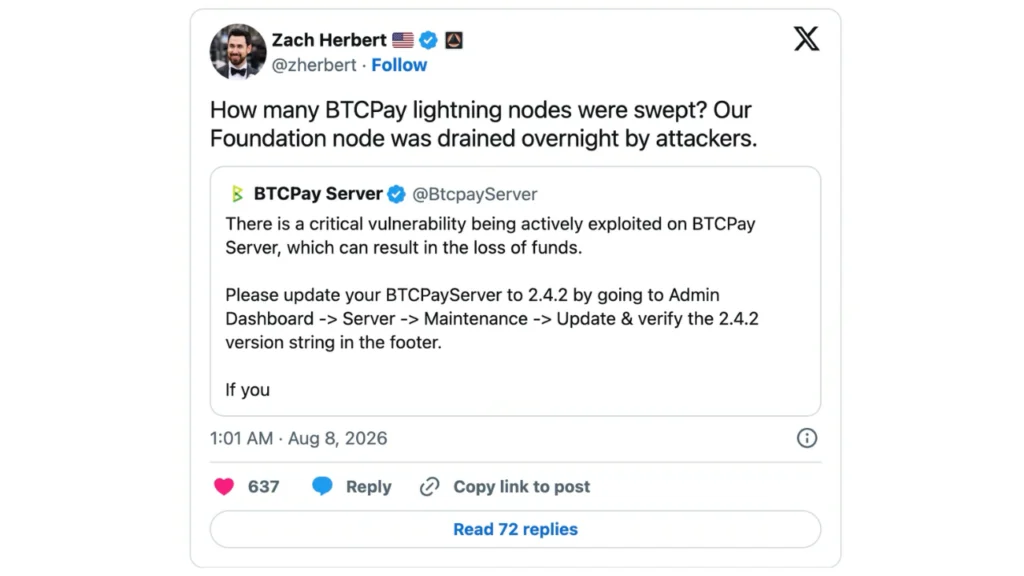
A critical security vulnerability within BTCPay Server, a popular open-source payment processor for Bitcoin, has been actively exploited by malicious actors, resulting in the draining of Bitcoin from Lightning Network nodes operated by merchants and businesses. The BTCPay Server project confirmed the ongoing attacks late Friday, issuing an urgent alert to operators utilizing LND (Lightning Network Daemon), the most widely adopted software for managing Lightning nodes. The warning strongly advised immediate updates to LND version 2.4.2 or, alternatively, to take vulnerable servers offline as a precautionary measure. While the precise number of affected users and the total amount of Bitcoin stolen remain undisclosed by the project, at least two prominent organizations have publicly confirmed significant financial losses due to the exploit. This incident casts a shadow over Bitcoin’s infrastructure, occurring amidst a week already fraught with security concerns following the discovery of thousands of vulnerabilities across various Bitcoin-related projects, identified through extensive AI-assisted code reviews.
Genesis of the Exploit: Understanding the Technical Breach
BTCPay Server, renowned for its self-hosted and open-source nature, empowers merchants to accept Bitcoin payments without the intermediary reliance on centralized payment processors. A significant portion of its user base leverages the Lightning Network through BTCPay Server to facilitate faster and more cost-effective transactions. The vulnerability specifically targeted BTCPay installations that were integrated with LND nodes.
Attackers were able to gain remote access to .macaroon files. These files contain crucial authorization credentials, essentially acting as digital keys that permit software to perform specific actions on an LND Lightning node. Such permissions can extend to critical functions like managing payment channels and, most importantly, transferring funds. Once in possession of these credentials, attackers effectively achieved unauthorized control over the compromised Lightning nodes. According to BTCPay’s preliminary analysis of the attacks, the exploited .macaroon files were utilized to initiate the closure of Lightning channels and systematically sweep Bitcoin from the affected nodes. The severity of this flaw was exacerbated by its nature, as it did not require any prior authentication from the attacker to the vulnerable server, enabling a swift and silent breach. As of the latest reports, BTCPay has refrained from disclosing the intricate technical details of the vulnerability, citing the need for operators to implement necessary patches before a full public disclosure. A comprehensive postmortem analysis is anticipated in the coming days.
The Ripple Effect: Prominent Organizations Report Losses
Among the organizations that have publicly confirmed being victims of this exploit is Foundation, a well-regarded manufacturer of Bitcoin hardware wallets. Zach Herbert, the CEO of Foundation, detailed how attackers successfully drained the company’s Lightning node overnight. The attackers reportedly closed the node’s existing channels and proceeded to withdraw all the Bitcoin held within it. Importantly, Herbert clarified that Foundation’s separate BTCPay on-chain hot wallet remained unaffected by this incident, highlighting the targeted nature of the exploit.
Another entity to report losses is Citadel21, a Bitcoin publication operated by the pseudonymous commentator known as hodlonaut. Citadel21 also confirmed that its Lightning node had been swept clean of its contents. The publication noted that the affected node contained a relatively small amount of Bitcoin, suggesting that while the financial impact for this specific entity was limited, it underscores the exploit’s capability across different scales of operations. These initial reports provide a tangible, albeit incomplete, picture of the exploit’s reach. However, the overall scale of the compromise, including the total number of affected servers and the aggregate value of stolen funds, remains a subject of ongoing investigation and has not been quantified by BTCPay.

Clarification on Scope: Differentiating Wallets and Nodes
In the wake of the developing situation, BTCPay Server issued further clarifications regarding the scope of the vulnerability. The project emphasized that the exploit does not affect its standard on-chain wallets, including those generated directly within the BTCPay Server interface, often referred to as "hot wallets." The critical exposure is specifically linked to deployments that integrate with LND.
This distinction is crucial for understanding the potential impact. A merchant might utilize BTCPay Server for various functions. Lightning Network funds are managed and controlled by the LND node itself. In contrast, an on-chain wallet, even if generated through BTCPay Server, can operate as a distinct entity. However, Bitcoin held within an LND wallet remains susceptible because its control is intrinsically tied to the compromised node. Therefore, operators should not assume their funds are secure simply because they are not actively engaged in Lightning channels at the moment of the exploit. This incident serves as a stark reminder of the inherent security risks associated with interconnecting multiple self-hosted components within a digital infrastructure. A vulnerability in one part of the system, such as the payment server, can inadvertently expose credentials that govern the security of an underlying wallet or a critical Lightning node.
The Bitcoin Red Team: Uncovering the Flaw
The discovery of this critical vulnerability is attributed to the diligent efforts of the Bitcoin Red Team, a collective of developers dedicated to conducting rigorous security reviews of Bitcoin-related software. BTCPay Server publicly acknowledged and credited Craig Raw, Rob Hamilton, Calle, and Evan Kaloudis for their pivotal role in reporting the vulnerability and assisting in the investigation of the incident.
This particular finding emerged from a broader initiative spearheaded by the Bitcoin Red Team, which employs advanced artificial intelligence techniques to meticulously examine Bitcoin codebases for potential security weaknesses. This large-scale AI-driven code review effort has reportedly yielded thousands of individual findings across hundreds of different projects within the Bitcoin ecosystem. The BTCPay Server incident also brings into sharp focus the intricate and often challenging balance between responsible vulnerability disclosure and the reality of active exploitation.
According to the researchers involved, their strategy of promptly publishing findings is partly driven by the recognition that similar vulnerabilities could be independently discovered by other security researchers or, more concerningly, by malicious actors. In this specific case, however, it appears that attackers were already actively exploiting the BTCPay Server flaw against live servers by the time the project’s public warning was disseminated. This scenario presents a particularly difficult predicament for open-source projects, where vulnerabilities can be unearthed by both defensive security teams and malicious entities concurrently, leading to a race against time to mitigate the damage.
An Urgent Call to Action: Protecting LND Operators
In light of the confirmed exploits, BTCPay Server has issued an unequivocal directive to all users operating LND: update to version 2.4.2 immediately. For those unable to apply the patch promptly, the recommended course of action is to take their BTCPay servers offline until the update can be safely implemented.

Beyond the immediate patching requirement, operators are strongly advised to conduct thorough checks of their Lightning nodes for any signs of unusual activity. This includes monitoring for unexpected channel closures, unauthorized transactions, or any other suspicious behavior that might indicate a breach. Given that sensitive credentials may have been compromised, users are encouraged to adhere to any further remediation guidance that BTCPay Server may release as the investigation progresses.
This incident serves as a potent reminder of the dual nature of self-hosted Bitcoin infrastructure. While it offers unparalleled control and autonomy, it simultaneously places the full burden of security responsibility directly upon the shoulders of the user. For merchants who rely on the Lightning Network for their day-to-day payment processing, a vulnerability in the software connecting their payment system to their node can rapidly escalate into a direct and significant financial loss. With the full extent of affected servers and the total value of stolen Bitcoin yet to be determined, the complete ramifications of the BTCPay Server exploit will likely only become fully apparent after the project releases its promised detailed postmortem report. Until then, operators utilizing BTCPay Server in conjunction with LND face a singular, critical priority: patch immediately or take the server offline.
Broader Implications for Bitcoin Infrastructure Security
The BTCPay Server exploit occurs at a sensitive juncture for the broader Bitcoin ecosystem. The week’s events have been punctuated by the revelation of thousands of vulnerabilities uncovered through AI-assisted code reviews of numerous Bitcoin-related projects. This highlights a systemic challenge in securing the decentralized infrastructure that underpins cryptocurrencies. The reliance on open-source software, while fostering innovation and transparency, necessitates a constant and vigilant approach to security.
The incident with BTCPay Server and LND underscores the interconnectedness of various layers within the Bitcoin stack. A compromise at the payment processor level can have cascading effects, jeopardizing the security of underlying network nodes and the funds they manage. This emphasizes the need for robust security practices not only at the individual project level but also across the entire ecosystem. As the adoption of Bitcoin and its associated technologies, like the Lightning Network, continues to grow, the sophistication and impact of exploits are likely to increase, demanding continuous investment in security research, development, and proactive defense mechanisms. The lessons learned from this exploit will undoubtedly inform future security protocols and best practices for self-hosted Bitcoin infrastructure.