
 admin
admin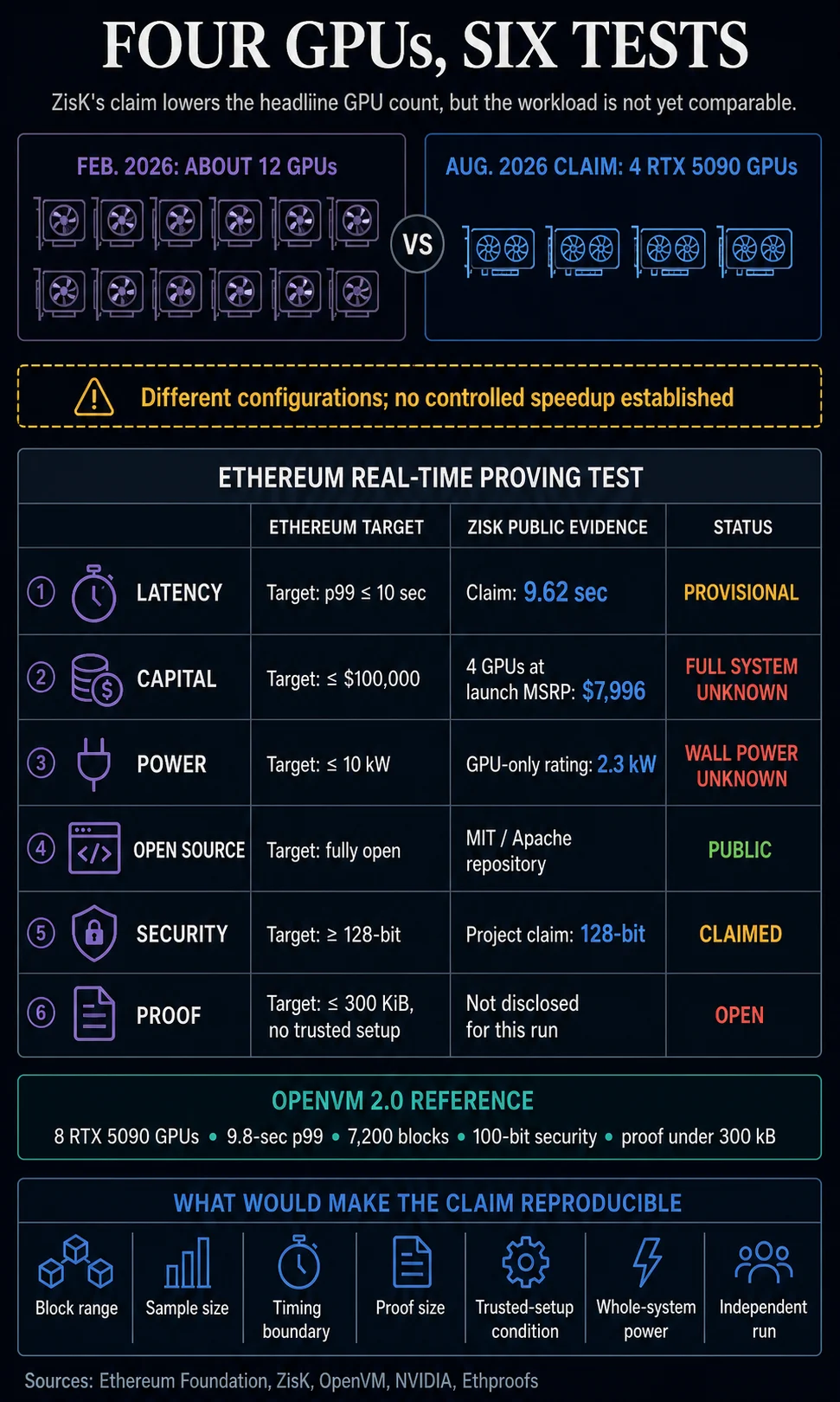
ZisK, an open-source zero-knowledge virtual machine project, has recently put forth a benchmark claim that significantly lowers the hardware requirements for Ethereum’s real-time proving race. On August 18th, the project announced that its v1.1.0-alpha prover achieved a p99 latency of 9.62 seconds using just four RTX 5090 GPUs. This figure represents a notable reduction from previous estimations of hardware needs, potentially bringing the generation of proofs closer to the reach of independent operators. In February, CryptoSlate had examined a roughly 12-GPU setup as a potential centralization risk, highlighting the significant hardware investment required. If ZisK’s new claim holds true under comparable workload and operating conditions, it could reshape the landscape of Ethereum’s proof verification.
The implications of this development are substantial for the Ethereum ecosystem, which is striving to maintain decentralization while enhancing scalability through technologies like zero-knowledge proofs. The ability to generate these proofs on less formidable hardware could empower a wider range of participants, thereby bolstering network security and resilience.
The Quest for Real-Time Proving: Ethereum’s Ambitious Goals
Ethereum’s vision for scalability hinges on the successful implementation of real-time proving, a critical component for its future development roadmap. The Ethereum Foundation has outlined a stringent set of six criteria designed to ensure that proof generation remains accessible and secure, thereby preserving the network’s decentralized ethos. These criteria, established to foster a robust and inclusive ecosystem, include:
- Latency: At least 99% of mainnet blocks must be proved within 10 seconds. This aggressive target is crucial for maintaining a responsive and efficient network.
- Capital Cost: On-premises equipment should not exceed a cost of $100,000. This aims to prevent prohibitive hardware expenses from centralizing proof generation.
- Power Consumption: The total power usage should remain at or below 10 kilowatts. This criterion addresses environmental concerns and the practical limitations of home or small-scale validators.
- Open-Source Code: All software involved in the proving process must be fully open-source, ensuring transparency and community auditability.
- Security: A minimum of 128-bit provable security is mandated, safeguarding against sophisticated attacks.
- Proof Size: Proofs must not exceed 300 KiB without the reliance on trusted setups, which can introduce vulnerabilities.
The Ethereum Foundation has consistently emphasized the importance of the 128-bit security threshold, recognizing it as a cornerstone of long-term network integrity. This focus underscores the delicate balance between speed, cost, and security that defines the future of Ethereum’s scaling solutions.
ZisK’s Claim: A Milestone or a Benchmark Nuance?
ZisK’s v1.1.0-alpha prover, with its reported 9.62-second p99 latency on four RTX 5090 GPUs, appears to meet the latency target, falling 0.38 seconds below the 10-second threshold. This accomplishment was further amplified by Jordi Baylina, a prominent figure in the ZK space, who hailed the result as a milestone. Baylina highlighted the achievement of combining four-GPU proving with claimed 128-bit security and post-quantum resistance, underscoring the potential advancements in cryptographic resilience.
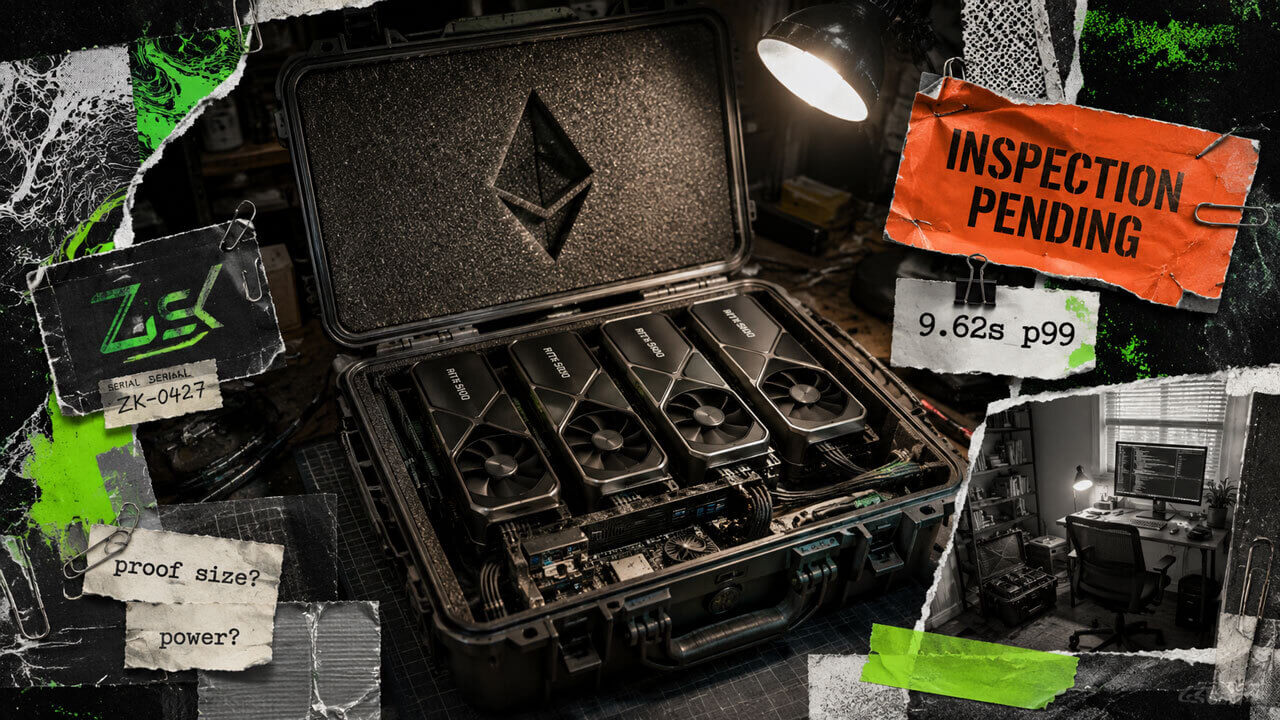
However, it is crucial to note that ZisK has yet to provide comprehensive details regarding the benchmark. The block range over which the p99 was calculated, the sample size, the exact methodology for p99 calculation, the specific timing boundary, the resulting proof size, and the measured whole-system power consumption for the four-GPU run remain undisclosed. As of now, the announcement stands as a benchmark claim, awaiting public verification and detailed substantiation.
The hardware specifications of the RTX 5090 offer some immediate insights. Nvidia specifies a total graphics power of 575 watts per RTX 5090 card. Four such cards would represent a combined GPU-only power draw of approximately 2.3 kW. This figure comfortably sits below the 10 kW ceiling, even before accounting for CPUs, memory, storage, power conversion losses, and cooling systems. Furthermore, with the RTX 5090 launched at a Manufacturer’s Suggested Retail Price (MSRP) of $1,999, four cards would cost $7,996 at launch MSRP. This leaves substantial room within the $100,000 capital cost limit for the rest of the multi-GPU machine’s components.
The OpenVM Comparison: Highlighting the Importance of Benchmark Boundaries
To understand why detailed benchmark reporting is vital, one can look to OpenVM’s recent production release. In July, OpenVM reported a 9.8-second p99 latency on eight RTX 5090 GPUs, achieved over 7,200 Ethereum mainnet blocks starting from block 24,000,000. This benchmark utilized 100-bit provable security and produced proofs under 300 KiB.
While ZisK’s four-GPU claim suggests a significant efficiency gain, the absence of equivalent inputs in its announcement prevents a direct and reliable ranking against OpenVM’s results. Several key differences exist:
- Security Levels: ZisK claims 128-bit security, whereas OpenVM used 100-bit security. The strength of cryptographic security can influence the computational resources required.
- Proof Size: ZisK has not yet attached a proof size to its four-GPU result, a critical metric for Ethereum’s requirements. OpenVM’s proofs were under 300 KiB.
- Workload and Timing: ZisK’s tested block population and timing boundary remain unpublished. OpenVM specified a clear block range and the definition of proving time, which, according to the Ethproofs API, includes witness generation but excludes data fetching and proof submission latency. A p99 calculated over a different interval can yield similar-looking results while measuring a disparate operational burden.
The Ethproofs API, a valuable resource for tracking ZK VM performance, currently lists ZisK versions up to v0.18.0. It also displays a 16-GPU RTX 5090 ZisK configuration. However, an independent four-GPU v1.1.0-alpha p99 result is not yet available on Ethproofs, meaning ZisK’s latest announcement lacks an immediate public reproducibility baseline.
ZisK’s Development and Audit History
ZisK’s release history indicates that v1.1.0-alpha is indeed the current iteration. The project’s repository describes this line as a foundation for a production release currently undergoing rigorous security and correctness audits. In November 2025, OpenZeppelin published a review of a limited set of ZisK binary and main constraints from a historical commit. This review identified 13 findings, including one critical and two high-severity issues, none of which were marked as resolved in that specific report. This highlights the ongoing nature of security hardening for ZK VM projects.
Broader Implications for Decentralization and Accessibility
The initial concern regarding a roughly 12-GPU setup, as analyzed by CryptoSlate in February, framed such hardware configurations as a potential centralization risk. ZisK’s current four-GPU claim, while not directly comparable due to undisclosed details, offers a compelling counterpoint. It suggests that the barrier to entry for real-time proof generation might be significantly lower than previously feared.
If ZisK can substantiate its claims with verifiable data—including a disclosed mainnet block set, a full timing definition, proofs under 300 KiB without a trusted setup, measured wall power, and an independently runnable release—it would represent a significant breakthrough for home-proving capabilities. Such evidence would transform the announcement from a promising claim into concrete data supporting the decentralization of Ethereum’s proof generation infrastructure.
For now, ZisK’s benchmark has effectively weakened the broad objection based on sheer data-center-scale hardware requirements. However, the operational case—encompassing the full suite of practical considerations like cooling, power delivery, and host hardware capacity—remains open for detailed examination. The race for efficient and decentralized real-time proving on Ethereum continues, with ZisK’s latest announcement marking a significant, albeit provisional, step forward. The project’s adherence to open-source principles, with its repository licensed under MIT or Apache 2.0, further aligns with Ethereum’s decentralization goals. The cryptographic security claims of 128-bit, and potentially post-quantum resistance, are particularly noteworthy, indicating a forward-looking approach to securing the network against future threats. As the ecosystem awaits further details, the potential for ZisK’s advancements to democratize proof generation remains a compelling prospect for the future of Ethereum.








