
 admin
admin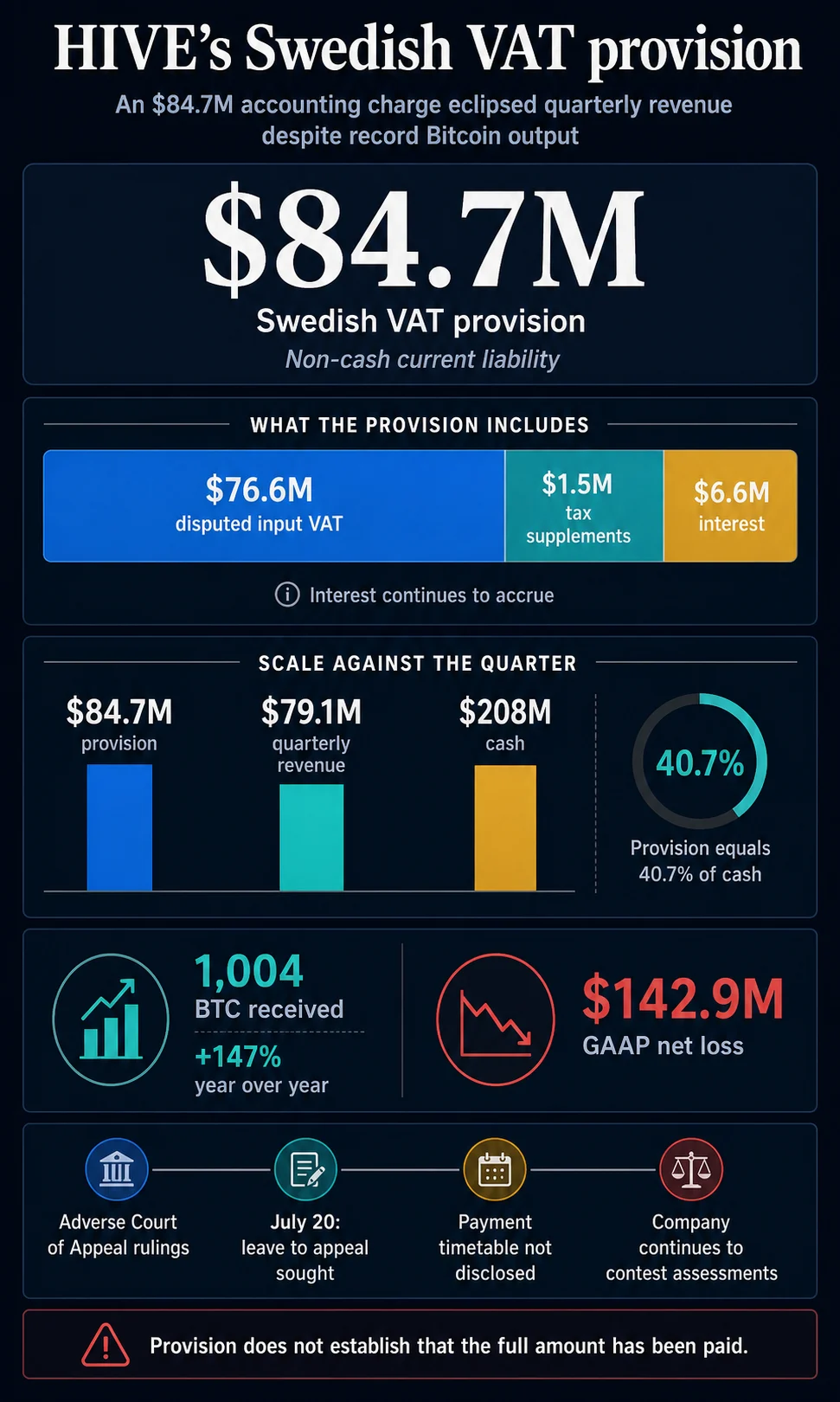
HIVE Digital Technologies has booked a substantial $84.7 million non-cash provision related to contested Value Added Tax (VAT) exposure in Sweden, a move that significantly impacted its financial reporting for the recent quarter. This provision, arising from adverse court rulings that prompted a reassessment of its accounting practices, has cast a shadow over the company’s financial performance, even as its Bitcoin mining operations achieved a record output. The non-cash liability represents a considerable portion of the company’s liquid assets, raising questions about the potential future cash outflows and the unresolved nature of the ongoing tax dispute.
The substantial tax provision dwarfed HIVE’s quarterly revenue of $79.1 million, underscoring the gravity of the situation. Furthermore, the provision equates to approximately 40.7% of the company’s cash reserves, which stood at $208 million. At the intraday high of $65,058.61 for Bitcoin on August 18, 2026, the provision’s value was equivalent to roughly 1,215 BTC. This figure is notably higher, by 21.5%, than the 1,004 BTC that HIVE successfully mined and received during the same quarter. This stark comparison highlights the significant financial burden the Swedish tax issue poses, potentially eclipsing the value generated by its core cryptocurrency mining activities.
The company’s GAAP net loss for the quarter reached a substantial $142.9 million. While the provision is categorized as a current liability, it is crucial to note that this classification does not automatically mandate an immediate cash payment. HIVE’s official filings have not yet provided a clear timeline for any potential payment, leaving a degree of uncertainty surrounding the timing and quantum of future cash outflows related to this provision. The overall net loss for the period was also influenced by other factors, including $53.7 million in depreciation charges, $7.1 million attributed to share-based compensation, and a $7.1 million change in derivative valuations. Therefore, the entire $142.9 million loss cannot be solely attributed to the Swedish tax provision.
Background of the Swedish VAT Dispute
The core of HIVE’s financial challenge lies in a protracted dispute with the Swedish Tax Agency concerning Value Added Tax (VAT) on its cryptocurrency mining operations. Swedish tax authorities have taken the stance that certain activities undertaken by HIVE, particularly those involving the verification of blockchain transactions and the provision of computational power, may be subject to VAT. This classification is often contentious in the cryptocurrency mining sector, where the nature of services provided can be complex and subject to varying interpretations of tax law.
Historically, HIVE, like many other mining entities, has operated under the assumption that its mining activities, particularly those involving the validation of transactions without identifiable counterparties, might not constitute taxable supplies of services under certain VAT regulations. However, the Swedish Tax Agency has issued decisions and proposed assessments that challenge this interpretation. The agency’s guidance, as well as a notable advance ruling issued in January 2026, has drawn a distinction between direct mining or verification activities and the supply of external computing capacity for a fixed fee. This distinction is critical, as the latter may be more readily classified as a taxable service.
The dispute has escalated over time, leading to court rulings that have been unfavorable to HIVE’s position. These adverse judicial outcomes have compelled HIVE to reassess its accounting treatment and recognize a significant provision for potential VAT liabilities. The company has been actively engaged in challenging these assessments through legal channels, including an application for leave to appeal to the Supreme Administrative Court filed on July 20, 2026. However, the company’s own Swedish legal counsel has assessed the prospects of a favorable outcome in this high court as remote, indicating a low probability of successfully overturning the prevailing legal interpretations.

Detailed Breakdown of the Tax Provision
The $84.7 million provision booked by HIVE is further delineated into specific components, providing a clearer picture of the financial exposure. Approximately $76.6 million of this amount pertains to disputed input VAT claims. Input VAT refers to the VAT that businesses pay on the goods and services they purchase for their operations. In this context, HIVE likely claims deductions for VAT paid on its mining hardware, energy, and other operational expenses. The Swedish Tax Agency’s challenge appears to be centered on whether these input VAT claims are valid, given their interpretation of HIVE’s mining activities.
In addition to the disputed input VAT, the provision includes $1.5 million in tax supplements and $6.6 million in accrued interest. Tax supplements can arise from penalties or adjustments imposed by tax authorities for non-compliance or underpayment. The accrued interest reflects the financial cost of the disputed amounts accumulating over time, as interest typically accrues on unpaid tax liabilities until they are settled.
The provision accounts for Swedish Tax Agency decisions or proposed decisions totaling SEK 769.6 million. Furthermore, it encompasses an additional SEK 52.4 million related to later periods up to June 30, 2026. These later amounts, while not yet subject to a formal decision, involve the same underlying factual circumstances as the earlier disputed amounts. The continuous accrual of interest means that the ultimate financial exposure for HIVE could potentially exceed the currently booked provision.
Unresolved Timelines and Financial Implications
A critical aspect of the current situation is the lack of a defined payment timetable for the provisioned amount. While the provision is classified as a current liability, suggesting a potential obligation within the next twelve months, HIVE’s filings do not provide clarity on when, or how, this liability will be settled. This ambiguity creates a degree of uncertainty for investors and financial analysts attempting to forecast the company’s future cash flows.
In its March 31, 2026 annual filing, HIVE disclosed that it had not yet paid a separately demanded tranche of SEK 84 million, approximately $9.4 million, as of that date. The subsequent quarterly filing, which details the significantly larger $84.7 million provision, offers no indication that HIVE has since made any payment, posted security for the disputed amounts, or secured a firm payment schedule with the Swedish tax authorities. This leaves the timing of cash outflows unresolved, while interest continues to accumulate on the disputed sums.
The company’s own legal assessment that the remaining appeal to the Supreme Administrative Court faces a low probability of success further complicates the outlook. This suggests that HIVE may eventually be compelled to settle the disputed VAT liability, potentially impacting its cash reserves and profitability. The magnitude of the provision, which exceeds quarterly revenue and represents a significant percentage of its cash on hand, underscores the financial strain this ongoing dispute could impose.

Record Bitcoin Production Amidst Financial Strain
Despite the significant financial headwinds from the Swedish tax provision, HIVE Digital Technologies reported a record quarter in terms of Bitcoin production. The company mined and received 1,004 BTC during the period, a substantial increase of 147% compared to the 406 BTC produced in the same quarter of the previous year. This operational success is a testament to HIVE’s expanding mining capacity and operational efficiency. The company’s total crypto mining revenue for the quarter reached $72.1 million, driven by this impressive output.
The growth in Bitcoin production signifies HIVE’s commitment to scaling its mining operations and capitalizing on the opportunities within the cryptocurrency market. However, the contrast between this operational achievement and the substantial financial provision creates a complex narrative for the company. It highlights HIVE’s ability to generate significant revenue and output from its mining activities while simultaneously grappling with significant regulatory and legal challenges that threaten to erode its financial stability.
Broader Implications and Industry Context
The situation faced by HIVE Digital Technologies is not an isolated incident within the broader cryptocurrency mining industry. Regulatory scrutiny and evolving tax interpretations are becoming increasingly common for companies operating in this sector. Governments worldwide are seeking to understand and regulate the economic impact of cryptocurrency mining, including its tax implications.
The Swedish tax authority’s stance on VAT for mining activities reflects a growing trend of tax bodies seeking to clarify and potentially expand their tax base to include digital asset-related revenues. Companies operating internationally must navigate a complex and often fragmented regulatory landscape, where tax laws can differ significantly from one jurisdiction to another.
For HIVE, the unresolved VAT dispute poses several potential implications:
- Cash Flow Strain: A substantial cash outflow to settle the VAT liability could significantly impact HIVE’s ability to fund future growth initiatives, capital expenditures, or dividend payments.
- Reputational Impact: Prolonged legal battles and significant financial provisions can affect investor confidence and the company’s overall reputation in the market.
- Operational Adjustments: Depending on the final outcome and financial impact, HIVE might need to consider operational adjustments, such as optimizing its tax structures or re-evaluating its presence in jurisdictions with unfavorable tax regimes.
- Industry Precedent: The resolution of HIVE’s case could set a precedent for how similar VAT disputes are handled in Sweden and potentially other jurisdictions, influencing the strategies of other cryptocurrency mining companies.
The company’s continued pursuit of legal recourse, despite a low probability of success, suggests a commitment to defending its position. However, the recognition of such a large provision indicates a pragmatic approach to financial reporting, acknowledging the potential for a significant financial obligation. Investors and industry observers will be closely monitoring the developments in this case, as it could offer valuable insights into the evolving regulatory and financial landscape for cryptocurrency miners. The interplay between operational success in a volatile market and the challenges posed by regulatory compliance remains a critical factor in the long-term sustainability of companies like HIVE Digital Technologies.








