James Watt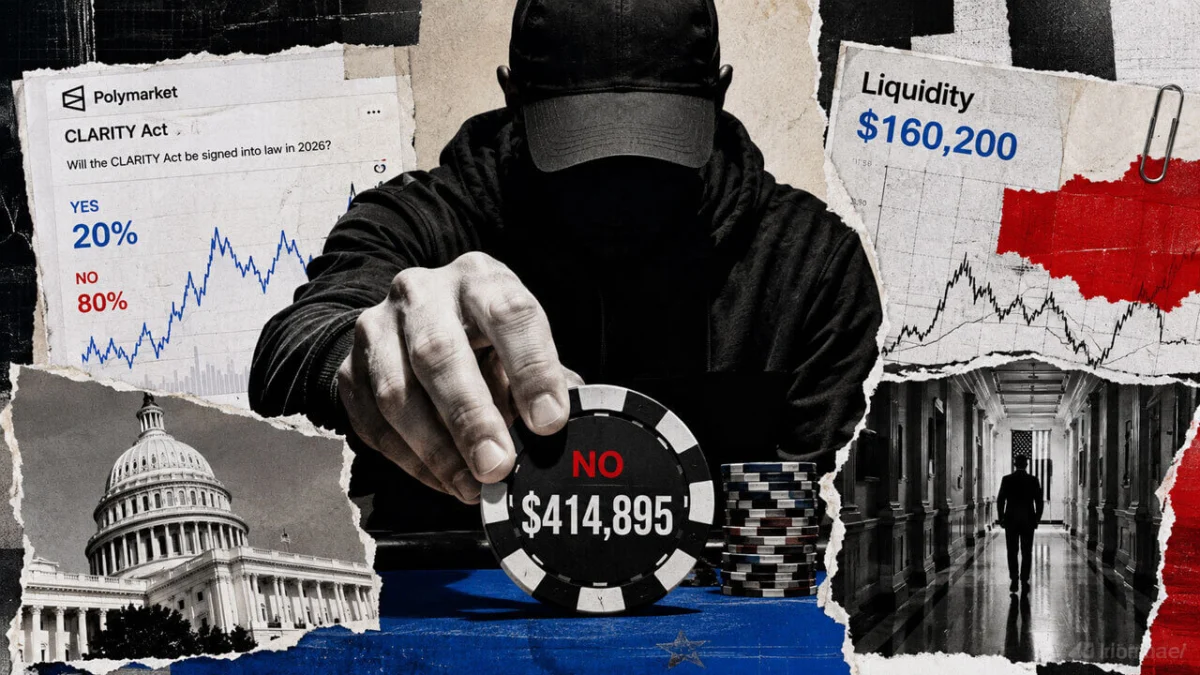
The digital asset legislative landscape faced a significant moment of market scrutiny this week as data revealed an anonymous trader on the decentralized prediction platform Polymarket has established a massive "No" position against the passage of the CLARITY Act. The position, valued at approximately $414,895, represents a staggering 2.6 times the total available liquidity currently residing in that specific market. This imbalance has raised urgent questions among analysts and political observers regarding the reliability of prediction markets as a real-time barometer for legislative success in Washington, especially when individual actors can exert such disproportionate influence over a "thin" order book.
As of late August, market data indicates that the odds for the CLARITY Act being signed into law by 2026 hover near 20%. While this figure is often cited by crypto-policy advocates as a proxy for the bill’s actual probability of success, a deeper dive into the market mechanics suggests the number may be more a reflection of one trader’s conviction—or perhaps a strategic hedge—than a broad consensus of the "wisdom of the crowd." The concentration of risk in a single account, combined with the lack of immediate exit liquidity, highlights a growing tension between the perceived authority of prediction markets and the underlying financial realities of the platforms that host them.
Anatomy of a Whale: The $500,000 Entry
The emergence of the position was first flagged by Predictbook on August 11, noting that the account in question was newly created with no prior trading history on the Polymarket platform. The sequence of events suggests a highly intentional and capitalized entry. The anonymous trader initiated the process by depositing approximately $499,999 in USDC, the dollar-pegged stablecoin that serves as the primary medium of exchange on the Polygon-based platform.
Almost immediately, the trader began building a "No" position, which bets against the CLARITY Act becoming law within the specified timeframe. Across three distinct trades, the account committed $398,122 to the position. The execution strategy was notable for its timing: the final two trades occurred roughly 14 hours after the initial entry, adding 382,601 shares at average price points of 75.55 cents and 77.61 cents per share.
By the time the position was fully established, the account held 515,398 "No" shares, making it the third-largest holder on that side of the contract. Perhaps more significant than the size of the position itself is the remaining capital; the account retains an unspent USDC balance of $101,877. This remaining cash is equivalent to roughly 64% of the total displayed liquidity for the entire market, suggesting the trader has the "dry powder" necessary to defend the position should a "Yes" rally begin to materialize.
Understanding the CLARITY Act and the Legislative Stakes
The CLARITY Act—an acronym for "Creating Legal Accountability and Reform in Tech and Yield"—is widely regarded as the most consequential piece of digital asset legislation currently moving through the United States Congress. Its primary objective is to resolve the long-standing jurisdictional dispute between the Securities and Exchange Commission (SEC) and the Commodity Futures Trading Commission (CFTC).
For years, the crypto industry has operated in a state of "regulation by enforcement," with the SEC asserting that most digital assets are securities under the 1946 Howey Test, while the industry argues they should be treated as commodities. The CLARITY Act seeks to codify these definitions, providing a clear pathway for digital asset exchanges to register and for issuers to bring tokens to market without the threat of retroactive litigation.
The bill’s progress has been a rollercoaster. The House of Representatives passed its version of the legislation in July 2025 with a bipartisan majority, signaling a shift in how lawmakers view the importance of the domestic digital asset economy. However, the path through the Senate remains fraught with obstacles. To reach the President’s desk, the bill requires Senate reconciliation, a 60-vote threshold to overcome a potential filibuster, and a final alignment of text between the two chambers.
The Liquidity Trap: Volume vs. Depth
One of the most misleading metrics in modern prediction markets is cumulative trading volume. For the CLARITY Act market on Polymarket, the cumulative volume currently stands at $7.11 million. To a casual observer, this figure suggests a deep, robust market where large positions can be entered and exited with ease. However, the reality of the central limit order book (CLOB) tells a different story.
Polymarket’s documentation clarifies that the displayed price is the midpoint between the best bid (what a seller receives) and the best ask (what a buyer pays). While millions of dollars may have flowed through the contract over several months, the "displayed market liquidity"—the amount of capital sitting on the books right now to facilitate immediate trades—is only $160,200.
This creates a "liquidity trap" for large-scale traders. The anonymous trader’s "No" position is valued at over $414,000, yet if they attempted to sell that position back into the market today, they would find only a fraction of that value available at the current price. This imbalance means that the 20% "Yes" probability is highly sensitive to even moderate capital flows.
To quantify this sensitivity, CryptoSlate conducted a series of order book simulations on August 17. At that time, the market showed a 19.5% midpoint. The results of the simulation were revealing:
- A $100,000 "Buy Yes" order would not only fill at a much higher average price (42.18%) but would touch a final ask of 87%, nearly quintupling the perceived odds of the bill passing.
- A $250,000 "Buy Yes" order would be impossible to fill completely, exhausting all visible liquidity after spending only $138,559 and leaving over $111,000 of the order unfulfilled.
- On the "Sell" side, the situation is even more dire. A trader attempting to sell $100,000 worth of "Yes" positions would only find $20,917 in bids before the price collapsed to 1%, effectively rendering the remaining $79,000 of the position worthless in the immediate term.
Chronology of Key Events and Future Milestones
The timeline for the CLARITY Act is entering its most critical phase, with several key dates likely to trigger massive volatility in the prediction markets.
- July 2025: The House of Representatives passes the initial version of the CLARITY Act, providing a "proof of concept" for digital asset oversight reform.
- August 11, 2025: An anonymous trader deposits $500,000 into Polymarket and begins an aggressive "No" campaign, significantly impacting the market’s depth.
- August 17, 2025: Market simulations confirm extreme slippage risks, suggesting that the 20% "Yes" odds are fragile and subject to "thin-book" shocks.
- September 15, 2025 (2:15 p.m.): The U.S. Senate is scheduled to hold a cloture vote on the CLARITY Act. This represents the first "real-world" information event since the anonymous whale established their position.
The September 15 cloture vote is particularly significant. In the Senate, cloture is the only procedure by which the chamber can vote to place a time limit on consideration of a bill, thereby overcoming a filibuster. It requires a three-fifths majority (usually 60 votes). If the vote succeeds, the "Yes" odds on Polymarket are expected to skyrocket as the bill moves toward a final floor vote. If it fails, the "No" position held by the anonymous whale will likely see significant mark-to-market gains.
Strategic Implications: Insider Information or Market Manipulation?
The sudden appearance of a $500,000 bet from a fresh account has led to rampant speculation regarding the trader’s motives. In the world of decentralized finance, such moves are often scrutinized for signs of "insider" knowledge. Could the trader be a political staffer with knowledge of a whip count? Or perhaps an institutional player hedging against the regulatory changes the CLARITY Act would bring?
Conversely, the trade could be a form of "opinion molding." Because prediction market odds are increasingly cited by mainstream media and political pundits, a well-funded actor can "buy" a narrative. By keeping the "Yes" odds low through large "No" positions, an actor could theoretically create a sense of inevitable failure, potentially demoralizing the bill’s supporters or influencing undecided senators who look to market sentiment as a gauge of political feasibility.
However, the "thinness" of the book works both ways. While the whale has successfully anchored the price near 20%, they are also "locked in." Without a significant increase in organic liquidity—meaning hundreds of new traders entering the market with smaller positions—the whale cannot exit their position without crashing the price against themselves. This makes the Sept. 15 vote a "dual-edged sword": it provides the catalyst for potential profit, but also the risk of a total wipeout if the political momentum shifts toward "Yes."
The Broader Impact on Policy and Prediction
The situation with the CLARITY Act on Polymarket serves as a case study for the limitations of decentralized prediction markets in their current state. While these platforms offer a unique, incentive-aligned method for forecasting events, they remain susceptible to the same "whale" dynamics found in low-cap cryptocurrency markets.
For the crypto industry, the stakes of the CLARITY Act go beyond the balance of a single Polymarket account. If the bill fails to pass by 2026, the industry faces another two years of jurisdictional uncertainty, likely leading to more "Wells Notices" from the SEC and the continued migration of blockchain innovation to offshore jurisdictions like Dubai, Singapore, and the European Union.
If the "Bull Case" for the bill manifests—driven by a successful cloture vote and a surge in "Yes" demand—the anonymous trader will face immense pressure. A six-figure "Buy" order from a pro-CLARITY advocate could theoretically force the "No" holder into a margin-call-like scenario, where they must either commit more USDC to defend the 20% mark or watch as their nearly $400,000 investment evaporates in a "short squeeze" of political odds.
As September 15 approaches, the eyes of both Washington and Wall Street will be on the Senate floor. But for those watching the digital tickers of Polymarket, the real drama will be in the order book, where a single anonymous actor has bet half a million dollars that the gears of American government will remain, as they so often do, jammed.