James Watt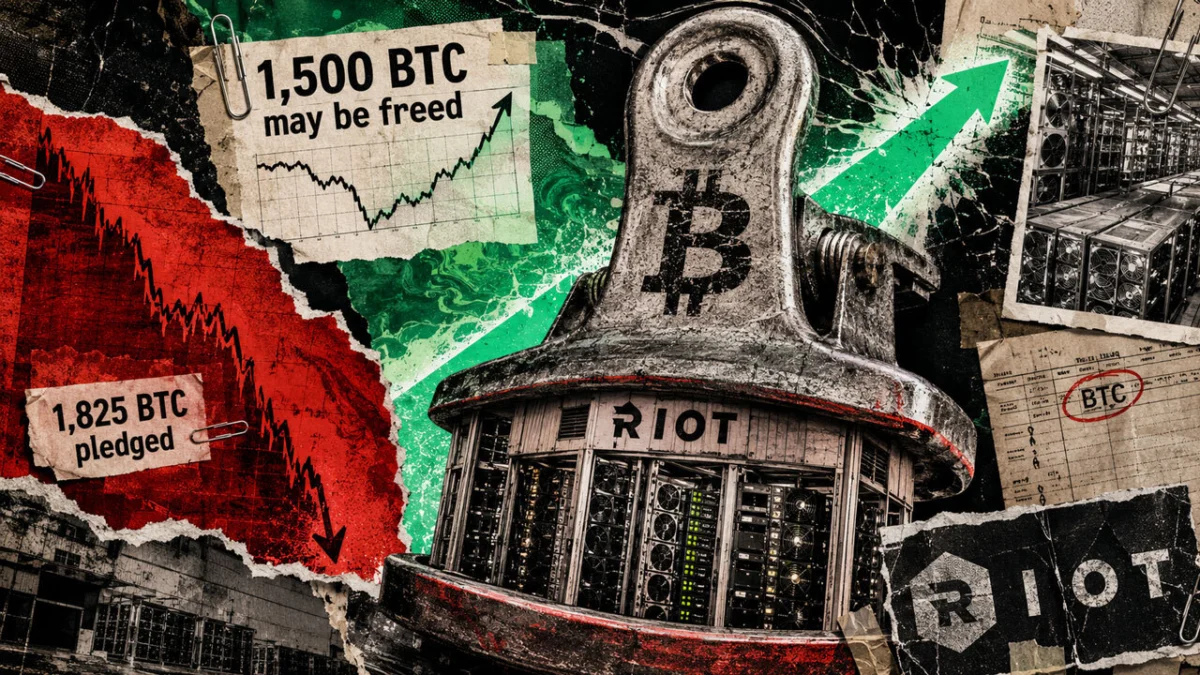
The recent surge in Bitcoin’s market price toward the $78,000 threshold has initiated a significant shift in the balance sheets of major cryptocurrency mining firms, most notably Riot Platforms. As Bitcoin reached its highest valuation in three months, the mechanics of Bitcoin-backed lending agreements began to favor the borrower, potentially releasing over 1,500 BTC from restricted collateral accounts. This development highlights a pivotal moment for Riot Platforms, which has navigated a complex credit facility with Coinbase throughout 2026, characterized by fluctuating collateral requirements dictated by market volatility.
Riot Platforms entered the 2026 fiscal year with a $200 million loan from Coinbase, secured by 3,977 BTC. However, as the price of Bitcoin experienced a sharp decline earlier in the year, the loan-to-value (LTV) ratio—a metric representing the loan amount divided by the market value of the collateral—deteriorated. This triggered "top-up" provisions within the credit agreement, forcing Riot to pledge an additional 1,825 BTC by February to maintain the required margin. By the end of the second quarter, Riot’s disclosed pledged balance stood at 5,821 BTC. With Bitcoin now trading near $78,000, the market value of this collateral has swelled to approximately $454 million, effectively reducing the LTV ratio to 44.1% and opening the door for a substantial return of assets to Riot’s unrestricted treasury.
The Mechanics of Bitcoin-Backed Financing
The financial relationship between Riot Platforms and Coinbase is governed by an April credit agreement that outlines specific "schedules" for collateral management. These schedules are designed to protect the lender from downside risk while providing the borrower a path to reclaim assets during market upswings. The LTV ratio is the primary engine of this mechanism. When the ratio falls below a certain threshold—meaning the collateral is worth significantly more than the debt—the borrower can request the release of "excess" Bitcoin.
According to SEC filings, Riot’s agreement includes three distinct schedules: Standard, First Deleveraging, and Second Deleveraging. The application of these schedules depends on the collateral’s market value relative to specific contract benchmarks.
Under the "Standard" schedule, the release threshold is set at an LTV of 50%. With the current rally pushing Riot’s LTV to 44.1%, the company is comfortably positioned below this line. If the Standard schedule applies, Riot could theoretically reset the facility to a 60% LTV. At a $78,000 Bitcoin price, a 60% LTV on a $200 million loan requires roughly 4,274 BTC. Given that Riot has 5,821 BTC pledged, this would result in the release of approximately 1,547 BTC, valued at $120.7 million.
The "First Deleveraging" schedule presents a tighter requirement, with a release line at 45% and a reset level at 55%. Under this scenario, Riot would still qualify for a release, as its 44.1% LTV sits just below the 45% trigger. A reset to 55% would require 4,662 BTC, allowing for the return of 1,159 BTC, worth approximately $90.4 million.
The "Second Deleveraging" schedule is the most restrictive, requiring the LTV to reach 40% before any collateral can be released. At current prices, Riot does not yet meet this criteria. For the ratio to hit 40%, Bitcoin would need to ascend to approximately $85,896, assuming the loan principal and collateral amount remain constant.
A Chronology of Riot’s Collateral Management
The movement of Bitcoin into and out of Riot’s collateral accounts provides a clear timeline of the company’s treasury management strategy during 2026. The year began with a relatively modest pledge of 3,977 BTC against the $200 million principal. The subsequent market downturn in February served as a stress test for this arrangement. As the price of Bitcoin fell, Coinbase exercised its right to demand additional security, leading to the pledge of 1,825 additional coins.
This "top-up" phase restricted a larger portion of Riot’s core asset exactly when the asset’s value was weakest, a phenomenon known as procyclicality. While these coins remained the property of Riot, they were held in a segregated custody account under Coinbase’s lien, preventing Riot from selling them, using them as collateral for other loans, or deploying them toward operational expansions.
In April, a refinancing event provided temporary relief, releasing 1,544 BTC and leaving the pledged balance at 4,258 BTC. However, by the end of the second quarter on June 30, the balance had climbed back to 5,821 BTC. Riot’s quarterly filings did not explicitly detail the reason for this increase, though it underscored the volatility of restricted versus unrestricted holdings. As of the end of Q2, Riot reported a total treasury of 11,380 BTC, meaning more than 51% of its total holdings were tied up in the Coinbase facility.
Strategic Implications for the Mining Industry
The potential release of over 1,000 BTC represents more than just a balance sheet adjustment; it provides Riot with significant operational flexibility. The company is currently in a phase of aggressive infrastructure diversification. In its second-quarter results, Riot reported $113.7 million in mining revenue alongside $23.2 million from its data center operations.
The capital requirements for these projects are substantial. In August, Riot signed a 20-year lease to develop 191 MW of capacity for an artificial intelligence (AI) tenant, a move that signals a shift toward high-performance computing (HPC) and AI hosting. To fund equipment and project costs, Riot disclosed a separate facility of up to $573 million.
The ability to reclaim Bitcoin from collateral accounts allows Riot to bolster its liquid treasury without selling its holdings at a time when many analysts expect further price appreciation. These "returned" coins can be kept as a reserve, used to secure more favorable financing for AI infrastructure, or, if necessary, sold to cover capital expenditures. This mechanism essentially turns Bitcoin into a dynamic liquidity tool that expands in utility as its market price rises.
Comparative Scale: The MARA Financing Model
Riot is not alone in utilizing Bitcoin-backed debt to fuel growth. Marathon Digital (MARA) has implemented a similar but significantly larger financing structure. On August 4, MARA disclosed that it had pledged 18,750 BTC across facilities managed by Coinbase and Two Prime. This arrangement provided $600 million in new borrowing while folding an existing $150 million Coinbase loan into the package, bringing the total facility to $750 million.
At the time of the agreement, MARA valued the opening collateral at approximately $1.2 billion. With Bitcoin trading at $78,000, those 18,750 coins are now worth $1.46 billion. While MARA has not published the specific LTV release ladders comparable to Riot’s detailed SEC filings, the scale of the collateral appreciation is evident. The rally has added roughly $262.5 million in market value to MARA’s pledged assets.
Combined, the rally has added approximately $376 million in market value to the pledged Bitcoin of both Riot and MARA. This surge in "hidden" liquidity illustrates the scale at which the mining industry has moved toward sophisticated financial engineering to manage the post-halving economic landscape.
Broader Market Impact and Procyclicality
The structure of these loans introduces a procyclical element to the Bitcoin market. When prices fall, miners are forced to lock up more of their treasury, reducing the "free float" of Bitcoin held by these institutions but also increasing their financial strain. Conversely, when prices rise, the debt "rests" on fewer coins, freeing up supply that the miners can then choose to hold or sell.
From a market supply perspective, the release of collateral is a double-edged sword. On one hand, it reduces the immediate need for miners to sell Bitcoin to raise cash, as they can use the newly unrestricted BTC for other financial maneuvers. On the other hand, it puts more Bitcoin back into the "available" pool, which could theoretically be liquidated if a company decides to take profits or needs to cover sudden expenses.
For Riot Platforms, the current rally to $78,000 satisfies several contractual conditions for a collateral release, provided the price remains stable. The agreement requires the LTV to stay below the release line for at least two consecutive days before a written request can be submitted. Furthermore, there must be no "blocking events"—such as a default or a breach of other covenants—active at the time of the request.
Conclusion and Outlook
As the digital asset market matures, the sophistication of treasury management among publicly traded miners continues to evolve. The ability of Riot Platforms to navigate the $200 million Coinbase facility demonstrates the importance of LTV monitoring in corporate strategy. While the company has not yet disclosed a formal release request, the math suggests that a significant portion of its 11,380 BTC treasury is on the verge of moving from "restricted" to "available" status.
This shift comes at a critical time as Riot and its peers transition from pure-play Bitcoin miners to diversified infrastructure providers. With $90 million to $121 million worth of Bitcoin potentially returning to Riot’s direct control, the company is better positioned to fund its ambitious AI and data center expansions. The $78,000 price point serves as a catalyst, proving that in the world of Bitcoin-backed finance, the value of the asset dictates not just the wealth of the holder, but the very utility of the balance sheet.