Layla Zulfa
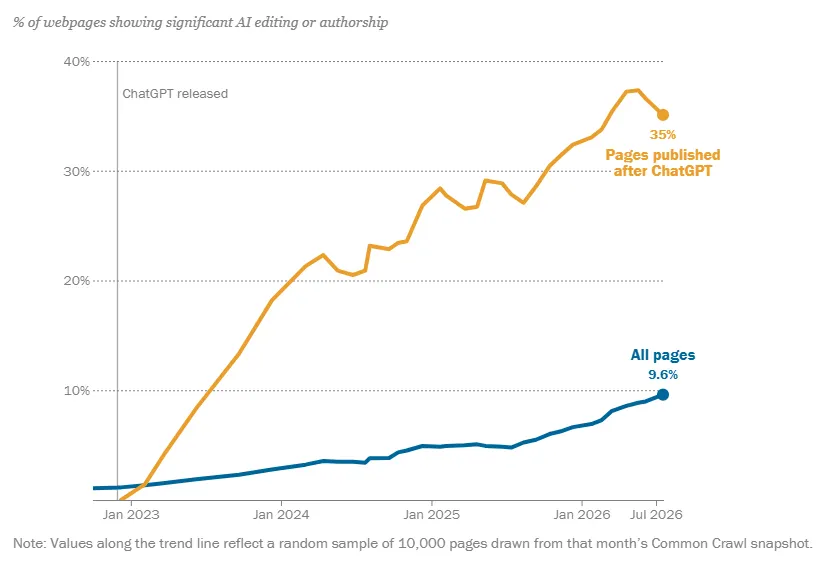
A comprehensive new study from the Pew Research Center has unveiled the staggering scale of artificial intelligence’s integration into the global information ecosystem, finding that approximately one in ten English-language webpages now shows significant signs of being authored by AI. The report, published on Thursday, highlights a transformative shift in digital content creation that has accelerated at an unprecedented pace since the public release of ChatGPT in late 2022. While the overall average across the entire web sits at 10%, the density of machine-generated content skyrockets when examining only the most recent contributions to the internet. For webpages published between the launch of generative AI tools and the present day, the share of AI-influenced content jumps to a remarkable 35%, suggesting that more than one-third of the modern web is now being shaped by algorithms rather than human hands.
The research provides a granular look at how large language models (LLMs) have migrated from experimental curiosities to foundational tools for web publishers. By analyzing roughly 490,000 pages archived by Common Crawl—a non-profit repository of the web—spanning a period from January 2021 through July 2026, researchers were able to track the "AI fingerprint" as it spread across different sectors of the internet. The data suggests that the internet is currently undergoing a structural evolution, moving away from human-centric authorship toward a hybrid model where automation handles the bulk of high-volume content production.
The Methodology of Detection: Identifying the Machine Fingerprint
To reach these conclusions, Pew Research utilized Open Pangram, an advanced AI detection model developed by Pangram Labs. Unlike early, simplistic detectors that looked for specific keywords, modern detection systems analyze statistical patterns, syntax, and the "predictability" of text. Large language models operate on the principle of token prediction, selecting the most statistically probable next word based on their training data. This process often leaves behind a distinctive mathematical signature—a lack of linguistic "burstiness" or the varied, often idiosyncratic sentence structures that characterize human writing.

Pew’s analysis focused on these statistical anomalies rather than single indicators. However, the study did identify specific linguistic "tells" that have become significantly more prevalent since the AI boom began in 2023. For instance, the use of em dashes has roughly doubled, and the frequency of the Oxford comma has increased by 63%. Furthermore, specific vocabulary favored by AI models—often described as "corporate-academic" or "neutrally sophisticated"—has seen a massive surge. Words such as "delve," "interplay," "testament," and "comprehensive" have more than doubled in frequency across the sampled pages.
Another prominent indicator identified by the researchers is "negative parallelism." This involves rhetorical constructions such as "it is not just about X, but also about Y." While such phrasing exists in human writing, its usage has nearly tripled since 2023, reflecting the balanced, often non-committal tone that RLHF (Reinforcement Learning from Human Feedback) processes instill in models like GPT-4 and Claude.
The Domain Divide: Commercial vs. Institutional Content
One of the most revealing aspects of the Pew study is the uneven distribution of AI-generated content across different top-level domains (TLDs). The data shows a stark contrast between commercial interests and institutional repositories, reflecting the varying incentives for speed and volume in digital publishing.
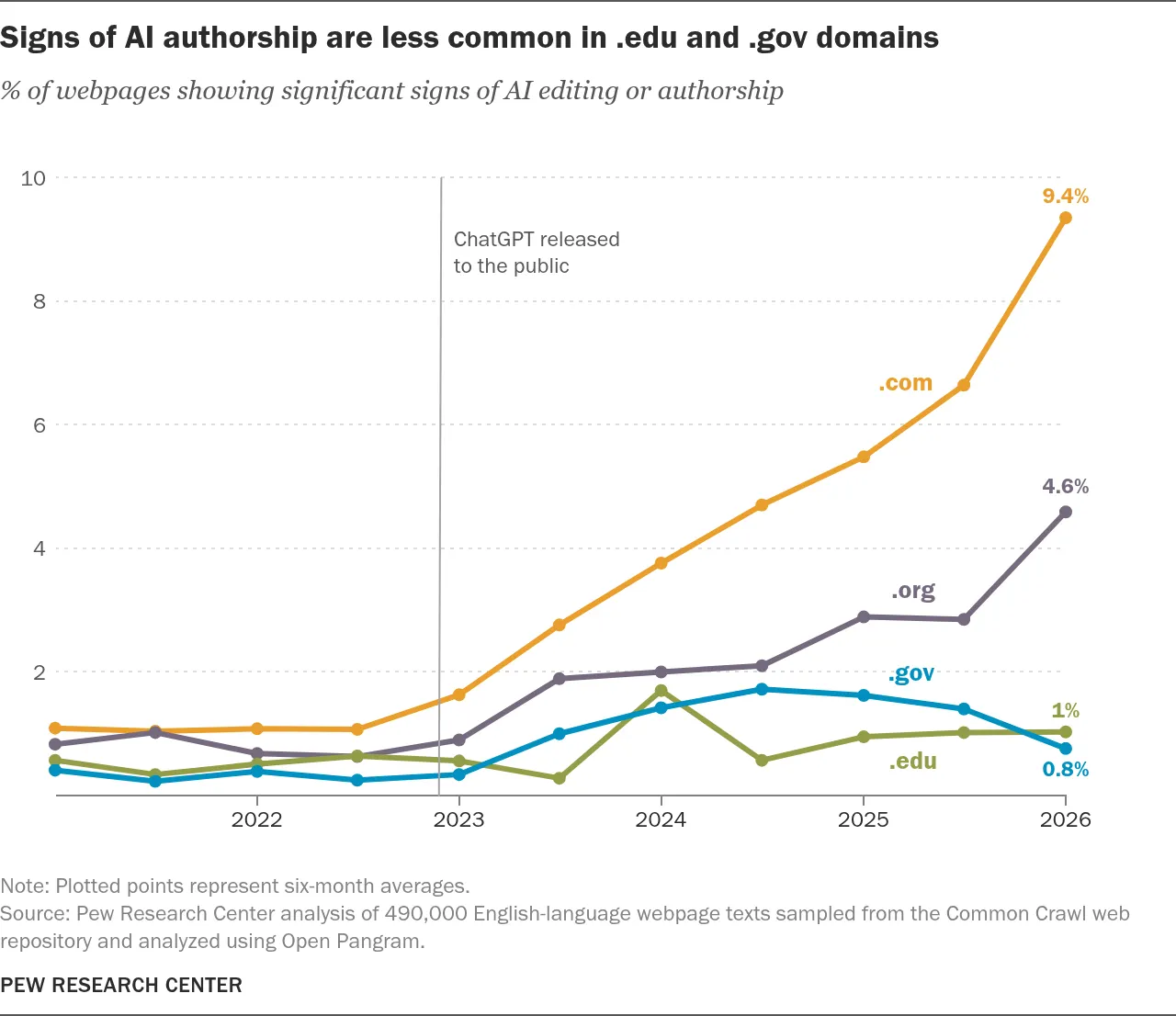
Pages hosted on .com domains are ten times more likely to show signs of AI authorship than those on .edu or .gov domains. Specifically, AI-influenced content on .com sites reached approximately 9.35% by early 2026, compared to a mere 1% for government and educational sites. The .org domain, often associated with non-profits and advocacy groups, sits in the middle with a 4.6% rate of AI authorship.

This discrepancy can be attributed to the differing editorial standards and publishing cycles of these entities. Government and academic institutions typically require multiple layers of human review, institutional sign-off, and adherence to strict factual protocols, which naturally slows down the publishing process. In contrast, the commercial web is driven by search engine optimization (SEO) and affiliate marketing. In these sectors, the ability to churn out thousands of articles on trending topics is a competitive advantage. AI allows "content farms" to produce vast quantities of text at a fraction of the cost of human writers, leading to what critics have termed the "slop-ification" of the internet.
A Chronology of the AI Content Revolution
The timeline of AI’s takeover of the web is brief but intense. In 2021, before the release of high-performance consumer LLMs, the rate of AI authorship was nearly identical across all domain types, hovering near zero or at statistically insignificant levels.
- January 2021 – October 2022: The "Pre-Boom" era. While models like GPT-3 existed, they were primarily used by developers and tech enthusiasts. The web remained overwhelmingly human-authored.
- November 2022: The launch of ChatGPT. This marked the inflection point. For the first time, high-quality generative AI was accessible to the general public for free.
- 2023: The Year of Integration. Major media outlets, marketing firms, and independent bloggers began experimenting with AI. Pew notes that this is when the frequency of "AI-favored" words began to climb sharply.
- 2024 – 2025: The "Mass Proliferation" phase. AI tools were integrated directly into content management systems, browsers, and office suites. The share of AI content in new publications reached the 35% mark.
- January 2026: The study’s most recent data point shows the .com sector reaching nearly 10% total saturation, with the trajectory continuing to point upward.
Impact on Media and the Information Landscape
The influence of AI is not limited to obscure blogs or marketing sites; it has penetrated the highest levels of professional journalism. Separate research from Pangram Labs found that approximately 9% of articles in major U.S. newspapers this year showed signs of AI generation. This includes not only automated sports scores or financial reports—which have been common for years—but also opinion pieces and feature stories in prestigious outlets such as The New York Times.
The reaction from the journalism industry has been mixed. While some editors argue that AI is a tool for efficiency—helping with transcription, summarization, and initial drafts—others express concern over the erosion of trust. If a reader cannot distinguish between a deeply reported human story and a statistically generated imitation, the value of the "brand" is diminished.
Furthermore, the rise of "slop"—a term coined to describe low-quality, AI-generated filler content—poses a challenge for search engines. Google and Bing have had to update their algorithms repeatedly to prioritize "helpful content" over the deluge of AI-generated SEO bait that threatens to bury legitimate information.
Future Implications: The Feedback Loop and Watermarking
As AI-generated content becomes a larger portion of the internet, a new technical challenge emerges: "Model Collapse." This occurs when future AI models are trained on data that was itself generated by AI. Without enough fresh human-generated data to ground the models, they can begin to amplify their own errors and biases, eventually producing nonsensical or highly repetitive output. The fact that 35% of new web content is now AI-derived suggests that the "data drought" for high-quality human text may arrive sooner than expected.
In response to these concerns, tech giants are moving toward "model-level watermarking." Anthropic, the creator of the Claude AI, has been working on techniques to embed invisible fingerprints into the text generated by their models. This would allow platforms and researchers to identify AI-generated content with near-certainty, potentially curbing the spread of misinformation and helping search engines categorize content more accurately.
However, the "arms race" between generators and detectors is far from over. As models become more sophisticated, they are increasingly capable of mimicking human idiosyncrasies, such as intentional typos or varied sentence lengths, making detection a moving target.
Conclusion: A New Digital Reality
The Pew Research Center’s findings serve as a landmark confirmation of the internet’s rapid transformation. The web is no longer a purely human space; it is a collaborative—and sometimes competitive—environment shared with machines. While the 10% figure is a significant milestone, the 35% rate for new content is the more telling statistic for the future.
The implications for education, governance, and commerce are profound. For students, the ubiquity of AI text makes traditional writing assessments more difficult. For citizens, the difficulty in verifying authorship raises the stakes for digital literacy. For the tech industry, the challenge lies in ensuring that the "automated web" remains a useful resource rather than a hall of mirrors reflecting its own algorithmic biases. As we move further into the 2020s, the "human-written" label may eventually become a premium marker of quality in a sea of synthetic data.