admin
admin
A comprehensive working paper recently published by the Federal Reserve Bank of Cleveland has introduced a compelling framework for understanding the unique behavioral economics of the cryptocurrency market. The study, titled "Do You Even Crypto, Bro? Cryptocurrencies in Household Finance," suggests that the fundamental driver of crypto adoption and market volatility is not found in traditional demographic shifts or standard risk-utility models, but rather in a radical divergence of beliefs regarding future returns between owners and non-owners.
The research, conducted by a distinguished team of economists including Michael Weber (University of Chicago), Bernardo Candia (UC Berkeley), Olivier Coibion (University of Texas at Austin), and Yuriy Gorodnichenko (UC Berkeley), utilizes extensive survey data from as many as 25,000 U.S. households. Their findings indicate that the cryptocurrency market operates under a distinct set of psychological rules compared to traditional asset classes like stocks, bonds, or gold. While traditional investments are often influenced by observable financial characteristics and demographic profiles, cryptocurrency ownership is overwhelmingly dictated by an individual’s subjective expectations of future price appreciation.
The Divergent Belief Gap
At the heart of the Cleveland Fed’s findings is a massive disparity in how different segments of the American public perceive the value proposition of digital assets. According to the study, the expectations held by cryptocurrency owners are not merely optimistic; they are statistically decoupled from the expectations of the general population.
On average, cryptocurrency owners surveyed by the researchers expected a 22% return on their holdings over the following year. In stark contrast, non-owners projected an average return of only 7% for the same period. This 15-percentage-point gap represents a fundamental disagreement on the asset’s utility and future. Furthermore, the study found that a one-percentage-point increase in an individual’s expected return for Bitcoin or other digital assets correlates with a 0.8-percentage-point increase in the probability of that individual becoming a crypto owner.
This "belief-driven" ownership model makes cryptocurrency an outlier in the financial world. In the markets for equities or precious metals, factors such as age, household income, and overall net worth are the primary predictors of participation. In the crypto market, these demographic factors are secondary to the investor’s internal narrative about where the price is headed.
The Feedback Loop and Speculative Bubbles
One of the most significant contributions of the paper is its exploration of how information—or the lack thereof—contributes to speculative bubbles. The researchers conducted a randomized information experiment to observe how households react to news regarding Bitcoin’s historical performance.

In the experimental phase, households were randomly assigned to receive specific data points regarding the 12-month trailing returns of Bitcoin, the S&P 500, GameStop stock, or general inflation rates. The results were immediate and measurable: participants who were shown Bitcoin’s recent positive performance increased their desired portfolio allocation to cryptocurrency by approximately two percentage points. This represented a 47% increase relative to the control group’s desired allocation of 4.3%.
The authors note that this mechanism creates a self-reinforcing feedback loop. When prices rise, the reporting of those gains serves as "information treatment" for the public, attracting new investors who previously sat on the sidelines due to a lack of data. These new entrants then drive prices higher through increased demand, which in turn generates more positive return data, starting the cycle anew. This dynamic explains why cryptocurrency rallies often take on a parabolic quality, as the "fear of missing out" (FOMO) is effectively codified through this information-triggered behavior.
Demographics of the Modern Crypto Investor
Despite the dominance of subjective beliefs in predicting ownership, the researchers did identify a clear demographic profile for the American cryptocurrency investor. Even when controlling for variations in beliefs and risk tolerance, certain groups remain significantly more likely to participate in the digital asset economy.
The study found that age is a primary differentiator. Individuals under the age of 40 are 13 percentage points more likely to own cryptocurrency than those over the age of 60. Gender also plays a role, with men being approximately 4 percentage points more likely than women to hold digital assets. Economic status further refines this profile, as higher-income and wealthier households show higher rates of participation, likely due to a greater capacity to absorb the high volatility associated with the asset class.
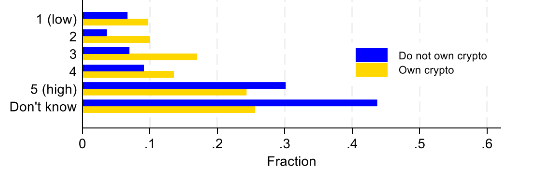
However, the "knowledge gap" remains a pervasive issue. In a 2021 survey cited by the paper, 87% of non-owners admitted they had no idea what kind of return to expect from cryptocurrency over a one-year horizon. Even among those who already owned crypto, 54% remained uncertain about future returns. This suggests that the market is characterized by a high degree of "uninformed" speculation, where even active participants are operating without a clear fundamental anchor for valuation.
The "Gambling Income" Effect on Consumption
The Cleveland Fed paper also delves into the "wealth effect" of cryptocurrency—specifically, how gains in digital assets translate into real-world spending. Traditionally, when an individual’s stock portfolio doubles, they might increase their overall consumption across various sectors as they feel permanently wealthier. Cryptocurrency gains, however, appear to be treated differently by the American household.
The researchers found that while a doubling in Bitcoin’s price does lead to increased spending, it is almost exclusively concentrated in the purchase of "durable goods"—large, one-time purchases such as electronics, appliances, or vehicles. A household with a portfolio entirely comprised of crypto was 1.4 percentage points more likely to purchase a durable good following a price surge, representing a 7% increase over the baseline probability.
Crucially, these gains did not lead to a persistent increase in ordinary, day-to-day spending. The authors conclude that investors view cryptocurrency wealth more like "gambling income" or a lottery win than a stable, long-term increase in net worth. This psychological accounting suggests that investors recognize the ephemeral nature of crypto gains and are quick to "lock in" value by purchasing physical goods before a potential market downturn.
Comparison with Traditional Assets and Historical Context
To provide context, the researchers compared crypto behavior with that of GameStop (GME) during the "meme stock" craze and traditional equities. While GameStop exhibited some of the speculative characteristics of cryptocurrency, digital assets remained unique in the sheer scale of the disagreement between owners and non-owners.
In the stock market, most investors operate based on a relatively narrow range of expected returns, often influenced by institutional guidance and historical averages. In the crypto market, the lack of a "centralized" valuation metric—such as price-to-earnings ratios or dividend yields—allows for the massive 15% gap in expectations found in the study. This absence of a common factual floor ensures that prices remain sensitive to sentiment rather than fundamentals.
The timeline of the study covers a period of extreme fluctuation in the crypto market, including the heights of 2021 and the subsequent "crypto winter" of 2022. By analyzing household behavior across these cycles, the Fed researchers have highlighted that the volatility of the asset is a feature of its ownership structure, not a bug. Because ownership is driven by "learning" from past prices, the market will inherently overcorrect in both directions.
Broader Implications for Financial Stability
The findings of the Federal Reserve Bank of Cleveland have significant implications for regulators and monetary policymakers. If cryptocurrency ownership is driven primarily by subjective beliefs and past-price feedback loops, traditional methods of cooling an overheated market—such as interest rate hikes—may have a less direct impact on crypto than they do on traditional equities.
The "gambling income" classification of crypto gains also suggests that while crypto market crashes can be devastating for individual households, they may have a more contained impact on the broader economy’s general consumption than a stock market crash of similar magnitude. However, the increasing tendency for crypto wealth to flow into durable goods markets suggests that large-scale volatility in Bitcoin could introduce unexpected fluctuations in specific retail sectors.
Ultimately, the paper concludes that as long as there is an "absence of common information and beliefs" across the investing public, price volatility will remain the defining characteristic of the cryptocurrency market. For the next wave of retail investors, the decision to enter the market will likely be less about the underlying technology of blockchain and more about the narrative of recent price performance. As the authors suggest, the future of retail demand is inextricably linked to the history of the price chart itself, ensuring that the "crypto bro" phenomenon remains a distinct and highly volatile chapter in the history of American household finance.