Lina Irawan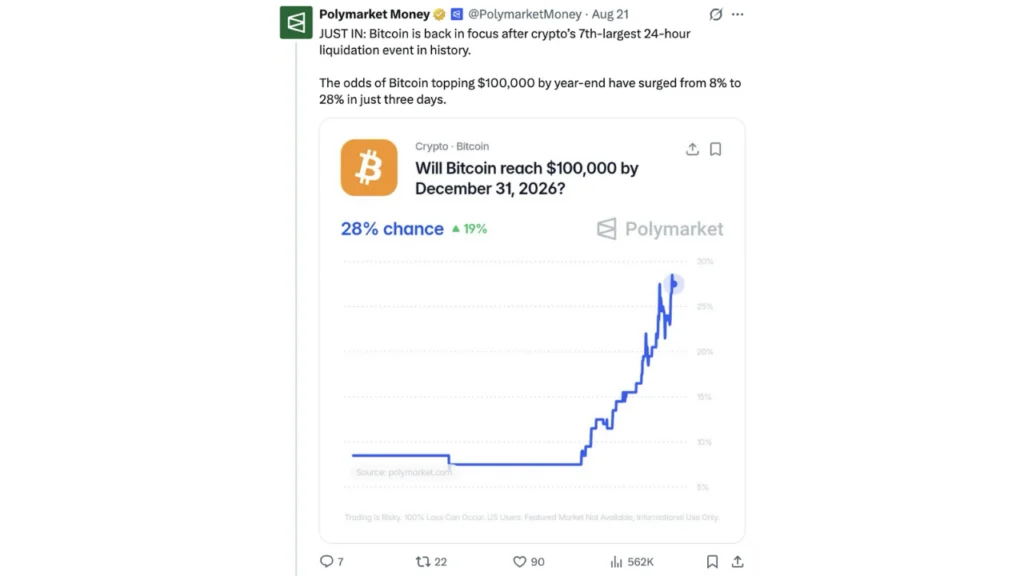
Bitcoin is once again hovering near the psychologically significant $80,000 mark, igniting fervent speculation among cryptocurrency traders. Data from the decentralized prediction market Polymarket reveals a growing consensus, with a majority of participants now placing their bets on Bitcoin achieving this ambitious price target before the close of August. The platform currently assigns a 59% probability to BTC breaching $80,000 within the month, a stark contrast to the sentiment just weeks prior.
This heightened optimism is directly correlated with Bitcoin’s recent, robust rally. The flagship cryptocurrency surged past $77,000 and even flirted with $79,500, demonstrating a remarkable resurgence from its early August trading range, where it began the month in the mid-$60,000s. This impressive ascent translates to gains exceeding 20% in a matter of weeks, propelling Bitcoin to levels not seen since the early summer and firmly placing the $80,000 threshold back in the spotlight of market discussions.
Beyond the immediate $80,000 target, Polymarket traders are also factoring in further upside potential. A 35% probability is assigned to Bitcoin reaching $82,500, while an 18% chance exists for it to touch $85,000 before August concludes. However, the prospect of a $100,000 Bitcoin within this timeframe remains a considerably longer shot, with odds currently standing at a mere 2%.
The Anatomy of a Short Squeeze: Catalyzing Bitcoin’s Rebound
The velocity of Bitcoin’s recent recovery has been a defining characteristic, transforming a modest uptick into a powerful rally. Within a compressed timeframe of just three days, Bitcoin experienced an astonishing surge from approximately $64,000 to nearly $79,500. This rapid price appreciation triggered a cascade of liquidations for bearish positions, with market data indicating that over $4 billion in leveraged short crypto positions were forcibly closed out.

The underlying mechanism driving this accelerated move was a classic short squeeze. Traders who had positioned themselves for a price decline were compelled to buy Bitcoin back as the market moved against them. This forced buying action created additional demand, propelling prices through successive technical resistance levels. Once Bitcoin decisively broke above the $70,000 and subsequently the $75,000 benchmarks, momentum traders, drawn by the accelerating trend, also entered the market. The confluence of short covering, new buying interest, and an improving market sentiment effectively converted what initially appeared to be a recovery into a formidable rally.
However, this powerful dynamic carries a dual-edged sword. The same forces that propelled prices upward can, under different conditions, exacerbate downward movements. As Bitcoin approached the $80,000 level, traders who had entered highly leveraged long positions began to face heightened risk. A subsequent pullback towards the $77,000 mark has already resulted in hundreds of millions of dollars in cryptocurrency liquidations, shifting the pressure from short sellers to those who had overextended their bullish bets. Consequently, the price zone between $79,000 and $80,000 has become a critical juncture. A decisive breakout above this level could reignite momentum buying, while a rejection might prompt traders to secure their profits, potentially leading to a retracement.
ETF Inflows: A Solidifying Pillar of Institutional Demand
In a departure from previous rallies that were predominantly fueled by derivatives activity, Bitcoin’s latest advance has been significantly bolstered by substantial inflows into U.S. spot Bitcoin Exchange-Traded Funds (ETFs). On Thursday, these ETFs collectively attracted $606 million in net inflows, marking the largest single-day inflow recorded since May. Cumulatively, from Monday through Thursday, spot Bitcoin ETFs registered approximately $1.6 billion in inflows, a clear signal of renewed and substantial institutional appetite for regulated Bitcoin exposure.
This robust demand continued into Friday, with U.S. spot Bitcoin ETFs recording net inflows of roughly $307.5 million on August 21st. This extended the positive inflow streak to five consecutive trading sessions. BlackRock’s iShares Bitcoin Trust (IBIT) led the pack, attracting approximately $239.3 million, while Fidelity’s Wise Origin Bitcoin Fund (FBTC) added about $30.2 million. The significance of these ETF flows cannot be overstated. They offer a more direct and transparent metric of investor demand, particularly from institutional players seeking to gain exposure to Bitcoin through traditional financial vehicles. Had Bitcoin’s price been rising while ETF investors were divesting, the rally’s conviction would have been significantly diminished. Instead, the alignment of strong institutional flows with price appreciation provides a compelling argument for continued upward momentum towards the $80,000 level and beyond.
Macroeconomic Tailwinds: Treasury Policy and Regulatory Clarity
Beyond the direct market mechanics, broader macroeconomic developments have also contributed to a more bullish backdrop for Bitcoin. The U.S. Treasury Department’s recent announcement of its intention to increase buybacks of longer-dated government bonds had an initial impact of easing pressure in the Treasury market and weakening the U.S. dollar. This move was interpreted by many investors as potentially beneficial for scarce assets like Bitcoin and gold, as it could lead to a more favorable liquidity environment.

The rally also coincided with a resurgence of optimism surrounding the regulatory landscape for cryptocurrencies in the United States. President Donald Trump has actively encouraged Congress to advance the CLARITY Act, a piece of proposed legislation aimed at establishing a clearer and more defined regulatory framework for digital assets. These recent political and regulatory developments have injected an additional layer of confidence into the cryptocurrency market sentiment.
Despite these positive developments, the macroeconomic picture is not entirely devoid of risks. Long-term Treasury yields remain at elevated levels, and market participants are keenly observing the Federal Reserve for any indications regarding future interest rate policies and overall financial conditions. The upcoming Jackson Hole Economic Symposium, a prominent gathering of central bankers and economists, could therefore present a crucial test for risk assets. Any signals suggesting that monetary policy might remain restrictive for an extended period could potentially temper Bitcoin’s upward trajectory, particularly following its rapid recent gains.
Navigating the $80,000 Threshold: Challenges and Opportunities
While the prevailing market sentiment leans bullish, the act of reaching $80,000 and, more importantly, establishing it as a new support level are distinct challenges. Bitcoin’s recent surge, while powerful in restoring momentum, has also created conditions ripe for profit-taking. Investors who acquired Bitcoin at lower price points, such as $64,000 or $70,000, are now sitting on substantial unrealized gains, making them potential sellers. Simultaneously, leveraged long positions are becoming increasingly susceptible to sharp reversals, increasing the potential for cascading liquidations if momentum falters.
The weekend trading period can introduce an additional layer of volatility. Although Bitcoin operates 24/7, U.S. spot ETFs do not trade when traditional financial markets are closed. This temporary suspension of a significant source of institutional demand means that relatively smaller orders can exert a more pronounced impact on price discovery in a thinner weekend liquidity environment. Consequently, the initial full U.S. trading sessions of the upcoming week are likely to be particularly revealing. If ETF inflows remain strong and Bitcoin demonstrates the ability to reclaim and hold the $80,000 level with sustained trading volume, market participants may begin to set their sights on the $82,500 to $85,000 range.
For the moment, Polymarket’s 59% probability assessment suggests that traders view a test of $80,000 as more probable than not. However, given Bitcoin’s already impressive gains of over 20% within a condensed timeframe, the path to further appreciation is unlikely to be smooth. The immediate focus has shifted from whether Bitcoin can recover from its mid-$60,000s lows to a more critical question: can the bulls successfully transform the psychological barrier of $80,000 into a solid foundation for future growth? The coming days will be crucial in determining the answer.