admin
admin
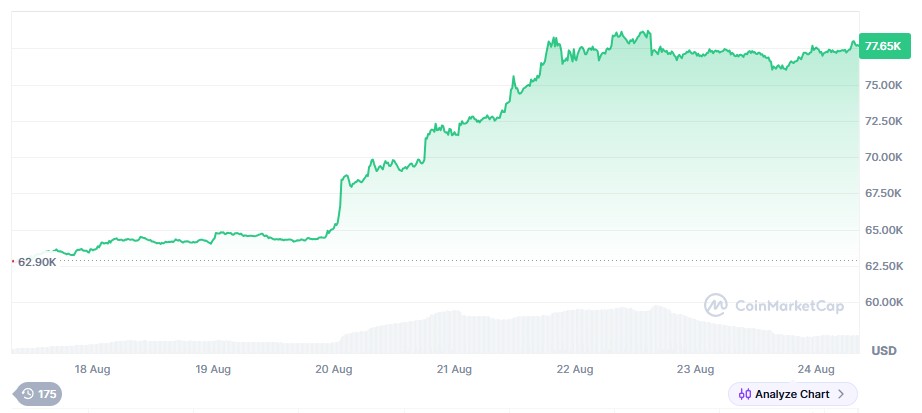
The sudden shift in market sentiment is underpinned by several technical indicators, most notably a report from the charting platform Barchart. On Thursday, analysts highlighted that Bitcoin’s price had successfully crossed above its 200-day moving average for the first time since November 2025. In the field of technical analysis, the 200-day moving average is a critical barometer used to distinguish between long-term bear and bull markets. A sustained move above this level is frequently interpreted as a signal that the broader trend has flipped positive, potentially inviting a new wave of institutional and retail capital.
Market-Wide Recovery and Altcoin Momentum
The rally was not confined to Bitcoin alone; the broader digital asset ecosystem experienced a synchronized surge. Ethereum (ETH), the second-largest cryptocurrency by market capitalization, recorded a 31% gain over the seven-day period. Meanwhile, Solana (SOL) saw its value increase by 28%, and XRP outperformed the major caps with an extraordinary 53.3% surge, bringing its price to $1.52.
Institutional appetite appears to be a primary driver of this recovery. Data indicates that spot Bitcoin and Ether exchange-traded funds (ETFs) collectively saw inflows exceeding $2.61 billion last week. This influx of capital suggests that institutional investors are viewing the current price levels as an attractive entry point, or perhaps as a necessary hedge against traditional financial instability.
The price recovery has also rehabilitated the public standing of prominent industry figures. Michael Saylor, the Executive Chairman of MicroStrategy, saw his company’s Bitcoin treasury return to profitability. With the current price surpassing MicroStrategy’s breakeven point of $75,385, Saylor has once again been characterized by market observers as a visionary strategist rather than a speculative financial engineer. The optimism is further reflected in prediction markets; on Polymarket, the odds of Bitcoin reaching $90,000 before 2027 have risen to 48%.

Macroeconomic Catalysts: The $40 Trillion Debt Milestone
A significant portion of the recent flight to crypto assets is attributed to deteriorating fiscal conditions in the United States. This week, the U.S. national debt officially crossed the $40 trillion threshold. With no concrete legislative plan to balance the federal budget or reduce the principal, the government’s primary strategy remains a reliance on long-term economic growth to outpace the debt.
The cost of servicing this debt has reached a critical inflection point. Annual interest payments now exceed the expenditures for Medicare, making interest the second-largest line item in the U.S. government’s budget, trailing only Social Security. The Kobeissi Letter, a leading commentary on global capital markets, attributed the rapid appreciation of both precious metals and cryptocurrencies to a "perfect storm" of persistent inflation, record deficit spending, and specific U.S. Treasury policies.
Further fueling the rally was the Treasury Department’s recent pledge to double the size of its debt buyback operations to $4 billion. Analysts argue that such interventions, while intended to provide liquidity to the bond market, often signal underlying stress in the traditional financial system, prompting investors to seek refuge in "hard" assets. Ray Dalio, the founder of Bridgewater Associates, recently advised that investors should consider allocating 15% of their portfolios to gold and a smaller portion to Bitcoin. Dalio warned that a full-scale U.S. debt crisis could manifest within the next three to five years if current fiscal trajectories are not corrected.
Legislative Developments: The CLARITY Act and the White House
The intersection of politics and digital finance has moved to the forefront of the national conversation. President Donald Trump recently held a high-profile meeting at the White House with several titans of the crypto industry, including Coinbase CEO Brian Armstrong and Gemini co-founders Cameron and Tyler Winklevoss. The central theme of the discussion was the passage of the CLARITY Act, a comprehensive market structure bill designed to provide a definitive regulatory framework for digital assets.
During the meeting, President Trump urged Congress to pass a "fair version" of the bill, framing the legislation as a matter of national security and economic competitiveness. He emphasized that the U.S. must establish clear rules of the road to remain "ahead of China" in the race for financial technology supremacy. The CLARITY Act, which originally passed the House of Representatives in July 2025, is scheduled for a pivotal procedural vote on September 15. The bill requires 60 votes in the Senate to proceed.
While the President described the support for the bill as "very bipartisan," the path to passage remains fraught with political tension. Democratic Senators, including Ruben Gallego, have expressed skepticism, suggesting that the "fairness" the President refers to may be skewed toward industry interests or executive overreach. Senator Gallego noted that the President does not have the sole authority to dictate the level of regulation, signaling that further concessions on ethics provisions and consumer protections may be required to secure a majority.
The meeting also had an immediate impact on specific asset prices. After the President revealed that CFTC Chair Michael Selig is working to bring the decentralized exchange Hyperliquid into the United States in a fully compliant manner, the price of the Hyperliquid token jumped by 20%.
Regulatory Shifts: SEC and CFTC Compete for Oversight
The U.S. Securities and Exchange Commission (SEC) has unveiled a new set of proposed rules that could fundamentally alter the landscape for token launches. Currently open for a 60-day public comment period, the proposal includes exemptions that would allow crypto projects to issue up to $5 million in tokens over a four-year period with minimal oversight, and up to $75 million over 12 months under stricter reporting requirements.
Perhaps most significantly, the SEC is considering a "safe harbor" proposal that would exempt certain cryptocurrencies from being classified as "investment contracts" under the Howey Test. SEC Commissioner Hester M. Peirce, a long-time advocate for regulatory clarity, remarked that a "whole generation" of developers has struggled under the application of "inapt rules." She described the new guidelines as a vital step toward sensible and enforceable regulation.
Simultaneously, the Commodity Futures Trading Commission (CFTC) is asserting its own authority. Michael Selig, the CFTC Chair, stated that the commission is prepared to move forward with its own independent crypto regulations if the CLARITY Act fails to pass the Senate. Selig has already directed his staff to explore frameworks that would allow both registered and non-registered entities to offer leveraged or margined crypto asset trading, while also focusing on protections for software developers. Selig’s stance serves as an ultimatum to lawmakers, suggesting that if a bipartisan legislative solution is not reached, the CFTC will act unilaterally to provide the industry with the rules it requires.

Performance Analysis: Winners and Losers of the Week
The cumulative market capitalization of all cryptocurrencies now stands at $2.63 trillion. While the "Big Three"—Bitcoin, Ethereum, and XRP—captured the headlines, the altcoin market showed significant volatility and opportunity.
The top performers among the 100 largest cryptocurrencies included:
- Pump.fun (PUMP): A 98.9% gain, leading the market.
- Ethena (ENA): A 98.3% increase, following developments in decentralized stablecoin protocols.
- Stacks (STX): A 94.8% rise, driven by its utility as a Bitcoin Layer-2 solution.
Conversely, some assets failed to capitalize on the bullish trend. The week’s notable losers included:
- JUST (JST): Down 4.3%.
- MemeCore (M): Down 2.9%.
- Sun (SUN): Down 1%.
In the equity markets, the crypto rally was mirrored by double-digit gains for publicly traded firms. Shares of the mining hardware manufacturer Canaan, the corporate Bitcoin holder Metaplanet, and consumer-facing platforms like Coinbase and Robinhood all saw substantial appreciation as investors bet on increased trading volumes and higher asset valuations.
Security Incidents and Technical Resilience
Despite the prevailing optimism, the week was not without its setbacks. MANTRA Chain, a prominent blockchain project, experienced a significant technical failure that resulted in its native token sinking to a record low of $0.004126. The price drop occurred shortly before the MANTRA team announced a precautionary halt of the network due to an "unexplained incident."

Following an investigation, the team identified a vulnerability in the Cosmos-EVM module. By August 22, the project announced that the vulnerability had been patched and the network had resumed operations. While no user funds were reportedly affected, the incident served as a stark reminder of the technical risks inherent in the nascent blockchain industry.
Future Outlook: Conflicting Predictions
As the year-end approaches, analysts remain divided on Bitcoin’s trajectory. Geoff Kendrick, the Global Head of Digital Asset Research at Standard Chartered, suggested that his previous year-end forecast of $100,000 might be too conservative. Kendrick pointed to the recent recovery of ETF inflows and a relatively low level of "open interest" in futures markets as signs that there is still significant room for price growth. He posited that Bitcoin could move toward its all-time high of $126,000 before the close of 2026.
In contrast, Bitget CEO Gracy Chen offered a more tempered outlook. Chen expects Bitcoin to remain near its current levels, citing the potential for higher interest rates and broader macroeconomic headwinds. She noted that as Bitcoin becomes more integrated with traditional finance, it has become increasingly sensitive to the Federal Reserve’s monetary policy. Chen predicted that Bitcoin could finish the year within a range of $10,000 to $20,000 relative to its current price, depending on economic data.
Public perception also remains a factor. A recent Reuters/Ipsos poll found that 63% of Americans believe it is "inappropriate" for a sitting President and his family to profit from cryptocurrency investments. This sentiment is deeply polarized along party lines, with 92% of Democrats opposing such investments while 69% of Republicans find them acceptable. As the 2026 election cycle approaches, the ethics of crypto ownership among public officials is likely to remain a contentious issue.
Whether this surge marks the definitive end of the bear market or a "bull trap" remains to be seen. However, the combination of technical breakthroughs, institutional capital, and an evolving regulatory landscape suggests that the cryptocurrency market has entered a new and more mature phase of its development.