admin
admin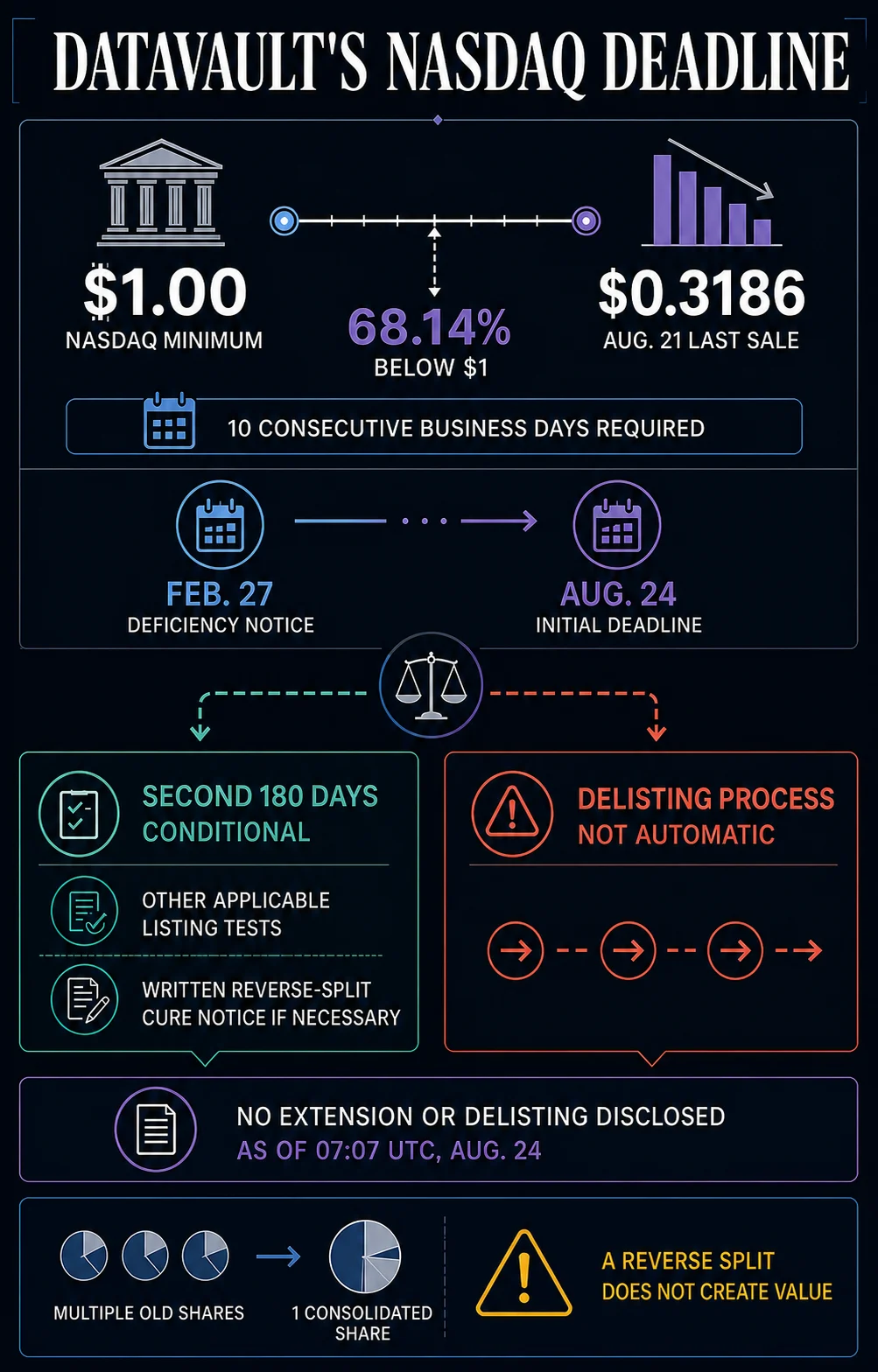
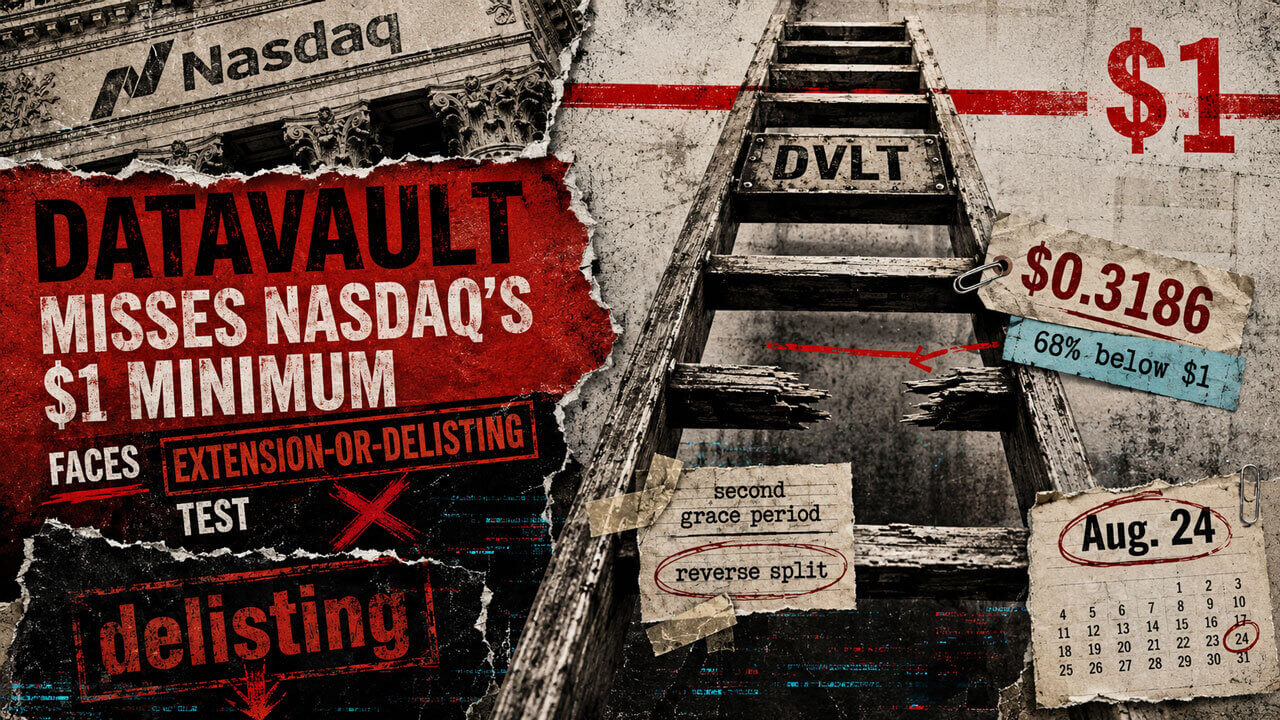
Datavault AI, a company operating in the data vault and artificial intelligence sector, is on the brink of being delisted from the Nasdaq stock exchange as its share price has fallen significantly below the required minimum of $1. The company’s first compliance period to regain the minimum bid price expired on August 24, leaving it in a precarious position with a decision looming from Nasdaq regarding either an extension or an official delisting notice. As of August 21, Datavault AI’s stock, traded under the ticker DVLT, closed at $0.3186, a staggering 68% below the critical $1 threshold. This marks a sustained period of underperformance, with Nasdaq historical data indicating that every closing price and last trade reading from August 7 through August 21 has remained below the exchange’s minimum requirement.
The gravity of the situation was first formally communicated to Datavault AI through a filing with the U.S. Securities and Exchange Commission (SEC) on February 27. In this disclosure, the company revealed that Nasdaq had granted it a grace period, extending until August 24, to achieve compliance. The Nasdaq’s Listing Rule 5450(a)(2) mandates that a listed company must maintain a minimum closing bid price of at least $1 for a minimum of 10 consecutive business days. With the August 24 deadline having passed and no indication of the stock price recovering to the required level for the stipulated consecutive days, the window for Datavault AI to rectify its bid price deficiency within this initial period has effectively closed.
Nasdaq’s Delisting Procedures and Potential Extensions
Under Nasdaq’s stringent continued listing requirements, companies that fall below the minimum bid price are typically afforded a specific timeframe to rectify the situation. The initial period, often referred to as the "cure period," is designed to give the company an opportunity to demonstrate a sustained recovery in its stock value. If a company fails to meet the minimum bid price requirement by the end of this initial period, Nasdaq has the discretion to grant a second compliance period, typically another 180 days. However, this extension is not automatic and is contingent upon the company meeting certain other listing standards.
Specifically, to qualify for an extended cure period, a company must satisfy all other applicable continued listing requirements, excluding the minimum bid price deficiency. This includes demonstrating compliance with the market value of publicly held shares (MVPHS) requirement, as well as any other initial listing standards that would have applied at the time of the company’s initial listing. Furthermore, the company must provide Nasdaq with a formal written notice, signifying its intent to cure the deficiency within the extended period. This notice often includes a commitment to take specific actions, such as implementing a reverse stock split, if deemed necessary to artificially increase the per-share price.
Datavault AI’s Financial Health and Market Performance
Datavault AI’s financial standing, as detailed in its recent filings, paints a complex picture. The company’s June-quarter filing, which included data as of August 19, reported stockholders’ equity of $245.9 million and a substantial number of shares outstanding at 949.7 million. At the closing price of $0.3186 on August 21, this share count would imply a total equity market value of approximately $302.6 million. While this figure represents the overall market capitalization based on outstanding shares, it is crucial to note that Nasdaq’s compliance metrics, particularly for the MVPHS, are based on the market value of the publicly traded float, not the entire equity. Public filings do not always provide the granular detail required to ascertain the precise public float and the necessary market-maker support that Nasdaq scrutinizes. Therefore, the determination of eligibility ultimately rests with Nasdaq’s independent assessment.
The company’s financial pressures are further highlighted by its recent capital-raising activities and operating expenses. In May, Datavault AI agreed to sell 109.1 million shares at a price of $0.55 per share, a move that generated capital but also diluted existing shareholders. Despite this, the company reported only $1.4 million in cash on hand at the end of the first half of the year. Concurrently, its operating cash outflow for the same period was a significant $79.96 million. These figures underscore the considerable financial demands placed on the company and the ongoing need for substantial funding to sustain its operations and pursue its strategic objectives, including its previously announced interest in acquiring a bank. Recent reports have detailed these ongoing financing challenges, emphasizing the critical need for capital infusion.
Historical Context of Shareholder Equity and Potential Reverse Splits
The narrative of Datavault AI’s stock performance and its struggle to meet Nasdaq’s listing requirements is not entirely new. The company’s filings indicate a history of authorized actions related to stock adjustments. A 2025 authorization, documented in SEC submissions, permitted a reverse stock split ranging from a 1-for-5 to a 1-for-20 ratio. This authorization was stipulated to be valid no later than the company’s annual meeting that year. However, a review of subsequent SEC submissions has not revealed any new proxy statements or information statements granting a renewed or updated authorization for such a split.
A reverse stock split is a corporate action where a company reduces the number of its outstanding shares by consolidating them. For example, a 1-for-10 reverse split would mean that for every ten shares an investor owns, they would now own one share. Mechanically, this action increases the per-share price, assuming the total market capitalization remains the same. While this can be a tool to regain compliance with exchange listing rules, it is important to understand that a reverse split does not inherently create economic value for shareholders. It is a financial engineering maneuver that can help a company meet a stock price requirement, but it does not address the underlying business fundamentals or the company’s ability to generate profits or cash flow. Consequently, a reverse split alone does not guarantee that DVLT will consistently remain above the $1 threshold or resolve the company’s broader capital needs.
The Path Forward: Nasdaq’s Decision and Potential Outcomes
The immediate future of Datavault AI’s listing status hinges on a formal communication from Nasdaq. The company’s SEC submissions feed and its press release index, as of the August 24 refresh, did not contain any announcements regarding an extension of the compliance period or a Staff Delisting Determination. This lack of immediate disclosure suggests that the decision-making process is ongoing or that the official notification is pending.

There are two primary paths forward:
-
Extension Granted: If Nasdaq determines that Datavault AI meets the criteria for an extended cure period, the company will receive an additional 180 days to achieve compliance with the minimum bid price requirement. During this extended period, Datavault AI would need to demonstrate a sustained increase in its stock price to at least $1 for 10 consecutive business days. This would likely involve strategic initiatives by the company to bolster investor confidence and improve its financial outlook. The company would also need to submit written notice to Nasdaq detailing its plan to cure the deficiency, potentially including a reverse stock split.
-
Staff Delisting Determination: If Nasdaq does not grant an extension, or if Datavault AI fails to meet the conditions for an extension, the exchange will issue a Staff Delisting Determination. This determination officially initiates the process for delisting DVLT from Nasdaq. Upon receiving such a determination, the company typically has the right to appeal the decision to a Nasdaq Listing Qualifications Panel. This appeal process can involve presenting further evidence and arguments to persuade the panel to grant additional time or to reconsider the delisting. However, appeals are not guaranteed to be successful, and the process can be lengthy and complex.
Broader Implications for Datavault AI and Investors
The current situation presents significant challenges for Datavault AI and its shareholders. A delisting from Nasdaq would severely impact the stock’s liquidity, making it more difficult for investors to buy and sell shares. The stock might trade on over-the-counter (OTC) markets, which are generally less regulated and have lower trading volumes, potentially leading to wider bid-ask spreads and increased volatility. This can diminish investor confidence and make it harder for the company to raise future capital.
For investors, the persistent sub-$1 stock price and the looming threat of delisting signal considerable risk. While a reverse stock split could temporarily boost the per-share price, it does not fundamentally alter the company’s financial health or its underlying business performance. Investors will be closely watching for any official announcements from Datavault AI or Nasdaq, as these will provide crucial clarity on the company’s immediate future on the exchange. The company’s ability to secure necessary funding, execute its strategic plans, and ultimately demonstrate sustainable profitability will be critical factors in its long-term viability, irrespective of its Nasdaq listing status. The current trajectory, however, points towards a period of significant uncertainty and potential adversity for Datavault AI.