admin
admin
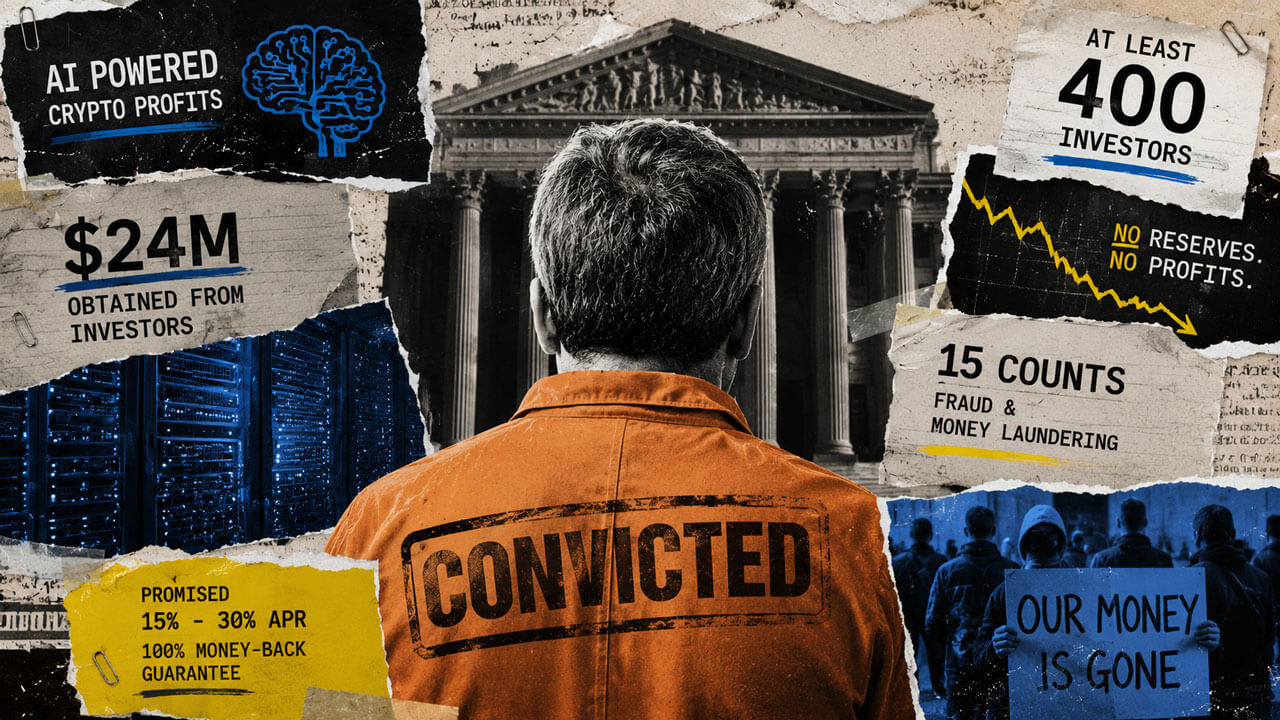
A federal jury has convicted Brent C. Kovar, the owner of Profit Connect, on 15 fraud and money-laundering counts. Prosecutors successfully argued that Kovar defrauded at least 400 investors out of approximately $24 million by making false claims about an artificial intelligence-powered cryptocurrency business. The conviction followed a nine-day trial, during which the jury found Kovar guilty of 11 counts of wire fraud, two counts of mail fraud, and two counts of money laundering.
The Justice Department detailed that Kovar’s fraudulent activities spanned from late 2017 to July 2021. During this period, he actively marketed Profit Connect as a highly profitable technology business, promising investors substantial returns. Central to his pitch was the assertion that Profit Connect employed sophisticated AI software running on a supercomputer to mine cryptocurrencies and verify blockchain transactions. Kovar assured investors that the company was generating significant profits and offered guaranteed annual returns ranging from 15% to 30%, further bolstered by a 100% money-back guarantee. To bolster the perceived legitimacy of his venture, he also claimed that Profit Connect held substantial cryptocurrency reserves, reportedly in the hundreds of millions of dollars.
However, evidence presented by the prosecution revealed a starkly different reality. The Justice Department asserted that Profit Connect was, in fact, an unprofitable enterprise with no genuine crypto reserves. The promised returns and the money-back guarantee were fabricated, lacking any legitimate operational basis. Instead of generating wealth through its purported AI technology, Kovar allegedly siphoned investor funds to sustain the scheme itself, to purchase luxury gifts for employees, to acquire a personal residence, and to make payments to earlier investors. These repayments were deceptively presented as legitimate profits derived from mining and transaction verification activities, effectively creating a Ponzi-like structure.
The Genesis of Allegations: From Civil Action to Criminal Conviction
The criminal conviction of Brent Kovar is not the first time his business dealings have come under scrutiny. Prior to the federal jury’s verdict, the Securities and Exchange Commission (SEC) initiated a civil action in 2021, alleging that both Joy and Brent Kovar had raised over $12 million from at least 277 retail investors through Profit Connect Wealth Services since May 2018. The SEC’s complaint echoed many of the same concerns later amplified by the Justice Department, highlighting the promotion of high annual returns (20% to 30%) linked to an alleged AI supercomputer.
CryptoSlate reported on these civil allegations at the time of their announcement. It is crucial to distinguish between the SEC’s civil case and the subsequent federal criminal trial. While the SEC’s action focused on civil penalties and the recovery of investor funds, Brent Kovar’s criminal conviction, handed down in August 2026, establishes his criminal liability for fraud and money laundering. The figures presented in each case, while related, represent different stages of legal proceedings and potentially different scopes of the alleged misconduct.
The Justice Department’s reported $24 million figure in the criminal case is nearly double the SEC’s earlier estimate of over $12 million. Similarly, the minimum number of investors cited in the criminal proceedings increased from at least 277 in the SEC’s civil case to at least 400. It is important to note that both these figures are presented as lower-bound estimates, suggesting that the actual number of individuals affected and the total sum of money involved could be even higher. These discrepancies in figures are attributable to the different legal frameworks and investigative periods of each case. The SEC’s civil action likely covered an earlier period, whereas the criminal investigation and subsequent trial encompassed a broader timeframe and potentially more detailed financial records. A definitive accounting of total investor losses and any potential recoveries would typically require access to detailed court or receivership records.
A Chronology of Alleged Deception
The timeline of events leading to Brent Kovar’s conviction paints a picture of a sustained fraudulent operation:
- Late 2017 – July 2021: Brent Kovar allegedly operates Profit Connect, soliciting investments from individuals with promises of high, guaranteed returns derived from an AI-powered cryptocurrency mining and verification business. During this period, he reportedly cultivates an image of a successful and technologically advanced enterprise.
- May 2018 onwards: The SEC alleges that Profit Connect Wealth Services, operated by Joy and Brent Kovar, begins raising significant funds from retail investors, purportedly based on the AI supercomputer model.
- Prior to July 2021: The scale of the operation grows, with the SEC later alleging over $12 million had been raised from at least 277 investors.
- July 2021: The SEC files a civil action against Joy and Brent Kovar, outlining their alleged fraudulent scheme.
- August 2026: Following an extensive investigation and a nine-day trial, a federal jury convicts Brent C. Kovar on 15 counts of fraud and money laundering, finding he obtained approximately $24 million from at least 400 investors. This criminal conviction signifies a distinct legal outcome from the earlier civil action.
- November 30, 2026: Brent Kovar is scheduled for sentencing. Prosecutors have indicated that the convictions carry a maximum statutory sentence of 280 years in prison, representing the aggregate legal ceiling across all the counts.
This chronological breakdown highlights the progression from alleged civil misconduct to a definitive criminal verdict, underscoring the seriousness of the financial crimes involved.
The Role of AI in Investment Fraud
The Profit Connect case also brings into sharp focus the increasing use of sophisticated technologies, such as artificial intelligence, as a lure in fraudulent investment schemes. Kovar’s claims of using an AI-powered supercomputer for cryptocurrency mining and transaction verification played a central role in convincing investors of the scheme’s legitimacy and profitability. The allure of cutting-edge technology, especially in the rapidly evolving world of cryptocurrency, can create a perception of innovation and high returns, making it a powerful tool for fraudsters.

In many legitimate AI-driven investment platforms, AI algorithms are employed to analyze market data, identify trading opportunities, and execute trades with greater speed and efficiency than human traders. However, in cases like Profit Connect, the AI narrative appears to have been a fabrication designed to mask a more traditional Ponzi scheme. This highlights a growing challenge for regulators and investors alike: distinguishing between genuine technological innovation and deceptive marketing ploys. The sophisticated nature of AI can make it difficult for the average investor to verify the underlying operational claims, making them more vulnerable to such scams.
Broader Implications for the Crypto and Investment Landscape
The conviction of Brent Kovar over the Profit Connect scheme has several significant implications for the broader cryptocurrency and investment landscape:
- Increased Regulatory Scrutiny: This verdict is likely to fuel further regulatory scrutiny of cryptocurrency-related investment schemes. Authorities are increasingly vigilant about fraudulent operations that exploit the hype and complexity surrounding digital assets and emerging technologies like AI.
- Investor Awareness and Due Diligence: The case serves as a stark reminder for investors to exercise extreme caution and conduct thorough due diligence before committing funds to any investment, particularly those promising exceptionally high or guaranteed returns, and those leveraging advanced technological claims without verifiable proof.
- Enforcement of Anti-Fraud Measures: The Justice Department’s successful prosecution demonstrates a commitment to holding individuals accountable for large-scale financial fraud, even when it involves novel technologies. This sends a strong message to potential fraudsters that their illicit activities will be met with rigorous legal consequences.
- The Evolving Nature of Financial Crime: The integration of AI in the alleged fraud underscores the evolving tactics employed by financial criminals. Law enforcement and regulatory bodies will need to continually adapt their strategies and expertise to combat these sophisticated schemes effectively.
Sentencing and Future Proceedings
Following the jury’s verdict, the case now moves to the sentencing phase. Brent Kovar faces a potentially lengthy prison sentence, with prosecutors seeking the maximum statutory penalty. The judge presiding over the case will consider various factors, including the U.S. Sentencing Guidelines, the severity of the offenses, and any mitigating or aggravating circumstances, before determining the final sentence. This sentencing will mark a crucial concluding chapter in the criminal proceedings against Kovar, while potentially offering some measure of justice to the defrauded investors. The ongoing legal processes serve as a critical component in maintaining trust and integrity within the financial markets, particularly in the rapidly developing sectors of cryptocurrency and artificial intelligence.