admin
admin
Global onchain cryptocurrency activity that could be subject to taxation reached a staggering $457 billion in 2025, yet current international reporting standards are poised to capture only a small fraction of these transactions. According to a comprehensive report released by blockchain analytics firm Chainalysis, the rapid expansion of the decentralized finance (DeFi) ecosystem and peer-to-peer (P2P) transfers has created a significant "tax gap" that existing regulatory frameworks, specifically the Organisation for Economic Co-operation and Development’s (OECD) Crypto-Asset Reporting Framework (CARF), are currently unequipped to bridge.
The findings highlight a growing disparity between the sheer volume of digital asset wealth generation and the ability of global tax authorities to monitor and collect revenue from these activities. As the digital economy matures, the tension between the transparency of the blockchain and the anonymity or decentralization of specific protocols remains a primary hurdle for fiscal policy implementation.
The Scale of Taxable Onchain Activity
The $457 billion figure identified by Chainalysis represents a baseline for potentially taxable events occurring directly on the blockchain. This total includes realized gains from asset appreciation, income generated through mining and staking activities, interest earned from decentralized lending protocols, and crypto-denominated payments for goods and services. The study focused on activity across six major blockchains, providing a representative snapshot of the broader market.
Significantly, this estimate deliberately excludes trading and other financial activities conducted within centralized exchanges (CEXs). Because centralized exchanges typically maintain internal ledgers that do not record every trade on the public blockchain, their inclusion would likely push the total taxable figure significantly higher. However, CEXs are also the entities most likely to comply with existing and emerging reporting mandates, making the $457 billion of purely onchain activity a more critical area of concern for regulators.
Geographically, the activity is concentrated in regions with high levels of institutional adoption and advanced digital infrastructure. The United States remains the single largest contributor to this figure, accounting for an estimated $112.6 billion in taxable onchain activity. When viewed as a broader region, North America led the world with a total of $134.6 billion. The European Union followed closely behind, recording $125.1 billion in identified taxable events, reflecting the region’s robust regulatory appetite and high retail engagement.
The CARF Coverage Gap: A 14% Reality
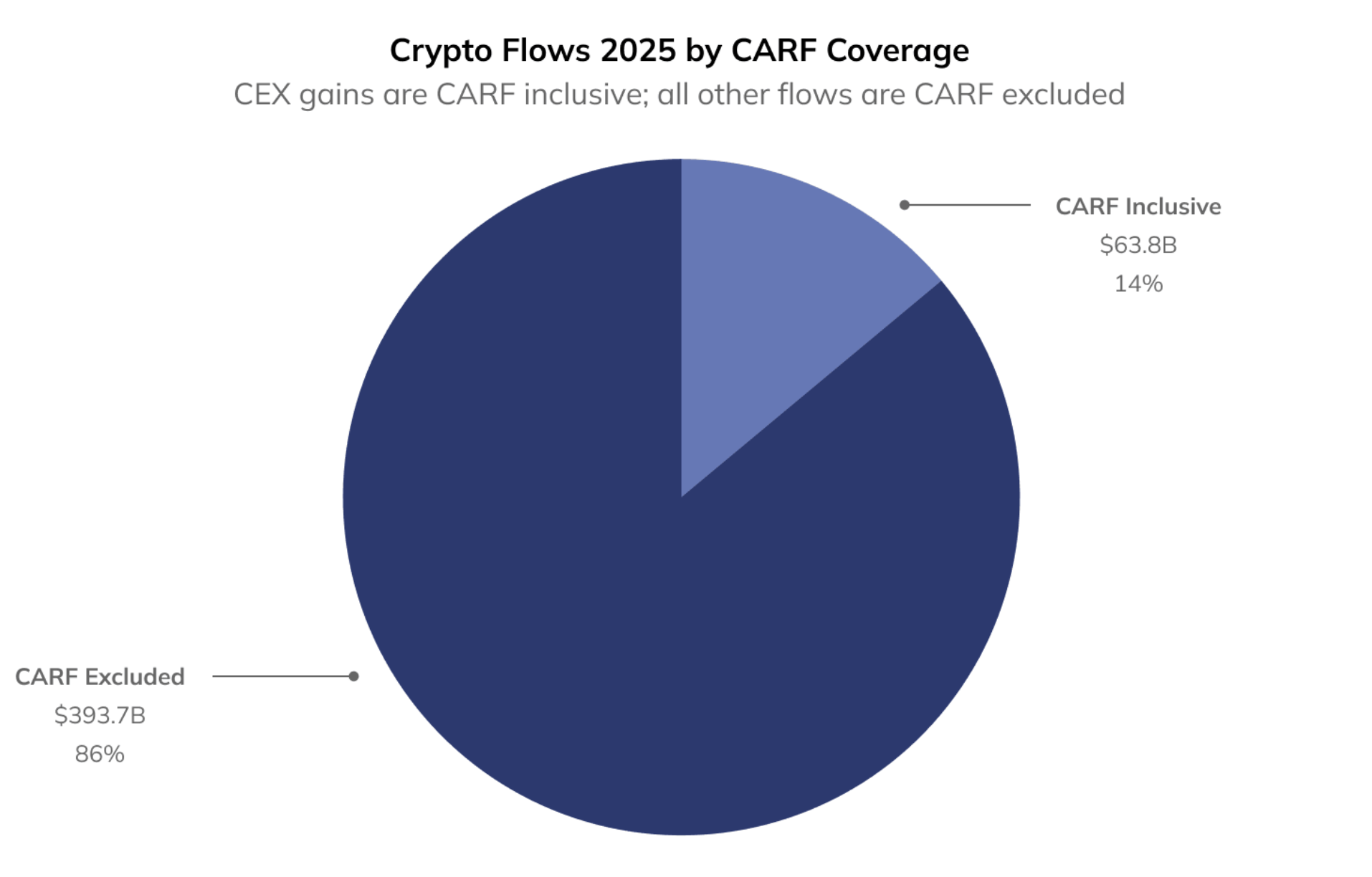
The most striking revelation of the report is the limited reach of the OECD’s Crypto-Asset Reporting Framework. Despite being hailed as a landmark in international tax cooperation, CARF is estimated to cover only 14% of the onchain taxable activity identified by Chainalysis. The remaining 86% of transactions—totaling hundreds of billions of dollars—fall outside the current reporting perimeter.
This massive "blind spot" is largely attributed to the design of the framework itself. CARF was developed in 2022 with the primary goal of requiring "reporting crypto-asset service providers" (RCASPs) to collect and share customer data with tax authorities. These service providers are generally defined as intermediaries that facilitate exchanges between crypto-assets and fiat currencies, or between different types of digital assets, as a business service.
While this effectively captures the activity of centralized brokerages and custodians, it leaves the following sectors largely untouched:
- Decentralized Exchanges (DEXs): Platforms that allow users to swap assets via automated smart contracts without a central intermediary.
- Peer-to-Peer (P2P) Transfers: Direct transfers between private unhosted wallets.
- Onchain Income Streams: Rewards earned directly from protocol-level activities like staking or providing liquidity to automated market makers (AMMs).
- Crypto Payments: Direct transactions between consumers and merchants using non-custodial payment rails.
Chronology of Global Crypto Tax Regulation
The current regulatory landscape is the result of several years of intensive policy development aimed at bringing the "wild west" of crypto into the global tax net.
- October 2022: The OECD delivers the Crypto-Asset Reporting Framework (CARF) to G20 Finance Ministers. The framework was designed to mirror the Common Reporting Standard (CRS) used for traditional financial accounts, ensuring that crypto-assets do not become a vehicle for tax evasion.
- 2023–2024: Individual jurisdictions begin the process of transposing CARF into domestic law. During this period, the European Union integrates CARF principles into its Directive on Administrative Cooperation (DAC8), while the United Kingdom and several other nations pledge early adoption.
- January 1, 2026: Official data collection under CARF begins across 48 signatory jurisdictions. This marks the first time that standardized, cross-border reporting of crypto transactions becomes a mandatory operational reality for covered service providers.
- Late 2026: The first major exchange of data between tax authorities is expected to take place, allowing jurisdictions like the UK, EU member states, and others to cross-reference the holdings of their tax residents in foreign crypto platforms.
The DeFi Dilemma and the Role of Intermediaries
The 86% of activity that remains uncaptured represents the core of the decentralized ethos. Colby Mangels, a former OECD adviser who played a key role in drafting CARF, has noted that the framework was intentionally built around the concept of "intermediaries." This approach was chosen because intermediaries provide a natural point of leverage for regulators; they possess the infrastructure to perform Know Your Customer (KYC) checks and the centralized authority to report data.
However, the rise of "pure" DeFi—where there is no centralized operator, no board of directors, and no custodial relationship—defies this model. In many DeFi protocols, the "operator" is a decentralized autonomous organization (DAO) or simply a set of immutable smart contracts. Imposing reporting requirements on these entities presents both technical and legal challenges.
"The framework was designed around intermediaries that facilitate crypto transactions as a business," Mangels stated in a recent industry discussion. "Much of decentralized finance therefore remains outside the reporting perimeter, as there may be no centralized operator on which to impose these requirements."
This creates a significant incentive for users seeking privacy or tax optimization to move their activity further onchain and away from regulated gateways. Tax authorities are reportedly aware of this trend and are closely monitoring the evolution of anti-money laundering (AML) regulations. There is a growing movement to redefine "service providers" to include any entity that exerts significant influence or control over a DeFi protocol, which could eventually pull more onchain activity into the reporting net.
Economic Implications and the Global "Tax Gap"
The inability to capture 86% of onchain activity has profound implications for national treasuries. At a time when many developed economies are grappling with high debt-to-GDP ratios and seeking new revenue streams, the "crypto tax gap" represents a significant loss of potential funding.
If the $457 billion in taxable activity were fully realized and taxed at an average capital gains or income rate of 20%, it would represent nearly $91 billion in global tax revenue. Under the current 14% coverage provided by CARF, only about $12.7 billion of that revenue is effectively visible to authorities through automated reporting. The remaining $78 billion relies on self-reporting by taxpayers—a method that has historically seen much lower compliance rates in the crypto sector compared to traditional brokerage accounts.
Furthermore, the disparity in reporting coverage could lead to market distortions. If centralized exchanges are burdened with heavy reporting requirements while decentralized platforms remain "free," it may drive institutional and sophisticated retail capital toward DeFi, potentially increasing systemic risks if those platforms lack the consumer protections found in the regulated sector.
Future Outlook: Toward Universal Transparency?
The Chainalysis report serves as a wake-up call for policymakers who believed that CARF would provide a comprehensive solution to crypto tax evasion. Instead, it suggests that CARF is merely the first step in a much longer journey toward global financial transparency in the digital age.
Regulators are expected to respond to these findings in several ways:
- Expansion of "Service Provider" Definitions: Future iterations of CARF or domestic laws may seek to classify software developers or DAO participants as "covered entities" if they derive financial benefit from a protocol.
- Enhanced Blockchain Analytics: Tax authorities are increasingly partnering with firms like Chainalysis to perform "off-cycle" audits. By analyzing public ledger data, authorities can identify high-value wallets and issue "John Doe" summons or requests for information to individuals who appear to have significant undisclosed gains.
- Integration with CBDCs and Stablecoins: As central bank digital currencies (CBDCs) and regulated stablecoins become more prevalent, tax reporting may be "baked into" the currency layer itself, making compliance automatic for any transaction involving these assets.
The findings also underscore the importance of international cooperation. With $134.6 billion in taxable activity in North America and $125.1 billion in the EU, the movement of digital wealth is inherently global. Without a unified approach that addresses the unique challenges of DeFi and P2P transfers, the "tax gap" is likely to persist, even as the total volume of onchain wealth continues its upward trajectory.
As the Jan. 1, 2026, deadline for CARF data collection passes, the focus of the global regulatory community will shift from policy creation to enforcement. The success of these efforts will depend not just on the laws written in books, but on the ability of governments to decode the complex, pseudonymized world of the blockchain. For now, the 86% remains a vast, untapped frontier for the world’s tax collectors.