admin
admin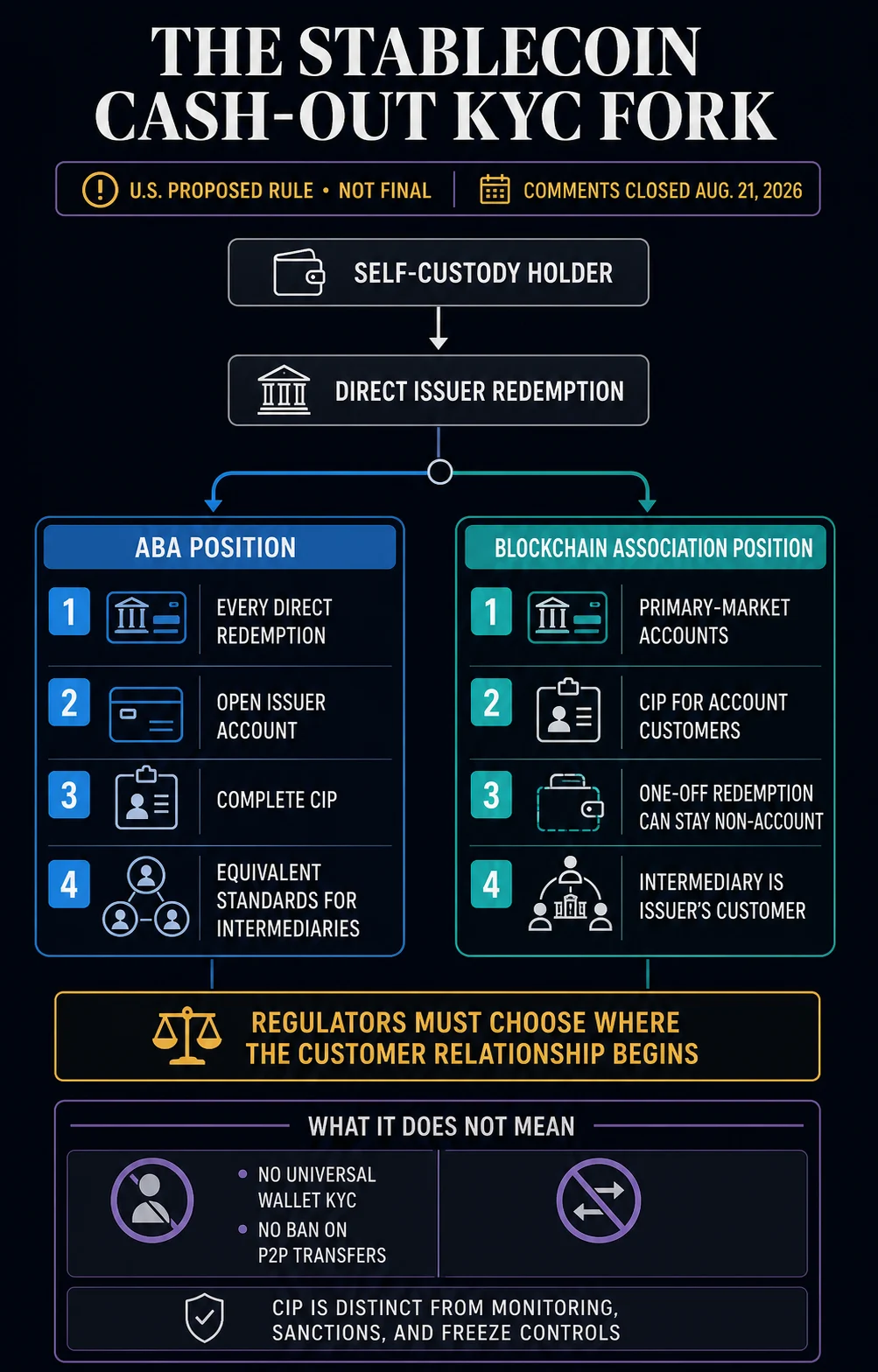
The American Bankers Association (ABA) is actively lobbying U.S. financial regulators, advocating for stringent customer identification requirements for any individual or entity directly engaging with a payment stablecoin issuer for the purchase or redemption of tokens. This push, detailed in recent public comments, proposes that such direct interactions should necessitate the opening of an account and the completion of comprehensive customer identification procedures, commonly known as Know Your Customer (KYC) or Customer Identification Programs (CIP). This stance has ignited a significant debate within the digital asset industry, with organizations like the Blockchain Association presenting a contrasting view that seeks to delineate between direct account relationships and more transactional redemption events.
The core of this disagreement revolves around the definition of an "account" and the scope of CIP obligations when users interact with stablecoin issuers. The ABA’s proposal, if adopted by regulators, would fundamentally alter the process for individuals seeking to convert stablecoins back into fiat currency directly with the issuer. For a holder currently maintaining their stablecoins in self-custody, a direct redemption would transform from a straightforward cash-out into a formal issuer-onboarding event, requiring the establishment of a direct customer relationship.
The Blockchain Association, while acknowledging the necessity of identity checks for customers establishing direct, ongoing relationships with primary-market issuers, argues that a one-off redemption or a redemption routed through a regulated intermediary should not automatically compel the underlying holder to become a direct customer of the issuer. This divergence in opinion surfaced prominently in the public comments submitted in response to a joint federal proposal concerning customer identification programs for permitted payment stablecoin issuers.
A Regulatory Crossroads: Defining the Stablecoin Redemption Boundary
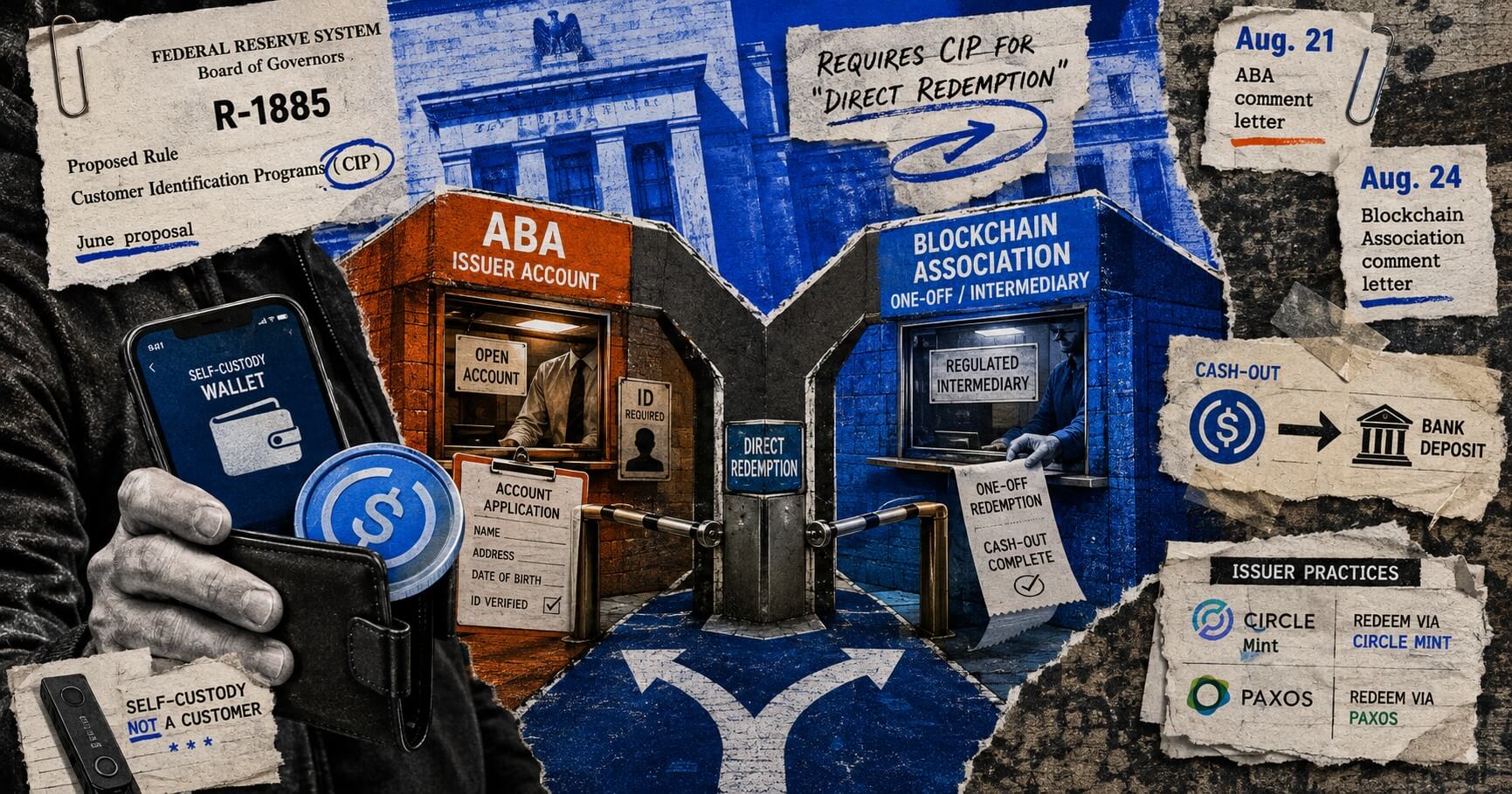
The federal agencies released a joint proposal on June 22, 2026, outlining the framework for Permitted Payment Stablecoin Issuer Customer Identification Programs (CIPs). This proposal seeks to clarify the obligations of entities that issue stablecoins designed for payment purposes. Under the proposed rule, these issuers would be required to implement a CIP for customers who open accounts with them. A CIP is the established regulatory process for collecting and verifying the identifying information of individuals and entities when they open financial accounts, a standard practice in traditional banking to combat financial crimes like money laundering and terrorism financing.
The proposal explicitly states that directly issuing or redeeming payment stablecoins are activities that can establish an account relationship with the issuer. However, it clarifies that mere ownership of a stablecoin token is insufficient on its own to create such a relationship. Furthermore, transactions that interact solely with an issuer’s smart contract, particularly those facilitated by third parties, would not automatically classify every user participating in such a transaction as a direct customer of the issuer.
The current landscape of stablecoin usage often involves users acquiring tokens through various channels, such as cryptocurrency exchanges, direct payments, or peer-to-peer transfers, without necessarily interacting directly with the stablecoin issuer. From this position, a holder has two primary avenues for converting their stablecoins back into fiat currency: either by seeking redemption directly from the stablecoin issuer or by utilizing an exchange or another regulated intermediary. These intermediaries often aggregate stablecoins from multiple users and redeem them in bulk on behalf of their customers.
Recognizing this complexity, the federal agencies specifically sought public input on a crucial question: Does a direct redemption request by a holder with no prior relationship with the issuer automatically trigger the creation of an account? The proposal, however, does not offer a definitive answer, leaving it to industry stakeholders to articulate their perspectives and for regulators to ultimately decide the path forward.
The ABA’s Stance: Equivalence and Robust Identity Verification
In its August 21, 2026, letter to regulators, the American Bankers Association strongly recommended that any individual or entity purchasing or redeeming a payment stablecoin directly from its issuer must first open an account and undergo the issuer’s established CIP. This approach, according to the ABA, is essential for maintaining a level playing field and ensuring that stablecoin activities are subject to the same rigorous customer identification standards as traditional financial services.
Under the ABA’s proposed framework, a holder would be precluded from making a one-off direct redemption as an unidentified, non-customer. Instead, the issuer would be mandated to collect and verify the necessary identifying information to formally establish an account before facilitating the redemption into fiat currency. This would mean that even a single, direct redemption transaction would initiate the account-opening process.
Furthermore, the ABA extended its call for robust oversight to secondary market participants. It argued that exchanges and other service providers facilitating stablecoin transactions should be subject to equivalent customer identification regulations and examinations. The association framed this recommendation as a critical measure to ensure comparable standards across both the burgeoning stablecoin market and established conventional financial channels, thereby mitigating potential regulatory arbitrage and enhancing overall financial system integrity.
The Blockchain Association’s Counterpoint: Flexibility and Intermediary Responsibility
The Blockchain Association, while not opposing identity checks for direct primary-market account customers, has voiced concerns about the ABA’s broad interpretation. In its public comments, the association urged regulators to preserve the option for issuers to conduct one-off redemptions for non-account holders without automatically mandating the opening of a full customer account. This suggests a desire for a more nuanced approach that distinguishes between established, ongoing customer relationships and occasional redemption activities.
A key point of contention for the Blockchain Association lies in the scenario where a regulated intermediary handles the redemption process. They argue that in such cases, the intermediary itself should be considered the issuer’s customer, and not every individual user whose tokens are aggregated by that intermediary. This perspective emphasizes the importance of maintaining a clear chain of responsibility, where the regulated entity acting as the conduit for redemption bears the primary compliance burden with the issuer, thereby avoiding a cascade of direct customer identification requirements for potentially millions of downstream users.
The differing positions were clearly delineated in a comparative table submitted as part of the public discourse:
| Position | Identity Trigger | Practical Result |
|---|---|---|
| ABA | Every direct issuer purchase or redemption | The holder opens an issuer account and completes CIP before cashing out. |
| Blockchain Association | A direct primary-market account relationship | An issuer can offer a one-off non-account redemption without automatically opening an account for the individual holder. |
| Intermediary-routed redemption | Disputed (ABA seeks equivalent standards; BA treats intermediary as issuer’s customer) | ABA seeks parity across channels; Blockchain Association assigns issuer customer status to the intermediary, not each underlying user. |
This divergence highlights a fundamental disagreement on how to balance regulatory compliance with the user experience and operational efficiency of the digital asset ecosystem.
Existing Practices and Future Implications
It is important to note that direct issuer redemption is already an account-based and identity-verified process for eligible U.S. customers with prominent stablecoin issuers such as Circle and Paxos. Circle’s USD Coin (USDC) terms, for instance, route eligible direct U.S. redemptions through a Circle Mint account, which requires verification and is subject to a user agreement. Similarly, Paxos mandates that direct redemption of its stablecoins is available only to fully verified, eligible account customers. These existing practices offer a glimpse into how robust compliance can be integrated, but they do not set a universal industry standard or definitively resolve what federal law should mandate.
The implications of the agencies’ eventual decision are significant. If they adopt the ABA’s approach, it could establish account-opening CIP as the federal baseline for any permitted issuer offering direct redemption services. This would leave little room for alternative structures that might offer more streamlined redemption pathways for certain user segments.
Conversely, the Blockchain Association’s stance suggests a desire for regulatory flexibility, allowing for various redemption models that cater to different user needs and market structures. The association’s position on intermediary-routed redemptions underscores a concern that overly broad CIP requirements could stifle innovation and create undue burdens on users and platforms alike.
It is also worth noting that Circle’s European operations present a different model. Under its MiCA (Markets in Crypto-Assets) redemption policy for the European Economic Area, eligible retail holders can utilize a dedicated form rather than the Circle Mint account. While this policy still mandates identity checks, transaction screening, and freeze checks, along with the requirement of an eligible EEA bank account, it illustrates a jurisdiction-specific approach to compliance that differs from the proposed U.S. regime.
Looking ahead, a separate federal proposal released in April 2026 addresses broader anti-money laundering (AML) and counter-financing of terrorism (CFT) programs for stablecoin issuers. This proposal encompasses elements like transaction monitoring, sanctions screening, and powers to block or freeze illicit activities. These measures may apply to specific transactions or wallet activities without necessarily defining every token holder as a direct issuer account customer. However, the current June proposal’s focus on CIP at the point of redemption directly links identity verification to the establishment of an account relationship.
The federal agencies are currently grappling with the precise "redemption boundary." The ABA advocates for placing the identity verification burden directly on the issuer for every direct interaction, whereas the Blockchain Association seeks to tie issuer CIP primarily to primary-market accounts and permit one-off or intermediary-routed cash-outs without automatically onboarding every underlying holder. The final rule emanating from these deliberations will shape the future compliance landscape for stablecoin issuers and users, determining whether direct redemption invariably leads to a formal account relationship or if more flexible redemption mechanisms will be permitted. Until a final rule is issued, these represent distinct advocacy positions rather than binding regulatory requirements.