admin
admin
In a significant move that signals the further integration of decentralized finance into the traditional American housing market, Better Mortgage and Coinbase have officially announced the general availability of their Bitcoin-backed mortgage product. This innovative financial offering allows prospective homebuyers across the United States to utilize their Bitcoin (BTC) holdings as collateral for a down payment, effectively removing the necessity to liquidate digital assets to secure a physical home. By bridging the gap between the volatile cryptocurrency market and the stability of real estate, the two companies aim to provide a liquidity solution for a growing class of "crypto-wealthy" individuals who have previously found it difficult to navigate traditional mortgage underwriting processes without incurring substantial capital gains taxes.
The partnership, which was first teased during an early-access phase in March, marks a pivotal moment for the mortgage industry. It addresses a long-standing friction point: the requirement for borrowers to convert digital assets into US dollars to satisfy down payment requirements. Under this new model, borrowers can maintain their long-term investment positions in Bitcoin while simultaneously accessing the credit necessary to enter the housing market.
The Structural Mechanics of Bitcoin-Backed Financing
The product is designed as a dual-loan structure that satisfies the stringent requirements of the secondary mortgage market while providing the flexibility of crypto-collateralization. According to technical documentation provided by Coinbase’s Help Center, the arrangement pairs a standard home loan—typically one backed by the government-sponsored enterprise (GSE) Fannie Mae—with a secondary, separate down payment loan. This secondary loan is the component secured specifically by the borrower’s Bitcoin.
To mitigate the risks associated with Bitcoin’s inherent price volatility, Better Mortgage has implemented a conservative collateralization ratio. Borrowers are required to pledge Bitcoin worth at least 250% of the value of the down payment loan. For example, a homebuyer seeking a $100,000 down payment loan would need to pledge $250,000 worth of BTC. This "over-collateralization" provides a significant buffer for the lender, ensuring that the loan remains well-covered even during periods of market contraction.
The pledged assets are not held by the borrower or Better Mortgage directly; instead, they are transferred to a dedicated custodial account managed by Coinbase Prime. This institutional-grade platform provides the security and compliance infrastructure necessary to handle large-scale digital asset custody. Once the mortgage is fully repaid or the property is refinanced, the pledged Bitcoin is returned to the borrower, subject to the specific terms of the agreement.
Repayment and Risk Management: The Absence of Margin Calls
One of the most distinctive features of the Better-Coinbase product is its approach to market volatility. In many crypto-collateralized lending environments, a sharp drop in the price of the underlying asset triggers a "margin call," requiring the borrower to either provide more collateral or face immediate liquidation. However, Better Mortgage has stated that Bitcoin price declines alone do not trigger margin calls or result in changes to the mortgage terms.
This feature provides a layer of security for homeowners that is rarely found in the digital asset lending space. The primary risk of liquidation is tied not to the market price of Bitcoin, but to the borrower’s performance on the loan. Better retains the right to liquidate the pledged BTC only if a borrower becomes 60 days delinquent on their monthly payments. This aligns the crypto-backed product more closely with traditional foreclosure timelines, giving borrowers a window to rectify missed payments before their collateral is seized.
The two loans—the primary mortgage and the Bitcoin-secured down payment loan—carry the identical interest rate and amortization term. To simplify the user experience, they are serviced through a single, unified monthly payment. This streamlined approach ensures that the complexity of the underlying collateral does not translate into a complex administrative burden for the homeowner.

A Timeline of Institutional and Regulatory Adoption
The launch of this product is the culmination of several years of incremental shifts within the US financial and regulatory landscape. The journey toward mainstream crypto-mortgages has been marked by both private sector innovation and federal oversight adjustments.
March 2024: Better and Coinbase first announce the "token-backed mortgage" concept, launching an early-access program to test the appetite of the market and the robustness of the dual-loan structure.
January 2025: Major mortgage lender and servicer Newrez announces that it will begin recognizing certain cryptocurrency holdings when evaluating mortgage applications. This move signalized that the industry was moving away from viewing crypto as a "suspicious" source of funds and toward viewing it as a legitimate asset class for risk assessment.
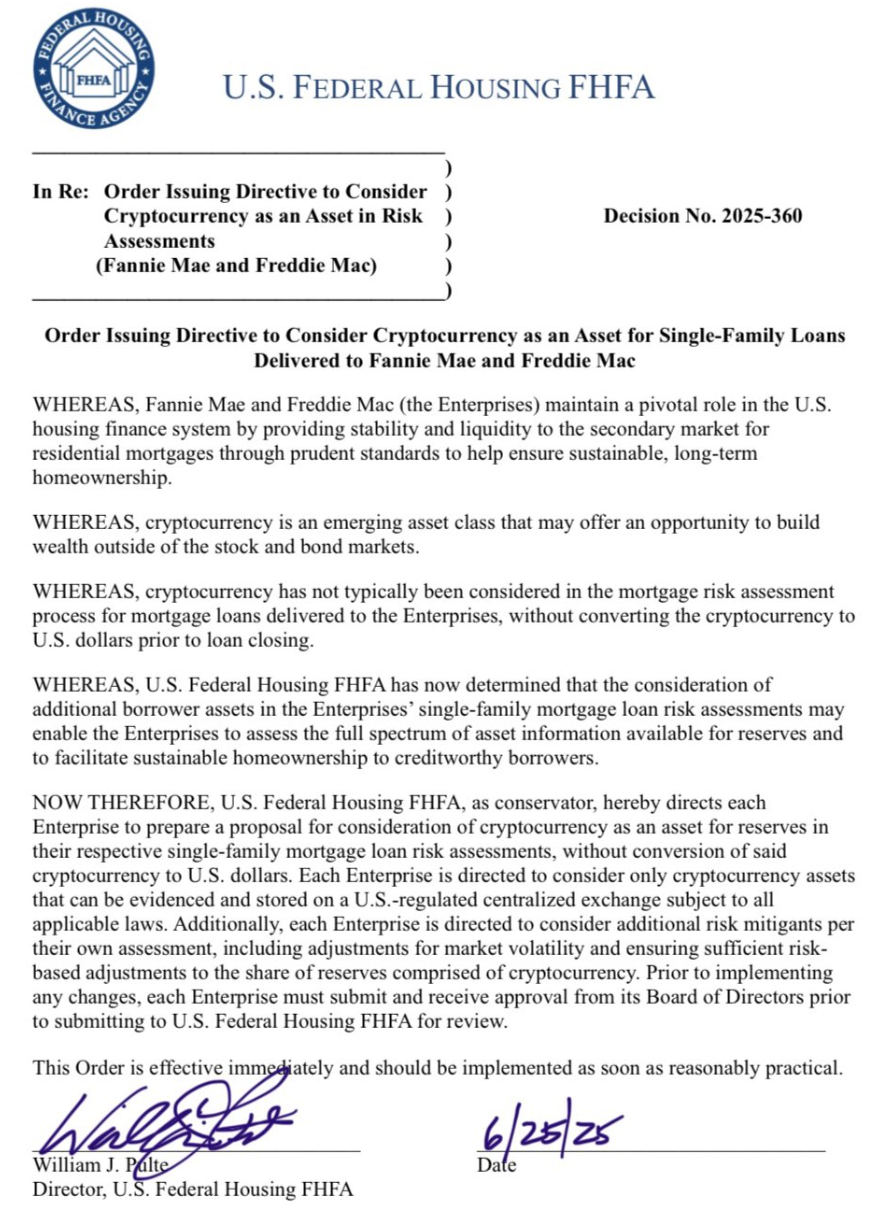
June 2025: In a landmark move, the Federal Housing Finance Agency (FHFA) issues a directive to Fannie Mae and Freddie Mac. The directive orders the GSEs to develop formal proposals to consider cryptocurrency held on US-regulated centralized exchanges as an asset in single-family mortgage risk assessments. Crucially, the FHFA specified that this should be done without requiring the conversion of these assets into US dollars, provided that risk-mitigation measures for volatility were in place.
Late 2025 – Early 2026: Throughout this period, median home prices in the US remained historically elevated, hovering around the $400,000 mark. This economic environment increased the pressure on lenders to find creative solutions for borrowers who have significant net worth tied up in digital assets but lack the liquid cash for traditional 20% down payments.
Market Context: Navigating High Interest Rates and Record Home Prices
The expansion of Bitcoin-backed financing comes at a time when the American dream of homeownership faces significant headwinds. Data from the US Census Bureau and the Department of Housing and Urban Development, compiled by the Federal Reserve Bank of St. Louis, shows that while home prices have seen some stabilization since the peaks of 2022, they remain at levels that are difficult for many first-time buyers to reach.
With the median sales price of a new home sitting near $400,000 in 2026, a traditional 20% down payment requires $80,000 in cash. For many younger professionals and "digital nomads" who invested early in the crypto markets, this liquidity is often locked in Bitcoin. Selling that Bitcoin to raise $80,000 would not only end their exposure to future BTC price appreciation but would also likely trigger a significant capital gains tax event, further reducing their purchasing power.
By allowing these assets to remain "in-place" as collateral, Better and Coinbase are effectively unlocking billions of dollars in dormant purchasing power. This could provide a much-needed boost to transaction volumes in a housing market that has been slowed by high interest rates and limited inventory.
Eligibility, Incentives, and Underwriting Standards
Despite the high-tech nature of the collateral, the underwriting process for a Better-Coinbase mortgage remains rooted in traditional financial prudence. Borrowers are not exempt from standard credit checks, income verification, or debt-to-income ratio assessments. To be eligible, applicants must be US residents and possess a verified Coinbase account.
To sweeten the deal for existing crypto users, Coinbase One members are eligible for a 1% rebate from Better. This rebate, which is capped at $10,000, can be applied toward closing costs and fees. This incentive is clearly designed to deepen the ecosystem stickiness for Coinbase, rewarding its most loyal subscribers with tangible savings on one of life’s largest purchases.
Better’s underwriting team continues to evaluate the borrower’s overall financial health, ensuring that the addition of a Bitcoin-collateralized loan does not over-leverage the homeowner. The requirement for a 250% collateral ratio serves as the primary safeguard for the lender, while the standard Fannie Mae requirements ensure the primary mortgage meets the quality standards for the secondary market.
Broader Implications for the Future of Real Estate and DeFi
The general availability of Bitcoin-backed mortgages represents a "proof of concept" for the broader tokenization of real estate. While this product uses Bitcoin as collateral, industry analysts suggest it paves the way for a future where various types of digital assets—including tokenized securities or even other real estate holdings—could be used to secure credit.
Furthermore, this development challenges the traditional "all-or-nothing" approach to asset management. Historically, an individual was either "in" the stock/crypto market or "in" the real estate market. The ability to use one to fund the other without a taxable exit event creates a more fluid financial environment.
However, the move is not without its critics. Some financial analysts point to the 77% of Americans who, according to recent surveys, view cryptocurrency in retirement plans as a risky endeavor. These skeptics argue that tying the roof over one’s head to the performance of a digital asset—even with a 250% buffer—introduces a level of systemic risk that traditional banking has spent decades trying to eliminate.
Despite these concerns, the FHFA’s directive and the entry of established players like Better and Coinbase suggest that the institutionalization of crypto-real estate financing is no longer a fringe experiment. It is becoming a formalized segment of the US mortgage market, catering to a new generation of homeowners who view their digital wallets with the same legitimacy as a traditional savings account.
As the product rolls out nationally, the industry will be watching closely to see the rate of adoption and, more importantly, the performance of these loans during the next major period of Bitcoin price volatility. If the 250% collateral buffer and the 60-day delinquency rule prove effective in preventing losses, it is likely that other major lenders will follow Better’s lead, further cementing Bitcoin’s role as a "pristine" collateral asset in the global economy.