Reza Arap Oktovian
The Ethereum network, a cornerstone of the decentralized finance ecosystem and home to hundreds of billions of dollars in digital assets, is poised for a transformative upgrade that will fundamentally alter its operational backbone. Later this year, Ethereum will transition from its current Proof-of-Work (PoW) consensus mechanism to a more energy-efficient Proof-of-Stake (PoS) model. This monumental undertaking, often likened to changing an airplane’s engine mid-flight, requires the network to maintain continuous operation and the production of valid blocks throughout the process, a feat of engineering and coordination unprecedented in the blockchain space.
Unlike many other prominent blockchains, such as Bitcoin, which rely on a more singular development approach, Ethereum’s vibrant developer community, bolstered by the Ethereum Foundation (EF) and influential figures within the ecosystem, has embarked on a multi-client strategy for its PoS implementation, commonly referred to as Ethereum 2.0. This approach involves the development of several distinct client software versions, each built by different teams and often coded in different programming languages, with the core objective of enhancing network resilience.

The Genesis of The Merge: A Phased Transition to Proof-of-Stake
The transition, colloquially known as "The Merge," is not a simple amalgamation of two independent blockchains. Instead, it signifies a pivotal moment where the existing Ethereum network’s nodes, which currently include miners responsible for transaction validation and block creation, will integrate with the "beacon chain." This beacon chain, a separate PoS consensus layer, has been operational since December 2020, laying the groundwork for the forthcoming shift.
A key architectural change resulting from The Merge is the separation of node duties. Under the current PoW system, nodes are responsible for both executing transactions and validating them. Post-Merge, this responsibility will be bifurcated:
- Execution Nodes: These nodes will continue to interact with users and smart contracts via the Ethereum Virtual Machine (EVM). Their primary role will be to process and execute transactions, subsequently submitting them to validator nodes for consensus. Essentially, their function will largely mirror their current responsibilities, with the critical distinction that validation will be offloaded.
- Validator Nodes: Operating on the consensus layer (the beacon chain), these nodes will be responsible for the security and integrity of the network by validating transactions and proposing new blocks. This role replaces the mining function of PoW.
While execution clients will undergo minor modifications to adapt to The Merge, a significant portion of their codebase, particularly the EVM, can be reused with minimal adjustments. Eventually, execution clients may shed the components related to PoW validation entirely. The Merge, therefore, is not about merging two chains into one but rather about redirecting the validation responsibilities at a specific block height to a new set of participants – the validators – thereby enhancing network robustness through a layered approach.

The Imperative of Client Diversity: Mitigating Systemic Risk
The strategic decision to develop multiple, independently coded client implementations for Ethereum’s PoS protocol stems from a fundamental commitment to decentralization and security. The rationale is that if a bug, vulnerability, or fault affects one client implementation, it will not cripple the entire network, as other clients, built on different codebases and languages, will remain unaffected.
This contrasts with simpler blockchain protocols, such as Bitcoin, where a more monolithic client architecture poses a different risk profile. Ethereum’s inherent complexity, being a significantly more advanced and feature-rich platform than Bitcoin, naturally increases the potential for vulnerabilities and expands the attack surface. The multi-client strategy is a direct response to this heightened complexity.
However, the efficacy of this strategy is contingent on the distribution of network participation across these various clients. A critical threshold exists: if any single client implementation is adopted by more than 33% of the network’s total staking power, the benefits of diversity begin to diminish significantly. The situation becomes particularly precarious if a client commands more than 66% of the staking power, as this concentration of control undermines the very principle of distributed security.
The implications of such a concentration are profound. A bug in a client with less than one-third of the staking power would likely have minimal impact, with the network continuing to operate smoothly while the bug is addressed. If a bug affects a client with between one-third and one-half of the staking power, the network might experience some disturbances, but automatic recovery mechanisms are expected to mitigate severe consequences.
The scenario escalates dramatically if a client with over half the staking power encounters a critical bug. While the network would likely self-correct, the process would involve significant complications and disruptions for users. The most catastrophic outcome, however, arises if a bug afflicts a client used by more than two-thirds of the staking power. In such a "supermajority" scenario, the buggy client would possess overwhelming control, potentially leading to the finalization of a compromised chain. The only recourse for non-buggy clients would be to either hard fork the chain, creating two separate Ethereums, or concede to the compromised chain, accepting whatever consequences the bug entails.
The Prysm Predicament: A Concentration of Power
As of early 2022, a significant portion of Ethereum’s staking power, approximately 40%, was concentrated in the Prysm client, developed by Prysmatic Labs. While this figure hovers just below the critical 66% threshold, it represents a concerning level of dominance and a deviation from the ideal of balanced client distribution. This concentration poses a non-zero risk in the event of a consensus-breaking bug within the Prysm client.
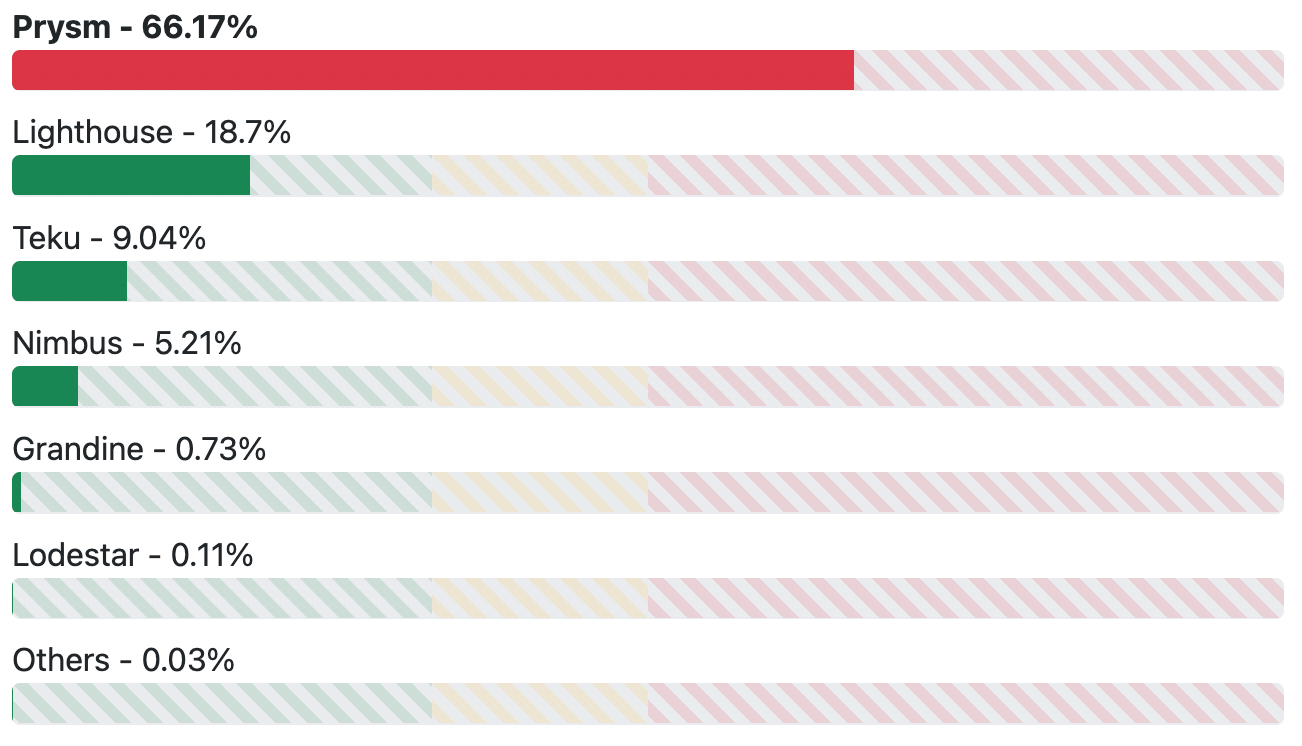
Several other client implementations exist, including Lighthouse, Teku, Nimbus, Grandine, and Loadstar. However, Grandine and Loadstar command very small market shares, both below 1%. Notably, Grandine is the only client developed under a closed-source license, which can raise concerns within the open-source ethos of the Ethereum community.
The distribution of consensus clients at the time of reporting indicated Prysm’s substantial lead, falling just shy of the critical two-thirds mark. Resources like clientdiversity.org provide real-time data and insights into this crucial aspect of network health.
Understanding Prysm’s Dominance: A First-Mover’s Advantage
The overwhelming adoption of the Prysm client can be attributed to several key factors, as explained by Marius van der Wijden, an Ethereum core developer. A primary driver is Prysm’s "first-mover advantage." As one of the earliest functional prototype implementations of a beacon chain client, Prysm had an extended period to optimize its performance, develop supplementary tooling, such as a user-friendly web interface, and establish comprehensive documentation.
Furthermore, Prysm’s choice of the Go programming language (Golang) has been a significant advantage. Golang is known for its performance and ease of development, making it accessible to a broader range of developers. Given that Go-Ethereum (Geth), a dominant Proof-of-Work execution client, is also written in Golang, developers familiar with Geth could readily understand and audit Prysm’s codebase, fostering trust and adoption.
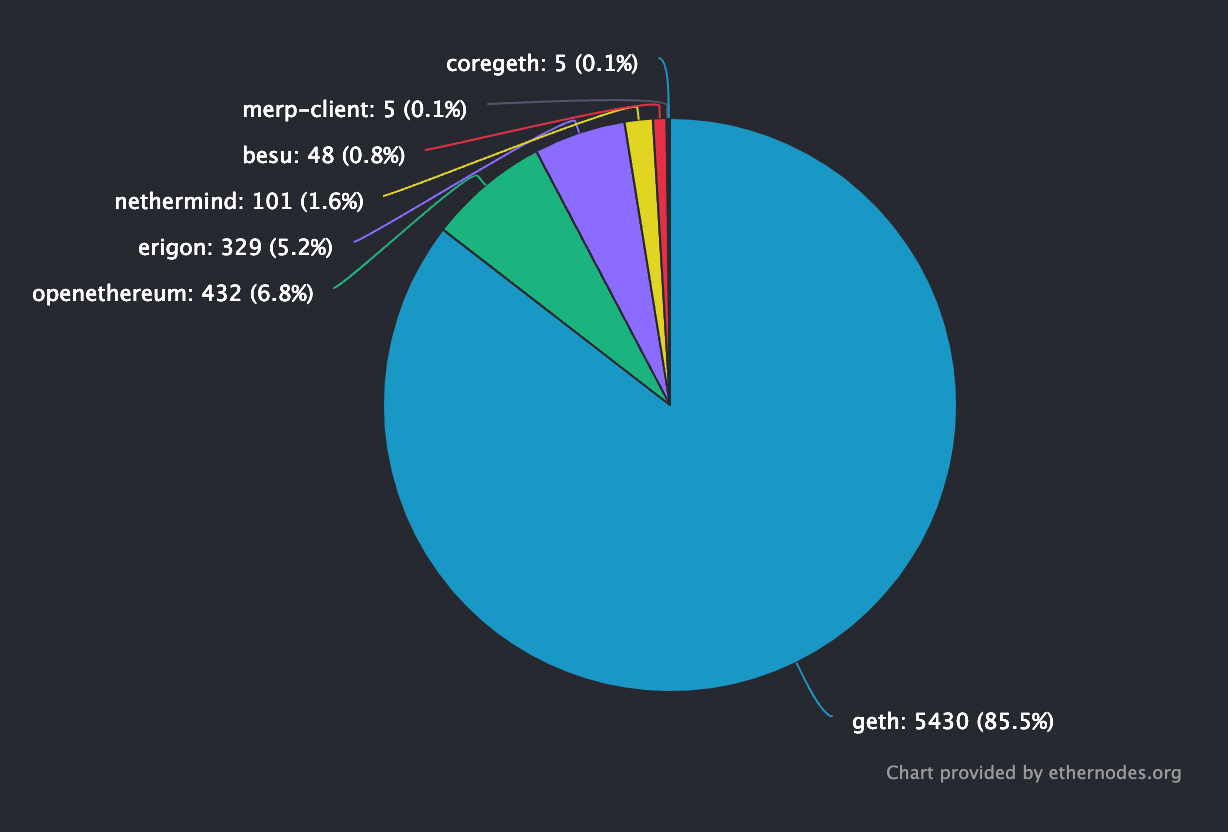
It’s important to note that the distribution of Proof-of-Work execution clients historically exhibited an even more pronounced concentration, with Geth holding over 85% of the market share. However, in the post-Merge environment, this concentration is considered less critical. Execution nodes primarily handle transaction processing and do not directly contribute to network security in the same way that consensus clients do. Post-Merge, stakers will have the flexibility to run multiple execution layer clients with a single beacon client, enhancing their ability to remain on the correct chain.
The Influence of Staking Services: A Centralizing Force
The issue of client diversity is further exacerbated by the role of large staking services and pools. These entities enable users to stake Ether without requiring the full 32 ETH validator deposit, making staking accessible to a wider audience. Crucially, the dominant staking services have largely opted for the Prysm client.
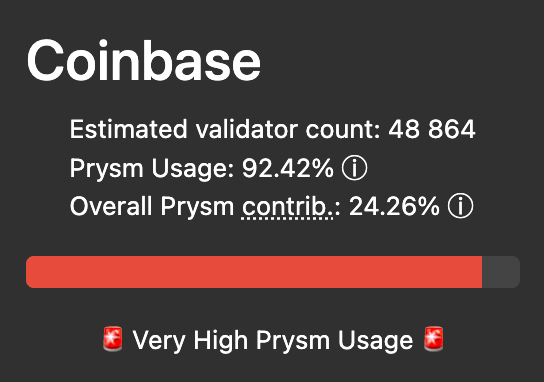
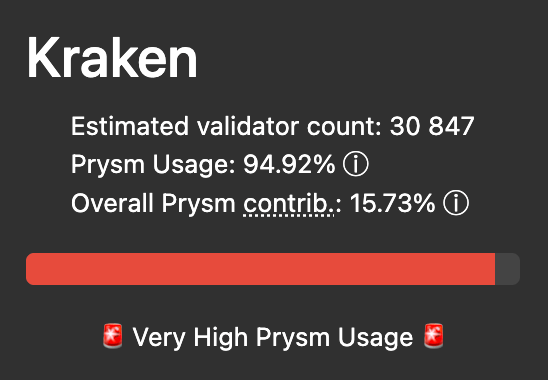
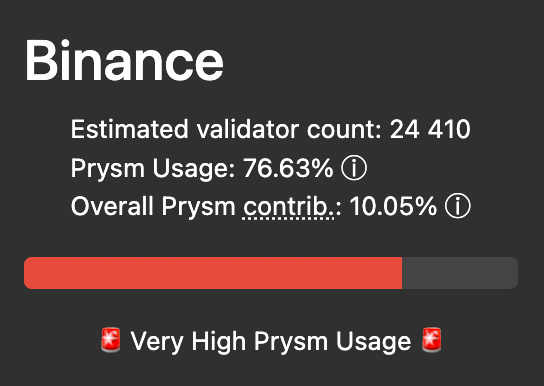
Major exchanges such as Coinbase, Kraken, and Binance, along with staking platforms like Lido and the decentralized staking pool Rocket Pool, are significant contributors to the Prysm ecosystem. For instance, Coinbase, with a substantial number of validators, reported that a significant majority of its validators ran on Prysm, contributing a considerable percentage to the overall Prysm dominance.
When approached for comment, Coinbase cited security as the primary motivation for their initial adoption of Prysm. They highlighted that Prysm was the only viable client at the time supporting remote signers, a feature crucial for securely managing validator keys in isolated environments, thereby enhancing security against potential compromises. Coinbase also indicated efforts to support other clients like Lighthouse and to integrate remote signer capabilities into them.
Kraken echoed similar sentiments, citing Prysm’s maturity and stability during their initial build-out. However, Kraken has also begun migrating some validators to the Teku client in collaboration with Staked, aiming to improve client diversity and bolster the resilience of their staking services. Binance did not provide a comment regarding their client distribution strategy.
Lido, another major staking service, while having a large number of validators, exhibited a comparatively lower Prysm usage rate, contributing significantly but not to the same extent as some other large providers.
In contrast, decentralized staking pools like Rocket Pool demonstrate a more diversified client distribution, with a significantly lower percentage of their validators running Prysm. This highlights the potential for more decentralized approaches to contribute positively to network health.
Discussions are reportedly underway between major staking services and the Ethereum Foundation regarding strategies to improve client diversity. Core developer Marius van der Wijden has described these discussions as "good," indicating that these large entities are exploring transitions to alternative clients. While updating infrastructure for new clients may take time for these larger operations compared to individual stakers, the commitment to diversity is seen as a positive development. The process of switching client software is generally not considered risky or difficult for individual node operators, provided proper precautions are taken, such as backing up slashing databases and adhering to recommended transition windows.
The Path Forward: Pursuing The Merge Amidst Challenges
With The Merge imminent, the Ethereum community faces the reality of a less-than-ideal client distribution. The likelihood of Prysm’s dominance falling below the critical 33% threshold in the short term is considered low. Nevertheless, this situation does not deter Ethereum core developers from proceeding with The Merge.
Developers express confidence in the network’s ability to navigate potential challenges. They point to robust testing and fuzzing infrastructures that continuously identify discrepancies between client implementations. In the unlikely event of a consensus failure, the community is prepared to swiftly deploy new releases and manage any resulting forks. Furthermore, a strong consensus exists among developers not to bail out stakers who might be adversely affected by running a majority client if its misbehavior leads to a consensus failure.
The transition to Proof-of-Stake represents a critical juncture for Ethereum, promising significant improvements in energy efficiency, scalability, and decentralization. While the current client distribution presents a notable governance and technical challenge, the collective efforts and ongoing dialogue within the Ethereum community suggest a determined approach to mitigating risks and ensuring the successful evolution of the network. The coming months will be a testament to the resilience and adaptability of this complex and rapidly evolving ecosystem.