James Watt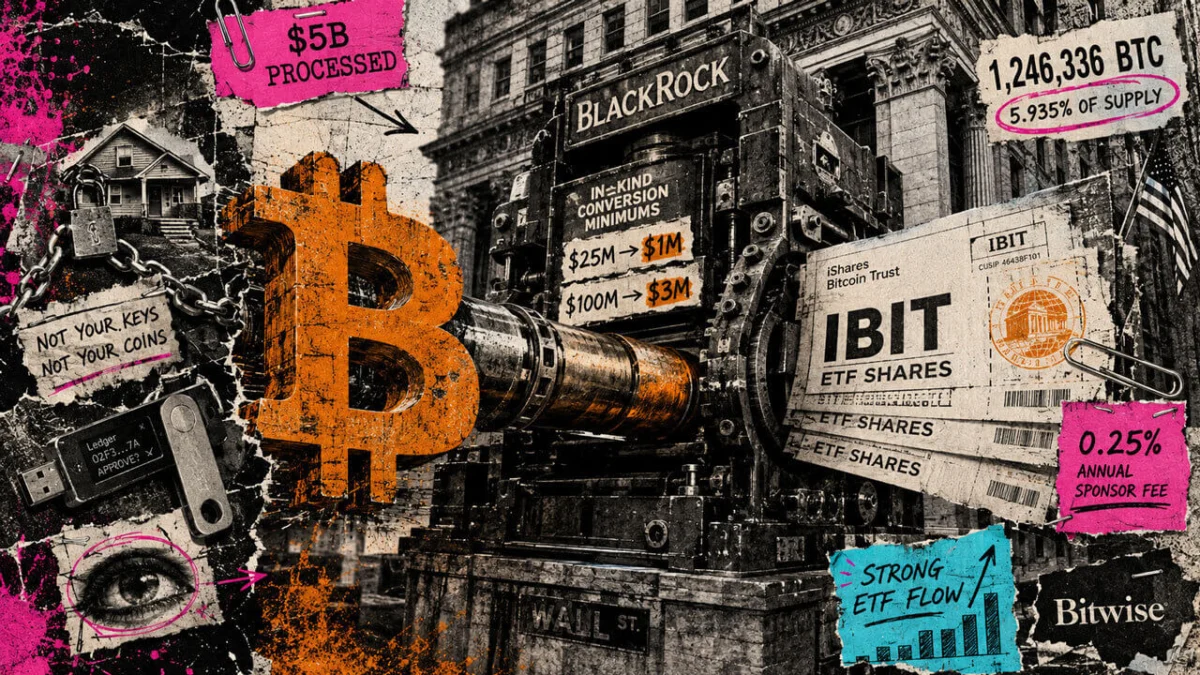
BlackRock has significantly lowered the entry barrier for institutional and wealthy investors seeking to transition from private Bitcoin holdings to its iShares Bitcoin Trust (IBIT), reducing the minimum threshold for in-kind conversions from $25 million to just $1 million. This 96% reduction in the "floor" for such transactions marks a pivotal shift in how the world’s largest asset manager views the bridge between decentralized self-custody and regulated financial products. Following BlackRock’s lead, Bitwise Asset Management implemented an even more aggressive 97% cut, lowering its minimum conversion requirement from an initial $100 million to $3 million. These structural adjustments signal that institutional custody is no longer a niche service reserved for the ultra-wealthy "whales" of the crypto world but is instead becoming a standardized wealth management product aimed at a much broader demographic of family offices and high-net-worth individuals.
The move by these financial giants addresses a growing demand for "in-kind" creation and redemption processes, a mechanism that allows holders to exchange their physical Bitcoin for ETF shares without first liquidating the assets into cash. By lowering the barriers to entry, BlackRock and Bitwise are effectively commoditizing the transition from the blockchain to the brokerage account, a process that once required bespoke legal arrangements and massive capital outlays. According to data provided by BlackRock to Bloomberg, the company’s conversion program has already processed more than $5 billion in assets, illustrating a substantial appetite among existing Bitcoin holders to move their coins into the safety and administrative familiarity of the iShares ecosystem.
The Mechanics and Economics of In-Kind Conversions
To understand the significance of these threshold reductions, it is necessary to examine the mechanics of the in-kind creation process. Unlike retail investors who buy and sell ETF shares using cash on a standard brokerage platform, institutional and eligible wealthy clients can utilize Authorized Participants (APs) to facilitate the direct exchange of Bitcoin for shares. In this model, a holder transfers their Bitcoin to an AP, who then deposits the coins into the trust’s trading account. In return, the trust issues new ETF shares to the AP, who credits them to the client’s account.
This process offers three distinct advantages over the traditional "sell-and-buy" method. First, it compresses the execution steps. Traditionally, an investor would have to sell their Bitcoin on an exchange, wire the resulting dollars to a brokerage, and then repurchase exposure through the ETF. This sequence introduces significant execution risk, market slippage, and wiring delays. Second, the in-kind model can offer substantial tax benefits. Selling Bitcoin typically triggers a capital gains tax event; however, an in-kind exchange may, depending on the legal structure and specific tax advice, allow the holder to defer those gains since the underlying economic exposure to Bitcoin remains constant. Finally, the reduction in transaction costs is significant. While BlackRock and Bitwise do not publicly disclose the specific one-time conversion charges, the efficiency of the in-kind model reduces the friction of moving large blocks of capital.
For a client utilizing the new $1 million minimum at BlackRock, the annual cost of maintaining this institutional custody is relatively low. With IBIT’s 0.25% sponsor fee, a $1 million position incurs an estimated annual fee of $2,500. Bitwise, which charges a slightly lower 0.20% fee, would cost a client $6,000 annually for a $3 million position. Compared to the administrative burden and security costs of self-custodying $1 million or $3 million worth of Bitcoin, many investors are finding these fees to be a reasonable trade-off for professional management.
A Chronology of Institutional Adaptation
The evolution of these conversion programs follows a timeline of regulatory shifts and competitive maneuvering. Initially, the U.S. Securities and Exchange Commission (SEC) mandated a "cash-only" creation and redemption model for spot Bitcoin ETFs to ensure tighter control over the flow of funds and to prevent potential market manipulation. However, as the market matured, the demand for more efficient tax-neutral pathways grew.
In July 2025, the SEC officially permitted in-kind creations and redemptions for crypto exchange-traded products (ETPs), ending the original cash-only restriction. This regulatory green light sparked a race among providers to capture the existing supply of Bitcoin held in private wallets.
- March 2024: Early spot ETF data showed that in-kind transactions represented only 28% of gross Bitcoin creations at Grayscale.
- June 2024: A referral program between Morgan Stanley and Galaxy was announced, targeting eligible clients with a $25 million minimum, which was later reduced to $5 million.
- July 2024: BlackRock implemented its 96% reduction, bringing the IBIT floor to $1 million.
- August 2024: Bitwise finalized its reduction to $3 million, following an interim floor of $50 million.
- August 2025: Bitbo and Farside data confirmed that U.S. spot ETFs had absorbed a staggering share of the total Bitcoin supply, with IBIT alone holding over 765,000 BTC.
This chronology illustrates a rapid professionalization of the Bitcoin market. What began as a volatile asset favored by tech enthusiasts has, within a few years, been integrated into the core infrastructure of the world’s largest wealth management firms.
The Physical Security Imperative: Beyond Digital Theft
One of the most compelling reasons for the shift toward ETF-based custody is the rising threat of physical coercion. While digital security—such as multi-signature wallets and cold storage—has become highly sophisticated, it does not protect the holder from physical violence. Robbie Mitchnick, BlackRock’s head of digital assets, noted that concerns regarding kidnappings, ransom demands, and "wrench attacks" are driving wealthy individuals toward institutional solutions.
Data from forensic firms underscores this trend. Chainalysis documented 46 violent crypto-related incidents in the first half of 2026, resulting in over $30 million in stolen funds. CertiK reported an even higher figure, verifying 52 incidents with $124.1 million in recorded exposure, including ransom demands. Most alarmingly, home invasions related to crypto holdings jumped from a single incident to 20 year-over-year.
For a high-net-worth individual, self-custody represents a "single point of failure" that involves their personal safety and that of their family. By moving assets into an ETF like IBIT or BITB, the individual removes themselves from the authorization chain. A criminal cannot force a victim to transfer Bitcoin that is held within a regulated trust and accessible only through complex brokerage protocols. In this context, the 0.25% annual fee is increasingly viewed as an insurance premium against physical risk.
Market Implications and the Coinbase "Choke Point"
The migration of Bitcoin from private wallets to ETFs has profound implications for the decentralization of the network. While the individual investor gains security and tax efficiency, the network’s supply is becoming increasingly concentrated in the hands of a few institutional custodians.
Analysis suggests that a significant majority of U.S. Bitcoin ETF assets are held by a single entity: Coinbase. Stricter estimates indicate that approximately 80.8% of all ETF-held Bitcoin—totaling over $74 billion—is under Coinbase’s custody or primary custody. This creates what some analysts call a "custody choke point." If a single custodian were to experience a regulatory, technical, or security failure, the impact on the entire ETF ecosystem would be catastrophic.
To mitigate this concentration risk, providers are beginning to diversify their custodial partners. BlackRock’s operating documents now list Anchorage as an available additional custodian, while ARK 21Shares utilizes a combination of Coinbase, BitGo, and Anchorage. Fidelity has opted for a vertically integrated approach, using its own digital-asset subsidiary. As more Bitcoin moves into the ETF structure via these newly lowered conversion thresholds, the distribution of those coins among multiple institutional custodians will be a critical factor in the long-term stability of the market.
The Convergence of Flows: Fresh Capital and Existing Supply
The success of the conversion programs is occurring alongside a resurgence in traditional cash-based demand. From August 17 to August 25, 2024, U.S. spot Bitcoin ETFs saw net inflows of $2.57 billion across seven consecutive positive sessions. BlackRock’s IBIT dominated this activity, capturing $1.82 billion, or roughly 71% of the total category inflows.
These two distinct streams—new cash arriving from traditional investors and existing Bitcoin migrating from private wallets—are converging to create a massive liquidity pool within the ETF structure. As of late August 2024, the 13 U.S. spot funds collectively held over 1.24 million BTC, representing nearly 6% of the total 21 million supply.
This convergence suggests that the Bitcoin market is entering a "mopping up" phase, where the "free float" of Bitcoin available on exchanges and in private hands is being steadily absorbed by institutional vehicles. The reduction in conversion minimums by BlackRock and Bitwise accelerates this process by making it viable for the "millionaire next door" to participate in a system previously reserved for billionaires.
Conclusion: A New Paradigm for Bitcoin Ownership
The decision by BlackRock and Bitwise to slash their in-kind conversion minimums represents a fundamental rethink of the relationship between Bitcoin and Wall Street. By lowering the threshold to $1 million and $3 million, respectively, these firms have turned what was once a bespoke, high-touch service into a scalable wealth management product.
For the Bitcoin protocol, this is a double-edged sword. On one hand, it validates Bitcoin as a legitimate institutional asset class and provides a pathway for safe, regulated ownership for millions of people. On the other hand, it accelerates the transition of the asset from a decentralized, self-sovereign currency to a concentrated financial instrument.
As the entry price for institutional custody drops by over 90%, the "physical price" of self-custody—measured in security costs, tax friction, and personal risk—becomes harder for the wealthy to justify. The $5 billion already processed by BlackRock is likely only the beginning of a larger migration that will redefine the Bitcoin ownership map for decades to come. In this new landscape, the ability to "be your own bank" remains a core feature of the Bitcoin network, but for many, the convenience and safety of a Wall Street vault is becoming an offer too efficient to refuse.