admin
admin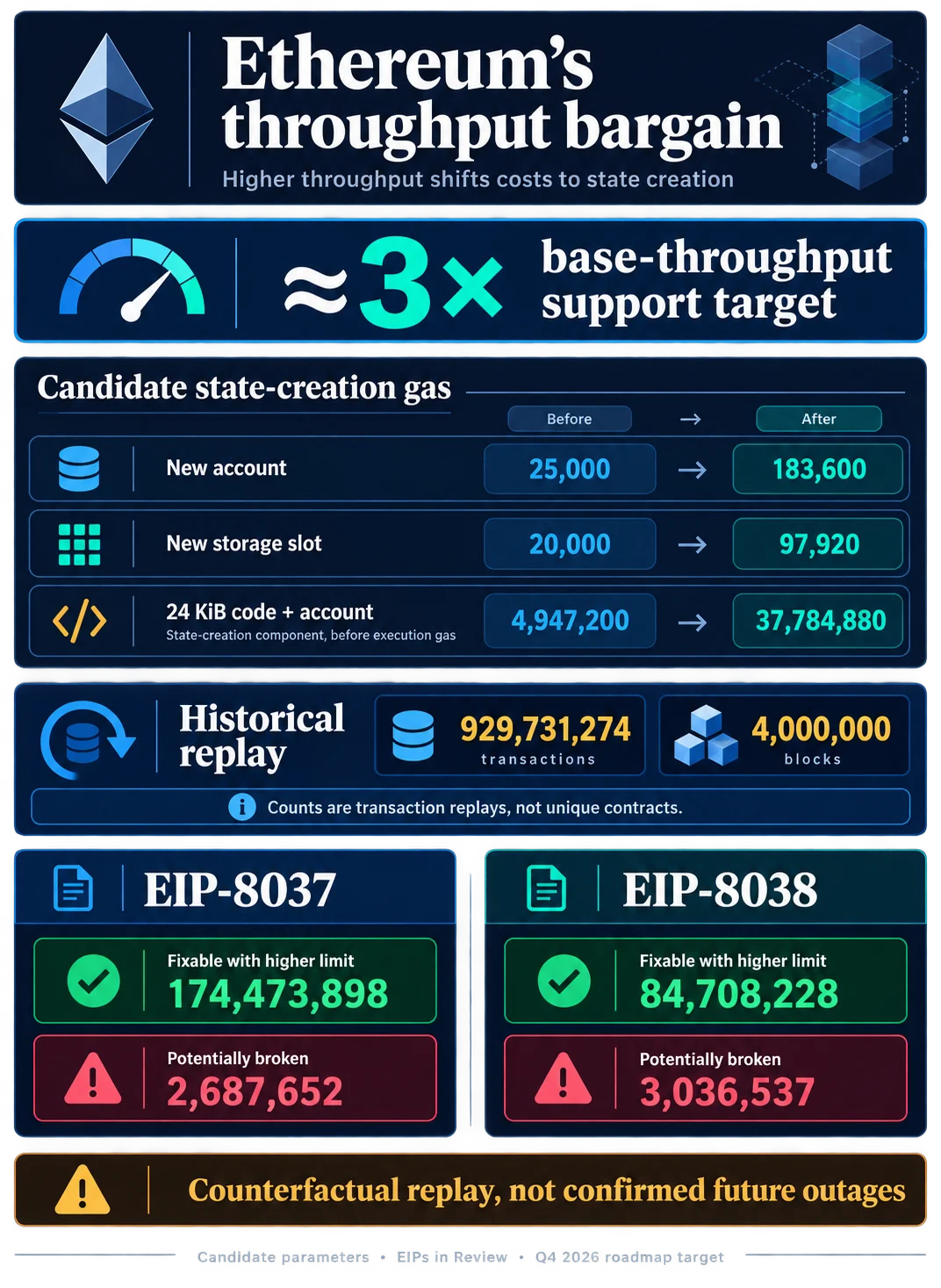
Ethereum is poised for a substantial evolution with its upcoming "Glamsterdam" upgrade, a pivotal moment in the network’s journey toward enhanced scalability and efficiency. This upgrade introduces a comprehensive repricing of gas costs, directly linking network fees to the resources consumed by state-creating transactions and contracts. The core objective is to significantly increase base-layer throughput by aligning gas charges more accurately with the persistent state that nodes must maintain and serve. This strategic shift is designed to support approximately three times more base throughput, a significant leap forward for the Ethereum network.
The Glamsterdam upgrade, currently slated for the fourth quarter of 2026, is built upon two key Ethereum Improvement Proposals (EIPs): EIP-8037 and EIP-8038. While both proposals are advancing through the review process and are scheduled for inclusion in the Glamsterdam release, they are currently in a formal "Review" status. This means there is still a window for developers and the wider ecosystem to test and adapt to the proposed changes before the candidate parameters and deployment schedule are finalized. The Ethereum Foundation has outlined a roadmap that includes testing on the Sepolia and Hoodi testnets, with specific fork dates for these networks and the mainnet yet to be announced. This phased approach provides crucial time for builders to integrate the new gas economics into their decentralized applications (dApps) and infrastructure.
The Core of Glamsterdam: Repricing State Creation
At the heart of the Glamsterdam upgrade lies a fundamental re-evaluation of how gas is consumed when interacting with Ethereum’s persistent state. Every new account created, every storage slot allocated, and every byte of deployed contract code contributes to this state, which is a fundamental component of the network’s architecture. Nodes on the Ethereum network are required to store and serve this ever-growing state, a process that demands significant computational and storage resources.
As of January 2026, the state portion of a Geth database, a popular Ethereum client, was reported to be approximately 390 GiB. This figure highlights the substantial data footprint of the network. Following a previous increase in Ethereum’s gas limit from 30 million to 60 million, there was a noticeable surge in the amount of new state created daily. The average daily increase in state grew from roughly 105 MiB to 326 MiB, translating to an annual growth rate of about 116 GiB.
EIP-8037 takes this observed post-increase rate and extrapolates it to a more ambitious scenario, simulating a gas limit of 200 million. Under this hypothetical severe scenario, the projected annual growth in network state reaches approximately 387 GiB. This rate is significant because it suggests that at this projected growth, the network could exceed a critical performance threshold of 650 GiB within a year, starting from the baseline of 390 GiB. It’s important to note that the EIP itself characterizes the earlier 30 million to 60 million gas limit increase response as non-linear, implying that the 387 GiB figure is a more motivated extrapolation rather than a precise forecast.
To manage this projected state expansion and ensure network stability, EIP-8037 proposes a new pricing mechanism. The core of this mechanism involves a common cost of 1,530 gas for every byte of new state created. Additionally, a separate "state-gas dimension" is introduced to further refine cost allocation. At a reference block limit of 150 million gas, this parameter is designed to target an average annual state growth of 120 GiB. In a more demanding scenario, with a 200 million gas limit after repricing, the proposal projects a worst-case annual growth of 160 GiB.
This repricing has direct implications for various state-creation operations. For instance, creating a new account, which currently costs 25,000 gas, would see a significant increase to 183,600 gas under the proposed schedule. Similarly, the creation of a new storage slot, currently priced at 20,000 gas, would jump to 97,920 gas. Deploying 24 KiB of code along with a new account, a complex operation, would see a dramatic rise from 4,947,200 gas to a substantial 37,784,880 gas.
The pricing strategy is designed to bifurcate transaction costs into two distinct components: execution gas and state gas. This separation ensures that while computational work remains appropriately priced, there’s a dedicated ceiling on the permanent additions to the network’s state. This dual-cost model is crucial for managing the network’s long-term storage requirements and preventing uncontrolled state bloat.
Complementing EIP-8037, EIP-8038 focuses on the costs associated with accessing and writing to existing state. This proposal aims to adjust the costs of selected account and storage operations based on client benchmarks conducted against a state snapshot comparable to the mainnet in March 2026. By addressing both the creation of new state and the modification of existing state, the combined impact of these EIPs is engineered to support a roughly threefold increase in network throughput. It’s important to clarify that this figure represents an engineering support target for higher gas limits, not a guarantee of an immediate tripling of mainnet capacity.
Testing the Waters: Replay Analysis and Potential Impacts
To gauge the real-world impact of these proposed changes, a comprehensive analysis of over 929 million transactions across 4 million blocks, spanning from December 3, 2024, to June 15, 2026, has been conducted. This extensive dataset allows researchers to replay historical transactions against both the existing gas schedule and the proposed candidate schedule.
The analysis involved two key scenarios: first, using the transaction’s original gas limit, and second, allowing the gas limit to be extended up to ten times the original. The comparison meticulously tracked success rates, gas consumption, log generation, output, and execution traces.
Under EIP-8037, the replay analysis revealed that 174,473,898 transactions, which would have failed at their original gas limits, succeeded when a higher gas limit was applied. However, a smaller but significant group of 2,687,652 transactions entered a category deemed "potentially broken." Similarly, for EIP-8038, 84,708,228 transactions were found to be "fixable" with an increased gas limit, while 3,036,537 transactions were classified as "potentially broken."

It is crucial to understand that these figures represent transaction counts and do not necessarily indicate millions of individual contracts at risk. Repeated activity from highly utilized applications can disproportionately inflate these numbers.
The "potentially broken" category encompasses transactions that, while successful under the original schedule, failed under the candidate schedule even with a tenfold increase in gas. This includes out-of-gas errors and transactions that reverted due to other reasons influenced by the new cost structures. This classification represents a counterfactual risk, as users, wallets, smart contracts, developers, and the fee market have the opportunity to adapt and make necessary adjustments before the upgrade goes live on mainnet.
The larger "fixable" cohort primarily indicates a shift in responsibilities. Frontends, bundlers, and infrastructure providers will need to ensure that they submit transactions with gas limits that accurately reflect the new pricing model. The "potentially broken" transactions, however, point to more fundamental issues. These often involve assumptions embedded within smart contract code that cannot be overcome simply by increasing the outer transaction’s gas limit. Examples include hardcoded gas stipends, gas forwarded to internal calls, logic that branches based on the gasleft() opcode, and presigned transactions with fixed gas limits.
Broader Ecosystem Implications and Developer Responsibilities
The implications of the Glamsterdam upgrade extend across the entire Ethereum ecosystem. A public outreach report has identified specific areas of concern, prioritizing updates for versions of the ERC-4337 EntryPoint and related smart-account stacks, including popular solutions like ZeroDev and Alchemy. The report also flagged recurring counterfactual failures within systems like Across, Socket/Bungee, CoW Protocol, and 0x.
For applications utilizing immutable contracts, the operational burden of adapting to the new gas economics can be substantial. A robust solution might necessitate the deployment of new EntryPoint, account, factory, or validator implementations, followed by a migration process for users. Other systems may find resolution through adjustments in routing logic, batching mechanisms, or more refined gas accounting.
Furthermore, ERC-4337 bundlers, which are responsible for aggregating and submitting transactions on behalf of users, will need to distinguish between the two classes of failures. Enhanced simulation capabilities and the submission of appropriate higher gas limits can resolve the "fixable" issues. However, for "potentially broken" transactions, where validation guards or internal gas assumptions remain problematic even with increased outer gas, further code modifications will be required.
Who Needs to Update Before Glamsterdam?
A broad spectrum of the Ethereum ecosystem will need to adapt to the upcoming changes. Wallets, RPC providers, indexers, node tooling, and gas estimators are among those that must integrate the new gas cost rules. Frontends and bundlers, in particular, will need to cease relying on cached constants or gas limits calibrated to the old schedule.
Both EIP-8037 and EIP-8038 necessitate updates to the eth_estimateGas RPC method and related estimation logic to accurately account for the new costs. The recent announcement regarding the Platåberget testnet also serves as a warning: tools built around hardcoded maximum gas limits or a single gas dimension are likely to encounter operational failures.
While a plain ETH transfer to an existing account will likely continue to operate with the familiar 21,000 gas, sending value to an account that does not yet exist will incur the new state-creation charge at runtime. Consequently, any software that assumes all transfers fit within the old, constant gas cost will require revision.
For the average user, the transition should remain largely seamless if their wallets and the underlying infrastructure are updated correctly. The immediate burden of adaptation falls upon developers. They are tasked with resimulating their transactions, meticulously reviewing fixed gas stipends and internal call limits within their smart contracts, and rigorously testing all affected transaction paths against the candidate gas pricing schedule.
The Glamsterdam fork was initially scheduled for August 20, with reports indicating its live deployment and the repricing schedule becoming effective by August 24. The published sequence for the upgrade involves a phased rollout, starting with stable developer networks, progressing to the long-lived Sepolia and Hoodi public testnets, and culminating in the mainnet launch. The 2026 roadmap target remains contingent on the successful outcomes of ongoing testing and community feedback.
In essence, Ethereum’s strategy to enhance throughput involves a sophisticated economic repricing. While the network can effectively "price its way" towards greater capacity, developers who have encoded outdated gas assumptions into their contracts and tools are now facing a critical, albeit limited, window to ensure their creations can withstand the network’s evolving economic landscape. The success of Glamsterdam hinges not only on the technical implementation but also on the ecosystem’s collective ability to adapt to these fundamental changes in gas economics.