Nila Kartika Wati
Solana validators have overwhelmingly approved a landmark proposal, SGP-0002, to significantly alter the network’s economic model by doubling its annual disinflation rate. This pivotal decision is set to reduce the future issuance of SOL tokens, aiming to accelerate the timeline for the cryptocurrency to reach its long-term inflation target. The move signals a strategic shift towards enhancing the asset’s scarcity and potentially its long-term value proposition for holders, while simultaneously introducing new considerations for validators and delegators.
A Deep Dive into SGP-0002: Doubling Disinflation
The approved proposal, officially known as SGP-0002 or "Double Disinflation," mandates an increase in Solana’s annual disinflation rate from its previous 15% to a new rate of 30%. This change, while impactful, carefully maintains the network’s long-term inflation target of 1.5% unchanged. The core mechanism of disinflation on a Proof-of-Stake (PoS) network like Solana is to gradually reduce the rate at which new tokens are introduced into circulation over time, rather than halting issuance entirely. This contrasts with deflation, where the total supply actively decreases, often through burning mechanisms. Solana’s approach aims for a controlled deceleration of supply growth, influencing the asset’s scarcity without undermining the incentives necessary for network security.
Under the newly adopted schedule, Solana is now projected to achieve its terminal inflation rate of 1.5% in approximately 2.8 years. This represents a significant acceleration compared to the previous schedule, which would have seen the network reach this target in roughly 5.7 years, effectively halving the transition period. The direct consequence of this accelerated disinflation is a substantial reduction in the total number of SOL tokens entering circulation over the coming years. According to analyses, this change is expected to result in an estimated 18.9 million fewer SOL being issued over the next six years alone.
This reduction in future supply carries dual implications for the Solana ecosystem. For existing SOL holders, the primary benefit is a decrease in token dilution. As fewer new tokens are minted, the proportionate share of existing holders is better preserved, which proponents argue could contribute to enhanced long-term value appreciation. However, the mechanism by which these new tokens are typically introduced is through staking rewards, which compensate validators for securing the network and delegators for supporting them. Consequently, the accelerated disinflation will lead to a reduction in staking rewards for both validators and delegators. This trade-off between increased token scarcity and potentially reduced incentives for network participation formed a central point of debate during the voting process.
The Landmark Governance Vote: A Community Mandate
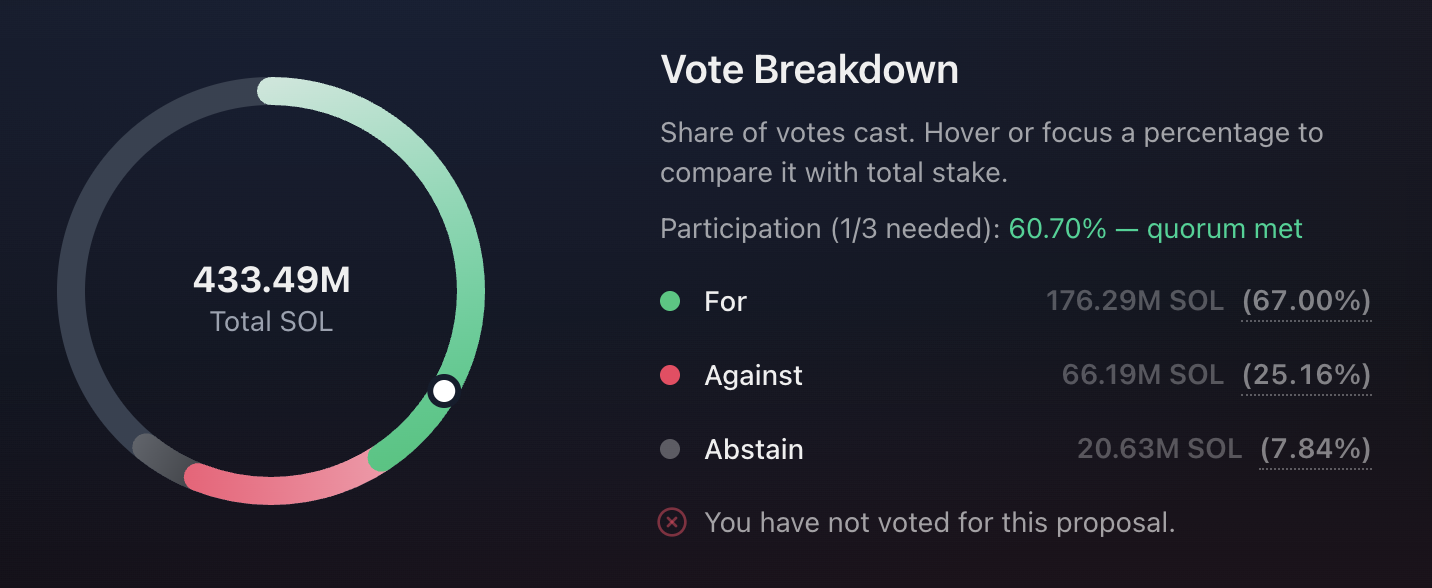
The approval of SGP-0002 marks a significant milestone for Solana, representing the culmination of its first binding governance process. This decentralized decision-making framework allows SOL holders to directly influence the protocol’s fundamental parameters, underscoring the network’s commitment to community-driven evolution. The voting results for SGP-0002 demonstrated robust support from the Solana community: the proposal garnered 67% of the total votes, with 25.16% voting against and 7.84% abstaining. Crucially, overall participation reached an impressive 60.7% of eligible staked SOL, indicating a highly engaged and active validator and delegator base.

Beyond SGP-0002, the inaugural governance period also saw the successful approval of a proposed Solana Constitution, which likely lays out foundational principles and guidelines for future network development and governance. However, a separate proposal concerning resource and inclusion fees was rejected, highlighting the nuanced and often divided perspectives within the community on various aspects of network economics and operation. This mixed outcome reflects the healthy debate inherent in decentralized governance, where not all proposals automatically gain consensus, even those aimed at improving network efficiency.
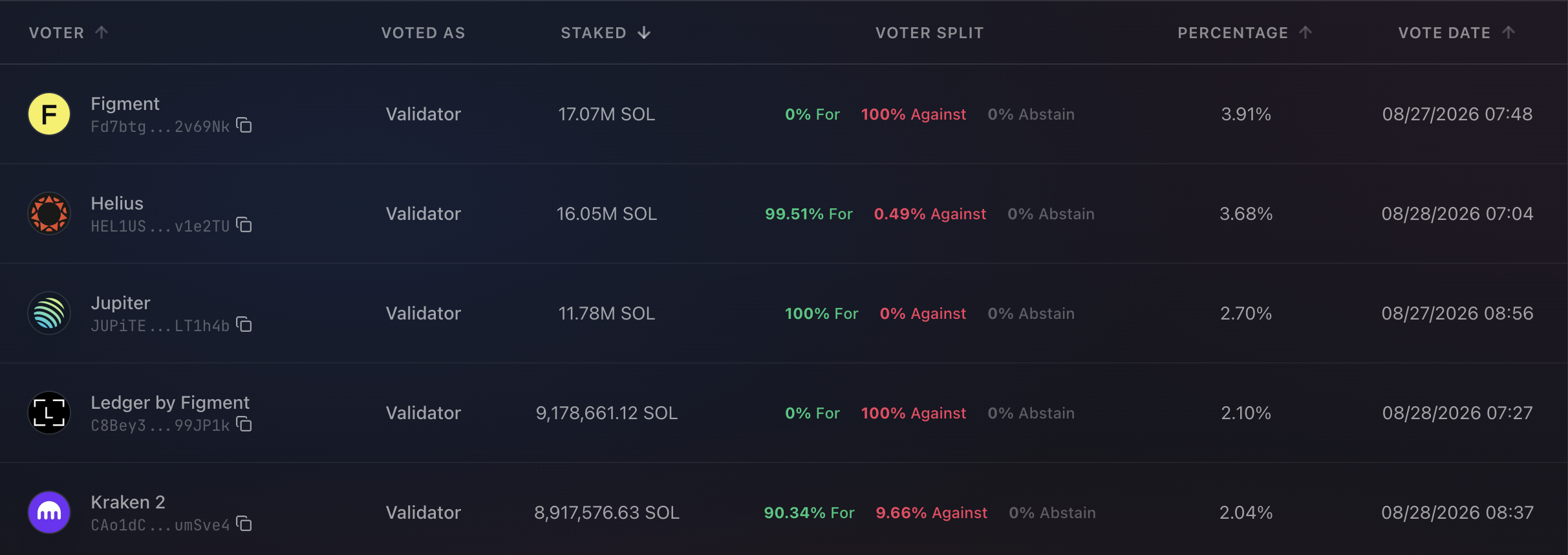
A closer look at the voting patterns revealed a fascinating dynamic among some of the largest participants in the Solana ecosystem. Key players held divergent views on SGP-0002, illustrating the complexity of balancing various stakeholder interests. Figment, one of the largest voters with a significant stake of 17.1 million SOL, notably cast its votes entirely against the measure. Their opposition likely stemmed from concerns regarding the impact of reduced staking rewards on validator economics and potentially on the long-term security model of the network, which relies on robust validator participation.
In contrast, other prominent entities such as Helius and Jupiter overwhelmingly backed the proposal, signaling their belief in the benefits of enhanced token scarcity and accelerated progression towards the terminal inflation rate. Perhaps the most intriguing development during the voting period involved Kraken, a major US-based crypto exchange. Kraken’s position initially wavered, with an early vote against SGP-0002 at 12:33 UTC temporarily pushing the proposal’s support below the required threshold. This moment underscored the critical influence of large staking entities in decentralized governance. However, by the close of the voting period, Kraken had shifted its stance significantly, with over 90% of its approximately 8.9 million SOL voting stake ultimately supporting the proposal. This late shift proved pivotal in securing the necessary majority for SGP-0002’s approval, showcasing the dynamic nature of such votes and the potential for last-minute reconsiderations or strategic adjustments by major stakeholders.
Economic Implications and Stakeholder Perspectives
The decision to double Solana’s disinflation rate is a bold economic maneuver with far-reaching implications for all participants in the ecosystem. For SOL holders, the primary and most immediate benefit is the prospect of reduced dilution. In an inflationary model, existing holdings are continuously diluted by the issuance of new tokens. By slowing down this issuance, SGP-0002 aims to make SOL a more attractive long-term store of value, potentially leading to increased demand and price appreciation as scarcity becomes a more pronounced factor. This aligns Solana’s tokenomics more closely with a "sound money" narrative often favored by investors, drawing parallels to assets with capped or decreasing supply schedules like Bitcoin.
However, the change introduces a significant challenge for validators and delegators. Staking rewards are a crucial incentive for participants to lock up their SOL and contribute to the network’s security and decentralization. A reduction in these rewards could potentially decrease the profitability of running a validator node or delegating SOL, especially for smaller operators or those with higher operational costs. While the exact percentage reduction in rewards will depend on various factors including total staked SOL and network activity, the overall trend will be downwards compared to the previous schedule.
Proponents of SGP-0002 argue that while staking rewards will decrease, the potential increase in the underlying value of SOL due to enhanced scarcity could offset this reduction, leading to a net positive outcome for long-term holders, including those who stake. They also emphasize that achieving the terminal inflation target sooner provides greater certainty and predictability for the network’s economic future. From this perspective, the short-to-medium term reduction in rewards is a necessary trade-off for long-term sustainability and value accrual.
Conversely, opponents, like Figment, likely voiced concerns that overly aggressive reductions in staking rewards could inadvertently impact network security. If staking becomes less attractive, it could lead to a decline in the number of active validators or a concentration of stake among larger entities who can absorb lower margins. This could potentially compromise the decentralization and robustness of the network. Balancing the desire for scarcity with the need to maintain sufficient incentives for a healthy and decentralized validator set is a delicate act, and SGP-0002 represents Solana’s current position on this equilibrium.
Contextualizing Solana’s Tokenomics in the Blockchain Landscape
Solana’s decision to accelerate its disinflation rate is not an isolated event but rather fits within a broader trend in the blockchain industry where Layer 1 protocols are actively refining their tokenomics. The economic models of Proof-of-Stake blockchains are designed to incentivize network participation, secure transactions, and facilitate decentralized governance. Inflation, in the context of PoS, is often a necessary component to pay validators for their work and encourage staking, thereby enhancing security. However, unchecked or high inflation can lead to dilution and erode token value over time.
Many leading PoS chains employ varying inflation and disinflation schedules. Ethereum, for instance, transitioned to a PoS model with its Merge and implemented EIP-1559, which includes a fee-burning mechanism, making its tokenomics potentially deflationary under certain network conditions. Bitcoin, the pioneer, has a fixed supply with programmatic halving events that reduce new issuance every four years, creating predictable scarcity. Solana’s current move aligns it more closely with a scarcity-driven narrative, positioning it as a network committed to long-term value preservation for its native asset.
The 1.5% long-term inflation target for Solana is also a notable figure. It’s designed to provide a minimal, sustainable reward for network security indefinitely, without causing significant dilution. This rate is comparable to, or even lower than, the long-term inflation rates observed in some traditional fiat currencies, aiming to strike a balance between incentivizing security and maintaining purchasing power. By accelerating the path to this target, Solana aims to provide a clearer, more predictable economic future for its ecosystem.
Broader Market Sentiment and ETF Success
The governance vote to double the disinflation rate comes at a time of growing institutional interest and positive market developments for Solana. In a significant indicator of its burgeoning appeal, US-listed Solana investment products have continued to attract substantial investor capital, even amidst periods of weaker performance for SOL earlier in the year.
Most notably, Bitwise’s Solana ETF recently surpassed the impressive milestone of $1 billion in assets under management (AUM), becoming the first Solana-focused exchange-traded fund to achieve this feat. This achievement was highlighted by Bloomberg ETF analyst Eric Balchunas, underscoring the increasing mainstream acceptance and investment appetite for Solana as a leading digital asset.
Overall, US Solana ETFs have collectively amassed approximately $1.7 billion in cumulative net inflows since their inception. This consistent inflow, with little sustained outflow, indicates robust and enduring investor confidence in Solana’s long-term prospects. The approval of SGP-0002 is likely to further bolster this sentiment. Institutional investors often prioritize assets with clear, predictable, and scarcity-enhancing tokenomics. The accelerated disinflation rate, by promising reduced dilution and an earlier achievement of a low terminal inflation rate, provides a more compelling investment thesis for traditional finance players who seek stability and long-term value preservation.
The correlation between a sound economic model and investor confidence cannot be overstated. By taking decisive action through decentralized governance to optimize its tokenomics, Solana is reinforcing its position as a mature and strategically managed blockchain platform. This move could potentially attract even more capital from institutional and retail investors alike, who are increasingly looking for robust assets with well-defined supply schedules in the volatile cryptocurrency market. The combination of a strong technical foundation, a growing ecosystem of decentralized applications, and now a more aggressive scarcity-driven tokenomics model positions Solana favorably in the competitive Layer 1 landscape.
Future Outlook and Challenges
The successful implementation of SGP-0002 will usher in a new era for Solana’s economic model. While the benefits of increased scarcity and reduced dilution for SOL holders are clear, the network must carefully monitor the impact on its validator ecosystem. The balance between incentivizing security and maintaining asset value is delicate. Should staking rewards become too low, it could theoretically lead to a consolidation of stake, potentially impacting decentralization. However, the Solana community’s engagement in this vote suggests a collective belief that the long-term benefits outweigh these potential short-term challenges.
The outcome of this first binding governance process also sets a precedent for future community decision-making on Solana. It demonstrates the network’s capacity for self-amendment and evolution through decentralized means, a core tenet of blockchain philosophy. As Solana continues to scale and mature, such governance mechanisms will be crucial for adapting to new market conditions, technological advancements, and community needs.
In conclusion, Solana’s validators have made a pivotal decision to accelerate the network’s disinflation rate, signaling a strong commitment to enhancing the long-term value proposition of SOL through increased scarcity. This strategic adjustment, while posing new considerations for staking economics, is likely to reinforce investor confidence, building on the recent success of Solana-based investment products. As the network moves towards its lower terminal inflation target at an expedited pace, the crypto world will be watching closely to see how this bold tokenomics shift influences Solana’s growth, security, and market position in the years to come.